


Occupy Oakland protesters say they were abused by the US police while in custody.

 Your new post is loading...
 Scoop.it! Occupy Oakland protesters say they were abused by the US police while in custody. 
No comment yet.
Sign up to comment
Scoop.it!

Living in a resource-constrained world where we consume so much stuff, the case for sharing that stuff should be evident. And it is indeed becoming evident for a growing number of people as they realize that the urge to own is not what it’s all cracked up to be. In fact, people are more interested in “owning” (or receiving) an experience or the functionality that stuff delivers. Rachel Botsman and Roo Rorgers makes a strong case for this in their book “What’s Mine is Yours: the Case for Collaborative Consumption” (or if you prefer a 15 minute version, check out Rachel Botsman’s Ted Talk).
Scoop.it!

"I think a lot of the people involved in the globalization movement, myself included, felt this was a continuation of our efforts, because we never really felt the globalization movement had come to an end. We’d smash our heads against the wall every year, saying “Oh yes, this time we’re really back. Oh wait, maybe not.” A lot of us gradually began to lose hope that it was really going to bounce back in the way we always thought we knew it would. And then it happened, as a combination of tactics of trying to create prefigurative models of what a democratic society would be like, as a way of organizing protest or actions that were directed against an obviously undemocratic structure of governance."
Scoop.it!

We present part one of John Peterson's introduction to the newly published Ted Grant Selected Works Volume 2: The Work of Marxists in the Mass Organizations. Ted Grant’s writings on the mass organizations represent a deepening of our understanding of Bolshevik strategy and tactics when it comes to connecting the ideas of revolutionary Marxism with the working class, and Peterson's introduction concisely explains Ted's method and the history of the Marxist approach to the mass organizations. Order your copy of Volume 2 at Marxistbooks.com.
Scoop.it!
Terry Eagleton discusses his combative, controversial book Why Marx was Right. In his book Eagleton takes issue with the prejudice that Marxism is dead and done with. Taking ten of the most common objections to Marxism - that it leads to political tyranny, that it reduces everything to the economic, that it is a form of historical determinism, and so on - he demonstrates in each case what a woeful travesty of Marx's own thought these assumptions are.
Scoop.it!
A destroyer of vulgar-Marxism http://t.co/CDh0VR6v...
Scoop.it!

I am a Marxist socialist: I stand on the hard-Left of the political spectrum, alongside anarchists and Left-libertarians, as seeing the current society of capitalism to be totally undesirable and disgusting, and I am fighting for the ...
Scoop.it!

What's wrong with us all? Why aren't we spending? In Athens, it was reported this week, shoppers are looking but not buying. The buzzword in Brussels these days, says the Economist, is growth. Everyone seems to be agreed: we need to spend our way out of deficit.
Scoop.it!
I think, therefore I am dangerous. A collection of Occupy photos set to We Are Winning by the Flobots. I do not own the photos or the music, nor do I claim o...
Scoop.it!

Revolution means more Egyptians transcend taboosThe Daily Star25 revolution, a newfound freedom of expression is breaking the silence about crucial issues in Egypt that were previously considered taboo.
Scoop.it!

Already in Athens the alternative economy is starting to catch on. People who have had to sacrifice many of life's little pleasures because of financial constraints are discovering that you don't always need money to get what you need.
Scoop.it!

At TED@MotorCity, Lisa Gansky, author of "The Mesh," talks about a future of business that's about sharing all kinds of stuff, either via smart and tech-enabled rental or, more boldly, peer-to-peer.
Scoop.it!

So, public choice theory poses some difficult questions for ‘the left’. If one takes an ‘interest-based’ view of politics then public choice offers a more plausible account of the way special interests seek and gain power than its leftist rivals – and of how to minimise the threat presented by such interests. If on the other hand one takes the view that ideas matter more than interests then the left is robbed of much of the ‘them versus us’ rhetoric which historically has been one of its most important vehicles of political recruitment.
Scoop.it!
January 28, 2012 Independent Reporter http://MOXNews.com...
Scoop.it!

As you can see for yourself in the graphic below, simply put, you're not going to be alone when you join the one million heroes wanted for this massive real-world global experiment in turning our home computers into our new financial system! Sounds cool as f**K right? That is because it is! And you and just about everyone else on the planet that comes by knows it's too! We know that, too!! :) Common peoples of the internet UNITE HERE! ;)
Scoop.it!
Noam Chomsky discusses the purpose of education, impact of technology, whether education should be perceived as a cost or an investment and the value of stan...
Scoop.it!

Social networks can act as a catalyst to help direct democracy prevail over current economic and political monopolies, writes Viktor Tkachuk from the "People First" organisation in Ukraine.
Scoop.it!
Solutions locales pour un désordre global - sortie en salle le 7 avril 2010. de Coline Serreau - Avec : Pierre Rabhi, Claude et Lydia Bourguignon, Vandana Sh...
Scoop.it!

Colin Crouch: Postdemocracy would be like postindustrialism. Postindustrial society – we have all the products of industry. Industrial activity continuous. But the energy, the dynamism of the economy has gone somewhere ...
Scoop.it!
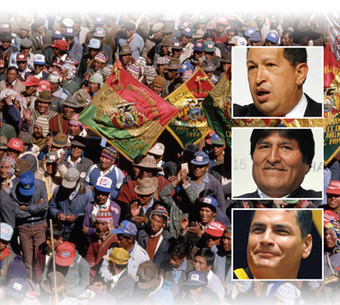
Most political analysts place the governments of Hugo Chávez (Venezuela), Evo Morales (Bolivia) and Rafael Correa (Ecuador) in the same category but without defining their common characteristics. Beginning with the publication of Leftovers in 2008, critics of the left sought to overcome the shortcoming by characterizing the three presidents as “populist leftists,” which they distinguished from the “good leftists” taking in such moderates as Brazil's Luiz Inácio Lula da Silva. According to the book's co-editors Jorge Castañeda and Marco Morales, the salient features of the populist left consist of a radical discourse devoid of ideological substance, disrespect for democratic institutions, pronounced authoritarian tendencies and vituperations against the United States designed to pay political dividends at the expense of their nation's economic interests (Castañeda and Morales, 2008).
Scoop.it!

Every day at Occupy Supply we talk with occupations across the country who are doing amazing work. So when we hear that “occupy is dead,” we know that someone is seriously ill-informed.
Scoop.it!
The world has just experienced the most severe recession in most people’s lifetimes. The economic aftershocks are still being felt and will be felt for many years to come. We are confronted with years of austerity. Though the Great Recession is now over, the crisis is ongoing.
Scoop.it!

Yesterday some 50 squatters were peacefully evicted from the Occupy movement’s “Bank of Ideas” located a mile and a half from the main site at St Paul’s Cathedral, just outside the borders of City’s Corporation of London. For the last three months, they successfully squatted the formerly vacant UBS-owned building, using it as an educational centre and meeting house Occupy London participants.
Scoop.it!

These great documentary films have a simple lesson: effective political protest needs good organisation and smart messaging
Scoop.it!

“It is a common theme” that the United States, which “only a few years ago was hailed to stride the world as a colossus with unparalleled power and unmatched appeal is in decline, ominously facing the prospect of its final decay,” Giacomo Chiozza writes in the current Political Science Quarterly.
|

Curated by jean lievens
Economist, specialized in political economy and peer-to-peer dynamics; core member of the P2P Foundation
Other Topics

Anders en beter
Met P2P voorbij markt en staat: voor een progressieve coalitie rond de commons. Met nieuws over op p2p gebaseerde praktijken en hoe de overheid, de politiek en de zakenwereld ermee (kunnen) omgaan...

money money money
on money and what it is

music-all
From the Great White Way to the West-End and beyond

Peer2Politics
on peer-to-peer dynamics in politics, the economy and organizations

real utopias
Not TINA (There Is No Alternative) but TAPAS: THERE ARE PLENTY OF ALTERNATIVES
|




