


An MTV reality programme documenting a party thrown by two young Capetonians made for nauseating viewing in a country riven by yawning economic inequalities. By REBECCA DAVIS.

 Your new post is loading...
 Scoop.it! An MTV reality programme documenting a party thrown by two young Capetonians made for nauseating viewing in a country riven by yawning economic inequalities. By REBECCA DAVIS. 
No comment yet.
Sign up to comment
Scoop.it!

Disruptive. Small-d democratic. Transparent. Tech savvy. Design savvy. Local and global. Nimble. Values-driven.
Scoop.it!

Sketchnotes are a visual form of note-taking that can include drawings, various lettering sizes and styles, color, icons, arrows, boxes and more — whatever works for you. I’d say that sketchnoting is officially a movement — maybe you’ve seen some from SXSWi or other conferences. And the best part? You don’t have to be a creative genius to do it. It’s called Sketchnoting, not Art School.
Scoop.it!

Walmart offers cheap goods, but from driving out competitors to expanding taxpayer subsidized healthcare, little good actually comes from this.
Scoop.it!

In late 2008, when the OECD countries had only just been hit by the credit crunch and Keynesians were arguing for a large stimulus package to offset private deleveraging, the German Finance Minister Peer Steinbrück launched an unprecedented attack on Gordon Brown, accusing him of ‘crass Keynesianism’ and claiming that economic stimulus would merely ‘raise Britain’s debt to a level that will take a whole generation to work off’. A year later, Steinbrück helped draft the Merkel government’s infamous debt-brake law (Schuldenbremse) effectively outlawing counter-cyclical deficit spending — which Ms Merkel currently wants applied to the whole Eurozone (EZ).
Scoop.it!

Dr Steward Wood, UK Shadow Minister without Portfolio, discusses the economic crisis, the situation of European social democracy and explains his ideas for the future of social democracy.
Scoop.it!

How far we have fallen! The vision of a cooperative Europe, that began in 1950 with the Iron and Steel Community, is now realized as a collection of weak and strong countries caught in a spiral of beggar-thy-neighbor trade and austerity policies, in which the 99% are the losers (even in Germany). The authoritarian governance of the EU has reached its fullest expression in the debt disasters of the 21st Century, bringing on a continental depression. The ideology that justified this consciously-created and unnecessary depression was and is pure neo-liberal economics.
Scoop.it!

Icelanders who pelted parliament with rocks in 2009 demanding their leaders and bankers answer for the country’s economic and financial collapse are reaping the benefits of their anger.
Scoop.it!

Many frustrated manufacturers say jobs are going unfilled because qualified workers are missing. (Matching needed skills with open jobs.
Scoop.it!

Earth is currently home to 7 billion people, a figure that’s expected to soar to more than 9 billion by 2050, with 70% living in cities. Concurrently, technology is extending its reach, with these parallel trends intersecting at a time when the world’s facing serious economic, environmental, and social challenges. We need more sustainable development.
Scoop.it!
First, I must say I liked this book. I think it is a major contribution to the debate about the nature not only of the latest crisis but of cyclical capitalist crises in general.
Scoop.it!

A personalized newspaper built from articles, blog posts, videos and photos selected by OccupyParis.
Scoop.it!

Yesterday, a group affiliated with Occupy Wall Street submitted an astounding comment letter to the Securities and Exchange Commission. Point by point, it methodically challenges the arguments of finance industry lobbyists who want to water down last year's historic Dodd-Frank Wall Street reforms. The lobbyists have been using the law's official public comment period to try to kneecap the reforms, and given how arcane financial regulation can be, they might get away with it. But Occupy the SEC is fighting fire with fire, and in so doing, defying stereotypes of the Occupy movement. Its letter explains:
Scoop.it!

Mark Zuckerberg believes he is not changing human nature but enabling it. If you buy that – and I do – then I'd suggest buying his stock, for he has created the platform for the sharing economy.
Scoop.it!
Workers at an idled ArcelorMittal steel plant in northeast France occupied the site on Monday, seeking to put their plight on the political map ahead of a presidential election where industrial decline is a central theme.
Scoop.it!
To contact the Canadian Senate, go to: http://www.parl.gc.ca/SenatorsMembers/Senate/SenatorsBiography/isenator.asp Senate phone toll-free (Canada): 1-866-599...
Scoop.it!
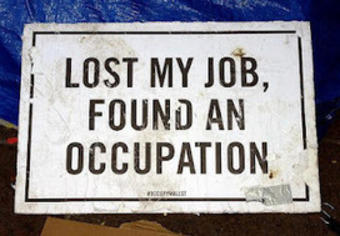
Yesterday I finally had the chance to hear David Graeber speak. The author of Debt: The First 5,000 Years, Graeber is credited with being one of the architects of the consensus decision making at the heart of the Occupy Wall Street movement. I had hoped his talk at Bertell Ollman's Friday afternoon seminar would focus on Debt, as I'd been hankering for some sort of in-person Cliff Notes for the hefty volume that arrived, appropriately enough, under the Christmas tree two months back.
Scoop.it!

Economics as a public artThe Guatemala TimesWe now know enough about human nature to know why and how the concept of individualistic, self-seeking 'economic man' is grossly inadequate.
Scoop.it!
If you haven't run across Aaron Heidemann yet, you may just be missing one of the most vibrant voices of this generation. In mid-2010, Aaron set off in search of The American Dream, literally. With only five dollars in his pocket and what he could carry on his back, he set out to hitchhike through all fifty states asking people what their American Dream was. Thirty states later, he has collected thousands of dreams from all walks of American life.
Scoop.it!

So, as you might have gathered, this Design and the Market module I’m doing at uni has had me thinking about my future rather a lot.
Scoop.it!

Significant anniversaries are solemnly commemorated -- Japan’s attack on the U.S. naval base at Pearl Harbor, for example. Others are ignored, and we can often learn valuable lessons from them about what is likely to lie ahead. Right now, in fact.
Scoop.it!

The results are in: austerity policies have been an utter failure.
Scoop.it!
The neoliberal model that says banks can govern themselves has failed. It is up to county governments to restore the rule of law and repair the economic distress wrought behind the smokescreen of MERS. New tools at the county’s disposal—including eminent domain, land banks, and publicly-owned banks—can facilitate this local rebirth.
Scoop.it!
The Americas are menaced by the emergence of a reactionary bloc of states & the rise of non-state actors that threaten to plunge the region into chaos.
Scoop.it!

Mitt Romney & Co. want us to think that making the rich richer will create jobs. That's not true. And it's not the American way.
|

Curated by jean lievens
Economist, specialized in political economy and peer-to-peer dynamics; core member of the P2P Foundation
Other Topics

Anders en beter
Met P2P voorbij markt en staat: voor een progressieve coalitie rond de commons. Met nieuws over op p2p gebaseerde praktijken en hoe de overheid, de politiek en de zakenwereld ermee (kunnen) omgaan...

money money money
on money and what it is

music-all
From the Great White Way to the West-End and beyond

Peer2Politics
on peer-to-peer dynamics in politics, the economy and organizations

real utopias
Not TINA (There Is No Alternative) but TAPAS: THERE ARE PLENTY OF ALTERNATIVES
|




