Your new post is loading...

|
Scooped by
The Morpho Institute
March 28, 2025 1:53 PM
|
|
|
Scooped by
The Morpho Institute
March 20, 6:17 PM
|
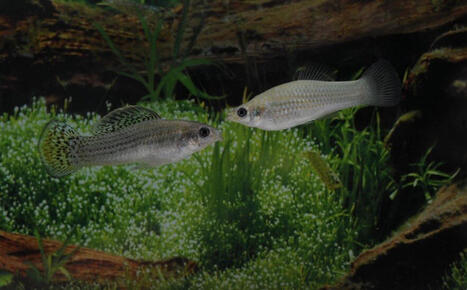
The tiny Amazon molly (Poecilia formosa) has always fascinated researchers because, according to the rules of evolution, it shouldn't have survived as a species, let alone thrive as a species for over 100,000 years. Using advanced genetic mapping and comparison techniques to track how the Amazon molly's DNA has changed over time, a new study set out to uncover the genetic secrets behind this apparent rebellion against evolutionary theory.
|
|
Scooped by
The Morpho Institute
March 18, 4:17 PM
|
Fueled by açaí flowers, a bee's resin once used for war wounds is now evolving as a new ingredient for cosmetics.
|
|
Scooped by
The Morpho Institute
March 18, 4:12 PM
|
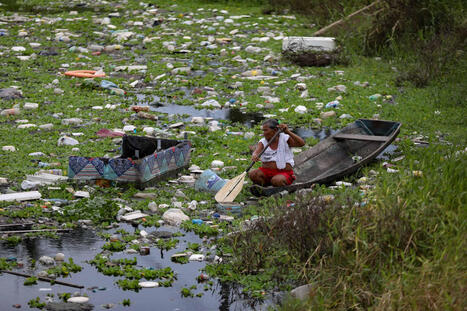
Plastic pollution is so widespread in the Amazon that it’s turning up in fish, birds, manatees, and even remote streams far from human settlements.
|
|
Scooped by
The Morpho Institute
March 18, 4:07 PM
|
I recently contributed a section on how to communicate about the Amazon for The Endangered Amazonia report, which came out this week in Spanish, Portuguese, and English. Here’s a brief summary of my contribution. From doom to agency: Talking about saving Amazonia Many stories about the Amazon read like elegies. Drought, smoke, lawlessness—each headline darker [Continue reading]
|
|
Scooped by
The Morpho Institute
March 18, 4:04 PM
|
The Amazon rainforest is one of Earth’s most diverse ecosystems, playing a key role in maintaining regional and global climate stability. However, recent changes in land use, vegetation, and the climate have disrupted biosphere-atmosphere interactions, leading to significant alterations in the water, energy, and carbon cycles. These disturbances have far-reaching consequences for the entire Earth system. Here, we quantify the relative contributions of deforestation and global climate change to observed shifts in key Amazonian climate parameters. We analyzed long-term atmospheric and land cover change data across 29 areas in the Brazilian Legal Amazon from 1985 to 2020, using parametric statistical models to disentangle the effects of forest loss and alterations of temperature, precipitation, and greenhouse gas mixing ratios. While the rise in atmospheric methane (CH4) and carbon dioxide (CO2) mixing ratios is primarily driven by global emissions (>99%), deforestation has significantly increased surface air temperatures and reduced precipitation during the Amazonian dry season. Over the past 35 years, deforestation has accounted for approximately 74% of the ~ 21 mm dry season−1 decline and 16.5% of the 2°C rise in maximum surface air temperature. Understanding the interplay between global climate change and deforestation is essential for developing effective mitigation and adaptation strategies to preserve this vital ecosystem. In this study, the distinct impacts of deforestation and global climate change on the Brazilian Amazon are quantified for the period 1985-2020. Deforestation amplifies the temperature increase and dominates the decrease in rainfall in the dry season.
|
|
Scooped by
The Morpho Institute
March 18, 4:00 PM
|
A new study suggests many tropical insects may be far less able to cope with rising heat, with the Amazon among the regions facing the biggest risks
|
|
Scooped by
The Morpho Institute
March 18, 3:56 PM
|
Hatchlings talk inside their shells to time their birth, but the roar of massive barges may soon drown out their sound.
|
|
Scooped by
The Morpho Institute
March 5, 9:12 PM
|
Now it’s our turn to shape what comes next. A new project. A mission years in the making.
|
|
Scooped by
The Morpho Institute
March 5, 7:57 AM
|
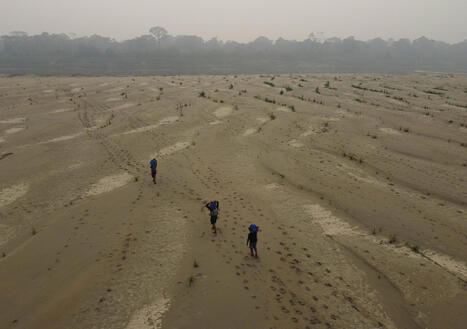
Brazil bet big on a mega river dam using old data, but climate change is leaving its massive turbines high and dry.
|
|
Scooped by
The Morpho Institute
February 25, 11:32 AM
|
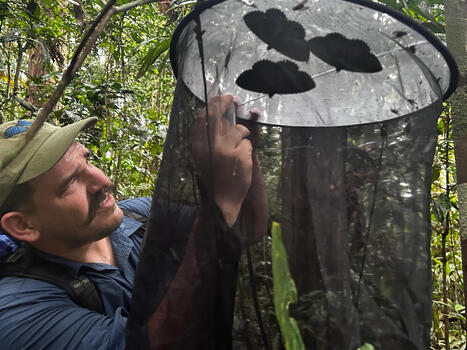
What happens when you look for biodiversity on both the forest floor and in the rainforest canopy? During the Amazon Research Initiative for Educators (ARIE), educators and researchers used simple fruit-baited traps at the Amazon Conservatory of Tropical Studies (ACTS) in Peru to explore...
|
|
Scooped by
The Morpho Institute
February 27, 9:56 AM
|
RESEARCH: This study explores how Adaptive Co-management—a collaborative and flexible approach to conservation—works in practice within the Maijuna-Kichwa Regional Conservation Area (MKRCA) in the Peruvian Amazon.
|
|
Scooped by
The Morpho Institute
March 4, 7:55 AM
|
Told in the perspective of dust, A River of Dust takes readers on a journey through vibrantly illustrated landscapes, celebrating the power and wonder of Earth's ecosystems, and showing how these tiny particles are in fact key to the health of our planet..
|
|
|
Scooped by
The Morpho Institute
March 29, 11:04 AM
|
Camera traps reveal a new way to track biodiversity
|
|
Scooped by
The Morpho Institute
March 20, 6:17 PM
|
Scientists have discovered a new species of poisonous frog—brightly colored and measuring just a few millimeters—in the Amazon, according to a Peruvian government agency in charge of environmental conservation.
|
|
Scooped by
The Morpho Institute
March 18, 4:15 PM
|
Throughout the Amazon Rainforest, forest fragmentation represents an escalating and existential threat to the preservation of fauna. Driven by intensive economic development, the expansion of agribusiness and large-scale infrastructure projects — such as highways, railways, power transmission lines and gas pipelines — continues carrying profound environmental risks. Foremost among these ecological pressures are the geographic […]
|
|
Scooped by
The Morpho Institute
March 18, 4:11 PM
|
A new study finds well-preserved areas of Amazon rainforest occupied and managed by Indigenous peoples show lower incidences of multiple diseases in the regions around them.
|
|
Scooped by
The Morpho Institute
March 18, 4:05 PM
|
Watch Conservation International's VR and 360 video experience in the Amazon, #UnderTheCanopy
|
|
Scooped by
The Morpho Institute
March 18, 4:02 PM
|
Scientist and National Geographic Fellow Dr. Thomas Lovejoy is leading a charge to combat deforestation and protect the Amazon.
|
|
Scooped by
The Morpho Institute
March 18, 3:58 PM
|
|
|
Scooped by
The Morpho Institute
March 9, 10:38 AM
|
As mysterious bird declines crop up in the Amazon and beyond, scientists suspect climate change may be to blame
|
|
Scooped by
The Morpho Institute
March 5, 7:59 AM
|
Throughout the Amazon Rainforest, forest fragmentation represents an escalating and existential threat to the preservation of fauna. Driven by intensive economic development, the expansion of agribusiness and large-scale infrastructure projects — such as highways, railways, power transmission lines and gas pipelines — continues carrying profound environmental risks. Foremost among these ecological pressures are the geographic […]
|
|
Scooped by
The Morpho Institute
February 24, 9:43 AM
|
Morpho is co-facilitating this workshop on March 11 at 9AM ET! Space is limited! Learning for Life: Co-Creating Educational Strategies for a Living Planet is a dynamic 3-hour online training designed for educators, conservation practitioners, policymakers, and youth leaders seeking to align learning with global biodiversity goals. Register Here
|
|
Scooped by
The Morpho Institute
March 4, 7:56 AM
|
Close-up views of glasswing butterflies reveal the secrets behind the insect’s see-through wings: sparse, spindly scales and a waxy coating.
|
|
Scooped by
The Morpho Institute
February 27, 12:14 AM
|
The proposed Pucallpa–Cruzeiro do Sul will connect the Amazon’s interior to urban centers and export markets in Peru and Brazil. However, critics are worried that the road will also create new opportunities for illegal logging and infringe on the territory of indigenous communities and wildlife.
|
|
Scooped by
The Morpho Institute
March 4, 7:54 AM
|
Using photos in lessons can help kids understand challenging issues, explains a researcher.
|