


Un nombre croissant d'établissements prennent des mesures pour interdire l'utilisation des Google Glass dans leurs murs.


 Your new post is loading...
 Scoop.it! Un nombre croissant d'établissements prennent des mesures pour interdire l'utilisation des Google Glass dans leurs murs. 
No comment yet.
Sign up to comment
Scoop.it!

This is really cool, a MakerBot Industries-supported 3D printable prosthetic hand project. When Richard Van As, a master carpenter in Johannesburg, South Africa, decided to make a set of mechanical fingers, it wasn’t just for fun. Via Club de TeleMatique
Scoop.it!

Dekko have secured $3.2 million to launch a system that can recognise objects in our environment and augment visual layers for devices like Google Glass. Via Miguel Mimoso Correia
Scoop.it!
A group at Tokyo Institute of Technology, led by Dr. Osamu Hasegawa, has succeeded in making further advances with SOINN, their machine learning algorithm, which can now use the internet to learn how to perform new tasks. The system, which is under development as an artificial brain for autonomous mental development robots, is currently being used to learn about objects in photos using image searches on the internet. It can also take aspects of other known objects and combine them to make guesses about objects it doesn't yet recognize. Via Sakis Koukouvis
Scoop.it!

Princeton scientists used 3-D printing to create a "bionic ear" made up of a coil antenna and cartilage, demonstrating an efficient method of merging electronics with tissue.
The researchers' primary purpose was to explore an efficient and versatile method of merging electronics with tissue. The scientists used 3-D printing of cells and nanoparticles — with an off-the-shelf printer purchased off the Internet — followed by cell culture to combine a small coil antenna with cartilage, creating what they term a bionic ear.
"In general, there are mechanical and thermal challenges with interfacing electronic materials with biological materials," said Michael McAlpine, an assistant professor ofmechanical and aerospace engineering at Princeton and the project's lead researcher. "Previously, researchers have suggested some strategies to tailor the electronics so that this merger is less awkward. That typically happens between a 2-D sheet of electronics and a surface of the tissue. However, our work suggests a new approach — to build and grow the biology up with the electronics synergistically and in a 3-D interwoven format."
"The design and implementation of bionic organs and devices that enhance human capabilities, known as cybernetics, has been an area of increasing scientific interest," the researchers wrote in an article published online May 1 in the scholarly journal Nano Letters. "This field has the potential to generate customized replacement parts for the human body, or even create organs containing capabilities beyond what human biology ordinarily provides." Via trendspotter
Scoop.it!

While patrolling the halls of the CHI 2013 Human Factors in Computing conference in Paris, we spied a research project from MIT's Media Lab called Via Gary Hayes, Mark Oehlert
Scoop.it!

From
mashable

A picture would convey the idea what it looks like to wear Google Glass, but how do you photograph a virtual screen? It's easier than it sounds. Via Miguel Mimoso Correia
Scoop.it!

Some believe in a utopian future, in which humans can transcend their physical limitations with the aid of machines. But others think humans will eventually relinquish most of their abilities and gradually become absorbed into artificial intelligence (AI)-based organisms, much like the energy making machinery in our own cells. Via Szabolcs Kósa
Scoop.it!

From
fr
La matrice hémisphérique de la caméra de 180 microlentilles donne un champ de vision de 160 degrés et la capacité de se concentrer, simultanément, sur des objets à des profondeurs différentes.
Scoop.it!

Sense-making Social intelligence Novel and adaptive thinking Cross cultural competency Computational thinking New media literacy Transdisciplinarity Design mindset Cognitive load management Virtual collaboration
Scoop.it!
From
mdelmas
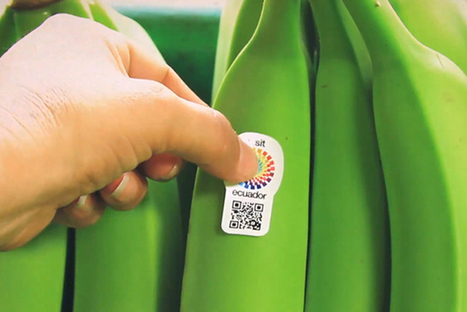
Le jour où les bananes sont devenues un véritable média ! L'Équateur est un tout petit pays de près de 15 millions d'habitants et qui a tout pour devenir une incontournable destination touristique.
Scoop.it!

Augmented Reality (AR) is becoming more and more a part of academic life. In this post we want to show you different AR cases in education, and want to encourage you to use them as examples to make... Via Pekka Puhakka
|
Scoop.it!

From
fr
Le projet Google Glass est en passe de se concrétiser. Avant la fin de cette année, Google compte proposer des lunettes interconnectées. Il ne s'agit pas de lunettes de vue, mais d'appareils donnant à l'utilisateur la possibilité de bénéficier de différents services "sous le casque", comme l'on dirait en aéronautique : GPS, accès aux bases d'informations concernant les objets et scènes observées, possibilité de filmer et mémoriser à tous moments les lieux et les personnes, sans évidemment leur demander leur accord.
Scoop.it!

Why pay more for colored prints when you can use off-the-shelf dyes to make them any color you want? Via Club de TeleMatique
Scoop.it!
La réalité augmentée comme interface de paramétrage d’objets connectés. Une approche intelligente qui déplace la complexité de l’interface sur une tablette tout en laissant l’objet simple. Via Audrey Bardon
Scoop.it!

The Exmobaby suit has a thermometer, heart rate monitor and movement sensor built into the fabric - and tells parents their child's 'mood' via their PC or smartphone. Via Tim Spencer
Scoop.it!

From
io9
It's another blow for immersive virtual reality. University of California researchers have shown that even people with perfect eyesight navigate the world by relying on a lot more than what they see. Via Henrik Safegaard - Cloneartist

Henrik Safegaard - Cloneartist's curator insight,
May 9, 2013 10:52 AM
Here's why VR won't really work until we go beyond visual cues and fancy treadmills.
Scoop.it!
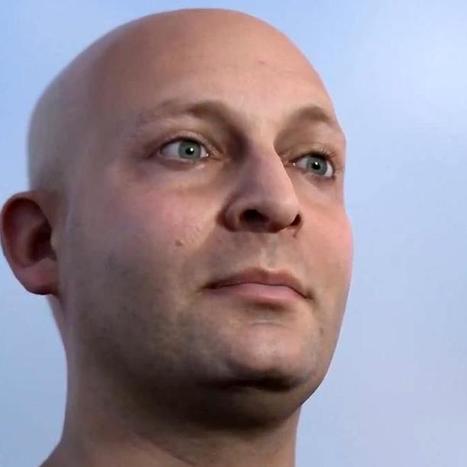
Activision showed off the state of the art of real-time graphics on Wednesday, releasing this mind-boggling character demo. The character's skin, facial expressions and eyes look so real, it's uncanny.
When you watch this video, see if you think this character has reached the other side of what's commonly called the "uncanny valley," a term first uttered by early robotics guruMasahiro Mori in 1970. It describes the range of sophistication of animated graphics, from one side of the valley where human figures simply look unrealistic, to the middle of the valley — where they look just realistic enough to be creepy — to our side of the valley, where animation is indistinguishable from reality.
Whenever the uncanny valley is mentioned, the animation techniques from the November, 2004 movie Polar Express come to mind. Most viewers noticed the characters weren't quite photorealistic enough to keep them out of the creepy zone. But that was nearly 8 years ago, and graphics technology has made spectacular progress since then. Via Marco Bertolini, Dr. Stefan Gruenwald, Sakis Koukouvis

Marco Bertolini's curator insight,
March 28, 2013 4:59 PM
Une vidéo bluffante : ce monsieur est en réalité une animation réalisée par la société Activision. Une reconstitution incroyable des expressions faciales, de la texture de la peau, etc. 
BEST-CAEXI 's curator insight,
May 9, 2013 1:14 AM
Activision Montre homme animé qui semble si réel, c'est Uncanny

Nintendo Gaston Tom's curator insight,
January 27, 2023 4:56 AM
Une avancée ingénieuse vers le réalisme des jeux vidéos
Scoop.it!

Reproduire le sens du toucher est une chose bien complexe. Pourtant, une peau artificielle capable de sensibilité aussi élevée que notre propre peau vient d’être mise au point. Elle repose sur la piézoélectricité. Via Jean-Philippe BOCQUENET, dm
Scoop.it!
Presented at ICRA 2013 by Samuel M. Felton, Michael T. Tolley, Cagdas D. Onal, Daniela Rus, and Robert J. Wood from the Wyss Institute for Biologically Inspi... Via Andrea Graziano
Scoop.it!

From
www
They started by printing their own gun parts and magazines. Now the internet gunsmiths at Defense Distributed have produced the world's first fully 3-D printed gun. It's been tested, and it works.
Scoop.it!

It seems almost too self-evident to be worth saying, but the passage of time is central to photography. Via Mario Pires, ABroaderView

Brad Tollefson's curator insight,
May 5, 2013 1:50 PM
The thing that I increasingly believe makes the history of photography interesting is that it is really a history of the relentless pursuit of speed. One might imagine that in a visual media each major innovation would be one of improving image quality (as has been the case in, for example, cinematography). But in photography each advance, from Daguerreotype to Polaroid, digital single lens reflex to the camera phone, has been first and foremost about increasing the medium’s pace, often indeed at the expense of image quality.
Scoop.it!

Faciliter la recherche d’emploi sur le territoire métropolitain grâce à la réalité augmentée Via QRious CODE, Vidos

QRious CODE's curator insight,
May 2, 2013 6:18 AM
Des affichettes NFC/QR code "Portail pour l’emploi" bientôt dans toutes les communes de NCA
Ce service de proximité vise à favoriser la recherche d’emploi dans toutes les communes de la Métropole. Levens est la 1ère commune de la Métropole à s’équiper des affichettes NFC/QR code "Portail pour l’emploi". Dans un mois toutes les autres communes les auront apposées, en mairie ou au sein d’un autre équipement municipal. Ces affichettes permettent d’accéder immédiatement aux offres d’emploi à partir d’un téléphone doté de la technologie NFC ou d’un smartphone connecté à Internet. 
Martine Le Jossec's curator insight,
May 4, 2013 9:44 PM
Faciliter la recherche d’emploi grâce à la réalité augmentée... Un exemple à suivre ? 
BOUTELOUP Jean-Paul's comment,
May 6, 2013 4:14 AM
Une simple carte n'est elle pas suffisante ? intéressant si le contenu des offres est enrichie...(video du poste, entretien en direct...)
|






