


3D reconstruction confocal microscopy image of a 3D macroporous nanoelectronic scaffold; a nanoelectronic device exists (too small to see in image) in each...
Via Ana Cristina Pratas


 Your new post is loading...
 Scoop.it! 3D reconstruction confocal microscopy image of a 3D macroporous nanoelectronic scaffold; a nanoelectronic device exists (too small to see in image) in each... Via Ana Cristina Pratas 
No comment yet.
Sign up to comment
Scoop.it!

If you've ever wanted to turn your life into a sci-fi flick, here's your shot. Using an XBox Kinect, you can re-create your room in a 3D hologram image. Via THE OFFICIAL ANDREASCY
Scoop.it!
Scoop.it!

Local produce meets technical process at the Internet giant's Mountain View headquarters. Via Andrea Graziano
Scoop.it!

Did you think that the Raspberry Pi will only be limited to benign uses? Did you think that the Raspberry Pi will always bask in the light of day? Well this Raspberry Pi...has embraced the darkness.
Scoop.it!

The 2012 RHoF inductees will be celebrated on Tuesday, October 23 at 6:30pm, at Carnegie Science Center in Pittsburgh.
Scoop.it!

Editor’s note: This is a contributed post by Gabriela Jugaru, a tech enthusiast who is passionate about the mobile industry and gadgets. She’s a technology entrepreneur, co-founder of UnlockUnit.com. Via Rui Guimarães Lima, Timo Ilomäki
Scoop.it!

Even at just six months old, babies turn out to be proficient robot drivers...
Scoop.it!
Sam Green from the Objet blog (http://www.objetblog.com/) visits the Pompidou Center in Paris to witness first-hand some of the incredible 3D printed objects... Via Andrea Graziano
Scoop.it!

Students write and produce movies for historic walking tours that can be accessed via Aurasma. How to merge technology and community involvement. Learning comes through gathering, processing, transferring and explaining... and knowledge stays!! Via Ricard Garcia
Scoop.it!

For the first time, Harvard scientists have created a type of cyborg tissue by embedding a three-dimensional network of functional, biocompatible, nanoscale wires into engineered human tissues. Via Jean-Philippe BOCQUENET
Scoop.it!

Either we allow for the ambiguity that freedom and unregulated 3D printing will bring, or we enforce far-reaching laws that may decrease liberty without changing results. For those who appreciate the internet because of its democratizing effects...
|
Scoop.it!

Love the good old days when your imagination was the graphics?
Scoop.it!
The Apple iPhone 4 may be a contender for the Greatest Gadget of the 21st Century, but you can't eat your dinner off it. That's where Table Connect comes in,... Via Duz_Machines, J Lynn Lock
Scoop.it!

Depuis quelques temps, les recruteurs voient apparaître sur les CV qu’ils reçoivent d’énigmatiques QR code, ces codes barres scannés via smartphone qui renvoient directement à une page Internet.
Via Veille digitale
Scoop.it!
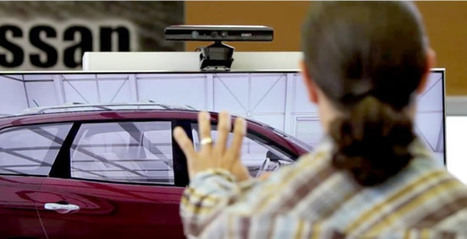
Bien que le ralentissement de l'économie influe sur les ventes des constructeurs automobiles, nombre d'entre eux poursuivent cet éternel jeu de séduction des...
Scoop.it!

Google is out with a new study “The New Multi-screen World: Understanding Cross-Platform Consumer Behavior.” It describes how we use multiple screens for the completion of a single task. Via Simon Staffans
Scoop.it!

The UAV is a combination of a plane and helicopter.
Scoop.it!

A robot called Nico has taken a step towards self-awareness by recognising that the mark on its body reflected in the mirror is its own (Robot learns to recognize itself in the mirror:
Scoop.it!
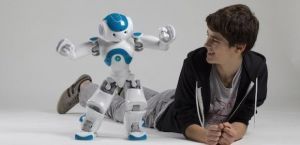
Inserting a robot that gets things wrong into a classroom environment may sound counterintuitive, but according to a new Japanese study, it's something that helps children learn.
If you believe that the best way to learn is through simple trial and error, you’ll be happy to know that – despite numerous impressive advances in technology that have seen the introduction of not only computers, but also tablets, into the classroom – the educational establishment still agrees with you. It’s just that the failures that teach children belong to robots now, apparently.
A story in New Scientist explains that Japanese children are learning to speak English faster than before thanks to a new robot that tries to teach them, but gets things wrong. The discovery comes after Shizuko Matsuzoe and Fumihide Tanaka, two scientists at the University of Tsukuba, studied nineteen children aged between four and eight years old interacted with a humanoid robot known as Nao as it tried to teach them simple English words for shapes such as “circle,” “square” or “heart.”... Via siobhan-o-flynn
Scoop.it!
Treffyn Koreshoff - Internet of things (Great video on how the Internet of Things can improve the world we live in by @treffyn at Ignite Sydney [5 min vid] http://t.co/2MJ3Pz35...)... Via Richard Kastelein
Scoop.it!

Un chercheur français du CNRS a mis au point un système qui pourrait redonner de la créativité à des personnes très handicapées. Via Jean-Philippe BOCQUENET
Scoop.it!

What if you could control a robot -- wait, don't answer yet -- with your mind? Pretty great, right? Via Jean-Philippe BOCQUENET
Scoop.it!

An easy to use online dictation tool. Just speak and this site types the words for you. Requires Chrome. http://ictmagic.wikispaces.com/ICT+%26+Web+Tools
Via Deb
|






