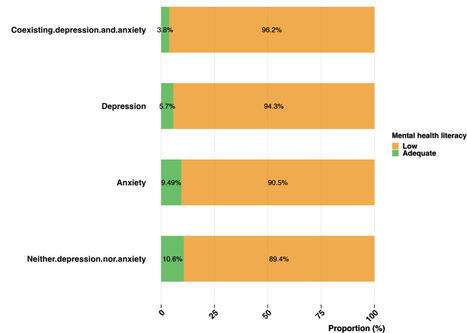
Collaborateurs du GBD 2019 sur les troubles mentaux.Fardeau mondial, régional et national de 12 troubles mentaux…...
Via Emmanuel Capitaine


|
PATIENT EMPOWERMENT & E-PATIENT
Patients as the healthcare system "missing link" #digitalhealth #hcsmeu #hcsm #epatient Curated by Lionel Reichardt / le Pharmageek |
 Your new post is loading...

|
Rescooped by
Lionel Reichardt / le Pharmageek
from Ma santé et le digital francophone
October 7, 2024 9:38 AM
|
 Scoop.it!
Collaborateurs du GBD 2019 sur les troubles mentaux.Fardeau mondial, régional et national de 12 troubles mentaux…...
|
|
Rescooped by
Lionel Reichardt / le Pharmageek
from CREADOC Nice
October 7, 2024 9:37 AM
|
Scoop.it!

Catherine, 42 ans, est la maman de Ryan, 21 ans, atteint d'un lourd handicap. Depuis des années, en parallèle de son activité professionnelle, elle s'occupe de son fils jour et nuit. Pendant deux jours, Clémentine Célarié va vivre le quotidien harassant de cette mère. Au-delà des contraintes journalières, Clémentine va aussi faire plus ample connaissance avec Ryan en partageant avec lui des moments complices. Quant à Théo Curin, il va proposer à Catherine de lâcher prise et de prendre du temps pour elle, ce qui ne lui arrive jamais. Il va également lui faire rencontrer des personnes aux parcours inspirants.
|
|
Rescooped by
Lionel Reichardt / le Pharmageek
from CREADOC Nice
July 12, 2024 5:07 AM
|
Scoop.it!

Ce guide donne des clefs pour évaluer, de manière subjective et objective, l’atteinte des objectifs du patient, fixés conjointement durant le bilan éducatif partagé.
|
|
Rescooped by
Lionel Reichardt / le Pharmageek
from Buzz e-sante
July 12, 2024 4:57 AM
|
Scoop.it!

Comment dit on? La Californie utilise l’IA pour traduire les informations sur les soins de santé
|
|
Rescooped by
Lionel Reichardt / le Pharmageek
from Digitized Health
July 12, 2024 4:53 AM
|
Scoop.it!
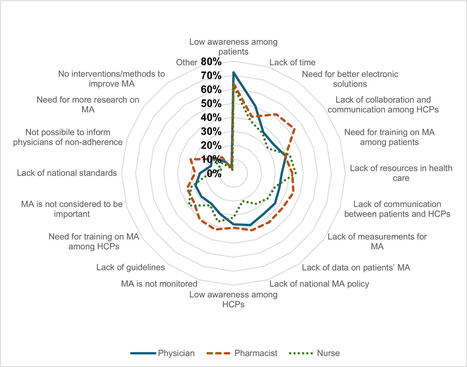
Background Medication adherence is essential for the achievement of therapeutic goals. Yet, the World Health Organization estimates that 50% of patients are nonadherent to medication and this has been associated with 125 billion euros and 200,000 deaths in Europe annually.
|
|
Rescooped by
Lionel Reichardt / le Pharmageek
from Digitized Health
July 12, 2024 4:45 AM
|
Scoop.it!
Empowering patients to take control of their health is a cornerstone of modern healthcare. Healthcare providers can foster a sense of ownership and active participation in their care by providing i...
|
|
Scooped by
Lionel Reichardt / le Pharmageek
May 28, 2024 5:05 AM
|
Scoop.it!

Le patient expert s'est fait une place dans l'univers médical, apportant son savoir-faire précieux. L'Académie de médecine lui consacre un rapport éclairant, lui préférant le terme de 'partenaire'. Pour une médecine vraiment participative ?
|
|
Rescooped by
Lionel Reichardt / le Pharmageek
from Digital News in France
May 27, 2024 3:59 AM
|
Scoop.it!
|
|
Rescooped by
Lionel Reichardt / le Pharmageek
from Digital News in France
May 27, 2024 3:51 AM
|
Scoop.it!

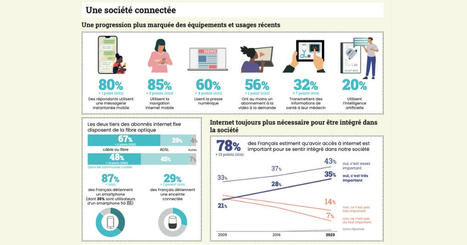
Les Français toujours plus connectés mais attentifs à leur empreinte environnementale numérique
|
|
Rescooped by
Lionel Reichardt / le Pharmageek
from CREADOC Nice
May 27, 2024 3:49 AM
|
Scoop.it!

Santé publique France et ses partenaires publient les résultats d'une enquête internationale permettant de mesurer les niveaux de littératie en santé des Français. Ces résultats montrent que 44% des adultes rencontrent des difficultés pour comprendre et s’approprier les informations en santé, avec des conséquences possibles sur leurs comportements et leur état de santé.
|
|
Rescooped by
Lionel Reichardt / le Pharmageek
from Buzz e-sante
May 14, 2024 6:41 AM
|
Scoop.it!

Rencontre avec Dr Clément Goehrs, médecin spécialisé en santé publique et en bio-informatique, co-fondateur de Synapse Medicine
|
|
Rescooped by
Lionel Reichardt / le Pharmageek
from CARDIOVASCULAR PREVENTION - PREVENTION CARDIOVASCULAIRE - BEHAVIOR CHANGES - CHANGEMENTS DE COMPORTEMENTS
April 30, 2024 4:32 AM
|
Scoop.it!

L’obésité est responsable chaque année de plus de 6,6 millions de pathologies, traitements et épisodes de soins, et de plus de 60 000 décès.
|
|
Rescooped by
Lionel Reichardt / le Pharmageek
from Buzz e-sante
April 28, 2024 1:53 PM
|
Scoop.it!
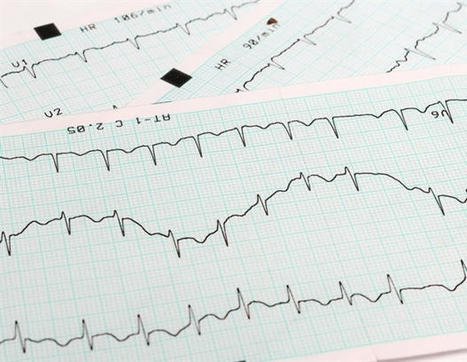
La Fondation PhRMA (PhF) a accordé des subventions de 500 000 $ à David G. Armstrong, DPM, MD, PhD, de l'Université de Californie du Sud et à Nino Isakadze, MD, MHS, de l'Université Johns Hopkins pour mener des recherches utilisant les technologies de santé numérique (DHT) pour améliorer l’équité en santé et les résultats de […]
|
|
Rescooped by
Lionel Reichardt / le Pharmageek
from Digitized Health
April 28, 2024 1:51 PM
|
Scoop.it!

Digital transformation of healthcare not only requires investments in digital technology, but also in digital health literacy. This must be coordinated across three critical levels: individual, institutional and policy-making.
|
|
Rescooped by
Lionel Reichardt / le Pharmageek
from CARDIOVASCULAR PREVENTION - PREVENTION CARDIOVASCULAIRE - BEHAVIOR CHANGES - CHANGEMENTS DE COMPORTEMENTS
April 23, 2024 4:13 AM
|
Scoop.it!
Background: Achieving clinically significant weight loss through lifestyle interventions for obesity management is challenging for most individuals. Improving intervention effectiveness involves early identification of intervention nonresponders and providing them with timely, tailored interventions. Early and frequent self-monitoring (SM) adherence predicts later weight loss success, making it a potential indicator for identifying nonresponders in the initial phase.
Objective: This study aims to identify clinically meaningful participant subgroups based on longitudinal adherence to SM of diet, activity, and weight over 6 months as well as psychological predictors of participant subgroups from a self-determination theory (SDT) perspective.
Methods: This was a secondary data analysis of a 6-month digital lifestyle intervention for adults with overweight or obesity. The participants were instructed to perform daily SM on 3 targets: diet, activity, and weight. Data from 50 participants (mean age: 53.0, SD 12.6 y) were analyzed. Group-based multitrajectory modeling was performed to identify subgroups with distinct trajectories of SM adherence across the 3 SM targets. Differences between subgroups were examined for changes in clinical outcomes (ie, body weight, hemoglobin A1c) and SDT constructs (ie, eating-related autonomous motivation and perceived competence for diet) over 6 months using linear mixed models.
Results: Two distinct SM trajectory subgroups emerged: the Lower SM group (21/50, 42%), characterized by all-around low and rapidly declining SM, and the Higher SM group (29/50, 58%), characterized by moderate and declining diet and weight SM with high activity SM. Since week 2, participants in the Lower SM group exhibited significantly lower levels of diet (P=.003), activity (P=.002), and weight SM (P=.02) compared with the Higher SM group. In terms of clinical outcomes, the Higher SM group achieved a significant reduction in body weight (estimate: −6.06, SD 0.87 kg; P<.001) and hemoglobin A1c (estimate: −0.38, SD 0.11%; P=.02), whereas the Lower SM group exhibited no improvements. For SDT constructs, both groups maintained high levels of autonomous motivation for over 6 months. However, the Lower SM group experienced a significant decline in perceived competence (P=.005) compared with the Higher SM group, which maintained a high level of perceived competence throughout the intervention (P=.09).
Conclusions: The presence of the Lower SM group highlights the value of using longitudinal SM adherence trajectories as an intervention response indicator. Future adaptive trials should identify nonresponders within the initial 2 weeks based on their SM adherence and integrate intervention strategies to enhance perceived competence in diet to benefit nonresponders.
Trial Registration: ClinicalTrials.gov NCT05071287; https://clinicaltrials.gov/study/NCT05071287

Découverte passionnante dans la gestion de l'obésité ��! Une nouvelle étude a identifié des sous-groupes de patients basés sur leur adhérence à l'auto-surveillance de l'alimentation, de l'activité physique et du poids sur une période de 6 mois. Cette approche pourrait être cruciale pour personnaliser les interventions et améliorer les résultats en matière de perte de poids et de contrôle de la santé.
Les chercheurs ont également exploré le rôle de la motivation autonome et de la compétence perçue dans le succès des interventions. Des résultats prometteurs pour une médecine plus prédictive et personnalisée! �
L'étude complète est disponible sur le Journal of Medical Internet Research. #SantéNumérique #Obésité #Recherche #Innovation
|
|
Rescooped by
Lionel Reichardt / le Pharmageek
from Digital News in France
April 23, 2024 4:11 AM
|
Scoop.it!
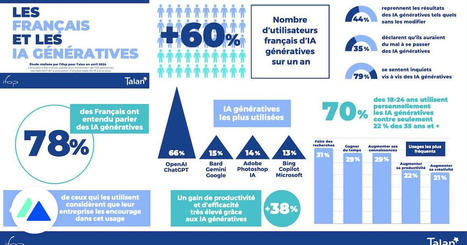
Les Français sont de plus en plus consommateurs des outils d'IA générative, notamment chez les plus jeunes et dans le cadre professionnel. Mais ils restent très méfiants.
|
|
Rescooped by
Lionel Reichardt / le Pharmageek
from Ma santé et le digital francophone
April 16, 2024 8:31 AM
|
Scoop.it!

Une équipe de spécialistes a compilé les informations d’une vaste base de données pour décrire l’évolution de la santé des Français et ses nombreuses facettes sur une période de trente ans. Florence Francis-Oliviero, médecin spécialiste en santé publique, en résume les principales conclusions.
|
|
Scooped by
Lionel Reichardt / le Pharmageek
April 3, 2024 6:07 AM
|
Scoop.it!
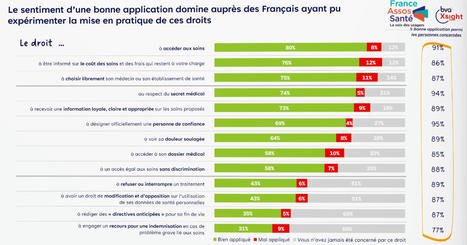
Réalisé auprès d'un échantillon de 1507 personnes âgées de plus de 15 ans représentatif de la population, ce baromètre de France assos santé dresse un état des lieux de la connaissance et de l'exercice des droits des malades, définis par la loi Kouchner de 2002.
|
|
Rescooped by
Lionel Reichardt / le Pharmageek
from Buzz e-sante
April 2, 2024 8:29 AM
|
Scoop.it!

La biotech française Cure51 a décidé de "tuer le cancer" en révélant les secrets moléculaires des patients qui ont échappé à des tumeurs incurables.
|
|
Rescooped by
Lionel Reichardt / le Pharmageek
from Digitized Health
March 11, 2024 4:20 AM
|
Scoop.it!

Health care portal use was higher during the COVID-19 pandemic, according to a study published online Feb.29 in JAMA Network Open.Esther Yoon, Ph.D., M.P.H., f...
|
|
Rescooped by
Lionel Reichardt / le Pharmageek
from Social Media and Healthcare
February 23, 2024 3:42 AM
|
Scoop.it!
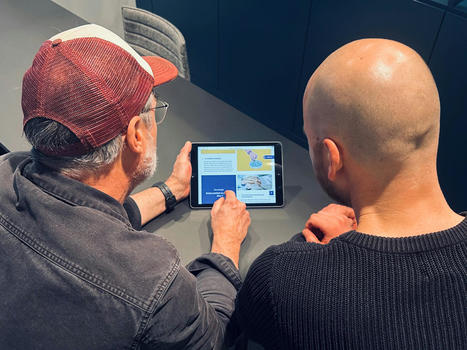
Digital health literacy, also known as eHealth literacy, describes the ability to seek, find, understand, and apply health information from the internet to address health problems.
The World Health Organization calls for actions to improve digital health literacy. To develop target group–specific digital health literacy interventions, it is necessary to know the digital health literacy of the general population and relevant subgroups.
This study aims to representatively assess the digital health literacy of the population in Germany and relevant subgroups. The results are meant to facilitate the development of target group–specific digital health literacy interventions. Additionally, this study further explores the associations between digital health literacy and physical health, mental health, life satisfaction, and diverse health behaviors.
Based on the results of this study, Digital health literacy is unevenly distributed within German society.
The results of this study suggest that people with a low level of formal education and people with a low social status would benefit from digital health literacy interventions that address their competencies in the domains of information seeking and information appraisal.
Furthermore, the results suggest that older people would likely benefit from digital health literacy interventions that address their competencies in the domains of information seeking and also information appraisal.
The results provide a starting point for the development of target group–specific digital health literacy interventions.
Lire l'article complet sur : publichealth.jmir.org


|
|
Rescooped by
Lionel Reichardt / le Pharmageek
from Digitized Health
February 21, 2024 3:45 AM
|
Scoop.it!

In the rapidly evolving landscape of healthcare, the concept of patient-centricity has gained significant traction, ushering in a new era where individuals actively participate in their own well-being.
|
|
Rescooped by
Lionel Reichardt / le Pharmageek
from CREADOC Nice
February 21, 2024 3:44 AM
|
Scoop.it!

Dans les pays développés, la moitié des patients atteints de maladie chronique ne se conforme pas à leurs prescriptions médicales. En France, cette inobservance provoquerait, chaque année, 12 000 morts prématurées et plusieurs milliards d’euros de pertes pour l’Assurance-maladie.
Lire l'article complet sur : www.lemonde.fr

Article réservé aux abonnés. Le Monde est disponible au CRD.
|
|
Rescooped by
Lionel Reichardt / le Pharmageek
from CARDIOVASCULAR PREVENTION - PREVENTION CARDIOVASCULAIRE - BEHAVIOR CHANGES - CHANGEMENTS DE COMPORTEMENTS
February 14, 2024 4:45 AM
|
Scoop.it!
Principaux repères sur les maladies cardiovasculaires: définition, facteurs de risque, symptômes, le problème pour les pays à revenu faible ou intermédiaire, comment réduire la charge des maladies cardiovasculaires.