


Pharma groups lack clarity on authorized marketing activities on social media websites, but that hasn't kept certain drugmakers from seeking ways to analyze the information generated on platforms such as Facebook and Twitter.
Via Parag Vora


Une veille sur la santé numérique en France et à l’international : politiques publiques, données, infrastructures, IA, services et usages. Études, rapports et retours de terrain sélectionnés par Lionel Reichardt, Pharmageek, pour comprendre les transformations et éclairer les décisions.
 Your new post is loading...
 Scoop.it! Pharma groups lack clarity on authorized marketing activities on social media websites, but that hasn't kept certain drugmakers from seeking ways to analyze the information generated on platforms such as Facebook and Twitter. Via Parag Vora 
No comment yet.
Sign up to comment
Scoop.it!
Dans une lettre adressée aujourd'hui au Premier ministre, le...
Scoop.it!

Pilot programs look to increase use of prescription drug monitoring databasesAmerican Medical NewsPilot programs look to increase use of prescription drug monitoring databases.
Via Jean-François Gouhier
Scoop.it!

The 50 Best Videos For Teachers Interested In Gamification http://t.co/dfGPT4Gu...
Via Gilles Jourquin
Scoop.it!

... les différents secteurs de l'industrie en y introduisant de la mobilité. Le secteur de la santé ne fait pas exception et on qualifie aujourd'hui de m-Health ou télésanté les applications du domaine médicale s'appuyant sur des devices mobiles.
Via Xavier Bouhet
Scoop.it!
50% des médicaments que nous utilisons sont sans effet, 20% présentent des risques et 5% sont même "potentiellement très dangereux". Ce sont les observations de deux professeurs dans leur livre "Le guide des 4000 médicaments utiles, inutiles ou dangereux". Philippe Even et Bernard Debré ont compilé pas moins de 20 000 études pour faire le point sur les vertus ou les méfaits des médicament les plus couramment utilisés. "C’est d’abord un outil pour les malades et les praticiens, mais aussi une matière de réflexion pour les politiques qui, théoriquement, devraient prendre des décisions", a expliqué sur Europe 1 le professeur Philippe Even.
Scoop.it!

Mirror Mirror on the Wall, Who's the Most Innovative of Them All? Pharma, Social Media Wise, That Is.
Scoop.it!

RT @CercleLesEchos: Le serious game : la plus sérieuse des méthodes pour se former en jouant http://t.co/vlYOqURE...
Scoop.it!

Eric Topol of Scripps Health, Chuck Parker of the Continua Health Alliance and Paul Sonnier of Popper and Company spoke with iHealthBeat about the rapid growth of the mobile health market.
Scoop.it!

Le constat dressé par deux professeurs est accablant : la France gaspillerait plus de 10 milliards par an.
Scoop.it!

« Comment la numérisation de l’être humain bouleversera la médecine de demain » par le Docteur Erard de Hemricourt.
Scoop.it!
Scoop.it!
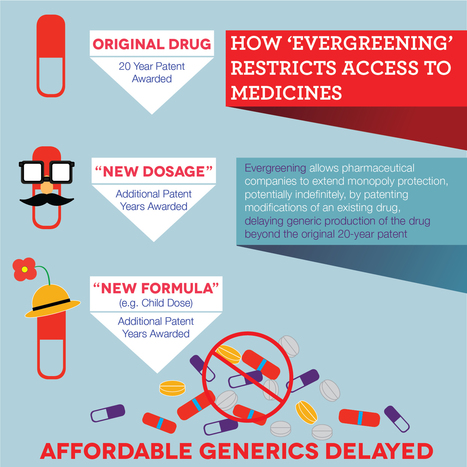
The Swiss pharmaceutical company Novartis heads to the Indian Supreme Court today in New Delhi, in a final bid to undermine a key public health safeguard in Indian patent law specifically designed to prevent drug companies from abusive patenting practices that keep medicine prices high, the international medical humanitarian organization Doctors Without Borders/Médecins Sans Frontières (MSF) said.
If successful, Novartis's move would have a devastating impact on access to essential medicines across the developing world, according to MSF, which relies on affordable generic drugs produced in India to carry out its work in 68 countries.
Novartis is challenging a part of India’s patent law—known as Section 3d—that says that a new form of a known medicine can only be patented if it shows significantly improved therapeutic efficacy over existing compounds. This is a provision to stop the common industry practice of extending, or "evergreening," patent monopolies for routine modifications of known compounds. Via nrip
|
Scoop.it!

In 2010 over 20 residents and attendings at NYU Langone Medical Center were given iPads for a study to examine these devices in a clinical setting.
Via Marie Ennis-O'Connor
Scoop.it!

New research out from Google, working with market analysts Ipsos and Sterling Brands, puts some hard numbers behind the often-noticed trend of how people in the U.S. Via Andrea Zeitz, Brian Yanish - MarketingHits.com
Scoop.it!

Abbott Nutrition recently revamped the Resident Learning Center (RLC.com), incorporating Gamification as the central redesign element.
Scoop.it!
Scoop.it!

Great Challenges...
Via Giovanna Marsico
Scoop.it!

This is an article about the future of digital marketing in pharma. (Will digital natives encourage pharma to embrace digital?
Via Olivier Delannoy
Scoop.it!

Thank you so much! @Healthgrades Great #Pinterest board!
Scoop.it!

This is an interview with Ed Bennett, University of Maryland Medical Center on social media use in hospitals (“There are lots of innovative techniques that hospitals are using…” http://t.co/A9QflnVm...
Scoop.it!

When science fiction films depict the future, the best writers and directors are often less concerned with accurately predicting how specific technologies might reshape the world than they are with confronting the moral or philosophical quandaries...
Via Giovanna Marsico
Scoop.it!

Le Leem réagit à la publication ce jour par Philippe Even et Bernard Debré d’un « Guide des 4 000 médicaments utiles, inutiles ou dangereux ».
Scoop.it!

Bernard Debré, député UMP de Paris, et Philippe Even, directeur de l'Institut Necker, auteurs en 2011 d'un rapport au vitriol dans l'affaire du Mediator, passent au crible 4.000 médicaments dans un livre choc dont le Nouvel Observateur, en kiosque jeudi, révèle les bonnes feuilles.
Le Guide des 4.000 médicaments utiles, inutiles ou dangereux est un livre d'information, pas d'opinion, assure le Pr Even dans une interview vidéo au Nouvel Observateur. Le livre recense ainsi, selon l'hebdomadaire, 50% de médicaments inutiles, 20% de mal tolérés, 5% de +potentiellement très dangereux+, mais, incroyable paradoxe, 75% sont remboursés. Le Pr Even s'en prend tout particulièrement aux statines, les médicaments contre le cholestérol, avalés par 3 à 5 millions de Français, qui coûtent à la France 2 milliards d'euros par an et qu'il juge complètement inutiles. Le Nouvel Observateur a mis par ailleurs en ligne la liste noire des médicaments dangereux, qui comprend des médicaments cardiovasculaires, des anti-inflammatoires, des pilules contraceptives, etc. L'industrie pharmaceutique (Leem) a dénoncé de son côté amalgames et approximations dans cet énième réquisitoire de Bernard Debré et Philippe Even. Via moune poli, EVELYNE PIERRON
Scoop.it!

|






