Via nathalie Bissot-Campos
|
|
Rescooped by
Lionel Reichardt / le Pharmageek
from e-santé,m-santé, santé 2.0, 3.0
November 8, 2012 12:51 AM
|
Une veille sur la santé numérique en France et à l’international : politiques publiques, données, infrastructures, IA, services et usages. Études, rapports et retours de terrain sélectionnés par Lionel Reichardt, Pharmageek, pour comprendre les transformations et éclairer les décisions.
Your new post is loading...
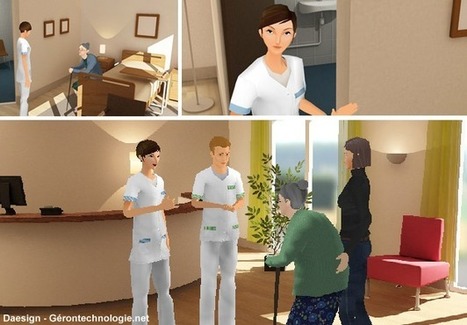
Le premier « serious game » infirmier, dédié à la transfusion sanguine, a été présenté mi-octobre au Pôle images Nord-Pas-de-Calais. Il inaugure une nouvelle voie pour la formation continue des soignantes.
Via nathalie Bissot-Campos No comment yet.
Sign up to comment
La ministre de la Santé Marisol Touraine a préconisé mardi soir un dossier médical personnel (DMP) de "nouvelle génération", choisissant une troisième voie entre la poursuite de ce coûteux projet dans les conditions actuelles et son abandon pur et simple."La difficulté à laquelle nous sommes clairement confrontés est que les professionnels de santé ne se sont pas appropriés ce dossier médical" a souligné la ministre devant la commission élargie (finances et affaires sociales) de l'Assemblée nationale. Selon la ministre il y a actuellement environ 210.000 dossiers numériques, (consultables sur internet par le patient et les médecins), qui ont créés dans 160 hôpitaux ou dans le cabinet de 4.000 médecins traitants.
Via Jean-François Gouhier, Agathe Quignot, Xavier Bouhet
Avec une demande provenant des patients, toujours plus d’outils orientés santé 2.0 voient le jour sur tablette, smartphone ou Internet. Une impulsion donnée à l’innovation qui reste souvent à attribuer aux startups. Via Isabelle Delignière-Léglise
Pendant des siècles, le seul traitement contre le cancer a été la chirurgie. Mais, depuis deux cents ans, d'autres moyens de lutter à la fois contre la maladie et la douleur ont été découverts. Retour sur ces années d’avancée contre le crabe.
Via catherine cerisey
Suffering from Psoriasis? Discover this comprehensive source of information on psoriasis - including treatment options and practical advice.
Infografía creada por innuo sobre el uso de Twitter en salud y las cuentas corporativas en Twitter de la industria farmacéutica española.
RT @TechurSelf 70 percent of Americans are self-trackers. Are you?
Déjà bien implantés aux Etats-Unis, les ad-exchanges commencent à faire parler d'eux dans l'Hexagone. Découvrez les principaux acteurs et leur écosystème.
Dominic Tyer writes:
Merck & Co has become the latest pharma company to bring gamification to its clinical research by tapping into online scientific research community Kaggle.
Merck launched the Merck Molecular Activity Challenge, with its $40,000 prize fund, in August to assist its drug development work by predicting molecular activity.
The competition was won by a team of three US academics, who beat 15 other teams to identify the best statistical technique for predicting biological activity of different molecules.
It was based on 15 molecular activity data sets, each for a biologically relevant target and each row corresponded to a molecule and contains descriptors derived from that molecule's chemical structure.
Sur le graphique ci-dessous, on peut voir que Google gagne une peu de terrain au premier trimestre 2012 bien qu’iOS reste loin devant. Via ELEPHANTBIRD-SOFTWARE |
Le Gartner estime que le nombre de tablettes achetées par les entreprises va plus que tripler d'ici 2016. A cette date, Windows 8 devrait être le troisième OS pour tablettes, derrière Apple iOS et Google Android.
Via imagescreations, dbtmobile
Gathering and transmitting vital information is a core function of the healthcare industry, and over the last decade the impact of new technology has completely transformed many procedures. What has emerged from this evolutionary process is the broad field of mHealth where everything from retrieval of patient records, to physician collaboration, to monitoring a patient’s medication compliance has changed. And, because the next generation of mobile devices are able to tap into this technological infrastructure, mHealth has emerged as the operative element in linking the power of electronically generated information with advanced health care solutions. Staying on the cutting edge of this information wave requires more agility and nimbleness than ever, challenging the many old-school marketing strategies that still dominate much of the industry. Via Sam Stern, Agathe Quignot
Pharma Testimonial Videos Overstate Efficacy More Often Than Other Ads: Mark Senak over at Eye On FDA Blog has a...
A new report says tablets have created a range of new opportunities for pharmaceutical companies as almost two-thirds of doctors and physicians in the U.S. are now using tablets (most of them iPads).
Via Nikos Papaioannou
These are excerpts from an interview with Shona Davies, MSD Sharp & Dohme GmbH, Univadis® Univadis® is an online resource providing medical news, educational content, point-of-care tools and services to health care professionals in 17 languages, free of charge. We have approximately 1.7M registered users in over 37 countries and we have sister brands in the US (Merck MedicusTM), South Korea (MDFaculty) and elsewhere. In the last 11 years, we have grown from being a small site called My Yahoo! for Physicians, to being a truly global force in online medical information and services and we aim to be the number 1 service in every market in which we operate within the next 5 years. To HCPs, the advantages are entirely in the value of the service that we provide them for no cost. We make it easy for HCPs to find the medical information, education and point-of-care tools that they need in their daily practice, all in one place and tailored to their own individual needs. We help them to expand their expertise and support their patients every single day. We save them the hassle of searching and verifying the quality of the information they find by bringing them unbiased content from world-leading medical publishers and providers that they trust. We save them time. For today’s busy HCP, that has an enormous value at a personal level.
POCKET.MD is The World's Most Comprehensive Directory of Mobile Applications Created by Pharmaceutical, Biotech, and Medical Device, and Life Science Companies -- for iPhone, iPad, Blackberry, WebOS, and Windows Mobile.
Via uri goren
Paper to Patient is a great way to pinpoint what matters most to you and your patients, quickly and easily.
Man MOT is funded by Pfizer and supported by Diabetes UK, Family Planning Association, HEART UK, Men's Health Forum, National Obesity Forum, Relate and Sexual Advice Association.
Technology transforms health care. Digital solutions are the future of medical landscapes. The pharmaceutical industry keeps pace with innovation and technology.
Top 15 drug patent losses for 2013 - FiercePharma: http://t.co/OY7qDd87...
Facebook is hiding your posts from 85% of your fans. Learn to develop a diversified online healthcare marketing plan.
Via Olivier Delannoy
The next stage of mobile management will less about devices and more of a move to application security. Speaking to SC Magazine, MobileIron CEO Bob Tinker said that the mobile control market is changing to enable users to choose and access email and applications in a secure way. He said that the first phase was how to enable device choice, from the perspective of an IT manager, and that is where mobile device management (MDM) came in. The next is now about how to enable mobile applications and content, establishing the content of 'mobile IT'. “This is about how to enable applications and the content inside, it is not just MDM, it is turning into a bigger market,” he said. “We believe in mobile application management; that is the next generation of mobile IT where access is to email and devices to enable application access and content. Applications that change a business to make your life easier. With mobile content, the biggest thing is access to applications and content.” Tinker said that he could see a big shake-up of the market as many vendors are entering the MDM market without the capability to offer secure access to applications. “Our technology is so dynamic that it is really about moving to the security of the application. To be successful in mobile you need to focus on mobile, as many are struggling to keep up,” he said. Alan Giles, managing director EMEA at Fiberlink, told SC Magazine that the concept of bring your own device (BYOD) doesn't have to be about providing for big business as small and medium enterprises are also opting into the policy. He said: “A 'containerised' approach will not work as it affects the user experience. If you take that away, the policy does not work so you want more of a lighter touch so the user can use the device as they want to but have secure access to corporate assets. However the IT manager needs to be safe in the knowledge that it is done securely. “Most vendors in the space are still growing, but we see more maturity in policy setting. Everyone knows that you can save money with BYOD and it is convenient, but companies are getting away from saving money as the driver to moving from it being a capital expenditure to an operational expenditure.” Asked if he felt that MDM was 'last year's technology', Giles said it was in terms of blocking and wiping, but a year ago application management took off for Fiberlink as it was about being security-centric. “Half of our business is application management so the corporate can decide what they allow from what is bought in-house and what is developed by a third party,” he said. “The distribution of apps is based on access right and need, and you can build a profile based on what goes where and how. On a personal device you cannot say 'you cannot use Angry Birds' but on a corporate device you can. You need to separate consumer from professional applications.” Analyst Alan Goode said that he had never been a fan of MDM, but felt that this was a maturing market as the wave of devices coming into the workplace continued. “We are getting reports of C-level executives and down wanting mobile management and wanting to use their own device,” he said. “We see instances with a sandbox for access to email and corporate applications in a silo and you authenticate into it, then the user experience is very poor. Do users like a client on their own device? Probably not. The market is maturing as it is another tool and a burden. We will see MAM coming more from vendors to improve the user interface to fix the inadequacies of MDM, and I think we will see that going into the platform. “Application management makes sense as it is understanding mobility and it will improve the development of applications in the lifecycle and how code is tested.” Via dbtmobile |
Your new post is loading...