Via Marie Ennis-O'Connor
|
|
Rescooped by
Lionel Reichardt / le Pharmageek
from Health Care Social Media And Digital Health
December 5, 2012 12:36 AM
|
Une veille sur la santé numérique en France et à l’international : politiques publiques, données, infrastructures, IA, services et usages. Études, rapports et retours de terrain sélectionnés par Lionel Reichardt, Pharmageek, pour comprendre les transformations et éclairer les décisions.
Your new post is loading...
Introductory presentation to health promotional professionals on the uses of social media for professional purposes by Carolyn Der Vartanian.
Via Marie Ennis-O'Connor No comment yet.
Sign up to comment
San Francisco-based AliveCor Inc.’s new iPhone electrocardiogram app has been approved by the FDA - now available for presale to medicla professionals (in the USA only!)...
This is a big hurdle, and has been somewhat controversial as to the definitions of medical apps. Pharma needs to integrate these step-change developments into its own R&D process, or risk being out-manouvered by the nimble.
Présentation faite lors de deux matinées organisées par Callimedia.
Article by Rosabeth Moss Kanter. Instead of being more money-generating machines, they combine financial and social logic to build enduring success. (Nov. 2011) Via Celine Schillinger
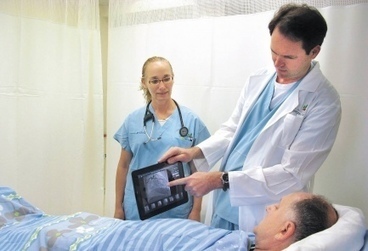
The next time your doctor says, "I have an app for that," try not to punch them in their stethoscope. Why? Because they just might be using AliveCor. Via Alex Butler
Psych Notes is a collection of resources for mental health professionals, Family Medicine and Emergency Department professionals, medical students, nurses …Συνεχίστε την ανάγνωση »... Via Nikos Papaioannou
Remboursement des dépenses de santé : les Français sont ...DoctissimoS'ils sont aujourd'hui globalement satisfaits du niveau de remboursement des frais de santé par la Sécurité sociale, les Français sont majoritairement pessimistes sur son évolution... Via Pharmacomptoir / Corinne Thuderoz
"Les résultats du dernier baromètre Ifop sur les réseaux sociaux 2012 Via FrancoisMagnan
Écoutez un extrait et téléchargez le podcast BFM Business : Check up santé sur iTunes. Lisez la description des épisodes et les avis d'autres utilisateurs.
The 23rd edition of the Festival Communication Santé dedicated to communication on health in France...
colloque Ethique dans les usages du numérique en santé (RT @Jcqslucas: Le verbatim et vidéos de la journée du CNOM consacrée à l'Ethique dans les usages du numérique en santé sont en ligne.)...
Typically mHealth relates to custom designed applications and systems such as telemedicine, telehealth, e-health and biomedical sensing systems trying to achieve the following. It is the use of mobile ...
Via Emmanuel Capitaine , dbtmobile |
|
|
|
Scooped by
Lionel Reichardt / le Pharmageek
December 4, 2012 10:44 AM
|
Hausse du coût de la rupture conventionnelle, d'un employé à domicile, du tabac, des prélèvements sociaux des indépendants et taxe sur les retraites.
|
|
Rescooped by
Lionel Reichardt / le Pharmageek
from healthcare technology
December 4, 2012 10:43 AM
|
When Ted Palen, a Kaiser Permanente researcher, started investigating what happens when doctors begin e-mailing with patients, he thought he would see the practice lighten workloads. Patients would get their questions answered remotely, with no need to turn up in person.
Palen just finished a five-year retrospective study of what happened when Kaiser Permanente in Colorado began allowing e-mail access to doctors in 2006. The outcome, as Palen notes in this week’s Journal of the American Medical Association, was “contrary to our expectations”: Online access to doctors was associated with more doctor visits, not fewer.
There was a big spike in visits and phone calls to doctors’ offices right when the new e-mail access, called MyHealthManager, came online. The graph displayed divides the Kaiser Permanente population into those who were using the online access program, and those who were not:
That initial spike did taper off with in a few months. Even a year later, however, those who utilized the online access to doctors still had higher rates of doctor visits per month
There are a few possible explanations of what is happening here. One that the researchers discuss is an issue of self-selection: Those who would sign up for the online health manager might be more inclined to take a greater role in managing their own health. “Members who are already more likely to use services may selectively sign up for online access and then use this technology to gain even more frequent access rather than view it as a substitute for contact with the health care system,” the researchers write.
|
|
Rescooped by
Lionel Reichardt / le Pharmageek
from i-Pharma Digital
December 4, 2012 7:23 AM
|
Pfizer UK has launched a new campaign that uses augmented reflection technology to raise awareness of generalised anxiety disorder (GAD).
The technology is based on a digitally enhanced mirror that blends the viewer’s actual reflection with additional pictures and graphics to create an immersive experience.
In Pfizer’s case, as the new Let’s Talk about GAD video shows, augmented reflection is used to convey what it is like to live with GAD symptoms.
|
|
Rescooped by
Lionel Reichardt / le Pharmageek
from #eHealthPromotion, #SaluteSocial
December 4, 2012 7:04 AM
|
|
|
Scooped by
Lionel Reichardt / le Pharmageek
December 4, 2012 7:01 AM
|
Une étude de l'agence Idaos sur l'impact des réseaux sociaux pour les entreprises et le marketing révèle qu'il reste des efforts à faire.
|
|
Rescooped by
Lionel Reichardt / le Pharmageek
from Innovations in Healthcare
December 4, 2012 6:55 AM
|
The future patient will be:
Committed to self management. The future patient is aware of the fact their personal health future is most likely to be conditioned by preventative strategies rather than treatment after the fact. The future patient is self-aware, and whilst they may not always abstain from actions that have health impacts, or engage in risky behaviours, they do so as a personal microchoice that they account for to themselves rather than expecting their decision to be ameliorated by external agencies. The future patient appreciates that informed choice trumps informed consent. The future patient will become who they are.
Health privileged. The future patient appreciates that whilst access to good healthcare should be a right, good health itself is a privilege and should be treated as such. The future health consumer aspires to maintain or attain good health in the same way that the historical retail consumer has aspired to the acquisition of commodities on the basis of their appreciation that health is the most precious possession of all.
Quantified. The future patient practices and advocates the collection and redistribution of the data that streams from their body among their healthcare team (and perhaps further, if they see a collective/personal benefit) not just to manage their day-to-day health or to optimise the management of chronic disease, but to inform the advancement of future health research through the processing of data on a planetary scale.
The future provider will be:
Fully participatory. The future provider’s default assumption is that the patient will participate fully in all decisions that are made about their health. The future provider will see it as a duty of care on their part to encourage the patient to self-identify as a shared decision maker, and a co-creator of their own care.
A committed innovator. The future provider will facilitate those expectations that the future patient brings to the point of care. They will provide access to health records. They will expect and encourage patients to research their own conditions. They will be looking to deploy proven innovations within the point of care as soon as their benefits have been proven. The future provider talks constantly about the ways in which facial recognition technologies could welcome patients to their practice, how non-invasive sensor technologies will revolutionise health, how artificial intelligence in the consulting room is an adjunct to their practice rather than an insult to their professionalism, how healthcare information should be prescribable, and dream along with their patients of the time when the personalised, genomic EHR is a reality.
Digitally integrated. The future provider continually seeks to refine and improve the reach of their professional digital presences to the communities they serve at a local level, and perhaps beyond. They endeavour to find ways of using digital technologies that improve the frequency and quality of professional connections with patients with a view to supporting health behaviours, improving compliance and working cooperatively towards better patient outcomes.
Two out of three future pharma requirements are primarily internal rather than external objectives. Future pharma will be:
Visible expertise. Future pharma will be the most open, available and discoverable source of gold standard information about their own products and the disease areas they work in. Future pharma works tirelessly to make all data about their medicines available in a balanced, approvable way in online environments and platforms that the communities of interest which they serve are most likely to find and use it. Future pharma’s default expectation is that it has an ethical responsibility to proactively and openly disseminate all information about its products from clinical trials onwards.
Socially evolved. Future pharma drives the precepts of social business through its enterprise and uses social technologies and the attitudinal dispositions that underpin them to the fullest. Future pharma fully appreciates that its future financial success is contingent upon rather than threatened by observing policies of openness wherever possible, and has reoriented its business away from the traditional conceptual frameworks within which its activities had formerly been configured.
Postmarketers. Future pharma has reconfigured the means whereby it talks about and shares information concerning its products and services to the point that they no longer resemble ‘marketing’ activity as it was formerly understood. Future pharma’s former dominant marketing behaviours and the contexts within which they were practiced have become residual. Future pharma now listens actively to patient and professional needs and responds quickly and openly. Future pharma’s goal state is to anticipate needs, not to directly influence behaviours. Future pharma appreciates that its further success will reside in sublimating everything other than its irrepressible desire to innovate and promote the science it practices.
|
|
Scooped by
Lionel Reichardt / le Pharmageek
December 4, 2012 1:44 AM
|
DEAUVILLE VENDREDI 30 NOVEMBRE et SAMEDI 1ER DECEMBRE 2012 TWEETS & PICS...
|
|
Scooped by
Lionel Reichardt / le Pharmageek
December 4, 2012 12:46 AM
|
Your new post is loading...