


Via EVELYNE PIERRON


Une veille sur la santé numérique en France et à l’international : politiques publiques, données, infrastructures, IA, services et usages. Études, rapports et retours de terrain sélectionnés par Lionel Reichardt, Pharmageek, pour comprendre les transformations et éclairer les décisions.
 Your new post is loading...
 Scoop.it! 
No comment yet.
Sign up to comment
Scoop.it!

We had a great attendance, fascinating presentations and a stimulating panel discussion at this month's Health2.0 Dublin meet -up at the Mont Clare Hotel. Our keynote speaker David Doherty, of 3GD... Via Marie Ennis-O'Connor

Dean Berg's comment,
February 10, 2013 6:45 AM
No problem, Marie. It looks like you are doing a great job!
Scoop.it!

A company that makes a digital medication adherence platform for pharmaceutical companies and health plans is on the verge of hitting big milestones. Via Heather Swift, Thierry Geufroi

Heather Swift's curator insight,
February 2, 2013 12:46 PM
Digital health CEO: One challenge in selling to Big Pharma is “Who else is doing it?”
There's getting patients to take their medications, and then there's convincing big pharmaceutical companies that they should invest in innovative ways to try to get patients to take their medications. The latter, apparently, is more complicated than it sounds. That's one thing I gleaned from a conversation with Tom Kottler,
Scoop.it!

By: Michael Esquivel The question of whether or not smartphone apps can play an important role in the delivery of healthcare services has been more or less answered with a resounding yes. Via Philippe Marchal, Pharmacomptoir / Corinne Thuderoz, Dan Baxter
Scoop.it!

Those of you who regularly follow this blog know that I am big supporter of the biopharmaceutical industry. I spent 30 years in Pfizer’s R&D organization and have since spent time working with a variety of biotech companies. Via Richard Meyer
Scoop.it!

games and health (How games improve health infographic http://t.co/hUpwwOoa via @pinterest #mhealth #digitalhealth #healthit #ehealth) Via rob halkes
Scoop.it!

France Info
Scoop.it!

Me gusto este articulo de E-Health (E-Health Reporter | Bill Gates Says that mHealth’s Time Has Come http://t.co/T54aiBr4)
Scoop.it!

Scoop.it!
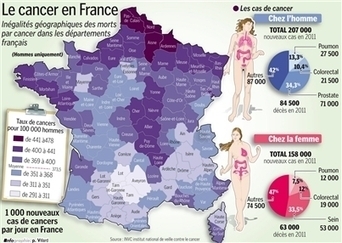
Le prochain plan cancer sera axé sur une prévention ciblée pour lutter contre les inégalités sociales, géographiques et génétiques qui ne cessent de s’aggraver en France face à la...
|
Scoop.it!
La première chambre civile de la Cour de cassation a rendu un arrêt le 16 janvier dernier rappelant que "toute personne a droit d'être informée sur son état de santé" et que cette information "incombe à tout professionnel de santé dans le cadre de... Via Mélanie Toussaint
Scoop.it!

A l'occasion du congrès de Tel Aviv sur les innovations en matière cardio-vasculaire, une start-up israélienne a présenté une application pour smartphone permettant de contrôler les principaux paramètres biologiques et notamment le poids, la... Via Chanfimao

Agathe Quignot's curator insight,
February 7, 2013 2:03 PM
SantéConnectée.fr (www.santeconnectee.fr) est la 1ère boutique française entièrement dédiée à la Santé Connectée et intelligente...
Scoop.it!


Matmi's curator insight,
February 6, 2013 6:17 AM
I find it shocking that in today's mobile optimized world that only 16% of marketeers have a mobile strategy. Having a mobile strategy is absolutely vital for a brand, why wouldn't you want your brand on a device in billions of peoples pockets all around the world? Get in touch to see what Matmi can do for your brand - HK
Scoop.it!

The Food and Drug Administration (FDA) might be changing to become “more business-friendly” in how it regulates mobile health, according to an article in the Wall Street Journal.
The article features interviews with participants at the Personalized Medicine World Conference.
The FDA is one of three bodies with a hand in regulating wireless health in the US, along with the Federal Trade Commission and Federal Communications Commission.
Some executives in wireless health gripe about the level of regulation they face and claim it will inhibit the market’s growth. The FDA issued draft guidelines about regulating mobile apps back in July 2011, one of the proposals that have attracted criticism.
However, Mavis Yee, a partner at a Silicon Valley law firm called Nixon Peabody, says the agency “has little to no interest in regulating the vast majority of the 40,000 or more mobile-health applications” that are available today.
The agency only wants to regulate companies “building wireless accessories for existing medical devices, as well as those that turn a phone or tablet into a clinical medical device”, said Yee.
Scoop.it!

Use of social media in healthcare industry has proved to be an effective strategy for many companies (RT @laumacom: Santé, le virage 2.0 http://t.co/epULFTFY #hcsmeufr)...
Scoop.it!

Many drug companies are ahead of the social media curve. But a closer
Scoop.it!

To start our patients focus month, pharmaphorum speaks with Zoe Barker speaks on how supporting patients can increase medication adherence. Via Emmanuel Capitaine
Scoop.it!
Médicaments : pourquoi l'accès aux données ne suffit-il pas ?
Scoop.it!

The application of gamification for patient health may have implications in the future. However, how can this be applied and with what objectives?
Gamification as an incentive for health may be a great feature to be studied and prudently applied in the future. This may be beneficial for increasing medication adherence, or serve as an incentive for diet and exercise. Ideally, future research should center on what factors increase patient utilization of an app and analyze objective outcomes that would be pertinent for patient healthcare. I would love to hear others thoughts on where gamification can be expanded and what possible challenges we may encounter.
Via nrip
Scoop.it!

ParkerWhite's curator insight,
February 4, 2013 8:13 PM
The greatest risk for health, medical and pharma social media is not joining and engaging with patients. |






