

|
Rescooped by
Lionel Reichardt / le Pharmageek
from La pharma dans tous ses états
February 12, 2013 4:04 AM
|


No comment yet.
Sign up to comment


Une veille sur la santé numérique en France et à l’international : politiques publiques, données, infrastructures, IA, services et usages. Études, rapports et retours de terrain sélectionnés par Lionel Reichardt, Pharmageek, pour comprendre les transformations et éclairer les décisions.
 Your new post is loading...
 Scoop.it! No comment yet.
Sign up to comment
Scoop.it!

The first mobile health device invented in 1975 is credited to the work of Gregory Lektman at Biosig Instruments. He collaborated with several companies included Polar Electro of Finland, which in 1977 introduced the first commercial wireless heart rate monitor. Healthy people - running and cycling enthusiasts - were able to train and perform better knowing more about their personal and physiological performance. The infection spread and Finland may well be the birthplace of today’s mobile health industry.
As more and more companies introduced heart rate monitors, the technology behind the product was fueled by a parallel technology progression across numerous industries. Boundaries disappeared and sensors became more available, sophisticated, smaller, implantable, injectable, and even tattoo-able. The integration between smartphones and sensors has sprung to life moving medicine, fitness, wellness, and human productivity to new levels, possibly as one industry.
Kevin Kelly and Gary Wolf collaborated in 2007 with users and tool makers who shared a common interest in self-knowledge through self-tracking. This was the start of the Quantified Self Movement. Mobile health took a quantum leap forward and Quantified Self lead to Participatory Health, Health at Home and Hospital at Home. In essence the ability to deliver care anywhere. Do you remember doctors making house calls? Well, this medical practice has returned because mobile technology has eliminated the physical and time barriers between the patient’s home and the hospital. And, mobile health incubators growing new mobile health companies are further enabling the collaboration and communication between doctor and patient that is further fueling the new consumer-centric healthcare ecosystem.
The 45th International Consumer Electronics Show took place this past January in Las Vegas. Over 175 companies exhibited their mobile healthcare products, most of which were not traditional healthcare companies. The rapid consumer and physician adoption of mobile health devices is real and potentially considered the future of healthcare. But the device is only part of the solution. The data is proving to be more important, and the experience of wearing a device a key driver. Doctors and patients alike are adopting and craving the next best medical or health gadget or app.

Pascal GIGOT's curator insight,
April 9, 2013 3:59 AM
Et la sécurité des données ? C'est le coeur de la problématique...
Scoop.it!

Joseph Jimenez had previously worked in consumer goods. He discusses how he's attempting to change the company in a Q&A with the Wall Street Journal. Some of it's your standard material about writing fewer power points and spending more time with customers, but he also gives an interesting example of how the industry can and must change in an age of budget crises: I also started to shift our business away from a transactional model that was focused on physically selling the drugs to delivering an outcome-based approach to add value beyond just the pill. I really believe that in the future, companies like Novartis are going to be paid on patient outcomes as opposed to selling the pill.
Scoop.it!

Les Laboratoires Expanscience investissent en ce début d'année les médias sociaux pour échanger autour de l'arthrose. Présentation. Au travers de différents médias sociaux, les Laboratoires Expansc... Via Rémy TESTON
Scoop.it!
Scoop.it!

If you’ve ever dieted, you know how frustrating it can be to discover you haven’t lost any weight after a week of counting calories. Sure, you can always blame a poorly calibrated scale. Via Emmanuel Capitaine
Scoop.it!

Using social media as a channel for engagement raises interesting challenges for any traditional Relationship Marketer.
Scoop.it!

Près d’un demi milliard de smartphones ne se connecteront pas à Internet, et ils seront 21% du marché français dans ce cas. Les raisons sont nombreuses, technologiques et humaines.
Scoop.it!

C\'est un système géré par l\'agence anglaise (MHRA) permettant de collecter les suspicions d\'effets indésirables rapportés par les professionnels de santé et les consommateurs. Via EVELYNE PIERRON, Thierry Geufroi
Scoop.it!

catherine cerisey's curator insight,
February 12, 2013 9:13 AM
Après de longs mois d’attente, la stratégie nationale de santé annoncée par le Premier ministre dans son discours de politique générale en juillet 2012 semble se dessiner. On comprend qu’elle sera centrée sur une approche rénovée du parcours de soins des patients aujourd’hui exposés à l’absence de coordination entre les acteurs d’un système de santé éclaté, pensé pour les cas aigus, alors que nous vivons au temps des maladies chroniques. Nous savons tous que ces prises en charge rénovées ne seront possibles que si la fongibilité des enveloppes de financement est au rendez-vous. Cela semble enfin à l’ordre du jour.
Pour autant, si rien n’est fait pour renforcer la participation des citoyens aux décisions de santé qui les concernent, nous aurons une réforme tout aussi technique que les précédentes. Il ne s’agit donc pas de promettre un parcours de soins mieux adapté aux attentes des patients et de leurs proches s’il reste toujours aussi illisible dans ses modalités ou dans sa tarification. Il ne s’agit donc pas non plus de continuer à tenir à l’écart des décisions les associations dont se sont dotés les usagers.....
Scoop.it!

Digital marketing channels have been viewed as better than traditional media for their measurability, but new research from Econsultancy and Responsys [download page] Via Gilles Jourquin
|
Scoop.it!

When does adoption of health info technology by physician practices lead to use by physicians w/i the practice? http://t.co/imBV7Af0 Via Kirrina
Scoop.it!

What can the retail sector teach us about mobile behaviour? Learn how to leverage mobile to increase patient adherence and revenues in 2013 for the Pharma sector. Via Parag Vora, Philippe Marchal
Scoop.it!
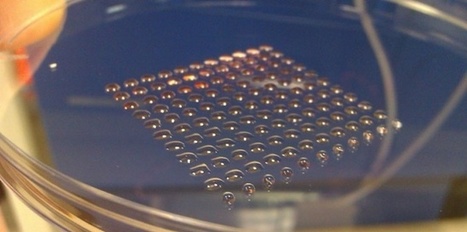
C’est un procédé encore expérimental mais en remplaçant l’encre par des cellules souches, il sera bientôt possible de fabriquer des organes neufs de remplacement limitant ainsi le recours au don d’organes. Via Hi_Camille_
Scoop.it!

Welch Allyn’s iExaminer is the next step in ophthalmoscopes for your practice. Via Guus van den Brekel, Pharmacomptoir / Corinne Thuderoz
Scoop.it!

As you might imagine because of visibility, the internet and social media outlets in particular, are another enormous area for potential regulation. Via Dean Berg
Scoop.it!

Thank you to Beth Bengtson for contributing this post. Via Ricard Robledo
Scoop.it!

Mobile healthcare and the super physician infographic visualization created by ZoomRx explores the rise of mobile healthcare in the clinical setting. Via Pharmacomptoir / Corinne Thuderoz
Scoop.it!

How well do you know your physicians? Venkat Gullapalli, MD shares his insights on physician profiles, why they‘re important, and how to create your own. Via Anneliz Hannan
Scoop.it!

MyFanGroup vient de publier une infographie présentant les chiffres du secteur mobile et de ses acteurs.
Scoop.it!

Deloitte publie son étude mondiale des prédictions 2013 pour le secteur des Technologies, Médias et Télécommunications (TMT). Via Isabelle Clément, Pierre Wouters, Pharmacomptoir / Corinne Thuderoz
|






