


Le président de l’Union française pour la médecine libre tire la sonnette d’alarme face à un décret qui, selon lui, pourrait signer la fin du secret médical.
Via Navaho


Une veille sur la santé numérique en France et à l’international : politiques publiques, données, infrastructures, IA, services et usages. Études, rapports et retours de terrain sélectionnés par Lionel Reichardt, Pharmageek, pour comprendre les transformations et éclairer les décisions.
 Your new post is loading...
 Scoop.it! Le président de l’Union française pour la médecine libre tire la sonnette d’alarme face à un décret qui, selon lui, pourrait signer la fin du secret médical. Via Navaho 
No comment yet.
Sign up to comment
Scoop.it!
Scoop.it!

The iPad vs. the Surface Pro. iOS vs. Windows 8. Apple vs. Microsoft. Have these two tech heavyweights elicited an internal debate within pharma companies over which device is better for their sales teams or is the choice a foregone conclusion? After all, pharma has already heavily adopted the iPad and they are not alone. According to preliminary data from the International Data Corporation (IDC) Worldwide Quarterly Tablet Tracker, worldwide tablet shipments have increased 142.4% year over year in the first quarter of 2013 with Apple capturing 39.6% of the market share of tablet operating systems compared to Microsoft’s 3.3%—however Android comes out on top with 56.5%. Of course, Microsoft has only recently ramped up its presence in this market with its release of the Surface RT and Surface Pro in the beginning of this year and we wouldn’t be having this discussion if pharma didn’t have some reservations over the iPad. Via Philippe Loizon, Bart Collet, Philippe Marchal
Scoop.it!

TechCrunch is a leading technology media property, dedicated to obsessively profiling startups, reviewing new Internet products, and breaking tech news. Via Alex Butler, David Dellamonica
Scoop.it!

From artificial intelligence to natural language to processing to MEMS, here are some technologies that will change the future of healthcare. Via Philippe Loizon, eMedToday
Scoop.it!

Le rythme de l’innovation dans la santé numérique s’est accéléré au cours de 6 derniers mois. Des technologies axées sur les consommateurs sont particulièrement prisées par les investisseurs. Via L'Atelier, Pharmacomptoir / Corinne Thuderoz
Scoop.it!

With Congress gearing up for yet another healthcare battle, how the U.S. system compares to those of other countries bears further consideration. This infographic from GW Public Health took informa... Via Nikos Papaioannou
Scoop.it!

Alors que le marché chinois s’apprête à connaître une forte croissance des wearable devices, les consommateurs chinois devraient principalement se tourner vers des fonctionalités et expériences relatives à la santé. Via Cluster #IoT - CITC, dbtmobile
Scoop.it!

In our conversation with Eula McKinney today, she talks with Lonnie Hirsch about: - how traditional hospital and service line marketing is shifting. - how traditional hospital and service line marketing is shifting. “The hospital marketing strategy now needs to take into account preventative, acute care and post acute organizations, because as an industry, we are now responsible for the full continuum of clinical care,”
Via ET Russell

ET Russell's curator insight,
August 25, 2013 3:10 AM
Food for thought: How can we change patients away from a transactional encounter to a relationship-based patient so they can contribute to their own healthcare?
Increasing patient participation through online information, accessibility via mobiles, apps, email/sms reminders, phone apps with Gamification which rewards patient...
Scoop.it!

Unfortunately for everyone doing keyword research, Google is taking down their Adwords Keyword Tool, which many of us have been using and loving for quite a while. It’s unclear exactly when this is happening, but as of this writing it will be “in the coming months.
Arguably one of the biggest downfalls of losing Google Adwords’ Keyword Tool is that the tool is currently the best available free tool for keyword research out there. We’ll have to mourn the loss momentarily but our keyword research must continue!
Thankfully, there are more fish in the sea. Keep reading and I’ll show you some viable free alternatives to our beloved Google Adwords Keyword Tool, along with pros and cons of each. Via Alex Butler
Scoop.it!

MedSnap ID veut aider les patients à identifier les pilules qu’ils doivent prendre pour identifier les bons médicaments à utiliser. Via Esposito Christelle
Scoop.it!
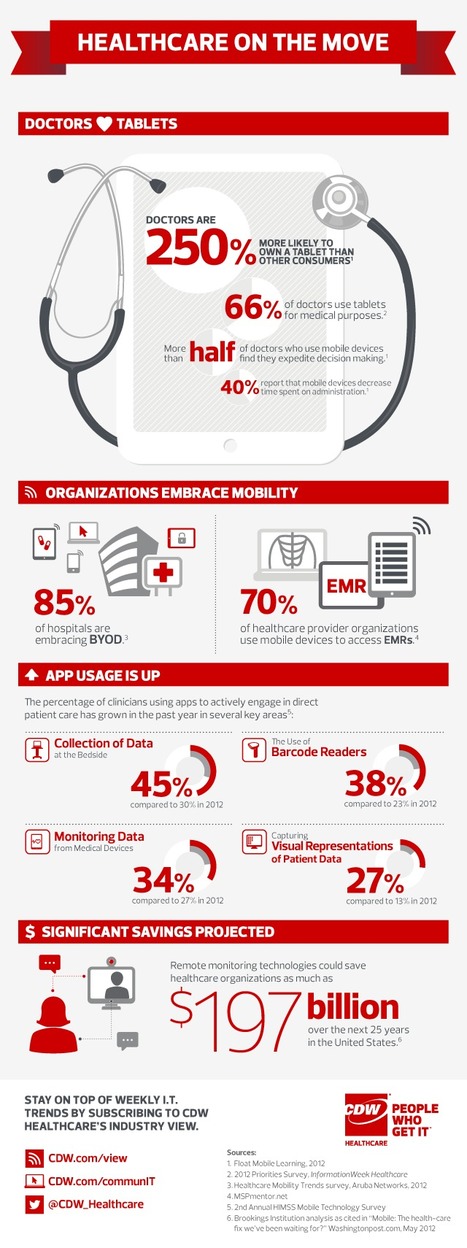
There are still some doubters who are skeptical of new shifts in healthcare such as the quantified self movement and mhealth. This infographic from CDW Healthcare using data from multiple sources should help to silence them. Via Richard Meyer
Scoop.it!

Searches for android medical recently surpassed searches for iPhone medical according to Google Trends analysis. The Apple iPhone started as the first dominant smartphone, but Android operating system smartphones are now growing in number and claiming an increasingly large share of the market. This Google Trends analysis below shows the relatively recent emergence of Android medical as an equal if not leading medical device in Google search. The take home message for app developers is to not ignore the Android operating system when planning and producing medical apps. Search interest in iPhone and iPad medical still remains high. Google Trends is a promising tool for continued monitoring of trends and geographic regional patterns in medical app device interest. The screen shot for the first comparison is shown below with iPhone medical plotted in blue and Android medical plotted in red. Several noteworthy findings can be seen in this comparison. First, iPhone medical clearly emerges as the earliest device with a nearly two year period before Android medical. Second, the iPhone medical keyword search peaked in early 2012. It is trending downward since that time. Third, Google Trends shows Android medical search terms recently equaling and then surpassing iPhone medical searches. In the second screen shot, the Google Trends forecast function shows expected trends in searches for the next few months. The forecast lines for the next six months show a trend for increasing Android medical searches with a stagnant trend for iPhone medical searches. In the third screen shot, Windows medical search finally appears on the radar in 2013, over four years after iPhone medical. The number of searches is relatively small in comparison to both iPhone and Android medical searches. Like the iPhone, the iPad emerged as the early leader in tablets. In the final screen shot, iPad medical searches in 2010 shows a significant upward trend through 2011-2012. There appears, however, to be a decrease in iPad medical searches over the last year. Interestingly, the regional distribution of trends by devices shows a predominance of iPhone medical search interest in the United States, Australia, Canada and the United Kingdom. In contrast, the highest regional trend for Android medical search comes from Pakistan, the Philippines and India. Via nrip
|
Scoop.it!
OMSignal a conçu un t-shirt intelligent capable de mesurer de nombreuses données (pouls, respiration etc...) (Un t-shirt intelligent bientôt utile pour la télémédecine ? Via Emmanuel Capitaine
Scoop.it!

A surgeon at The Ohio State University Wexner Medical Center is the first in the United States to consult with a distant colleague using live, point-of-view video from the operating room via Google Glass, a head-mounted computer and camera device. “It’s a privilege to be a part of this project as we explore how this exciting new technology might be incorporated into the everyday care of our patients,” said Dr. Christopher Kaeding, the physician who performed the surgery and director of sports medicine at Ohio State. “To be honest, once we got into the surgery, I often forgot the device was there. It just seemed very intuitive and fit seamlessly.” Google Glass has a frame similar to traditional glasses, but instead of lenses, there is a small glass block that sits above the right eye. On that glass is a computer screen that, with a simple voice command, allows users to pull up information as they would on any other computer. Attached to the front of the device is a camera that offers a point-of-view image and the ability to take both photos and videos while the device is worn. During this procedure at the medical center’s University East facility, Kaeding wore the device as he performed ACL surgery on Paula Kobalka, 47, from Westerville, Ohio, who hurt her knee playing softball. As he performed her operation at a facility on the east side of Columbus, Google Glass showed his vantage point via the internet to audiences miles away. Across town, one of Kaeding’s Ohio State colleagues, Dr. Robert Magnussen, watched the surgery his office, while on the main campus, several students at The Ohio State University College of Medicine watched on their laptops. “To have the opportunity to be a medical student and share in this technology is really exciting,” said Ryan Blackwell, a second-year medical student who watched the surgery remotely. “This could have huge implications, not only from the medical education perspective, but because a doctor can use this technology remotely, it could spread patient care all over the world in places that we don’t have it already.” “As an academic medical center, we’re very excited about the opportunities this device could provide for education,” said Dr. Clay Marsh, chief innovation officer at The Ohio State University Wexner Medical Center. “But beyond, that, it could be a game-changer for the doctor during the surgery itself.” Experts have theorized that during surgery doctors could use voice commands to instantly call up x-ray or MRI images of their patient, pathology reports or reference materials. They could collaborate live and face-to-face with colleagues via the internet, anywhere in the world. “It puts you right there, real time,” said Marsh, who is also the executive director of the Center for Personalized Health Care at Ohio State. “Not only might you be able to call up any kind of information you need or to get the help you need, but it’s the ability to do it immediately that’s so exciting,” he said. “Now, we just have to start using it. Like many technologies, it needs to be evaluated in different situations to find out where the greatest value is and how it can impact the lives of our patients in a positive way.” Only 1,000 people in the United States have been chosen to test Google Glass as part of Google’s Explorer Program. Dr. Ismail Nabeel, an assistant professor of general internal medicine at Ohio State applied and was chosen. He then partnered with Kaeding to perform this groundbreaking surgery and to help test technology that could change the way we see medicine in the future. Via Dr. Stefan Gruenwald
Scoop.it!

With the proliferation of smartphones and tablets, mobile technologies are quickly being adopted as a means to alleviate certain physician pain points and strengthen patient self-management. The recently released Meaningful Use Stage 2 objectives hold a larger focus on patient engagement, and mobile health holds promise as a key tool in helping organizations address these requirements. In fact, many of the engagement objectives that were optional in Stage 1 – such as patient reminders and education resources – are now required in Stage 2. Additionally, many of the Stage 2 rules reference the delivery of results directly to patients.
Via ET Russell
Scoop.it!
http://StoryofDigitalHealth.com This is an animated video definition of digital health that includes the underlying lexicon we've all become so familiar with... Via L'Université d'été de la e-santé
Scoop.it!

mHealth presents a major opportunity for the pharmaceutical industry, but mobile is not about being remote, it’s about being connected and to progress, pharma needs to be better connected with the mobile industry itself. mHealth is currently being billed as the magic pill that will transform the provision of healthcare services on a global scale. Described in the US as 'the biggest technology breakthrough of our time', advocates claim that mobile technology can help engage patients, improve compliance, support preventative care models and lower healthcare costs by reducing avoidable hospital admissions. But commentators fear that, in an evolving marketplace with few proven business models, mHealth could yet represent more 'technology-led hype' and expensively fail to deliver its promise. The pharmaceutical industry could therefore be forgiven for being characteristically cautious about the 'next big thing'. But that's not quite the case. The industry is trying hard to harness the potential of mobile technology. But is it doing enough?
Scoop.it!

Samsung will launch its smart watch, Galaxy Gear, on September 4, ahead of IFA consumer electronics fair in Berlin, Germany. Via Olivier Janin
Scoop.it!

Douze experts internationaux, lanceurs d'alerte et journalistes de référence démontrent comment l'industrie pharmaceutique détourne l'usage des médicaments. Via EVELYNE PIERRON
Scoop.it!

Pedometer-Based Internet-Mediated Intervention For Adults With Chronic Low Back Pain: Randomized Controlled Trial (RT @mHealthAlliance: Pedometer-based Internet-mediated intervention for adults w/ chronic low back pain Via Gilles Jourquin
Scoop.it!

L'Institut Novamétrie a réalisé un baromètre des réseaux sociaux dans l'industrie pharmaceutique afin d'évaluer la place du web social dans les stratégies de communication des laboratoires. Les chi... Via Isabelle Delignière-Léglise
Scoop.it!

Mobile health startup 2morrow has collaborated with a nonprofit foundation to develop a behavior change app to improve medication adherence among patients with bone marrow failure disorders, a set of rare diseases. Via Agathe Quignot

kenza's curator insight,
August 24, 2013 7:44 AM
App available on : http://aamds.org/press-release/aamdsif-creates-free-treatment-tracker-app ;
Scoop.it!

A German doctor surgeon has leveraged the power of Apple's iPad and an accompanying augmented reality app to assist him in the completion of a surgery, marking one of the first times a procedure has been performed in such a manner. Via Alex Butler
Scoop.it!

Calculer sa glycémie chaque jour n'est pas toujours une partie de plaisir pour les diabétiques. MySugr Companion, une application mobile ludique transforme la corvée des patients en jeu amusant. Via Pharmacomptoir / Corinne Thuderoz
|






