


Via Delphine Eriau


Une veille sur la santé numérique en France et à l’international : politiques publiques, données, infrastructures, IA, services et usages. Études, rapports et retours de terrain sélectionnés par Lionel Reichardt, Pharmageek, pour comprendre les transformations et éclairer les décisions.
 Your new post is loading...
 Scoop.it! 
Scoop.it!

Je sais que mes petits camarades du Club Digital Santé s’attendent à ce que je fasse une tribune sur Health 2.0 Europe qui a eu lieu la semaine dernière à Londres et auquel j’ai eu le plaisir d’ass...
Scoop.it!

Un site dédié permettra bientôt aux patients britanniques de poster leurs commentaires sur les soins reçus dans les structures sanitaires du pays. Via EVELYNE PIERRON
Scoop.it!

A la croisée du secteur des jeux, de la simulation 3D, des tutoriels et des outils de communication, les serious games se sont réellement développés en France à partir de 2009 dans un marché qui pesait fin 2011, 47 millions d’euros, selon l’Idate. Vincent Leclercq, directeur de Pictanovo, organisme chargé du soutien au cinéma en région Nord-Pas de Calais, décrit les pré-requis pour créer un bon serious game: « le jeu doit être un vrai jeu, avec des règles, un objectif, un contexte, ainsi qu’une histoire, une mesure de performance et une ergonomie adaptée. » Via France Silver Eco, Ilan Hirsch
Scoop.it!

Steve Blank hosts an excellent review of the revenue sources for diagnostics, devices, therapeutics, and digital health and the challenges facing each group.
Do not forget to check also these!: - https://vimeo.com/groups/213077 - http://steveblank.com/category/life-sciences/ Via ehealthgr, Bart Collet
Scoop.it!
The medical technology industry was for several decades at the forefront of innovation, but it now needs to re-assess itself and find new ways to innovate in the new healthcare environment. Via Herve Ansanay
Scoop.it!

The good news is that pharma companies are planning to invest more money into digital marketing, the bad news is that pharma is planning to invest more money into digital marketing. With most phar... Via eMedToday

eMedToday's comment,
April 19, 2013 6:56 AM
The author suggest rather than write checks for more digital marketing, pharma’s need to recruit and hire digital marketing talent.
Scoop.it!

The Digitally Sick team discuss the question: Does pharma need an injection of external talent to speed up the adoption of digital technologies and sharpen their digital strategy?
The pod chats with guest Alex Clarke from Sanofi about what this talent would be, what they would do and how this would improve pharma digital.
We also discuss the pharma agency landscape and ask if this needs a reboot. Via Alex Butler
Scoop.it!

L'industrie pharmaceutique, élément essentiel de l'écosystème de soin, subit et crée la digitalisation des outils médicaux. Via Alexandre DUBOIS
Scoop.it!

Mobile medical apps need to be regulated because patient safety is at risk when they are used to diagnose or treat a disease, said Jeffrey Shuren, director of the Food and Drug Administration's Center for Devices and Radiological Health at a Nov. 19 House Energy and Commerce Committee subcommittee on health hearing. The FDA's regulation of software as a medical device is based on risk and function, Shuren told the panel, and the FDA treats devices that perform the same function the same way regardless of the platform on which it is used. "It's not about the platform. It's about the function," said Shuren. Software becomes a medical device through intended use and diagnosis of disease and conditions or treatment cure mitigation of disease, he said. "All we are saying is, the functions, when they stay the same, treat them the same, because the impact and the risk to patients is the same," Shuren said. "Simply because they got smaller and I can pick it up and walk out of the room with it, doesn't change the risk to the patients. Why for that reason alone would we treat it differently?" The FDA issued nonbinding guidance Sept. 25 with their plan of how to regulate mobile apps as medical devices. If, for instance, an app illuminates an LED light, like prevalent flashlight apps do, the FDA wouldn't consider it a medical device. But if the developer labels and markets it as a light source for doctors to examine patients, the FDA would approach it as it would an ophthalmoscope, the guidance says. But the FDA might not need that guidance if Congress passes a bill that's currently sitting in the House Energy and Commerce Committee. The bill (H.R.3303) would amend the Food, Drug and Cosmetic Act to regulate medical software. It would establish three categories of software--clinical, health and medical--with the two former software types not subject to FDA regulation. But Shuren told the subcommittee that the bill undermines the FDA's authority to assure the safety and effectiveness of high risk medical devices. The FDA would no longer be able to regulate blood glucose meters and software that is used to analyze pap smear slides, Shuren said. "It's very confusing to us what this actually accomplishes," he said. Via Parag Vora

Avraham Harris's curator insight,
June 29, 2014 7:43 AM
Medical Apps - FDA's standpoint overkill - or proposed bill is risky? If you ask me, probably the latter. Health apps are fun, easy to make, distribute and can effect misuse if risk controls and information for safety are not required. Can't they? What do you think? Avraham
Scoop.it!

Fortune 500 companies and global agencies face a serious digital marketing skills shortage, according to the State of Digital Marketing Talent report.
eMedToday's curator insight,
November 29, 2013 10:20 PM
one reason Pharma do not address e detailing is lack of digital talent |
Scoop.it!

In the fourth and final article from COUCH., Ash Rishi discusses the issues pharma companies face when it comes to patient adherence. Ash shares his thoughts on how pharma marketers can improve adherence through better understanding of patient... Via COUCH Medcomms
Scoop.it!
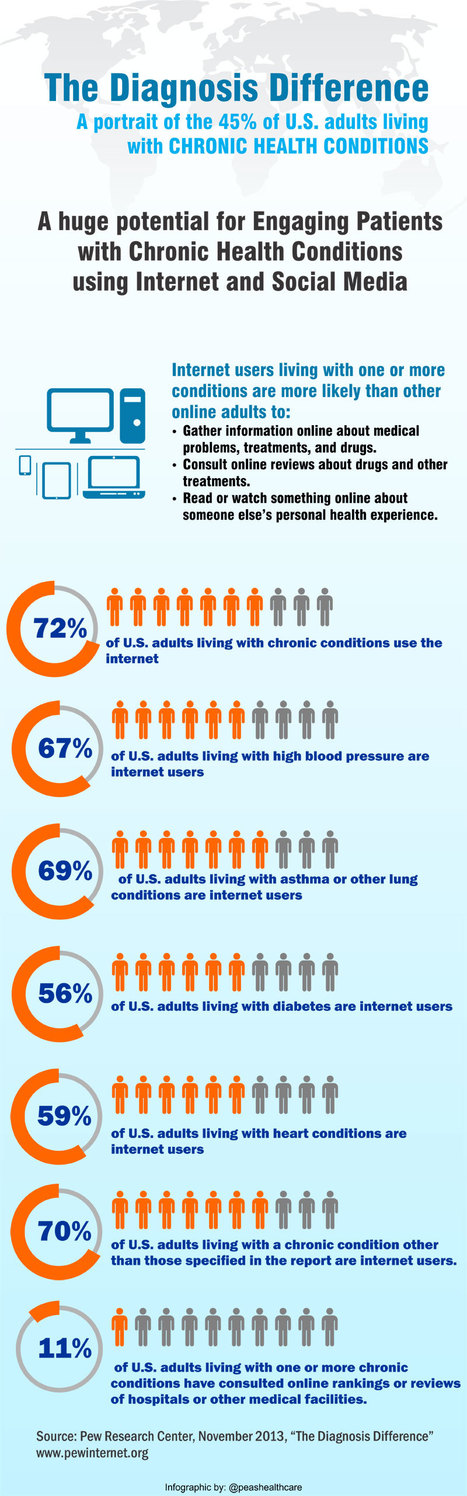
45% of U.S. adults live with chronic disease Living with a chronic disease has an independent effect on people’s technology adoption and health behavior 72% of U.S. adults living with chronic conditions use the internet 7 in 10 track weight, diet, exercise routine, or symptoms The findings of this report presents a great opportunity of engaging patients with chronic conditions using internet and social media Via Parag Vora, Giovanna Marsico, catherine cerisey, dbtmobile, Isabelle Delignière-Léglise
Scoop.it!
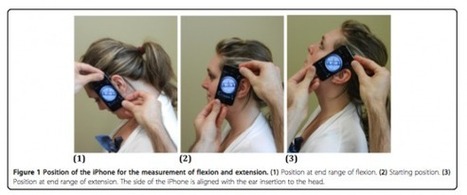
Introduction: Recent smartphones, such as the iPhone, are often equipped with an accelerometer and magnetometer that, through software applications, can perform various inclinometric functions. Although many of these applications are intended for recreational use, they have the potential to measure and quantify range of motion.
Objective: The purpose of this study was to estimate the intra and inter-rater reliability as well as the criterion validity of the clinometer and compass applications of the iPhone in the assessment of the cervical range of motion in healthy participants.
Study Conclusion: When compared to the gold standard (CROM), the iPhone applications showed moderate to good validity as an assessment tool. There was also good intra-rater reliability and but lower inter-rater reliability.
Commentary: The ability to carry an accurate mobile gyroscope and accelerometer in a mobile device has implications for a range of specialties including orthopedics & physiatry. This study agrees with a number of other studies that show mobile devices can be relatively accurate when compared to existing measuring standards. Future work in the field of cervical range of motion should focus on measurements in pathological scenarios.
Methods: The sample consisted of 28 healthy participants (9 men and 19 women) aged from 19 to 43 years old (mean ± SD: 23 ± 6)Two examiners measured cervical range of motion of each participant twice using the iPhone (for the estimation of intra and inter-reliability) and once with the CROM (for the estimation of criterion validity).An iPhone 3GS and an iPhone 4 were used for the study.The application used to measure the cervical ROM in frontal and sagittal planes is Clinometer. The application used to measure the cervical ROM in horizontal plane is Compass, software already integrated in the iPhone.Estimates of reliability and validity were then established using the intraclass correlation coefficient (ICC).
Results: There was moderate intra-rater reliability for each movement (ICC = 0.65-0.85) but a poor inter-rater reliability (ICC < 0.60).For the criterion validity, the ICCs are moderate (>0.50) to good (>0.65) for movements of flexion, extension, lateral flexions and right rotation, but poor (<0.50) for the movement left rotation.The findings of this study showed that when the cervical ROM is measured with the iPhone by the same examiner (intra-rater reliability), similar results can be expected from one session to the next.
Via Parag Vora, Family Doctor
Scoop.it!

What should every pharma marketer do and not do when it comes to social media? Alexandra Fulford shares her answers in her article for our marketing excellence focus month. Social media is still a very prickly subject in the pharmaceutical... Via Clara Hamelin
Scoop.it!

Le laboratoire Sanofi lance un nouveau site web consacré aux brûlures d'estomac : Stop-brulures-estomac.fr. Découverte. Pour sensibiliser le grand public sur le Reflux gastro-œsophagien et accompag... Via Clara Hamelin
Scoop.it!

Just how bad is the digital talent within pharma marketing ? Look no further than the game that is being developed by Boehringer Ingelheim to “educate” people about drug development. ... Via Pharmacomptoir / Corinne Thuderoz
Scoop.it!

This quote of Nick Mason (the Pink Floyd Drummer) on trends within the music industry got me thinking about some unthinkable things we'll see materialise as a result of the rapid convergence of mob... Via JP DOUMENG, Cecile Chelim
Scoop.it!

Les nouvelles technologies en santé ne servent pas seulement à soigner. Elles sont aussi désormais utilisées pour la formation des professionnels de santé. Quelles sont les nouvelles pratiques et que changent-elles ? Via Henri Lefèvre
Scoop.it!

A pharma-backed website to help patients and the public find the most suitable mobile health apps has launched. My Health Apps, which aims to help bring health apps into mainstream healthcare, promises to test every app it features for usability and trustworthiness. It has been launched by patient research firm PatientView in partnership with GSK, Janssen, Novo Nordisk and telecoms companies O2/Telefonica Europe and Vodafone Foundation. PatientView also received assistance from NHS England's Library of Health Apps, UK government body KTN CONNECT and the European Commission's Directorate General for Communications Networks, Content and Technology (DG CONNECT). Robert Madelin, director general, DG CONNECT, said: “Mobile health in Europe is one small, but important, part in our expanding efforts to help Europeans being healthier. "I commend this effort to help guide the citizens looking for a good choice in health and wellbeing apps." The new international site follows PatientView's publication last year of the first health app directory for patients in Europe and comes shortly after a recent study that found many of the currently available health apps underperformed when it came to usability. Via Marc Phippen
Scoop.it!
eMedToday's curator insight,
November 27, 2013 7:37 PM
The days of the televised drug advertisement may not be coming to an end, but there is mounting evidence that the next pitch you hear for “the little purple pill” is more likely to come on a little handheld screen than sitting in front of the tube.
Analysts say the pharmaceutical industry is increasingly replacing face-to-face doctor visits and broad product promotion with greater use of digital channels and online interactions, precipitating the need for sophisticated analytics to reach customers and cut costs. According to a recent survey from Accenture’s Life Sciences Sales and Marketing practice, roughly 25% of pharmaceutical marketing to doctors, insurance companies and patients is now delivered over a digital platform – with 87% of respondents reporting the need to apply greater use of analytics to target spending and drive improved returns on investment.
Scoop.it!

As more and more pharma and biotech companies invest more money into digital marketing one has to wonder if they can attract digital talent to a regulated industry. According to a Click Z report "...
|






dans la série des #ScopeSanté rendez-vous aussi sur http://ljscope.com !