Your new post is loading...

|
Scooped by
jean lievens
July 23, 2016 1:34 AM
|
The City as Commons: a Policy Reader, brings together 34 contributions and 31 authors exploring policies and strategies for creating cities as commons.
|
|
Scooped by
jean lievens
July 23, 2016 1:32 AM
|
According to the new school, neoclassical economic theory is based on a false conception of human nature and must be replaced with a more realistic conception. As Thaler and Sunstein put it in Nudge, economic theory and policy needs to be based on “Humans”, not “Econs.” I cheered when I first read these lines and looked forward to learning about the new improved conception of human nature, which presumably would be informed by evolutionary theory. I was disappointed. My colleagues such as Herb, Sam, and Ernst confirmed my own impression: They appreciated the relevance of evolution but were a tiny minority among behavioral and experimental economists, who in turn were a tiny minority among neoclassical economists. Modern evolutionary theory was having virtually no impact on currently economic theory and policy.
|
|
Scooped by
jean lievens
July 23, 2016 1:15 AM
|
1. The most important thing we learned from the constructive failure of Occupy Wall Street is that social movements are born when two things happen. One, when there is a new tactic that arises that unlocks the people’s collective hope and imagination. And two, when a new kind of mood spreads throughout society. For example, during the Arab Spring, a Tunisian fruit seller set himself on fire, triggering a mood of fearlessness that spread all over the world. People were no longer afraid of the authorities or of losing their jobs and rushed into the streets to protest. And at the same time, with Occupy Wall Street, we gave the people a new tactic which was the combination of the acampadas with the Tahrir Uprising: let’s go into the financial districts and set up consensus-based assemblies. The combination of these two ingredients is the formula for social movement creation.
|
|
Scooped by
jean lievens
July 22, 2016 5:33 AM
|
|
|
Scooped by
jean lievens
July 22, 2016 5:32 AM
|
Apichai Puntasen, a good friend and also the author of the first textbook on Buddhist Economics, forwarded me an interesting thesis: * Thesis: The relevance of Buddhist Economics: Capitalism, Morality, and the Global Financial Crisis. By Timothy Allen Golden, 1033690. Dept. of Economics, Lingnan University. Submitted: May 4, 2009 You can obtain a copy from... Continue reading →
|
|
Scooped by
jean lievens
July 22, 2016 5:27 AM
|
Agreement on the Action Plan about Sharing Economy by the Mayor and Executive Board of the Municipality of Amsterdam is giving space to the opportunities that the sharing (or collaborative) economy offers to the city.
|
|
Scooped by
jean lievens
July 22, 2016 5:26 AM
|
José Luis Carretero MiramarMember of the Institute of Economic Sciences and Self-management (ICEA)Spain Self-management, syndicalism, constituent processes, popular resistance, class positions… thi…
|
|
Scooped by
jean lievens
July 22, 2016 5:26 AM
|
The blockchain is more than an information technology—it's an institutional technology. This means that institutional economics, as well as public choice and constitutional political economy, should provide the toolkit for 'blockchain studies'. That's the argument I'll make at the 2016 Public Choice Society conference this week, where I'll be presenting some of the latest research from the Melbourne…
|
|
Scooped by
jean lievens
July 22, 2016 5:25 AM
|
Reinventing a startup. From closed intellectual property to open source software. From a corporate, centralized model to an open governance where both users and contributors have a say. From a for-profit business to a new form of commons, owned by its stakeholders.
|
|
Scooped by
jean lievens
July 22, 2016 5:24 AM
|
Theory of unbundled and non-territorial governance This thesis is largely theoretical in nature, broadly falling into the field of political economy. The aim is to contribute to the literature by providing a theoretical analysis of two hitherto underappreciated principles of political organisation: unbundling the functions of government and devolving responsibilities to non-territorial jurisdictions. The motivation…
|
|
Scooped by
jean lievens
July 22, 2016 5:23 AM
|
When he isn’t spewing insults, the Republican frontrunner is hammering home a powerful message about free trade and its victims
|
|
Scooped by
jean lievens
July 22, 2016 5:23 AM
|
I was a guest on the latest episode of the CryptoGoss podcast, talking all things bitcoin and blockchain, with a focus on emergent nations and emergent firms. Most of the discussion is centred on BITNATION—a collaborative platform for do-it-yourself governance, powered by Bitcoin 2.0 blockchain technology. But we also managed to cover my PhD thesis, RMIT's brand…
|
|
Scooped by
jean lievens
July 22, 2016 5:22 AM
|
This week I'm up in Sydney speaking at Blockchain Workshops. Today I presented these slides based on a working paper with Trent MacDonald (the paper will follow soon, and you can find the abstract below). Our basic argument is that we can explain extensive cooperation by entrepreneurs around the blockchain technology using both entrepreneurial theory and comparative institutional…
|
|
|
Scooped by
jean lievens
July 23, 2016 1:33 AM
|
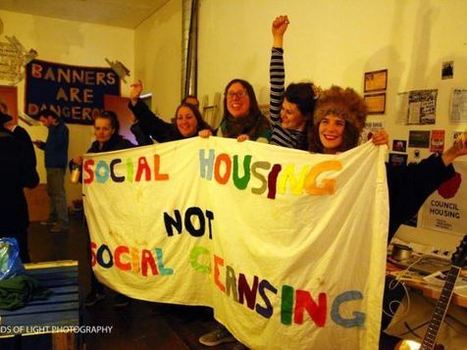
Help us raise the final funds we need to employ a coordinator to help build the housing movement in London! The Radical Housing Network was set up in 2013 in response to London’s growing housing crisis. The network helps facilitate mutual support and solidarity between local housing group
|
|
Scooped by
jean lievens
July 23, 2016 1:16 AM
|
What can Ellen Meiksins Wood's historical account of the origins of capitalism tell us about the potential role of markets in a next system?
|
|
Scooped by
jean lievens
July 23, 2016 1:14 AM
|
There were more protests in Britain last year than at any time since the 1970s.
|
|
Scooped by
jean lievens
July 22, 2016 5:32 AM
|
The Silk Road might have started as a libertarian experiment, but it was doomed to end as a fiefdom run by pirate kings
|
|
Scooped by
jean lievens
July 22, 2016 5:27 AM
|
Reviews of Daniel Wahl's Designing Regenerative Cultures published by Triarchy Press
|
|
Scooped by
jean lievens
July 22, 2016 5:27 AM
|
While you may not remember life as a toddler, you most likely believe that your selfhood then—your essential being—was intrinsically the same as it is today. Buddhists, though, suggest that this is just an illusion—a philosophy that's increasingly supported by scientific research. “Buddhists argue that nothing is constant, everything changes through time, you hav
|
|
Scooped by
jean lievens
July 22, 2016 5:26 AM
|
|
|
Scooped by
jean lievens
July 22, 2016 5:26 AM
|
This is a pre-release excerpt from the first chapter of
Designing Regenerative Cultures, by Daniel Christian Wahl, PhD
Publication Date: May 2nd, 2016 | Publisher: Triarchy Press, UK
Regenerative Cultures create win-win-win solutions by asking deeper questions
On an over-populated planet f
|
|
Scooped by
jean lievens
July 22, 2016 5:24 AM
|
|
|
Scooped by
jean lievens
July 22, 2016 5:24 AM
|
We often hear about how federalism or 'Tiebout' sorting can limit government over-taxation. Taking this one step further some argue that the threat of secession or 'internal exit' has the same effect. And many steps further is the emerging phenomenon of 'cryptosecession.' Cryptosecession is the use of cryptographic and blockchain-based technologies (e.g. Bitcoin, Ethereum, Bitnation) to economically secede from…
|
|
Scooped by
jean lievens
July 22, 2016 5:23 AM
|
This week I too was at the Sydney Blockchain Workshop, with both Darcy and Trent. I had the opportunity to participate in the 'Alternative economies and reputation-based systems' session, where I spoke about the economics of emergent economies built on blockchains. Also on the panel was Michel Bauwens (P2P Foundation), Primavera de Filippi (Harvard Berkman Center), and Gregory Meredith (Synereo, which…
|
|
Scooped by
jean lievens
July 22, 2016 5:22 AM
|
“There is nothing more difficult to plan, nor more dangerous to manage, than the creation of a new system. For the creator has the enmity of all who would profit by the preservation of the old system and merely lukewarm defenders in those who would gain by the new one.”
— Niccolò Machiavelli
E
|


 Scoop.it!