Today’s economy is built on the founda��ons of a global industrial and financial system with immense produc��ve capacity, but the extrac��ve nature of which has created extreme income disparity and social injus��ce and wrought devasta��on on the natural world. There is an increasingly spirited debate about the need for a ‘new economy’, which has fer��le and important implica��ons for the legal and philosophical founda��ons of the current system. What are different visions of the ‘new economy’ and how achievable are they? What possibili��es exist at their intersec��on?
How can we reimagine work, exchange, money, care, law and our rela��on- ship with the natural world through the prism of a new economy?
A lot was written about open-source architecture by Kaspori (2003), Fuller & Haque (2008), Sallingaros (2011), Ratti (2011) and Ratti and Claudel (2015), but very was actually done, because the framework doesn't exists and the open-source architecture ideas have been related to "Architecture without architects", DIY architecture and Alexander's (1977) ideas. But open source isn't about the amateurs - it's about the professionals, delivering faster, inexpensive and better products."
The good news from my perspective, is that we as humans have actually been developing effective ways to make meaning together, across a wide diversity of initial perspectives. However, many of the "social technologies" that make this possible are not yet widely known, and much less widely applied. Still, just as we already have technologies to generate power from the sun (and only need to invest in them to make them more widely available) we also already have powerful human and social technologies that are largely untapped.
The frightful and bloody hours of Friday night and Saturday morning in Munich and Kabul – despite the 3,000 miles that separate the two cities – provided a highly instructive lesson in the semantics of horror and hypocrisy. I despair of that generic old hate-word, “terror”. It long ago became the punctuation mark and signature tune of every facile politician, policeman, journalist and think tank crank in the world. Terror, terror, terror, terror, terror. Or terrorist, terrorist, terrorist, terrorist, terrorist.
Yet another? But yet another what? One does not even know. Once more tens of people killed, many more injured. Once more, a human being has carried them over towards death and suffering in his trajectory of violence and self-destruction. And both ISIS and most western commentators rush to describe him as the soldier of a cause when one does not even know if and when he discovered it.
"I think Peter Thiel supports Donald Trump because he believes it's a once-in-a-lifetime opportunity to weaken America's attachment to democratic government. I'm not accusing Thiel of any ambitions he hasn't more or less copped to. In an often-quoted 2009 essay, Thiel declared, "I no longer believe that freedom and democracy are compatible." He also wrote that his fellow libertarians were on a "fool's errand" trying to achieve their ends through political means: "In our time, the great task for libertarians is to find an escape from politics in all its forms--from the totalitarian and fundamentalist catastrophes to the unthinking demos that guides so-called 'social democracy.'" The only thing that matters, he said, is that politics never be allowed to interfere with technological progress, because it's the latter, not the former, that will be humankind's salvation. "The fate of our world may depend on the effort of a single person who builds or propagates the machinery of freedom that makes the world safe for capitalism."
The commons – as a constellation of specific projects, a transnational network, and a discourse that makes bracing moral and political claims -- is on the rise. It can be seen in renewed interest in classical commons such as farmland, fisheries, forests and water as well as in efforts to build communities around shared digital resources and re-imagine governance of city resources as commons, among many other initiatives. Much of the focus of commons is not on the resource alone, but on the social practices and norms of working together in equitable ways for shared ends, often known as “commoning.”
The Market/State is in crisis and representative democracy seems to be broken. Many argue, that both problems need to be adressed for the sake of social coherence and security. We think, that adressing them properly implies rethinking the core ideas state power and representative democracy are based upon. After all, there is nothing in the current institutional arrangment or in the system of representation through political parties defending the commons: nor as a special type of institutions, nor as a world-view, nor as a plethora of social practices.
The term post-democracy was coined by Warwick University political scientist Colin Crouch in 2000 in his book Coping with Post-Democracy. It designates states that are conducted by fully operating democratic systems ( elections are being held, governments fall and there is freedom of speech), but whose application is progressively limited.
Open State - A 10-day program of events exploring how open and transparent decision-making, innovation and engagement can address the complex challenges of the future.
The Internet of Communities (IoC) is a vision of a social Web willfully designed to maximize social engagement by introducing a new set of collective incentives. First, the IoC aims to explore how collective reputation can be used as a catalyst to regulate social interactions. Secondly, the IoC promotes internally rewarding incentives rooted in positive emotions and in reciprocity to spark social engagement without the prior need to mobilize financial assets. Collective reputation is chosen as a means for collective governance and internally rewarding incentives are chosen as the prime motive for action. Within this scheme, influence is more likely to shift to those who positively impact their communities, to those who lead by example, and to those who reciprocate with fairness. Grounded in personal fulfilment and in social empowerment, the IoC is therefore an attempt to actualize greater human, social and economic value from online communities. Read our white paper.
The Responsive Cities Symposium / Urbanism in the Experience Age is one of the main activities carried out under the Knowledge Alliance for Advanced Urbanism - KAAU (www.ka-au.net) EU co-funded project. Based on the assumption that the increasing availability of data creates new opportunities not only for monitoring and management, but also for changing the way we describe, understand and design cities, KAAU is seeking to promote the innovative education and training that emerging technologies require, developing courses, symposiums and an educational and training platform.
With over a trillion dollars in assets and more than 100 million members, it is clear that credit unions must play a pivotal part of any effective strategy aimed at bringing the co-op model to full scale in the American economy. At first glance, one would assume that their obvious role would be as the financial backbone of the co-op movement, providing financial services and loans to existing co-ops, while offering incubation and start-up capital to new ones.
RI recently sat down with ecosystem restoration researcher John D. Liu. Liu explains that when humans work with nature, degraded landscapes can be restored in a matter of years, and economies can be regenerated, putting food security and climate change mitigation within our reach.
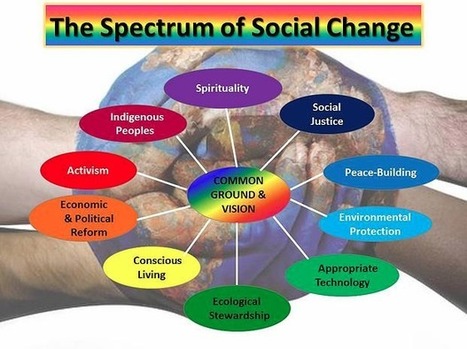
The “Global Transformation Movement” (GTM) includes and involves hundreds of thousands organisations and hundreds of millions of people, from all sectors of human society and from all walks of life, who are all longing and working for a better world. Within this vast, diverse and inspiring movement there is a growing awareness that we already have the knowledge, the skills, the technologies, the tools, the mentors and the living examples to co-create a peaceful, just and healthy world.
"“I put lipstick on a pig,” he said. “I feel a deep sense of remorse that I contributed to presenting Trump in a way that brought him wider attention and made him more appealing than he is.” He went on, “I genuinely believe that if Trump wins and gets the nuclear codes there is an excellent possibility it will lead to the end of civilization.” If he were writing “The Art of the Deal” today, Schwartz said, it would be a very different book with a very different title. Asked what he would call it, he answered, “The Sociopath.”
Neoliberalism is a widely used term today. However, it is often unclear what people refer to when they use it. In its most systematic usage it might refer to a theory, a set of ideas, a political strategy, or a historical period. Could you begin by explaining how you understand neoliberalism?
To get content containing either thought or leadership enter:
To get content containing both thought and leadership enter:
To get content containing the expression thought leadership enter:
You can enter several keywords and you can refine them whenever you want. Our suggestion engine uses more signals but entering a few keywords here will rapidly give you great content to curate.


 Your new post is loading...