Your new post is loading...

|
Suggested by
Société Francaise d'Immunologie
October 1, 2020 9:49 AM
|

|
Scooped by
Gilbert C FAURE
September 8, 2020 4:46 AM
|
There is a widespread notion that educational systems should empower learners with skills and competences to cope with a constantly changing landscape. Reference is often made to skills such as critical thinking, problem solving, collaborative skills, innovation, digital literacy, and adaptability. What is negotiable is how best to achieve the development of those skills, in particular which teaching and learning approaches are suitable for facilitating or enabling complex skills development. In this paper, we build on our previous work of exploring new forms of pedagogy for an interactive world, as documented in our Innovating Pedagogy report series. We present a set of innovative pedagogical approaches that have the potential to guide teaching and transform learning. An integrated framework has been developed to select pedagogies for inclusion in this paper, consisting of the following five dimensions: (a) relevance to effective educational theories, (b) research evidence about the effectiveness of the proposed pedagogies, (c) relation to the development of twenty-first century skills, (d) innovative aspects of pedagogy, and (e) level of adoption in educational practice. The selected pedagogies, namely formative analytics, teachback, place-based learning, learning with drones, learning with robots, and citizen inquiry are either attached to specific technological developments, or they have emerged due to an advanced understanding of the science of learning. Each one i
Via NextLearning, Dennis Swender, juandoming
When your students read, view, and listen to multiple sources on a topic or issue, do they tackle each source in a silo? Learning a little bit about this and a little bit about that but not really synthesizing the information from multiple sources?
Via Elizabeth E Charles
|
|
Scooped by
Gilbert C FAURE
April 28, 2020 3:05 AM
|
Sustainable assessment & online learning environments
|
|
Scooped by
Gilbert C FAURE
February 14, 2020 4:48 AM
|
Addressing a crisis in adolescent literacy with strategies of learning
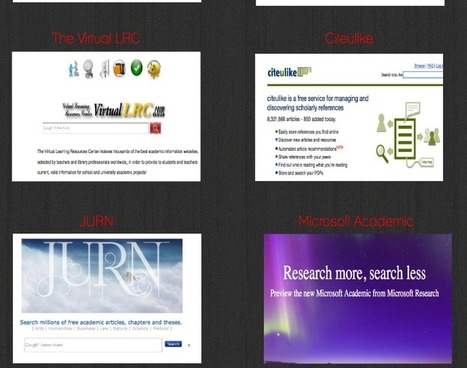
Below is a collection of some handy academic search engines teachers and educators can use to search for and find a wide variety of academic articles, journals, documents and theses. Some of these search engines are subject focused and others are generic.
Via Elizabeth E Charles
|
|
Scooped by
Gilbert C FAURE
December 14, 2019 2:49 PM
|
Reference : Le référentiel « cinq piliers de la maîtrise de l'information scientifique » d’ULiège... Document type : Scientific congresses and symposiums : Unpublished conference/Abstract Discipline(s) : Social & behavioral sciences, psychology : Library & information sciences To cite this reference: http://hdl.handle.net/2268/242189 Title : Le référentiel « cinq piliers de la maîtrise de l'information scientifique » d’ULiège Library, outil de formation et de communication Language : French Author, co-author : Durieux, Nancy [Université de Liège - ULiège > > Bibliothèque des Sciences de la vie >] Pochet, Bernard [Université de Liège - ULiège > > Bibliothèque et Centre de Documentation (GxABT) >] Publication date : 12-Dec-2019 Peer reviewed : No On invitation : Yes Event name : De la recherche documentaire à la maîtrise informationnelle Event date : Le 12 décembre 2019 Event organizer : Pôle académique Liège-Luxembourg Event place (city) : Liège Event country : Belgique Keywords : [fr] 5PMIS ; Maîtrise informationnelle [en] Information literacy Permalink : http://hdl.handle.net/2268/242189 File(s) associated to this reference Fulltext file(s): File Commentary Version Size Access Open access Référentiel_5PMIS_Décembre2019_vdef.pdf Publisher postprint 1.8 MB View/Open All documents in ORBi are protected by a user license.
The MOOC: Information Literacy Online has been released. The MOOC is available in: English, German, Catalan, Spanish, Croatian and Slovenian. There are six main modules:
Module 1: Orienting in an information landscape
Module 2: Research is a journey of inquiries
Module 3: The power of search
Module 4: Critical information appraisal
Module 5: Information use: the right and fair way
Module 6: Let’s create something new based on information and share it!
Additionally there are a couple subject-specific modules (in the English-language version, but only one in the German and Croatian versions and none in the Spanish). There is text and pictures, plus some videos and quizzes.
This is the outcome of a European project (articles etc. about the project here - this article gives an interesting and detailed account of the guiding principles and practicalities).
The content can also be re-used under a Creative Commons license.
Go to https://informationliteracy.eu/en
Via Elizabeth E Charles
|
|
Scooped by
Gilbert C FAURE
August 19, 2019 8:33 AM
|
A special issue of the priced journal Teaching in Higher Education (volume 24 issue 3, 2019) focuses on Experts, knowledge an
|
|
Scooped by
Gilbert C FAURE
July 30, 2019 3:32 PM
|
|
|
Scooped by
Gilbert C FAURE
May 20, 2019 3:31 AM
|
We were delighted to have such a great line up for our "Literacy in all its forms – digital, academic, information, health, and more" Spring Forum, in the wonderful venue of the Royal Society of Medicine. Improving literacy has always been at the core of a librarians role, but the definition of literacy is evolving…
|
|
Scooped by
Gilbert C FAURE
May 8, 2019 5:12 AM
|
This afternoon I returned from the LILAC 2019 library conference in Nottingham, England. I need some time (and sleep) before I put together major information literacy messages that I took away--and there are many! In the meantime, I wanted to praise LILAC and its organizer, CILIP's Information Literacy Group, for the subtle yet noticeable efforts…
|
|
|
Scooped by
Gilbert C FAURE
September 24, 2020 1:05 AM
|
|
|
Scooped by
Gilbert C FAURE
September 7, 2020 2:29 PM
|
In our 24/7, always-connected world where we are inundated with information from all sides, the ability to identify quality resources to inform our research and actions has become a major focus in higher education. Digital Content Curation, as it is called, is something that many faculty believe they should be teaching their students, but they are not sure where to start. I have created a model of Digital Content Curation that faculty can use to help students sharpen their digital literacy and research skills (Garner, in press).
Via Elizabeth E Charles

|
Suggested by
LIGHTING
May 16, 2020 6:59 AM
|
Read chapter Summary: Science is a way of knowing about the world. At once a process, a product, and an institution, science enables people to both engage...
|
|
Scooped by
Gilbert C FAURE
February 18, 2020 3:50 AM
|
I am collecting resources (a work in progress…) around the web that will help raise awareness, learn about the topics of information, news, and media literacy with videos, article, games, pod…
|
|
Scooped by
Gilbert C FAURE
February 13, 2020 2:43 PM
|
Le champ des littératies est parcouru de tensions conceptuelles importantes depuis les années 1970. Le terme de « littératie » est entendu de façon plus large en anglais qu’en français et un très grand nombre de littératies coexistent donc : à côté de l’information literacy, on dénombre la computer
The purpose of this article is to present an overview of why annotated bibliographies are needed in higher education, especially in doctoral education programs. The necessity for emerging scholars to build an annotated bibliography is paramount to the development of their research study. However, there are numerous types of annotated bibliographies. This article will discuss the different types of annotations and which format best facilitates the development of a dissertation.
Via Elizabeth E Charles
|
|
Rescooped by
Gilbert C FAURE
from MarketingHits
November 26, 2019 8:39 AM
|
In 2012, Mashable had published an article called “Technology Creating a Generation of Distracted Students” which reported the results of a study done by Pew Research Center. According to their data, about 90 percent of 2,500 education professionals agreed that contemporary technology had created a generation which struggled to concentrate, was prone to distraction, yet apt with web search and quick to find any information.
Those changes in our capacity to concentrate has society-wide effects: a recent article by Fortune publicized the findings of Educational Testing Service (ETS) which indicated steep decline in American Millenials’ literacy, numeracy and something called ‘problem-solving in technology-rich environments'; as compared not only to their peers abroad but to the older generations in the US. “We’ve forced companies to make technology that’s extremely easy to use, and that’s better at doing our day-to-day tasks than we are”, said Andy Campbell in a Huffington Post article.
Via Brian Yanish - MarketingHits.com
|
|
Scooped by
Gilbert C FAURE
September 8, 2019 11:32 AM
|
I've had a few requests for the latest PDF of Web Literacy for Student Fact-Checkers, so I've put it here.
|
|
Scooped by
Gilbert C FAURE
August 10, 2019 1:31 AM
|
Interview with Jesus Lau Jesus Lau is well known worldwide for his research and practice on information literacy. Currently he is a professor at the Universidad Veracruzana (Mexico). He received …
|
|
Scooped by
Gilbert C FAURE
July 16, 2019 1:24 PM
|
Today I delivered a workshop Media and Information Literacy: creative and critical engagement across the curriculum and beyond universit
|
|
Scooped by
Gilbert C FAURE
May 14, 2019 4:58 AM
|
I’ve been doing a bit of research on digital literacy/fluency over the past few months, wondering what initiatives and programs are currently being offered at our post-secondary institutions …
|


 Scoop.it!