Dunedin study has tracked physical and mental health, finances, and social relations, making its participants one of the most closely observed populations on Earth


 Your new post is loading...
 Scoop.it! Dunedin study has tracked physical and mental health, finances, and social relations, making its participants one of the most closely observed populations on Earth 
No comment yet.
Sign up to comment
Scoop.it!

If creativity is about having unique ideas and new ways to do things, innovation is all about making those ideas happen.
Learn more / En savoir plus / Mehr erfahren:
https://www.scoop.it/t/21st-century-learning-and-teaching/?&tag=innovation
Via Gust MEES

Gust MEES's curator insight,
February 3, 2018 5:09 AM
If creativity is about having unique ideas and new ways to do things, innovation is all about making those ideas happen.
Learn more / En savoir plus / Mehr erfahren:
https://www.scoop.it/t/21st-century-learning-and-teaching/?&tag=innovation

designsgalaxy's curator insight,
February 3, 2018 10:27 PM
We are a technology inspired and knowledge-based Website Design & Digital Marketing agency, offering a proven solution for all types of businesses.
Scoop.it!

Bundle up! Punxsutawney Phil, the world-famous groundhog, emerged from his burrow in western Pennsylvania and saw his shadow Friday morning, predicting another six weeks of winter. As the sun rose at Gobbler's Knob in Punxsatawney, Pennsylvania, the groundhog's handlers -- known as the "
Scoop.it!
Scoop.it!

Two studies in 2001 found that libraries do not manage knowledge as well as they manage information. Has anything changed since, and should things change?
Scoop.it!
News publishers have the opportunity to enter the curation business by leveraging their reputations as trusted sources, and on proven technologies. Curation has been consistently ignored by big media…
Scoop.it!

Content Intelligence is defined as technology that provides data and insights on owned and third-party content to increase results from marketing.
Scoop.it!

Start Today Smarter: Continuous and Collaborative Learning
Scoop.it!

#JNFormateursBib rassemblent les formateurs en bibliothèques de l’ESR. L'ADBU, les formateurs IDF et le SCD du Cnam ont organisé les JNF2018 Via Marianne Begin
Gilbert C FAURE's insight:
missed it, j'étais à Bobcatsss2018, Riga
Scoop.it!

... and the movies and TV shows we watch
Scoop.it!

Beaucoup de médias ont manqué leur virage numérique et se retrouvent aujourd'hui à la merci des GAFA.
Scoop.it!

The rise of algorithms has been relentless, but we need human input in our world of technological innovations
|
Scoop.it!
Comments on the Use of the Journal Impact Factor for Assessing the Research Contributions of Individual Authors
Scoop.it!

A case study, thought-backed post from Julia McCoy on why inbound content and SEO just got 10x more important, in an era of no-more-HuffPost-Contributor and Facebook business page reach death.
Scoop.it!

Vous avez sans doute déjà entendu parlé du nouveau statut d'auto-entrepreneur !
Scoop.it!
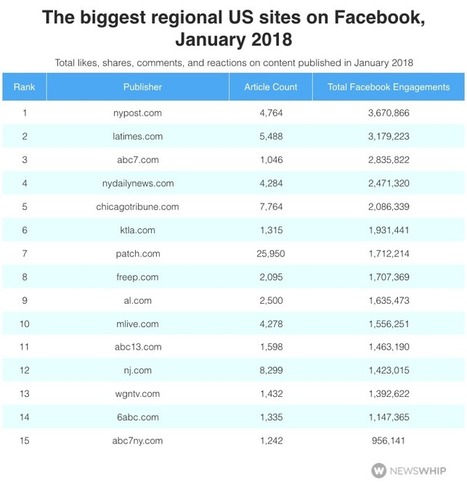
A ranking of the 15 US regional news sites with the greatest impact on Facebook, including names such as the New York Post, the LA Times and more.
Scoop.it!

Scientists often herald the role of chance in research. A project in Britain aims to test the popular idea with evidence.
Scoop.it!
New measures to boost key competences and digital skills, as well as the European dimension of education
1. A Council Recommendation on Key Competences for Lifelong Learning: Building on the Recommendation on Key Competences adopted in 2006, this proposal brings forward important updates reflecting the rapid evolution of teaching and learning since then. It aims to improve the development of key competences of people of all ages throughout their lives and to provide guidance to Member States on how to achieve this objective. A particular focus is placed on promoting entrepreneurial drive and innovation-oriented mindsets in order to unlock personal potential, creativity and self-initiative. Moreover, the Commission is recommending steps to foster competences in science, technology, engineering and mathematics (STEM) and motivate more young people to embark on a career in these fields. The proposals made today should also be seen as part of the answer to urgently improve European education systems to face the many challenges highlighted in the latest PISA survey. More generally, the measures will support Member States in better preparing learners for changing labour markets and for active citizenship in more diverse, mobile, digital and global societies.
2. A Digital Education Action Plan that outlines how the EU can help people, educational institutions and education systems better adapt to life and work in an age of rapid digital change by: making better use of digital technology for teaching and learning; developing the digital competences and skills needed for living and working in an age of digital transformation; and improving education through better data analysis and foresight.
Initiatives include supporting schools with high-speed broadband connections, scaling up a new self-assessment tool for schools on the use of technology for teaching and learning (SELFIE) and a public awareness campaign on online safety, media literacy and cyber hygiene.
3. A Council Recommendation on common values, inclusive education and the European dimension of teaching: This initiative proposes ways in which education can help young people understand the importance of and adhere to common values set out in Article 2 of the Treaty of the European Union. It aims at strengthening social cohesion and contributing to fight the rise of populism, xenophobia, divisive nationalism and the spreading of fake news. The proposal also strengthens inclusive education to promote quality education for all pupils as well as the European dimension of teaching, so children also learn about Europe's common heritage and diversity and get a good understanding of the functioning of the EU. To support these aims, the Commission will take steps to increase virtual exchanges among schools, notably through the successful e-Twinning network, and boost school mobility through the Erasmus+ programme.
Learn more / En savoir plus / Mehr erfahren:
https://www.scoop.it/t/21st-century-learning-and-teaching/?&tag=EU
Via Gust MEES
Gust MEES's curator insight,
January 31, 2018 10:07 AM
New measures to boost key competences and digital skills, as well as the European dimension of education
1. A Council Recommendation on Key Competences for Lifelong Learning: Building on the Recommendation on Key Competences adopted in 2006, this proposal brings forward important updates reflecting the rapid evolution of teaching and learning since then. It aims to improve the development of key competences of people of all ages throughout their lives and to provide guidance to Member States on how to achieve this objective. A particular focus is placed on promoting entrepreneurial drive and innovation-oriented mindsets in order to unlock personal potential, creativity and self-initiative. Moreover, the Commission is recommending steps to foster competences in science, technology, engineering and mathematics (STEM) and motivate more young people to embark on a career in these fields. The proposals made today should also be seen as part of the answer to urgently improve European education systems to face the many challenges highlighted in the latest PISA survey. More generally, the measures will support Member States in better preparing learners for changing labour markets and for active citizenship in more diverse, mobile, digital and global societies.
2. A Digital Education Action Plan that outlines how the EU can help people, educational institutions and education systems better adapt to life and work in an age of rapid digital change by:
Initiatives include supporting schools with high-speed broadband connections, scaling up a new self-assessment tool for schools on the use of technology for teaching and learning (SELFIE) and a public awareness campaign on online safety, media literacy and cyber hygiene.
3. A Council Recommendation on common values, inclusive education and the European dimension of teaching: This initiative proposes ways in which education can help young people understand the importance of and adhere to common values set out in Article 2 of the Treaty of the European Union. It aims at strengthening social cohesion and contributing to fight the rise of populism, xenophobia, divisive nationalism and the spreading of fake news. The proposal also strengthens inclusive education to promote quality education for all pupils as well as the European dimension of teaching, so children also learn about Europe's common heritage and diversity and get a good understanding of the functioning of the EU. To support these aims, the Commission will take steps to increase virtual exchanges among schools, notably through the successful e-Twinning network, and boost school mobility through the Erasmus+ programme.
Learn more / En savoir plus / Mehr erfahren:
https://www.scoop.it/t/21st-century-learning-and-teaching/?&tag=EU
Scoop.it!

La toujours très attendue étude menée par Hootsuite et We Are Social sur les tendances du digital et des réseaux sociaux vient de sortir. Comme d'habitude,
Scoop.it!

The world of scholarly publishing is in upheaval. As the open science and open research movements rapidly gain momentum, the access restrictions and paywalls of many publishers put them at odds wit…
Scoop.it!

Google has quietly launched a pilot for a news app that it says will “put a spotlight on inspiring stories that aren’t being told.” Out this week via a limited pilot in Nashville and Oakland, Bulletin is essentially a public, shared blog space that doesn’t require any expertise on content management systems, HTML, or even an app download. Google hopes it will help users tell “hyperlocal” stories.
|