



To assess the credibility of the information they find online, students should turn to the power of the web to determine its trustworthiness.
Via Afroditi Fragkou


 Your new post is loading...
 Scoop.it! To assess the credibility of the information they find online, students should turn to the power of the web to determine its trustworthiness. Via Afroditi Fragkou 
No comment yet.
Sign up to comment
Scoop.it!

TuneYou est un site web en forme de poste de radio virtuel qui permet d’écouter des milliers de radios à travers le monde. Plus de 50 000 chaînes de radio sont proposées ! Le plus grand poste de radio au monde. Il suffit d’un clic pour l’allumer.
Scoop.it!

Life as we know is over in the transmogrified plot of real estate where Annihilation happens. It’s the latest scifi movie that shows how the end of the world often becomes the start of something simultaneously lovely and dangerous, a paradoxical approach that’s stretched back decades. Here’s a list of entertainments where the world has broken down, but become something grander as a result.
Scoop.it!
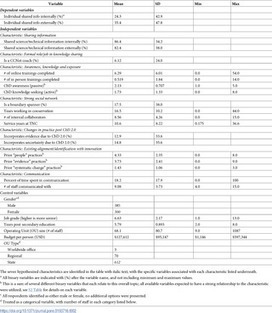
The spread and uptake of new ideas (diffusion of innovations) is critical for organizations to adapt over time, but there is little evidence of how this happens within organizations and to their broader community. To address this, we analyzed how individuals accessed information about a recent science innovation at a large, international, biodiversity conservation non-profit–The Nature Conservancy–and then traced the flow of how this information was shared within the organization and externally, drawing on an exceptionally data-rich environment. We used surveys and tracking of individual internet activity to understand mechanisms for early-stage diffusion (knowledge seeking and sharing) following the integration of social science and evidence principles into the institutional planning framework: Conservation by Design (CbD 2.0). Communications sent to all employees effectively catalyzed 56.4% to exhibit knowledge seeking behavior, measured by individual downloads from and visits to a restricted-access site. Individuals who self-reported through a survey that they shared information about CbD 2.0 internally were more likely to have both received and sought out information about the framework. Such individuals tended to hold positions within a higher job grade, were more likely to train others on CbD as part of their job, and to enroll in other online professional development offerings. Communication strategies targeting external audiences did not appear to influence information seeking behavior. Staff who engaged in internal knowledge sharing and adopting “evidence” practices from CbD 2.0 were more likely to have shared the document externally. We found a negative correlation with external sharing behavior and in-person trainings. Our findings suggest repeated, direct email communications aimed at wide audiences can effectively promote diffusion of new ideas. We also found a wide range of employee characteristics and circumstances to be associated with knowledge diffusion behavior (at both an organizational and individual level).
Scoop.it!

Vous vous demandez souvent comment être plus créatif ? Voici 5 habitudes qui boostent la créativité.
Scoop.it!

A website for free access to the History of Cartography, Volumes One, Two, and Three, in PDF format.
Scoop.it!

Pour produire du bon contenu, il est indispensable de faire des recherches pour trouver l'inspiration et rédiger des articles pertinents.
Scoop.it!

Intégrer le numérique dans sa pratique pédagogique.
Scoop.it!

Quick Search est un tout nouveau moteur de recherche pour le web et les réseaux sociaux qui va vous surprendre par sa facilité d’utilisation, mais surtout par sa puissance de tir. La platef
Scoop.it!

Parents interact with children following specific styles, known to influence child development. These styles represent variations in the dimensions of demandingness and responsiveness, resulting in authoritarian, authoritative, permissive or uninvolved parenting. Given the similarities in the parent to child and owner to dog relationships, we determined the extent to which parenting styles exist in the owner to dog relationship using the existing Parenting Styles and Dimensions Questionnaire for the parent-child relationship and an adapted version for dog owners. Items on the parenting of children/dogs were rated for applicability on a five-point Likert scale by 518 Dutch dog owning parents. Principal Component Analyses grouped parenting propensities into styles, with some marked differences between the findings for children and dogs. Dog-directed items grouped into an authoritarian-correction orientated style, incorporating variation in demandingness and focussing on correcting a dog for behaviour verbally/physically, and in two styles based on authoritative items. An authoritative-intrinsic value orientated style reflected variation in mainly responsiveness and oriented on the assumed needs and emotions of the animal. A second authoritative-item based style, captured variations in demandingness and responsiveness. We labelled this style authoritative-training orientated, as it orientated on manners in teaching a dog how to behave in social situations. Thus, we defined dog-directed parenting styles and constructed a Dog-Directed Parenting Styles and Dimensions Questionnaire along the lines of the existing theoretical framework on parenting styles. We did not find a dog-directed parenting style of being permissive or uninvolved, which we attribute to a study population of devoted dog owners and our findings should be interpreted with this specific study population in mind. We found evidence of dog-directed parenting styles and provide a fundament for determining their possible impact on the different aspects of a dog’s life.
Scoop.it!

As a gift for Estonia’s centenary on 24 February, Estonian World has, with the help of its co-authors, compiled a list of a hundred facts about the country – some known, but some perhaps even surprising.
Scoop.it!
Pierre Lévy Professeur à l’Université d’Ottawa. Ce travail est la pré-impression d’un article dans le numéro 58 de RED. Il sera publié en tant que contribution d’invité, dans le genre «histoire personnelle comme recherche éducative» (Personal History as Educational Research). Cet article n’a d’autre but que de raconter mon expérience...
Learn more / En savoir plus / Mehr erfahren:
https://gustmees.wordpress.com/?s=curation
https://gustmees.wordpress.com/?s=blogging
Via Gust MEES

Gust MEES's curator insight,
February 22, 2018 4:23 PM
Pierre Lévy Professeur à l’Université d’Ottawa. Ce travail est la pré-impression d’un article dans le numéro 58 de RED. Il sera publié en tant que contribution d’invité, dans le genre «histoire personnelle comme recherche éducative» (Personal History as Educational Research). Cet article n’a d’autre but que de raconter mon expérience...
Learn more / En savoir plus / Mehr erfahren:
https://gustmees.wordpress.com/?s=curation
https://gustmees.wordpress.com/?s=blogging
|
Scoop.it!

Le 20 mars à 22h, je publierai sur ce blog un 5eme livre blanc intitulé "L'accès à l'information et aux réseaux sociaux rend-il plus innovant.e ?". Il regroupera les témoignages de plus de 180 participants. Avec la participations notamment de : BENOIT ANGER, JOSE MANUEL ANTELO GARCIA, QUIQUE APARISI RICO, VALERIE ASSELOT HERPET, DELPHINE…
Scoop.it!

A big blast could hobble global trade, communications and financial systems.
Scoop.it!

PowerPoint slides "are toxic to education."
Scoop.it!

Everyone’s familiar with the smell of old books, the weirdly intoxicating scent that haunts libraries and second-hand book stores. Similarly, who doesn’t enjoy riffling through the page…
Scoop.it!

La digitalisation de la formation voit apparaitre son lot de nouveaux métiers : ingénieur pédagogique multimédia, chef de projet e-learning, digital learning manager, et donc learning community manager. Mais qui est cette personne et quelles sont ses missions ? Un community manager, qu’est-ce que c’est ? Reprenons la base : un community manager, appelé animateur de communauté... Voir l'article
Scoop.it!

Social in silico includes a series of occasional posts focused on community management tips and related information. I’m tagging these Considering Community and you can find all the posts in the series here. Previously on this blog, I've reflected on the different types of community that I've observed within science and specifically in the first cohort of…
Scoop.it!
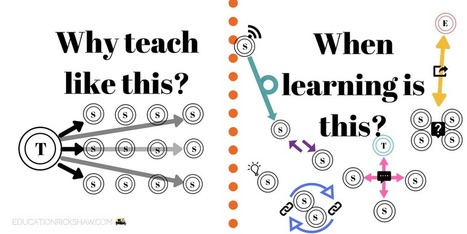
It’s time to change the direction of the arrow by for once and for all turning it around and allowing it to originate from the student. Imagine a classroom where students are the ones driving the learning and are empowered to pursue things that matter to them. In the infographic above we see multiple modalities being employed by these students as students are accessing human and digital resources to drive their own learning. In a 21st century learning model, learning extends beyond the classroom walls, and students are exchanging, discussing, questioning, reflecting and making connections anywhere, anytime. Most importantly, students are inspired and empowered to act, rather than sit back and have the knowledge brought to them. Via Edumorfosis, june holley, juandoming
Scoop.it!

Votre chien a tendance à faire sa vie comme bon lui semble lorsqu’il est tout seul : détruire le canapé, vider la poubelle, rétrécir les pieds de la table en bois, gratter le tapis, faire ses besoins, aboyer, couiner, et j’en passe… Vous n’en pouvez plus, vos voisins non plus : il est temps d’agir ! Mais la cage est-elle une bonne solution ? Réponse de Clémentine Turgot, éducatrice canin chez Nature de chien.
Scoop.it!

Purdue University’s Online Writing Lab provides students with a guide to help them successfully complete writing assignments not only in writing classes, but also in STEM coursework and multimedia presentations.
Scoop.it!

As Estonians around the world are gathering to cheer for their homeland, and celebrate its 100th birthday on 24 February, it’s appropriate to recall how the independent country was born.
|






