Your new post is loading...

|
Scooped by
Gilbert C FAURE
June 14, 2017 4:27 AM
|
Tenofovir is a preexposure drug used to prevent HIV infection. In clinical trials, tenofovir was effective for men, but not women. Klatt et al. now show that tenofovir efficacy in women depends on the composition of the vaginal microbiome (see the Perspective by Tuddenham and Ghanem). In a clinical trial of 688 women, tenofovir was three times as effective among those with a Lactobacillus -dominant vaginal microbiome as it was among other women. Gardnerella vaginalis tended to predominate in the women for whom tenofovir was less effective, and the authors found that the organism could rapidly metabolize and thereby inactivate the drug.
Science , this issue p. [938][1]; see also p. [907][2]
[1]: /lookup/doi/10.1126/science.aai9383
[2]: /lookup/doi/10.1126/science.aan6103
|
|
Scooped by
Gilbert C FAURE
May 22, 2017 1:53 PM
|
Chemokine receptor type 6 (CCR6)+CD4+ T cells are preferentially infected and depleted during HIV disease progression, but are preserved in non-progressors. CCR6 is expressed on a heterogeneous population of memory CD4+ T cells that are critical to mucosal immunity. Preferential infection of these cells is associated, in part, with high surface expression of CCR5, CXCR4, and α4β7. In addition, CCR6+CD4+ T cells harbor elevated levels of integrated viral DNA and high levels of proliferation markers. We have previously shown that the CCR6 ligands MIP-3α and human beta defensins inhibit HIV replication. The inhibition required CCR6 and the induction of APOBEC3G. Here, we further characterize the induction of apolipoprotein B mRNA editing enzyme (APOBEC3G) by human beta defensin 2. Human beta defensin 2 rapidly induces transcriptional induction of APOBEC3G that involves extracellular signal-regulated kinases 1/2 (ERK1/2) activation and the transcription factors NFATc2, NFATc1, and IRF4. We demonstrate that human beta defensin 2 selectively protects primary CCR6+CD4+ T cells infected with HIV-1. The selective protection of CCR6+CD4+ T cell subsets may be critical in maintaining mucosal immune function and preventing disease progression.
|
|
Scooped by
Gilbert C FAURE
February 28, 2017 1:39 PM
|
PLoS Pathog. 2017 Feb 27;13(2):e1006247. doi: 10.1371/journal.ppat.1006247. [Epub ahead of print]
|
|
Scooped by
Gilbert C FAURE
February 13, 2017 9:39 AM
|
|
|
Scooped by
Gilbert C FAURE
February 12, 2017 11:28 AM
|
Mucosal‐associated invariant T (MAIT) cells are donor‐unrestricted lymphocytes that are surprisingly abundant in humans, representing 1–10% of circulating T cells and further enriched in mucosa
|
|
Scooped by
Gilbert C FAURE
January 27, 2017 5:12 AM
|
Author Summary Despite significant effort, our understanding of how HIV-1 virus undermines the immune system is limited. HIV-1infection is characterized by extensive damage to intestinal mucosal barrier and translocation of bacteria and microbial products into the systemic circulation. Immune activation induced by microbial products results in chronic inflammation that drives HIV-1 pathogenesis and progression to AIDS despite successful control of HIV-1 replication by antiretroviral therapy. Here we provide evidence indicating that antibody-producing cells in the intestinal mucosa of HIV-1-infected individuals have decreased capacity to switch from the production of IgM to IgA and IgG, the types of antibodies that normally restrict the translocation of bacterial antigens across the mucosal barrier. This may facilitate systemic dissemination of microbial products and subsequent inflammation in HIV-1-infected individuals. Furthermore, the accumulation of IgM in gut mucosa may contribute to the exacerbation of inflammatory processes by the formation of inflammatory immune complexes. This newly identified dysregulation of immune system alters our understanding of HIV-1 pathogenesis and may facilitate the design of novel therapies targeting immune dysfunction in HIV-1/AIDS.
|
|
Scooped by
Gilbert C FAURE
January 11, 2017 1:33 PM
|
RT @J_Immunol: #Mucosal CD8+ #Tcells in #HIV infection before and after seroconversion https://t.co/ieYeqC4BXb #immunology #ReadTheJI https…
|
|
Scooped by
Gilbert C FAURE
January 6, 2017 9:33 AM
|
Mucosal-associated invariant T cells (MAIT) are innate T cells restricted by major histocompatibility related molecule 1 (MR1) presenting riboflavin metabolite ligands derived from microbes. Specificity to riboflavin metabolites confers MAIT cells a broad array of host-protective activity against gram-negative and -positive bacteria, mycobacteria, and fungal pathogens. MAIT cells are present at low levels in the peripheral blood of neonates and gradually expand to relatively abundant levels during childhood. Despite no anti-viral activity, MAIT cells are depleted early and irreversibly in HIV infected adults. Such loss or impaired expansion of MAIT cells in HIV-positive children may render them more susceptible to common childhood illnesses and opportunistic infections. In this study we evaluated the frequency of MAIT cells in perinatally HIV-infected children, their response to antiretroviral treatment and their associations with HIV clinical status and related innate and adaptive immune cell subsets with potent antibacterial effector functions. We found HIV+ children between ages 3 to 18 years have significantly decreased CD8+ MAIT cell frequencies compared to uninfected healthy children. Remarkably, CD8 MAIT levels gradually increased with antiretroviral therapy, with greater recovery when treatment is initiated at a young age. Moreover, diminished CD8+ MAIT cell frequencies are associated with low CD4:CD8 ratios and elevated sCD14, suggesting a link with HIV disease progression. Last, CD8+ MAIT cell levels tightly correlate with other antibacterial and mucosa-protective immune subsets, namely, neutrophils, innate-like T cells, and Th17 and Th22 cells. Together these findings suggest that low frequencies of MAIT cells in HIV positive children are part of a concerted disruption to the innate and adaptive immune compartments specialized in sensing and responding to pathogenic or commensal bacteria.
|
|
Scooped by
Gilbert C FAURE
January 1, 2017 1:06 PM
|
Cell Microbiol. 2016 May;18(5):645-51. doi: 10.1111/cmi.12588. Review
|
|
Scooped by
Gilbert C FAURE
December 24, 2016 8:48 AM
|
Curr HIV/AIDS Rep. 2016 Feb;13(1):53-63. doi: 10.1007/s11904-016-0305-0. Research Support, N.I.H., Extramural; Research Support, Non-U.S. Gov't; Review
|
|
Scooped by
Gilbert C FAURE
December 5, 2016 12:13 PM
|
AIDS Res Ther. 2016 Apr 11;13(1):19. Review

|
Suggested by
Société Francaise d'Immunologie
September 19, 2016 2:19 PM
|
Initiation of antiretroviral therapy before detection of colonic infiltration by HIV reduces viral reservoirs, inflammation and immune activation
|
|
|
Scooped by
Gilbert C FAURE
July 1, 2017 4:56 AM
|
AIDS. 2017 Jul 17;31(11):1529-1534. doi: 10.1097/QAD.0000000000001515.
|
|
Scooped by
Gilbert C FAURE
May 25, 2017 1:51 AM
|
Antiretroviral therapy (ART) effectively limits HIV replication, but HIV+ individuals are medicated for life because ART withdrawal results in rebound of persistent virus. Developing therapies that keep viral loads low in the long term and prevent reinfection remains an important goal—one emerging approach is an antibody against integrin α4β7. Integrin α4β7 is a receptor that facilitates homing of CD4+ T cells to the gut, a key site for HIV persistence. ART-suppressed macaques that received antibodies against integrin α4β7 controlled the virus even after ART withdrawal. Here, Guzzo et al. demonstrate that integrin α4β7 is incorporated into the HIV envelope, suggesting that antibody treatment may directly interfere with the ability of HIV to target intestinal tissues. Their results change our perception of the role of integrin α4β7, a promising therapeutic target in HIV pathogenesis.
|
|
Scooped by
Gilbert C FAURE
April 24, 2017 8:14 AM
|
Mucosal Immunology is the official publication of the Society of Mucosal Immunology (SMI). It aims to provide a forum for both basic and clinical scientists to discuss all aspects of immunity and inflammation involving mucosal tissues. The journal reflects the interests of scientists studying gastrointestinal, pulmonary, nasopharyngeal, oral, ocular, and genitourinary immunology through the publication of original research articles, scholarly reviews, and timely commentaries, editorials and letters.
|
|
Scooped by
Gilbert C FAURE
February 21, 2017 7:01 AM
|
Author summary The molecular basis by which small amounts of HIV can initiate infection in the mucosa is not well understood. Here, we report that genital and rectal fibroblasts, amongst the most abundant cells of the mucosa, potently increase HIV infection of T cells. Fibroblasts are more abundant and can be more effective as infection enhancers than dendritic cells, which are thought to play a role in early HIV transmission by facilitating infection of T cells. In contrast to fibroblasts, mucosal epithelial cells, which line the mucosa, inhibit HIV infection. Our findings suggest that abrasions in the genital and rectal epithelium may increase HIV transmission in part by allowing external HIV to escape an antiviral environment to access the infection-favorable environment of the stromal fibroblasts. These studies suggest that approaches to limit fibroblast-mediated enhancement may diminish HIV transmission rates.
|
|
Scooped by
Gilbert C FAURE
February 13, 2017 7:05 AM
|
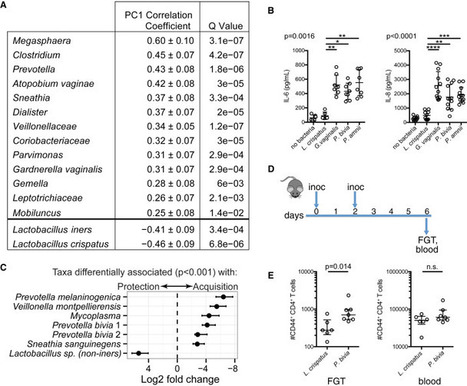
The potential impact of cervicovaginal bacteria on HIV susceptibility is not well-defined.
Gosmann et al. (2017) identify anaerobic cervicovaginal bacterial communities and
specific taxa highly prevalent in young healthy South African women that increase
their HIV risk. These findings might be leveraged to reduce HIV acquisition in women.
|
|
Scooped by
Gilbert C FAURE
February 5, 2017 10:33 AM
|
Persistent B cell responses in mucosal tissues are crucial to control infection against sexually transmitted pathogens like Human Immunodeficiency Virus 1 (HIV-1). The genital tract is a major site of infection by HIV. Sublingual immunization in mice was previously shown to generate HIV-specific B cell immunity that disseminates to the genital tract. We report here the immunogenicity in female cynomolgus macaques of a sublingual vaccine based on a modified gp41 polypeptide coupled to the cholera toxin B subunit designed to expose hidden epitopes and to improve mucosal retention. Combined sublingual/intramuscular immunization with such muco-adhesive gp41-based vaccine elicited mucosal HIV-specific IgG and IgA antibodies more efficiently than intramuscular immunization alone. This strategy increased the number and duration of gp41-specific IgA secreting cells. Importantly, combined immunization improved the generation of functional antibodies three months after vaccination as detected in HIV-neutralizing assays. Therefore, sublingual immunization represents a promising vaccine strategy to block HIV-1 transmission.
|
|
Scooped by
Gilbert C FAURE
January 16, 2017 1:42 PM
|
J Immunol. 2017 Jan 15;198(2):605-614. doi: 10.4049/jimmunol.1601355. Review
|
|
Scooped by
Gilbert C FAURE
January 9, 2017 2:03 PM
|
Sci Rep. 2015 Jun 2;5:10443. doi: 10.1038/srep10443. Research Support, N.I.H., Extramural; Research Support, Non-U.S. Gov't; Research Support, U.S. Gov't, Non-P.H.S.
|
|
Scooped by
Gilbert C FAURE
January 2, 2017 8:53 AM
|
Official Full-Text Publication: The effects of prebiotics on microbial dysbiosis, butyrate production and immunity in HIV-infected subjects on ResearchGate, the professional network for scientists.
|
|
Scooped by
Gilbert C FAURE
December 27, 2016 1:30 PM
|
Mucosal Immunology is the official publication of the Society of Mucosal Immunology (SMI). It aims to provide a forum for both basic and clinical scientists to discuss all aspects of immunity and inflammation involving mucosal tissues. The journal reflects the interests of scientists studying gastrointestinal, pulmonary, nasopharyngeal, oral, ocular, and genitourinary immunology through the publication of original research articles, scholarly reviews, and timely commentaries, editorials and letters.
|
|
Suggested by
Société Francaise d'Immunologie
December 14, 2016 3:55 AM
|
|
|
Scooped by
Gilbert C FAURE
October 29, 2016 1:49 PM
|
Background. Lung CD4+ T-cell depletion and dysfunction, CD8+ T-cell alveolitis, smoking, and poor control of human immunodeficiency virus (HIV) are features of HIV-associated chronic obstructive pulmonary disease (COPD), but these changes have not...
|



 Scoop.it!