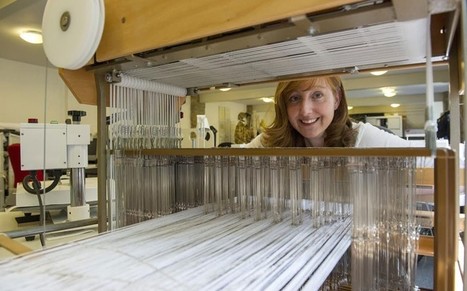

Wearable technology has been touted as the 'next big thing' in consumer electronics. Sophie Curtis meets some of the British start-ups taking on the technology giants of Silicon Valley.

 Your new post is loading...
 Scoop.it! Wearable technology has been touted as the 'next big thing' in consumer electronics. Sophie Curtis meets some of the British start-ups taking on the technology giants of Silicon Valley. 
No comment yet.
Sign up to comment
Scoop.it!

For wearables to really take off, they will have to cannibalize the smartphone, just as mobile devices have cannibalized the PC.
Richard Platt's insight:
The challenge is to deliver devices that are useful to a much wider market of potential consumers: Wearable devices need to be truly personal and essential in their own right. When you take all of that together, there's only one outcome to expect. We are at the beginning of the end of the smartphone. "For a Wearable World to transpire, where it is the dominant platform, the smartphone has to give way," writes The Register, arguing that wearable computing will need to cannibalize the smartphone market. People will still use smartphones, just as people still use PCs, but a lot of what people do on smartphones today will be done instead on a watch, a button or other wearable device.
Scoop.it!

Above: Ineda Systems has designed a wearable processor. Image Credit: Ineda Systems Ineda Systems is announcing today it is developing a wearable processor with an always-on battery that can last a whole month. The company also said it has raised $17 million from big chip industry players. The aim is to supply chips for the multitude of devices that are coming with the new age of wearable computing and the internet of things. Above: Ineda architecture Image Credit: Ineda Hyderabad, India-based Ineda is designing its Dhanush chips from the ground up for wearable devices and the internet of things. That means the chips have to operate on as little electrical power as possible, thanks to a unique design. Investors include Walden-Riverwood Ventures, Samsung Catalyst Fund, Qualcomm, Indus Age, Imagination Technologies other existing investors. The startup chip design company has come with a design that it calls a “wearable processor unit,” much like graphics chips are called “graphics processing units” and microprocessors are called “central processing units.” The wearable device has multiple components and only uses those which are needed at any given time. The name Dhanush is Sanskrit for a bow, as in bow and arrow. Such WPUs can take input from sensors on an always-on basis, meaning they can take data from devices such as smart watches and continuously update applications for users. The company says it will have 10 times less power consumption compared to rival devices. Above: Ineda’s advantage Image Credit: Ineda “The class of the WPU we are designing for wearables is very unique,” said Dasaradha Gude, chief executive of Ineda, in an interview with VentureBeat. “Unless you design from the ground up, you will have the same problem. The power requirements are too difficult. What we have done is the first in the world. This is a brand new architecture.” Big companies like Intel are adapting their chips for smartphones, laptops, and even desktops for the wearable world. But Ineda doesn’t believe such approaches are sustainable and can’t offer the power reduction required. Ineda, which has a U.S. office in Santa Clara, Calif., is targeted devices such as smart watches, health and fitness trackers, and other wearable devices. The management team includes Sanjay Jha, chairman of Ineda’s board and CEO of contract chip manufacturer Global Foundries; Ineda board member Young Sohn, president and chief strategy officer at Samsung Electronics; and Ineda board member Krishna Yarlagadda, president of chip design firm Imagination Technologies. Gude has 25 years of chip industry experience with companies like Advanced Micro Devices. He helped work on AMD’s accelerated processing units (APUs), which combined GPUs and CPUs on the same chip. The system uses a new patent-pending Hierarchical Computing architecture, which is different from well-known processor architectures such as x86, which is used by Intel and AMD. It has its own security built into it. This architecture can be combined with low-power, high-performance MIPS processor cores and PowerVR graphics into a complete wearable chip. The Hierarchical Computing architecture has multiple tiers of CPUs within the larger WPU device. All of those CPUs can operate either simultaneously or independently. Gude said that Android requires too much operating power to serve as the OS for the device. The company has a single operating system that continues to operate all of the time. Depending on what is running at the time, the operating system changes. Above: Ineda’s advantage in wearables Image Credit: Ineda “We have multiple CPUs, including small CPus and a large CPU in the same chip,” Gude said. “That is common today. The differentiation is we also have multiple operating systems within the CPU. If you are running on a small CPU, you use a small OS. The power consumption can be much lower.” But the WPU can basically run a variety of operating systems, as required by customers. Gude isn’t sure which application will come first. Dhanush chips will have low price points that are appropriate for wearable markets. Gude believes that wearable chips will take off in the same way that smartphones and tablets have taken over, only that there will be a market for many more wearable devices. “Wearable electronics and devices for the Internet of Things (IoT) are an open field for innovation, and Ineda is entering the market at the right time with a truly disruptive architecture,” said Yarlagadda. “Leveraging multiple Imagination IP Cores, Ineda’s Dhanush WPU brings the wearable device industry the performance and power reduction it has needed to ensure wide-scale adoption.” The company has prototypes and it is sampling chips to potential customers. “We are hoping we can get a design win in the next couple of months and then go to production,” Gude said. The Dhanush family of chips will operate at low frequencies, ranging from 10 megahertz to 500 megahertz. The Dhanush WPU family will have a variety of versions for different markets. Those products are dubbed Nano, Micro, Optima and Advanced. The Nano version is designed for simple wearables with appliance-like, microcontroller-class memory and computing requirements. The Micro version is designed for low-end devices such as smart watches, with a sensor hub that can operate in an always-on fashion. The Optima version can also run a mobile-class operating system and support mid-range devices. The advanced version has all the features, including rich graphics and a user interface, with the ability to run operating systems such as Android. Ineda has raised $25 million to date and it has 180 employees. Rivals include Samsung, Intel, Qualcomm, Imagination, and many others. “We are using much less power than other devices,” Gude said. Related articles Chip makers are now targeting silicon for wearable devices With Quark, Intel blesses the market of chips for wearable devices LG is reportedly diving into the wearables space with a smartwatch and fitness band Intel acquires health-tracking wearable device maker Basis Science Our fourth annual VentureBeat Mobile Summit, April 14-15 at the scenic Cavallo Point Resort in Sausalito, Calif., will gather the top mobile 180 executives to tackle the biggest growth opportunities in the industry today. Request an invitation
Scoop.it!

Wearable technology is without a doubt a hot topic and here at The Drum we hear a lot about the development of wearables; where the...
Scoop.it!

From dresses and coats to specs and bands, we look at ten of the best wearable devices this year.
Scoop.it!

The presence of wearable technology at this year’s Consumer Electronics Show was astounding; you couldn’t walk 30 feet without passing another form...
Richard Platt's insight:
A compiled list - nothing really new here - of what wearables are already doing, but it isn't a list of what it could do.
Scoop.it!

Digital Trends Qualcomm reveals its 2015 processors: 64-bit and support for 55MP cameras Digital Trends If you're still dreamily looking forward to the Snapdragon 805 processor, due for release later this year, then Qualcomm has just given you... Via Pekka Puhakka
Richard Platt's insight:
And Qualcomm comes big with this announcement, all the others can either make their play or stay at home.
Scoop.it!

They're not that comfortable to wear.
Richard Platt's insight:
“It’s not enough to sync with, link to, or work alongside one of the current devices on the market, or to partner with one of the many startups to design an even better device,” the report said. “Designing a strategy to ensure sustained engagement is the key to long-term success in this highly competitive space.” - We've said it before and we'll say it again Use Case, Use Case, Use Case

IoT Centrum 's curator insight,
April 7, 2014 9:52 AM
“Designing a strategy to ensure sustained engagement is the key to long-term success in this highly competitive space.”
Scoop.it!

Intel plans to invest even more in Chinese mobile tech companies (Intel launches $100M venture fund to invest in smart devices and wearables in China http://t.co/6yEU5SR92W by @deantak)... Via Pekka Puhakka
Richard Platt's insight:
Intel said it wants to expand its work beyond tablets. Since 1998, Intel Capital has invested more than $670 million in 110 companies in China across two already-established investment funds. Krzanich said Intel is on track to ship 40 million tablets with Intel chips this year.
Scoop.it!

XOEye's James Beecham and Anthony Blanco meet with Skyhook at CES 2014 to shed insight on the future of wearable technology.
Richard Platt's insight:
Finally someone with the Use Case that we understood - " Imagine sending a repair technician to fix a cortical machine and he or she gets stuck. We can send visuals, video and stills to other experts, reducing travel costs, getting equipment fixed faster, improving processes and bringing the world closer. This way, we can reduce workman's complications. We can catalog the work during the day and optimize processes while making safety practices better. We can measure the movement of workers with our accelerometer and find more ways to optimize a person's work style."
Scoop.it!

Steve Jobs gave senior software engineer Greg Christie an ultimatum: Lay out a vision for what would become the iPhone in two weeks or another group would take on the project.
Richard Platt's insight:
The detailed story on how an innovation came to be at Apple, the detail of which will likely derail Samsung's patent infringement defense.
Scoop.it!

What's the future of Apple? These are six categories that Apple can really impact.
Richard Platt's insight:
At a minimum they need to play in these areas
|
Scoop.it!

We've all heard this story before: a company tries to trademark a common word and the Internet collectively chimes in about how silly it seems. For rather
Scoop.it!

Confusion over wireless devices on the network and a lack of planning demonstrate an acute lack of readiness for wearable technology in the workplace
Scoop.it!

When it comes to chips, India generally delivers what foreign companies order. Indeda, a startup with some big-name backers, is breaking from that pattern.
Richard Platt's insight:
Rather than the ARM Holdings technology used in most smartphone chips, Ineda builds chips using technology from rival MIPS, which is now part of Imagination Technologies–a British company that is also one of Ineda’s investors.
Scoop.it!

Holst Centre and Imec shrink wearable health patch April 08, 2014 // Julien Happich Relying on system in package (SiP) technology from industrial partner Shinko Electric Industries, Holst Centre and imec have built a flexible health patch demonstrator whose electronic module measures only 17.4x17.4m
Scoop.it!

Wearable technology is touching all aspects of fashion and function as computing integrates with the human body. In this forum we’ll touch on the design aspects that critical for mass consumer adoption of wearable technology. Additionally, we’ll look at the possibilities of improving health care delivery using new technologies like Google Glass. Finally, issues of usability will be addressed, as these inevitably arise.
Richard Platt's insight:
14 minute video - decent conversation on fashion and the function of wearables and how they intersect
Scoop.it!

The small Santa Clara, Calif.- startup, Ineda Systems, will make chips for wearables that offer long battery life.
Richard Platt's insight:
Flank move by Samsung and Qualcomm to outmaneuver their competitors in the wearable market - basic strategy - if you don't have the capability buy it and make it exclusive to your products. All other wearable tech companies better take heed
Scoop.it!

After releasing a critical dud last fall with...
Richard Platt's insight:
The value add of Gear Fit helps you to not take out your smartphone - "Whenever you get a new notification, the Gear Fit displays the text on the screen. You can tap a button to launch the corresponding app on your phone, or delete the notification and view it later. For incoming calls and texts, you can use the Gear Fit Manager to preprogram a few common responses like "I can't talk now…I'm in a meeting" so you don't have to pull out your phone. But for everything else, you'll need your phone to respond to incoming notifications" - so there you have it the big wow of a use case of smartwatches - are you going to buy one now?.
Scoop.it!

Part 3 focuses on innovators using wearables to push fashion and clothing to their next frontiers. Via Amleto Picerno Ceraso
Scoop.it!

Consisting of metal foil, saline, and biodegradable polymers, the new device simply dissolves in the body, after delivering drugs or wirelessly relaying vital measurements. Via Innovate UK
Richard Platt's insight:
The implant dissolves completely (pictured above) in three weeks -- but not before dispensing drugs or monitoring vital signs, and then wirelessly relaying data. Once dissolved, the battery releases less than 9 milligrams of magnesium, a concentration that’s unlikely to cause problems in the body,
Scoop.it!
One differentiator between the Recon Eyewear and Google Glass is the placing of the computer monitor. Recon Jet and Recon Snow2 have a microcomputer at the bottom of the field of vision rather than at the top. Athletes will benefit from the Recon Jet due to the built in sensors that cater to endurance sports. Skyhook met with (name and position) at the CES event in Las Vegas to learn more about Recon and their ideas on Wearable Technology trends.
Richard Platt's insight:
One differentiator between the Recon Eyewear and Google Glass is the placing of the computer monitor. Recon Jet and Recon Snow2 have a microcomputer at the bottom of the field of vision rather than at the top. Athletes will benefit from the Recon Jet due to the built in sensors that cater to endurance sports.
Scoop.it!

Apple makes Greg Christie, whose name is on the slide-to-unlock patent, available to the Journal.
Richard Platt's insight:
Apple's preemptive strike against Samsung's patent infringement defense where Samsung denies that one of the patented ideas was not really innovative. Very interesting to watch this front of the Silicon Wars and a couple of the major players do this, don't often see this kind of wrangling done in public In this case Apple is attempting to make their case in the public domain by having the story published as a part of the public record to be able to have it admitted as evidence in court proceedings (likely reason behind this move).
|