


Nouriel Roubini, the New York University professor who predicted the 2008 financial crisis, and Ian Bremmer, president of Eurasia Group, talk about the outlook for the global economy and China-U.S. relations.

 Your new post is loading...
 Scoop.it! Nouriel Roubini, the New York University professor who predicted the 2008 financial crisis, and Ian Bremmer, president of Eurasia Group, talk about the outlook for the global economy and China-U.S. relations. 
No comment yet.
Sign up to comment
Scoop.it!

If the International Monetary Fund did not exist, it would surely have to be invented. Its medicine is often harsh and frequently criticised, but as lender of last resort to countries that temporarily find themselves shut out of financial markets, its purpose is noble and necessary.
Scoop.it!

Leo Panitch: People need to build their own political organizations that push for public banking and serious capital controls...
Scoop.it!
Isn’t it strange? When the Berlin Wall fell and the Iron Curtain was raised, a historic competition appeared to have come to an end.
Scoop.it!

Investors, bankers, regulators: who is responsible for the financial crisis? The Financial Crisis Inquiry Commission underestimated the role of investors and focused too much on 'financial institutions' and 'regulators.' The commission's minority, or 'dissenting,' report only partially resolved the imbalance as it blamed investors for creating a 'credit bubble' which made their role seem transient. In reality, the behavior of investors is the long-run driving force behind the financial crisis and financial markets.
Scoop.it!

European Central Bank President Mario Draghi said 2012 will be a “much better” year for the euro area as governments push ahead with fiscal reforms and the benefits of the ECB’s flood of cheap cash become more apparent.
Scoop.it!
Yesterday Zero Hedge ran a story that most people will never see or really understand. Zero Hedge reported that the Russians have sold off half of their US Treasury bonds over the past year. China has been dumping their dollar holdings too but still have over a trillion dollars left. Other foreigners have been dumping their dollars too. The current US inflation rate is 12%. Ben Bernanke has been creating trillions of dollars to bail out banks in Europe, to buy worthless securities from US banks and to fund the US debt. That will accelerate inflation. Inflation will go from 12% to 15% and then 20% in less than a year. The media will no longer be able to repeat the lie that the inflation rate is only 3 1/2%. Inflation will become an issue in the 2012 races for congress, Senate and the presidency.
Scoop.it!

Archaeological treasures including the Acropolis and the temple of Delphi will be available as backdrops for filming and photographic shoots for as little as €1,600 (£1,339) a day.
Scoop.it!

The single-currency zone, stretching from Senegal to the Central African Republic, links eight countries and 123 million people. Will it survive if the Euro crashes?
Scoop.it!

Europe’s sovereign debt crisis is the financial world’s nightmare of the moment, but there is some good news. The intensity of the crisis appears to be ebbing, according to DBRS Ltd., a Toronto-based bond rater that is Canada’s answer to the better known international credit evaluators, Moody’s and Standard & Poor’s, which made headlines last week by kicking France out of the triple-A club.
Scoop.it!
The risk of a break-up of the euro zone is “vastly overplayed” and a collapse of the single currency area is out of the question, Ian Bremmer, President of the Eurasia Group told CNBC on Tuesday.
Scoop.it!
"If the American people ever allow private banks to control the issue of their money, first by inflation and then by deflation, the banks and corporations th...
Scoop.it!
http://www.positivemoney.org.uk Banks make so much money because they can create money, effectively out of nothing, by lending. Every single pound in your ba...
Scoop.it!
http://www.positivemoney.org.uk - Have you ever wondered why there's so much debt? Or why the experts and authorities seem completely unable to solve the cur...
Scoop.it!
http://www.positivemoney.org.uk Ben Dyson gives clear answers to 3 Key Questions: Who creates money? How much money do they create? What do they do with the ...
Scoop.it!

The first top-to-bottom audit of the Federal Reserve uncovered eye-popping new details about how the U.S. provided a whopping $16 trillion in secret loans to bail out American and foreign banks and businesses during the worst economic crisis since the Great Depression. An amendment by Sen. Bernie Sanders to the Wall Street reform law passed one year ago this week directed the Government Accountability Office to conduct the study.
Scoop.it!

Press TV'West on verge of economic collapse'Press TVA senior Iranian diplomat has downplayed US-led sanctions against Tehran while pointing to increasing indications that the West is on the verge of an economic free fall.
Scoop.it!
Tony Blair: Europe Has only 'Weeks' to Solve Financial Crisis - The euro zone has only a matter of weeks to take...
Scoop.it!

AUSTERITY in the euro zone has been under attack ever since the first economist representing the troika (IMF, ECB, EU) set foot on Greek soil. Actually, the troika may become more of a duoika (?), according to Athens News (via Tim Duy), because the one-sided emphasis on austerity is enervating the IMF.
Scoop.it!

Chancellor Merkel and her policymakers have been acting on the basis that Greece is an isolated case. Yet every reactive decision and feeble measure by Berlin increases the likelihood of a Greek tragedy becoming a Europe-wide one.
Scoop.it!

By Vlad Grinkevich January 1 will mark ten years of Euro cash. This anniversary will be a sad one; the eurozone is going through tough times.
Scoop.it!
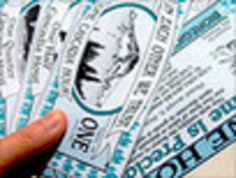
It may seem like Monopoly money to outsiders, but a growing number of communities across the U.S. are using homegrown local currencies to stimulate their economies and protect themselves from the nation's broader economic woes.
Scoop.it!

The problem with money is that it either has to have intrinsic value in itself, like gold, or it has to be backed by or exchangeable for something that has intrinsic value. The abandonment of this principle, and the worldwide move to fiat currency, money freely printed and backed only by the soundness of the country or bank that issued it, has been brought the world’s economies to the verge of collapse in short order.
Scoop.it!
Economist Steve Keen says we are already in another Great Depression. He advocates bankrupting the banks, nationalising the financial system and paying off people’s debt
Scoop.it!

They're the currencies you've never heard of, conceived by businesses to facilitate bartering. But are IOUs an answer to the credit crunch?
|

Curated by jean lievens
Economist, specialized in political economy and peer-to-peer dynamics; core member of the P2P Foundation
Other Topics

Anders en beter
Met P2P voorbij markt en staat: voor een progressieve coalitie rond de commons. Met nieuws over op p2p gebaseerde praktijken en hoe de overheid, de politiek en de zakenwereld ermee (kunnen) omgaan...

money money money
on money and what it is

music-all
From the Great White Way to the West-End and beyond

Peer2Politics
on peer-to-peer dynamics in politics, the economy and organizations

real utopias
Not TINA (There Is No Alternative) but TAPAS: THERE ARE PLENTY OF ALTERNATIVES
|




