
Media reports this week
9.3K views |
+5 today


Get your free media and communication reports online!
Curated by
heather dawson
 Your new post is loading...
 Scoop.it! This article analyses 3,038,026 English tweets about COVID-19 from March 10 to 23, 2020. It focuses on one relevant aspect of public reaction:gender differences. The results show that females are more likely to tweet 
Scoop.it!

How can schools, educators, and parents and caregivers embrace the opportunities to support young people in becoming digital citizens?
Scoop.it!

From
rsf

Press freedom NGO, Reporters Without Borders (RSF), creates a loophole to overcome censorship by building a safe haven for press freedom. Where? Within one of the world’s most successful video games, Minecraft. In many countries, free information is hard to access. Blogs, newspapers and websites are censored. Journalists get arrested and have to fear for their lives. Such censorship lets many young people grow up in systems with almost no access to independent press. Their opinions become heavily manipulated by governmental disinformation campaigns. But although the youth in those countries differ from ours, they do what young people all around the globe do: play video games. Minecraft is a favourite – one of the world’s most successful computer games, with more than 145 million active players every month. Here communities can build entire worlds out of blocks, experience the freedom of an open world. Its creative mode is often described as “digital Lego”. In these countries, where websites, blogs and free press in general are strictly limited, Minecraft is still accessible by everyone. Minecraft offers unlimited freedom even in countries where there is no press freedom. Reporters Without Borders (RSF) used this backdoor to build “The Uncensored Library”: A library that is now accessible on an open server for Minecraft players around the globe. The library is filled with books, containing articles that were censored in their country of origin.
Scoop.it!

A collection created by the Content Development Group of the International Internet Preservation Consortium in collaboration with Archive-It to preserve web content related to the ongoing Novel Coronavirus (Covid-19) outbreak. Idenitifcation of seed websites and initial web crawling begain in February 2020, and the collection will continue to add new content as needed during the course of the outbreak and its containment. High priority subtopics include: coronavirus origins; information about the spread of infection; regional or local containment efforts; medical'scientific aspects; social aspects; economic aspects; and political aspects. Websites from anywhere in the world and in any language are in scope
Scoop.it!

This report looks at online harassment and its connection to internal corporate culture, shedding light on the relationship between online harassment and systemic bias in the newsroom.
Scoop.it!

Scoop.it!

a report from Fullfact.org and Africa Check it includes information resources and an excellent report entitled: Media and information literacy Lessons from interventions around the world. It has three case studies from Uganda Argentina and the Uk on the role good teachers can play in teaching children to find real facts..
Scoop.it!

Microsoft has been measuring online behaviour and has found a worrying increase of bad behaviour and digital incivility over the last 4 years . This webpage gives information about safer internet campaignsou can scroll down to get global and country report cards. The data is based on surveys of teenagers and adults in 25 nations about 21 types of internet ‘risks behaviours ‘. These include: Unwanted contact hoaxes, frauds & scams; unwanted sexting and trolling .
Scoop.it!

This report provides detailed evidence on media use, attitudes and understanding among children and young people aged 5-15, as well as detailed information about the media access and use of young children aged 3-4.
Scoop.it!

To be 'digitally literate' is supposedly a good thing - but what does it actually mean? In this session, we will be investigating digital literacy:- What does it mean for us Heidi Julien: https://youtu.be/UFWd3kVnO98 Amelia Johns: https://youtu.be/YuUQ-Z1knUg
Scoop.it!

Declining levels of trust in the media . Government and media are perceived as both incompetent and unethical.Online survey in 28 markets
|
Scoop.it!
Centre for Countering Digital Hate social media conspiracy fuels non compliance with public health advice.
Scoop.it!

Public Knowledge has initiated monitoring of the approaches of the major digital platforms to respond to the crisis. Our goal is to provide current and accurate updates in the hope the information may help shape policy responses to the pandemic. For each report, updates are marked with NEW (in the narrative) or the date of communication (in the chart).
Scoop.it!

From
www
Specialist units are operating to combat misinformation about coronavirus and five to ten incidents are being identified and tackled each day.
Scoop.it!

By Fernando Bermejo The Media Cloud team has started using our repository of news publications from across the globe to look at the coverage of the coronavirus (COVID-19) pandemic in various digital media ecosystems. It will take time to answer most of the questions that we have, but we can share
Scoop.it!
Matteo Cinelli, Walter Quattrociocchi, Alessandro Galeazzi, Carlo Michele Valensise, Emanuele Brugnoli, Ana Lucia Schmidt, Paola Zola, Fabiana Zollo, Antonio Scala
Scoop.it!

study on levels of online harassment. among young users worldwide and their perceptions on privacy and online abuse http://webfoundation.org/docs/2020/03/WF_WAGGGS-Survey-1-pager-1.pdf
Scoop.it!

This article is by Polis Visiting Research Fellow Ville Kinnunen of Finnish broadcaster Yle Voice technologies are changing the way we use machines to access information…
Scoop.it!

This report describes a database of online tools that are developed by nonprofit, civil society organizations and are designed to reduce the spread of online disinformation.
Scoop.it!

As Hollywood tallies its year-end totals, a new study released Feb. 5 offers insight into how gender and race/ethnicity of the lead/co-lead character is related to economic success.
Scoop.it!
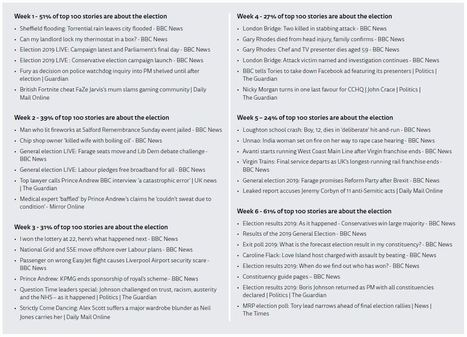
How did Brits engage with news online during the recent election? We tracked more than 1,700 people's online news usage during the campaign to find out.
Scoop.it!

As ownership of mobile phones, especially smartphones, spreads rapidly across the globe, there are still notable numbers of people in emerging economies who don't have access to mobile phones. And even phone owners struggle with connectivity, costs and security issues.
|






