


"Current technology gives us systems that teach students algebra using mastery and flexible pacing, but they just mimic the process of working through a textbook. To better engage today’s students, we should leverage technology and research about learning."

Math, Technology and UDL: Closing the Achievement Gap
27.4K views |
+0 today
Creating new learning environments in math by applying UDL principles may just close the achievement gap in the US!
Curated by
Kathleen McClaskey
 Your new post is loading...
 Your new post is loading...
Your new post is loading...
 Scoop.it!

Interactive, animated maths dictionary for kids with over 600 common math terms explained in simple language. Math glossary with math definitions, examples, math practice interactives, mathematics activities and math calculators.
Why UDL?: A Maths Dictionary for Kids uses multiple means of representation to define, illustrate and reinforce math terms and concepts. For most math vocabulary, there is an interactive student activity that provides multiple experiences to math vocabulary that can increase depth of knowledge. 
Scoop.it!
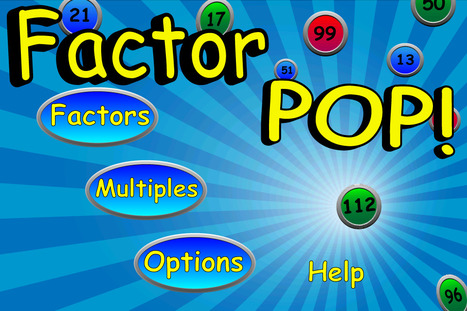
Factor POP!! - More than a video game, Factor POP! challenges users to utilize math skills and quick fingers. “This program reaches out to those students who do not do well with traditional programs. It supports the struggling learners by using fun, kinesthetic response to traditional problems. Through the different speeds, students will increase the rate at which they make calculations, transitioning from calculating to just memorizing what numbers divide into other numbers."
Scoop.it!

The Futures Channel Videos and Activities Deliver Hands-On, Real World Math and Science Lessons for the Classroom. The Futures Channel supports the UDL principles: multiple means of representation and engagement.
Scoop.it!

Educational tools that help mid-school learners better understand math concepts.
Why UDL?: Math Snacks provides Multiple Means of Representation and Engagement of math concepts using animation and interactive math games. They can be used online or as app on an iPod Touch, iPhone or iPad. (Funded by USDOE and NSF)
Scoop.it!

"Is there is a way to narrow the middle school science and math gap for children with disabilities? According to one researcher, Dr. Matthew Marino of Washington State University, perhaps it has already arrived, via a STEM (Science, Technology, Engineering and Math) curriculum in a Universal Design for Learning (UDL) framework underpinned by nascent assistive and instructional technology. "
A "must read" on UDL and STEM published by The Family Center on Technology and Disability.
Scoop.it!
A master teacher in Anchorage, Alaska, establishes a cooperative-learning environment in an upper-elementary classroom.
Watch this video for a great example of UDL in a classroom that requires no technology. A teacher in Anchorage, AK demonstrates his strategies for creating a collaborative environment for learning.
Why UDL? Fostering collaboration and communication is an important UDL strategy. Watch students share ideas, practice discussion, provide constructive feedback, and work in groups.
Scoop.it!
Students in Eeva Reeder's geometry class design schools for 2050.
Geometry students at Mountlake Terrace High School design a state of the art high school for 2050 in teams as a culminating project. Students receive guidance and feedback from a local architect who eventually judges the students' projects.
Why UDL? Connecting learning to students' own lives is an important UDL strategy. Relevance, value, and authenticity are enhanced for these high school students by developing their math skills through a real world problem
Scoop.it!
David Allsopp discusses how RTI can impact math achievement. Because there is usually no pedagogy behind math instruction as he explains, the UDL pedagogical framework may just be the missing piece. Your thoughts...
Scoop.it!
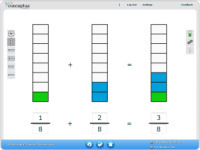
Visual fractions tools and activities support whole class instruction, student practice and student investigations...
Scoop.it!
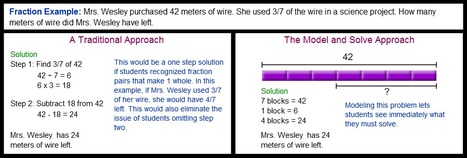
Thinking Blocks supports the 1st principle (multiple representation) of UDL in providing blocks to model and solve word problems. It also supports the research from the IES (Institute of Education Sciences) where there is strong evidence that interventions should include instruction on solving word problems that is based on common underlying structures. Help all students learn how to solve word problems using the Thinking Blocks Model and Solve Tool!
Scoop.it!

Edmonton Regional Learning Consortium includes math applets that can be used to support conceptual understanding of math.
Scoop.it!
On the CAST site, a comprehensive list of math software and websites are described.
|
Scoop.it!

Learn about the innovative language-independent ST Math software developed by the MIND Research Institute that uses a visual approach to teach math concepts.
"Born out of decades of breakthrough neuroscience and education research, MIND's Education Division deploys its distinctive visual approach through innovative instructional software, textbooks, and professional development for the K-12 math market. MIND's unique math education process engages the learner's spatial temporal reasoning abilities to explain, understand, and solve multi-step problems."
Some of the benefits from the MIND Program includes:
> Innovative visual approach teaches math concepts
Scoop.it!

"Available for free, the app uses the camera on iPhone or iPod touch to overlay computer-generated graphics on top of the physical, real-world environment. Extending PBS’s leadership in using augmented reality as an educational tool, FETCH! Lunch Rush opens a new world of learning by teaching kids ages six to eight math skills, like addition and subtraction, while blending the virtual and real world into a truly engaging experience." Via Barbara Bray
Scoop.it!

This is a great alternative to physical fraction bars. The virtual bars allow for more flexibility and provide options that physical pieces cannot. Via kathy pryor, michel verstrepen, Smaragda Papadopoulou
Scoop.it!

In this essay, UDL is proposed as the first tier in a prevention strategy by Fuchs and Fuchs, well known for their work in intervention strategies.
"Universal Design for Learning from the Center for Applied Special Technology calls for students to have multiple means of expression, representation, and engagement in their learning. Instructional media should provide those elements and have scaffolds built in (Deubel, 2003). Within a universal design framework, Fuchs and Fuchs (2001, pp. 86-87) presented four principles of primary prevention that can be used with all students."
Scoop.it!
Sue Glascoe has created a blog with a wealth of resources on how to use tools to make math both engaging and accessible to all learners. This link shows how to use Livescribe in math in combination with Glogster. Thank you Sue for empowering us with ideas and resources to level the playing field for all learners!
Scoop.it!
Math videos on Math Playground can be used to provide "multiple means of representation and engagement" for students who need another way to understand math concepts and processes. I know from teacher and student testimonials how effective they have been in improving math understanding. If you have a website or LMS, link to these math videos that support all students in and out of school. Oh yes, this site has math games that kid's love.
Scoop.it!
In Be The Game, high school students mentor peers and use game design as a tool for teaching science, technology, engineering, and math, and the program's high tech bus travels to locations where tech facilities are not available.
Advanced high school students serve as mentors, teaching younger students the fundamentals of game design as part of McKinley School's STEM (Science, Technology, Engineering, Math program).
Why UDL? Fostering collaboration and communication is an important UDL strategy. In this video, see how student mentors gain confidence and reinforce their skills by teaching others and see how younger students benefit from individualized coaching.
Scoop.it!

"Research shows that children formulate extraordinarily interesting and complex mathematical ideas, even at a very young age. The Private Universe Project in Mathematics demonstrates and honors the power and sophistication of these ideas, and explores how mathematics teaching can be structured to resonate with children's sophisticated thinking. This workshop offers the rare opportunity to follow the mathematical development of one group of students throughout grades 1-12, and to observe teachers in the process of redefining what mathematics is for themselves and for their students."
Scoop.it!

Ms. Olaughlin and Ms. Caballero talk about how they share the teaching tasks in a co-taught algebra classroom.
Tools: Interactive White Boards, MS Word, MS Excel
UDL Principle: Representation
UDL Guideline: Options that illustrate key concepts non-linguistically
Scoop.it!
"Each module consists of a set of free, downloadable, printer-friendly publications. The publications include a teacherʼs guide, teacher resources (such as transparencies, wall charts, and unit organizers), and student materials (student booklets containing reference materials for students as well as problem sets/activity sheets for use during guided and independent practice). The modules assist teachers in enhancing how new content is presented and represented, how students learn and practice the content, and how students express what they know and can do."
Scoop.it!
Here is an example of a Math Lesson created for First Grade students that utilizes Universal Design for Learning elements.
Scoop.it!
Steve Nobel makes the case for the need for Universal Design in Math as he states: "Math textbooks and other instructional materials will provide much greater accessibility for students with visual or learning disabilities when they are made available in a universally designed accessible digital format."
|




