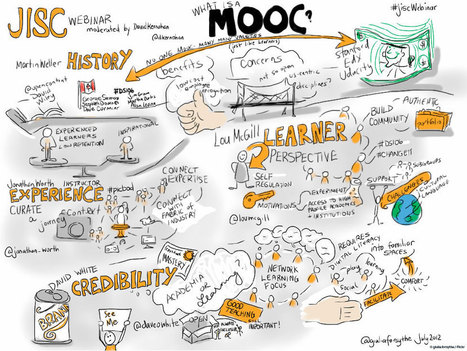
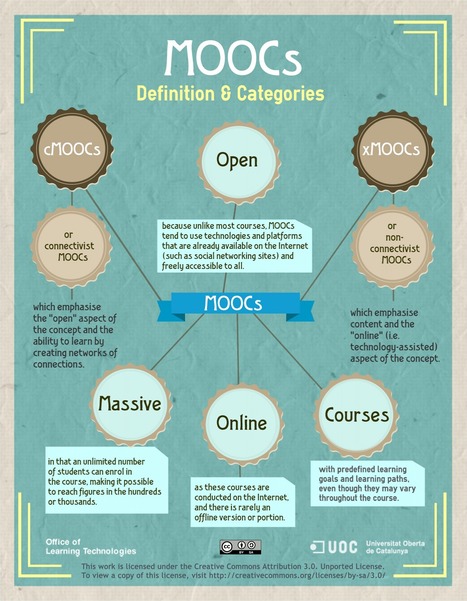
Moocs required us to rethink how to create open and free courses that would engage large numbers of learners. Over the years, we’ve adapted our services in response to lessons we’ve learnt from our experiments, write Nikki Stuart and Lauren Johnston-Smith
Curtis J. Bonk will deliver a presentation via videoconference at Tampere University of Applied Sciences, http://www.tamk.fi/. The following themes are included in presentation:
- Massive open online courses as part of the higher education. - The trends of e-learning and educational technology. - Opportunities and challenges in online learning, blended learning and moocs - Recommendations and guidelines for design and implementation of MOOCs
... Passively watching a video doesn’t achieve the same level of rich learning, because it does not require the student to do anything but sit, watch, and hopefully absorb information.
The great news is, designing active learning experiences for your MOOC is fun and won’t cost you a thing! ...
...“MOOCs challenge everyone involved – participants and staff – to use and improve their skills in digital learning – which is in itself a 21st century skill,” Professor Griffin said...
"Whilst the initial success of MOOCs has been substantial, there has been a growing desire to see the format of learning offered updated to reflect the way people study in a modern world…"
"Massive open online courses (MOOCs) are still pretty new but more and more universities, platform providers and publishers are beginning to create MOOCs to raise their profile and showcase high-quality materials. But there is a risk that reputations can take a serious hit if materials and data are being used incorrectly, or without permission."
I report on the demographics and experiences of two cohorts of students who completed an 8 week course. The cohorts include: 29,000 students who took the course via MOOC, and 100 students who took the course on campus at Georgia Tech. Of those students, the data is based on 879 respondents who completed the course online and 57 who completed the course on campus. Both groups were provided the same curricula and were assessed according to the same criteria...
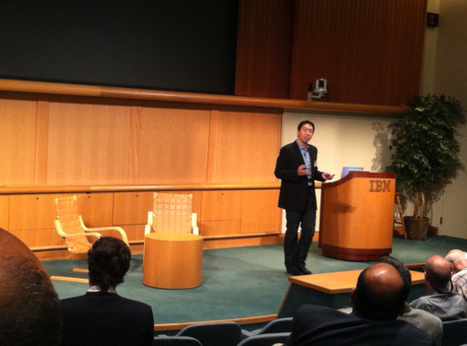
Coursera uses data on clicks and response to emails to see how engagement with course content changes, co-founder Andrew Ng said at an IBM event today.
"... an analysis of Twitter usage surrounding a German-language MOOC that could indicate future trends in technology-enhanced learning. Our research focuses on the Twitter stream accompanying the course and ask how Twitter is used and for what purposes by the heavy twitter users, by the educators / organisers / guestspeakers in the course and if tweets from “outside” get into to the stream.."
Reference: van Treeck, T., Ebner, M. (2013) How Useful Is Twitter for Learning in Massive Communities? An Analysis of Two MOOCs. In: Twitter & Society, Weller, K., Bruns, A., Burgess, J., Mahrt, M., Puschmann, C. (eds.), Peter Lang, p. 411-424
Figuring out how the pieces that you cobble together to create a MOOC actually work. Read this and make your own decisions about whether Twitter should be part of your MOOC sandwich.
Use of TWitter within MOOCS - expect more of this to come. Rather detailed and reviews two German Language MOOCs. Some ideas on how Twitter can be applied to on campus classes
A slideshare presentation by George Siemans with references to the 'MOOC Canvas model' (Alario-Hoyos et al) and 'Design and Evaluation Framework' (Grover et al)
So after a couple of years since MOOCs become a recognized eLearning strategy (and for the sake of our readers, I’ll suppose you know what generally defines a MOOC), where do they stand? Still the possible future of education? Still a developing concept? Or perhaps a failed experiment?
I’ll stand in the middle, aligning myself with ‘developing concept’, as there is promise, hype, and both encouraging and discouraging results.
"Everyday, thousands of students around the world perch themselves in front of computer screens in homes, libraries, coffee shops, and Internet cafes to take a ma..."
While highlighting the obvious benefits of MOOCs for self-motivated individuals, this aricle does a nice job of also explaining the importance of face-to-face interaction with the instructor for many students to succeed. Blending MOOCs with other forms of delivery may be a way for MOOCs to move forward with lower dropout rates.
Massive Open Online Courses, or MOOCs, took the world by storm in 2012. After years of experimentation at the fringes of higher education, prestigious universities from around the world progressively surged…
"...But one reason institutions like Stanford University and Edinburgh University embraced MOOCs was that they provided a wonderful opportunity to learn about online learning. These institutions recognised that MOOCs were a vehicle for educational research, particularly through the use of learning analytics..."
"As digital learning environments, MOOCs are ideal for incorporating game elements. In fact, many MOOCs already have some kind of gamification, such as digital badges, which are becoming preferred alternative credentials in both the education and training spheres.
Gamification in MOOCs can take a variety of forms, from merely introducing a progress bar into courses (these now come standard in many learning management systems) to full-scale gamified training programs, with competitions, levels, content unlocking, rewards, and more…"
Massive Open Online Courses (MOOCs) collect valuable data on student learning behavior; essentially complete records of al student interactions in a self-contained learning environment, with the benefit of large sample sizes. […]
• […] 76% of all participants were browsers who collectively accounted for only 8% of time spent in the course, whereas, the 7% certificate-earning participants averaged 100 hours each and collectively accounted for 60% of total time.
• Students spent the most time per week interacting with lecture videos and homework, followed by discussion forums and online laboratories;
The article analyses the behaviour of some 150,000 registrants for the inaugural edX course — 6.002x: Circuits and Electronics, which was offered in the spring of 2012. The analysis is based on the log files for the course, constituting an exemplary case of the application of learning analytics in action (although the authors don’t use that term at all). It consists of two parts. First, the authors take the data of all registrants into account, later to focus on those relatively few (about 10,000) who managed to earn a course certificate.
Overall, this is an interesting and useful study. I have two minor qualms with it. First, the analysis focuses on those registrants who passed the exam and earned a certificate. Although the 10,000 students who managed to do this is a sizable number, it pales with the 150,000 who registred in the first place. Second, and as far as I am concerned more importantly, no attempts is made to frame the discussion in the context of a particular learning theory. However, these qualms do not detract from the value of this study, it deserves to be widely read, particularly by people who are engaged in learning analytics (who might miss it as that term is not used). @pbsloep
The popularity of Massive Open Online Courses (MOOCs) has attracted considerable attention from academic institutions providing the courses, potential students and researchers. The enthusiasm for all the possibilities of this type of online education has, however, been tempered by issues such as of the quality of education provided, the support needed by vast numbers of students and the high drop-out rate. The Educational Data Mining community has an important role to play in the debate about the advantages and disadvantages of MOOCs, as well as in proposing intelligent solutions for addressing various educational aspects. There are many challenges of knowledge discovery in MOOCs, including the vast volume of data and the diversity of users. These challenges, however, bring opportunities to develop new data mining techniques or adapt established knowledge discovery approaches to the requirements of analysing MOOCs data.
Last week I reported on the EMOOCs conference, in which a significant part was reserved for reporting on various experiences with and research results on MOOCs. This July a workshop will be held focussing on data mining in MOOCs. If MOOCs are as massive as their name suggests - which of course is not always the case in actual fact - then data mining should be particularly profitable. It should give us insights in how MOOCs fare but also on how to generate the raw material on which recommenders may operate. The call for papers is still open until April 14th, so everybody who has a data mining & MOOCs axe to grind, pay attention! @pbsloep
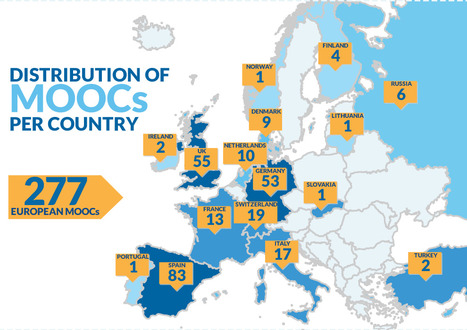
"The aim of this scoreboard is to highlight the huge potential that European institutions have in the world of MOOCs and to help visualize this potential by compiling the existing European-provided MOOCs and open courses available on different open websites"
Massive Open Online Courses are attracting millions of students, but providers and platforms are struggling with holding their attention to completion.
To get content containing either thought or leadership enter:
To get content containing both thought and leadership enter:
To get content containing the expression thought leadership enter:
You can enter several keywords and you can refine them whenever you want. Our suggestion engine uses more signals but entering a few keywords here will rapidly give you great content to curate.


 Your new post is loading...