Your new post is loading...
As part of its ongoing initiative to offer library patrons access to 21st-century technology, Chicago Public Library (CPL) has added programmable Finch Robots to its catalog. ...The robots, which were developed at Carnegie Mellon University’s CREATE (Community Robotics, Education, And Technology Empowerment) Lab, aim to teach children and adults the fundamentals of computer programming and are geared toward patrons ages 8 and up, Kraft explains. Students can program the robots in more than a dozen computer languages to perform functions such as move, make noise, light up, and draw.
Via Judy Schrape

|
Scooped by
Kim Flintoff
November 6, 2014 12:45 AM
|
|
|
Scooped by
Kim Flintoff
November 5, 2014 8:09 AM
|
The John and Stella Graves MakerSpace is an area where members of the University of Maryland community can try new equipment and experiment with all sorts of materials.
A space to unleash creativity and innovation, and located in the popular Terrapin Learning Commons (McKeldin Library’s second floor), the Makerspace models a new environment in the library where students can use technology and tools to create prototypes, experiment and learn. We will also have a list of other fabrication labs on campus soon!
Use a wide array of items, such as our 3D printers, vinyl cutter, soldering kit, and more! This space is located on the second floor of McKeldin Library in the TLC and will be available to use starting in Fall 2014. Makerspace Definition from EDUCAUSE.
Check out the links below to learn more about the Makerspace:
Policies
List of Equipment
3D Printing Request Form
Makerspace Interest Form
Events
Launch UMD is partnering with the iSchool and our MakerSpace
|
|
Scooped by
Kim Flintoff
November 5, 2014 8:05 AM
|
Over the past year , the Fayetteville Free Library (FFL) has enjoyed the successful rollout of its Fabulous Laboratory (Fab Lab), a Maker space that resulted from the library’s commitment to community engagement and innovation. During this time, the library’s staff have been honored to speak about the Fab Lab and to explain not only its success but also the variety of challenges and assumptions that most libraries will face when developing a similar space.
One of the most important contributing factors to FFL’s success is its culture of innovation that requires the team to think beyond the limitations of the past and to imagine a new vision for the community. As part of this culture, FFL has developed a staffing model that takes advantage of our close proximity to Syracuse University’s iSchool, one of the most renowned library and information science schools in our nation.
|
|
Scooped by
Kim Flintoff
November 5, 2014 8:03 AM
|
Maker spaces in libraries are the latest step in the evolving debate over what public libraries’ core mission is or should be. From collecting in an era of scarce resources to curation in an era of overabundant ones, some libraries are moving to incorporate cocreation: providing the tools to help patrons produce their own works of art or information and sometimes also collecting the results to share with other members of the community.
Maker spaces promote learning through play; have the potential to demystify science, math, technology, and engineering; and encourage women and underrepresented minorities to seek careers in those fields.
|
|
Scooped by
Kim Flintoff
November 5, 2014 8:02 AM
|
What Are Makerspaces?
Makerspaces are part of a growing movement of hands-on, mentor-led learning environments to make and remake the physical and digital worlds. They foster experimentation, invention, creation, and exploration through design thinking and project-based learning. The movement aligns with President Obama’s Educate to Innovate initiative and his call to “think about new and creative ways to engage young people in science and engineering [and]...encourage young people to create and build and invent—to be makers of things, not just consumers of things.” (Obama, 2009)
|
|
Scooped by
Kim Flintoff
November 5, 2014 7:59 AM
|
I first heard of makerspaces when, as I sat in my office, a colleague called me over to see if I wanted to join a webinar on makerspaces. Listening over her shoulder, I heard phrases like DIY, and tools kept popping up. Not the usual web-based tools talked about in webinars, physical tools... y’know, wrenches and pliers? Real tools. I’ve always seen libraries as community centers for people to gather and work together, but this? It stretched my imagination.
When most people think of libraries, they naturally think books. Anyone working in a library today, however, knows that we are so much more than just books. Libraries are places of community engagement. Recently many libraries have begun to develop spaces for design and activities that both teach and empower patrons. The learning in these spaces varies wildly--from home bicycle repair, to using 3D printers, to building model airplanes. Fittingly, they are called makerspaces.
|
|
Scooped by
Kim Flintoff
November 5, 2014 7:47 AM
|
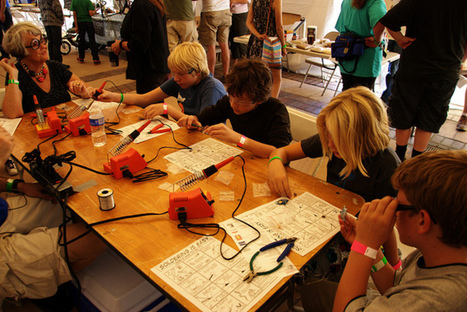
Kids gather to make Lego robots; teens create digital music, movies, and games with computers and mixers; and students engineer new projects while adults create prototypes for small business products with laser cutters and 3D printers. Many libraries across the US have developed makerspaces—places to create, build, and craft—and they are experiencing increased visits and demand as a result. For public libraries, they are places to promote community engagement. For academic libraries, they are places where students and faculty feel welcome to do classwork and research. Fundamentally, makerspaces are a technological leap past library knitting and quilting circles, where patrons and experts have often come together to learn new techniques and train others in a skill. The new tools are a lot flashier, and certainly more expensive than a needle and thread. The cost factor is what makes a makerspace so appealing to library visitors—what one person cannot afford to purchase for occasional use, the library can buy and share with the community.
|
|
Scooped by
Kim Flintoff
November 5, 2014 7:46 AM
|

|
Scooped by
Karen Miller
November 4, 2014 7:45 PM
|
The Maker Movement Manifesto - Rules for Innovation in the New World of Crafters, Hackers, and Tinkerers by Mark Hatch
|
|
Scooped by
Karen Miller
November 4, 2014 7:31 PM
|
littleBits is an opensource library of electronic modules that snap together with magnets for prototyping, learning and fun.
|
|
Scooped by
Karen Miller
November 3, 2014 12:37 AM
|
"The uTEC Maker Model visualizes the developmental stages of creativity from individuals and groups as they develop from passively using a system or process to the ultimate phase of creativity and invention".
|
|
Scooped by
Kim Flintoff
November 2, 2014 8:11 PM
|
Have you ever look at a Maker's Notebook and said, "What a waste of money!" You can easily make your own Maker's Notebook. This may not be exactly like the Maker's Notebook, but it's pretty close.
Disclaimer:
I have no responsibility to what following the instructable causes: this includes any damage to yourself, any other person, or any property.
|
|
|
Scooped by
Kim Flintoff
November 8, 2014 8:30 PM
|
The Maker Movement is everywhere. What is it? How do you “do” it? What is the difference between “maker space” “creation station” “genius hour” and all of these other terms? How can you decide what to do in your own classroom? Here are a few essential resources for you: Reading About the Movement My research …
|
|
Scooped by
Kim Flintoff
November 5, 2014 8:50 AM
|
One evening when I was young, my father confiscated my radio because he said I was playing it too loud (I wasn’t). Fortunately, I had a bunch of broken down receivers in my room, so I built a new one. In hindsight, this was probably the start of my career as a Maker. Makers see a need but rather than asking somebody else to address it, they take matters into their own hands and fix things themselves.
|
|
Scooped by
Kim Flintoff
November 5, 2014 8:07 AM
|
Your community is supercharged about the new makerspace planned for your library. All systems are full speed ahead, and the staff is ready. But wait. Have you considered all the issues? For instance, Do you know about the liability issues inherent in makerspace programs?What can your library do to protect itself from liability?What elements should be in user waivers and in partnership agreements?Can the library protect itself from intellectual property liability when patrons use library equipment to create and copy all types of works using library tools and equipment such as 3D printers? At the end of this one-hour webinar, participants will understand ways to: Minimize liability through waivers and insurancePoint users to intellectual property resources to minimize their risksRegister the library with U.S. Copyright Office to minimize its exposure to copyright liability from user generated contentFrame a partnership agreement with an outside provider
|
|
Scooped by
Kim Flintoff
November 5, 2014 8:04 AM
|
In his presentation at the 2012 Computers in Libraries conference, Fiacre O’Duinn defined Maker culture as “learning through hands-on creation; a combination of technology, art, and citizen science; and a sharing of results and, often, process.” Whether its via 3-D printers, microcontrollers, knitting, or gardening, Makers want to shape everyday objects to be reflections of themselves, not have their identities be made up of the objects they use.
Over the past 40 years, public libraries have followed popular culture through the ever-more-abstract artifacts of the digital age, offering music and video in every format, public computers for Internet access, online branches, and downloadable content. Now, some libraries are following Maker culture back to things we can hold in our hands.
|
|
Scooped by
Kim Flintoff
November 5, 2014 8:03 AM
|
Content-creation spaces, or ‘makerspaces’, are an emerging phenomenon in public libraries worldwide. This study investigated the current state of makerspaces in Australian public libraries. Qualitative interviews with three information professionals formed the data collection. Thematic analysis of interviews addressed two research questions: What are the issues and challenges of creating makerspaces within Australian public libraries? How can they be addressed? Findings revealed the substantive benefits of these spaces, including enhanced community engagement, development of a new form of library as ‘third place’, and transforming the library's image from that of a place where works are consumed to that of a place where works are created. Additionally the study highlighted significant challenges to creating these spaces, including budgetary constraints, resistance to change within organisations and proving the relevance of such spaces within a library context. The study provides suggestions for overcoming these obstacles and provides areas for further research in the area, including larger studies across a broader geographic area and further investigation and follow-up into upcoming programs within existing makerspaces.
|
|
Scooped by
Kim Flintoff
November 5, 2014 8:00 AM
|
What is a Makerspace?
A place where people can collaborate, innovate, and create using information, resources, tools, and collections provided at the library. People can play, tinker, explore, or pursue personal or professional goals.
Goals:
Spur innovation and artistic expression through hands-on experiences
Collaborate with the community to explore talents, skills, and expertise
Build technology confidence and integrate technologies into our services, spaces, and processes
|
|
Scooped by
Kim Flintoff
November 5, 2014 7:48 AM
|
Presented at 'The evolving space: Makerspace' seminar at the State Library of Victoria, 4 June 2014. Presentation based on paper: Diane Slatter & Zaana Howard …
|
|
Scooped by
Kim Flintoff
November 5, 2014 7:47 AM
|
|
|
Scooped by
Kim Flintoff
November 5, 2014 7:29 AM
|
As it turns out, you can make just about anything with a 3-D printer and make it work.
When 12-year-old Minghao of China was diagnosed a couple of months ago with Ewing's sarcoma, a bone cancer typically found in children, his doctors opted for a...
|
|
Scooped by
Karen Miller
November 4, 2014 7:40 PM
|
From FastCo.Labs: Starting this week anyone can download 3-D models of sculptures and artifacts from the collection of the British Museum. The models are available online in file formats that are ready to be used by any 3-D printer. Through a partnership with the British Museum in London,
|
|
Scooped by
Karen Miller
November 4, 2014 7:19 PM
|
|
|
Scooped by
Kim Flintoff
November 2, 2014 8:11 PM
|
littleBits is an opensource library of electronic modules that snap together with magnets for prototyping, learning and fun.
|