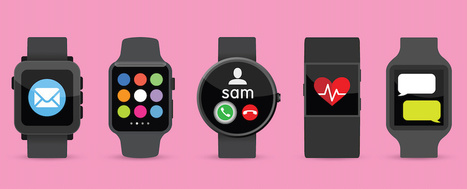
Today, technology is allowing us to capture unprecedented data on our daily activities. Wearables like Fitbit track movement, calories burned—even sleep. GPS enabled mobile devices capture my car’s every turn. The Internet of Things helps us understand temperature preferences to optimize energy
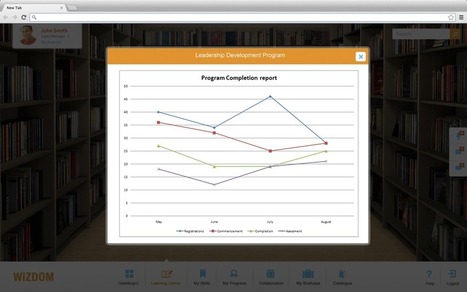
What will the game-changing tool kit look like for next-generation learning? How can institutions prepare to meet the increasing demands? Institutions will be required to transition from metrics to analytics and from reporting to actionable interventions. In this next generation of the learning environment, analytics will play a role in higher education. But leading the institution from metrics to analytics and reporting to action will require a significant institutional shift.
Content mining of archival materials can make for amazing discoveries. Here's how to prepare for the coming influx of researchers who will want access to digital archives as a data source.
The Predictive Analytics Reporting (PAR) Framework was launched in 2011. PAR's Ellen Wagner discusses insights from four years of exploring the impact of predictive modeling for improving postsecondary student success.
The Predictive Analytics Reporting (PAR) Framework was launched in 2011. PAR's Ellen Wagner discusses insights from four years of exploring the impact of predictive modeling for improving postsecondary student success.
Can we imagienPersonal data collection has long been used to boost productivity but could tiny microphones – embedded in each employee’s own lanyard – be about to change the face of office culture forever?
A Deloitte team in Newfoundland adopted the pilot project last winter during office renovations – CBC News recently reported on its impact. According to one in-house HR expert, it’s been a huge success.
"The minute that you get the report that you're not speaking enough and that you don't show leadership, immediately, the next day, you change your behaviour," Silvia Gonzalez-Zamora told CBC News.
"It's powerful to see how people want to display better behaviours or the behaviours that you're moving them towards,” added the analytics leader.
The concept isn’t as Orwellian as you might think – while the microphones pick up tone of voice and frequency of contributions during meetings, they don’t record specific conversations.
Similarly, accelerometers measure body language and track how often an employee pushes away from their desk – but don’t count coffee breaks or trips to the toilet.
All the data collected is done so anonymously and each employee is assigned their own confidential ID – this way they can compare their own behaviour against that of other participants without fear of reprisal.
Can we imagine this kind of data collectiion making its way into Teaching and Learning? These devices are simple "wearable technologies" integrating with an Internet of Things to become data new data source for analysiing learning behaviours... presents a whole raft of ethical considerations...
Building an exceptional student experience requires and alignment of various disparate data across the institution. A key part of the exceptional student experience is identifying which students are at risk of dropping out or leaving their institution. As reputation and the bottom line are impacted, it is critical to stem attrition in higher education. But what do you do once you've identified which students are at risk? Successful intervention is key to keeping students on track. That could consistent of academic intervention for extra course study, better advising, a revised set of classes. Or it could be non-academic intervention: more financial aid, a work-study program, or social services intervention.
Colleges and universities must address several critical issues in the years ahead in order to prepare for the next seismic change: the unbundling of higher education.
With changing technologies, the learning industry is changing its expectations from e-learning as well. While until a few years ago e-learning was simply making learning available and accessible
Institutional readiness for learning analytics. Is sounds like a dream. And it is a dream. , it was the title for a conference LACE project organised in collaboration with University of Amsterdam middle of December. Through exploring a number of pilots organised at UvA, a detour to the swamps of interoperability and standardisation, an introduction to the practice of institutional readiness consultations, the around 40 participants gathered in Allard Pierson Museum in Amsterdam were eventually invited to develop visions of the future. Judging from the evaluations sheets filled out in the end the experience had been ‘educational’ with enough slides, receiving more than ‘good’ marks, both in content and organisation.
According to ResearchGate, the academic social networking site, their RG Score is “a new way to measure your scientific reputation”. With such high aims, Peter Kraker, Katy Jordan and Elisabeth Lex take a closer look at the opaque metric. By reverse engineering the score, they find that a significant weight is linked to ‘impact points’ – a similar metric to the widely discredited journal impact factor.Transparency in metrics is the only way scholarly measures can be put into context and the only way biases – which are inherent in all socially created metrics – can be uncovered.
This fall, Oral Roberts University (OK) issued Fitbits to on-campus students and Garmin vivofits to online students — part of the "whole person" philosophy at the Tulsa-based institution that urges students to be "well prepared" physically. The data generated by those activity trackers on movement, heart rate and sleep patterns drizzles automatically into the university's D2L gradebook in time for settling up midterm grades and finals. The results are displayed through D2L for faculty and students, just as if they were weekly quiz grades. The Garmin device, added CIO Mike Mathews, syncs with an online service that allows students to set goals and share progress with others.
Eventually, the campus will use the analytics to find out whether tracking the fitness data and making it visible gets students to move their bodies more, which is the goal, after all.
Insufficient academic preparation is a major barrier to student success in higher education in the United States, and a large percentage of students who require remedial education become mired in courses that are taught using the same deficit-based pedagogy that contributed to their failure to master the curriculum in high school. In 2011, declining state revenues in California and shrinking budgets for education prompted a review of massive open online courses (MOOCs) as a means to improve access to college. However, MOOCs are often designed for students who already possess the kinds of study skills and habits that many remedial students lack. Could a MOOC be designed to serve remedial students without strong study skills and habits? Crafting an Effective Writer: Tools for the Trade (CEW) was designed to create a noncredit option for remedial students to help build their skills before they enter college and thus reduce the remedial instruction needed.
Data are at the heart of the ongoing dialogue between teachers and students. We asked more than 4,600 teachers about the digital tools available to help teachers collect and use data to tailor and improve instruction for individual students.
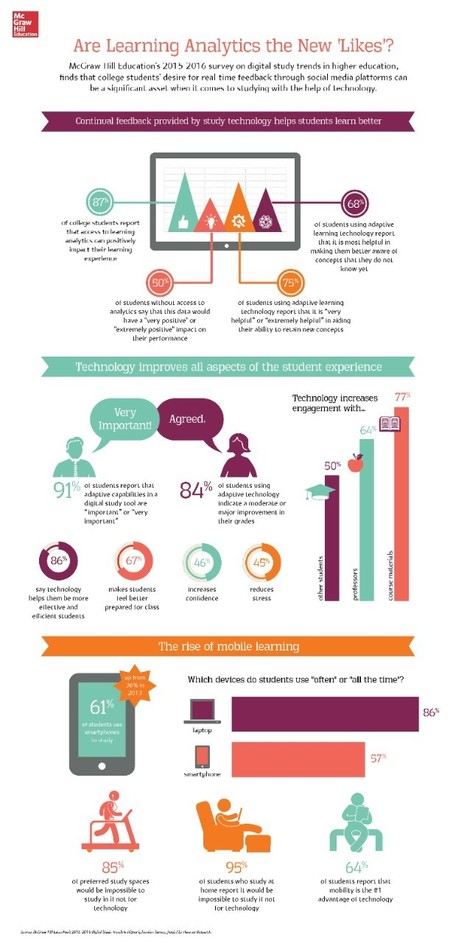
Nearly four out of five college students in a recent survey said that having immediate access to data analytics regarding their academic performance had a positive impact on their learning experience. The study, conducted by Hanover Research on behalf of McGraw-Hill Education, suggested that students seek the same kind of immediate feedback in the classroom as they get from social media.
The survey of 2,657 college students found that almost two-thirds of students believe the impact of analytics reports on their academic performance is "very positive." Three-quarters of the students said adaptive learning is "very helpful" to them in retaining new concepts. Adaptive learning technology is designed to personalize students' learning experiences based on their command of course material, enabling them to focus their attention on the concepts they need help understanding, at the moment they need it.
There’s something big happening in the world of technology. Over the past couple of years there’s been a resurgent interest in neural networks and excitement over the challenging problems that they can now solve. Folks are talking about Deep Learning… I’ve been keeping an eye on what’s happening in the field to see if there’s anything that we can use to build better tools for researchers here at Mendeley. Recently I went along to the Re-Work’s Deep Learning Summit and thought I’d share my experiences of it here.
This literature review, list of definitions, and resources provide a guide for community college leaders evaluating analytics for their institutional technology to promote student success. In the end, a technology strategy inclusive of analytics and combined with an unwavering focus on student achievement might prove an essential precursor to student success at all colleges.
The Education Week Spotlight on Creating a Culture of Datais a collection of articles hand-picked by our editors for their insights on:
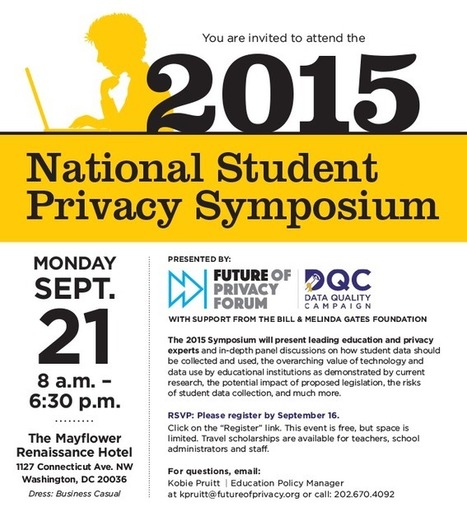
Promoting a culture of data accessibility in schoolsChallenges to the long-term usefulness of state longitudinal data systemsPolicy shifts in the use of students' educational recordsAddressing privacy challenges in a digital age
You get the seven articles below in a downloadable PDF.
Welcome to our project Transforming Learning and Teaching with Practical Analytics.
Learning analytics take advantage of large data sets that relate to student online behaviour. These data sets are analysed to inform approaches that help staff make meaningful and informed decisions around student learning and retention, as well as strengthen student retention and success.
There are systems, such as learning analytics, for staff to understand and interpret student behaviour in Blackboard but what is required is understanding and training in the use of analytics and predictive analytics to make better use of these tools.
The project will develop a practical approach to learning analytics (what we term practical analytics) by providing feedback to academic and teaching staff to support meaningful blended delivery. The project will enable learning analytics for early intervention and support academic staff to translate data into improvement in their teaching practice. We aim to increase the number of staff capable of easily accessing and applying analytics to their teaching practice.
To get content containing either thought or leadership enter:
To get content containing both thought and leadership enter:
To get content containing the expression thought leadership enter:
You can enter several keywords and you can refine them whenever you want. Our suggestion engine uses more signals but entering a few keywords here will rapidly give you great content to curate.


 Your new post is loading...