Your new post is loading...
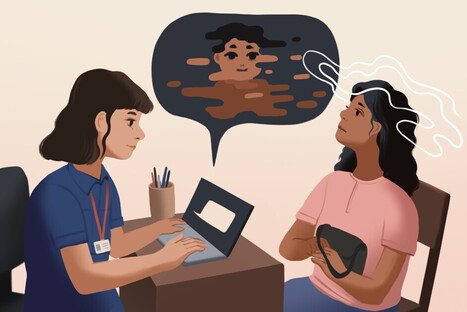
AI tools can translate school materials for non-English-speaking parents, but there are challenges around privacy and accuracy.
While it is tempting to think second-language learners need their own learning routes, this school found that a different approach paid far greater dividends
Hint: It has little to do with imparting knowledge to students.
Ben Knight, Head of Language Content, Research, and Pedagogy, discusses the key takeaways of our recently published paper on digital pedagogy.
Artificial intelligence has moved quickly from something teachers experimented with to something that now shapes everyday instructional decisions. While I have written about classroom uses of AI tools and practical entry points for basic use, it has become clear that tips and tricks alone do not prepare educators to work meaningfully with AI. The more […]
Massachusetts high schools struggle to balance supporting mastery of English and progress toward graduation for immigrant newcomers, according to a new report led by researchers at Brown.
Active family engagement is essential to ensuring children benefit fully from early childhood education and care programs. Yet language barriers and cultural misunderstandings can sometimes keep educators and the families of Dual Language Learners (DLLs) from forming this important partnership. This policy brief explores strategies to better utilize federal funding to engage with DLL children and families.
Modeling, pre-teaching, and effective use of visuals can help students, speakers at an EdWeek forum said.
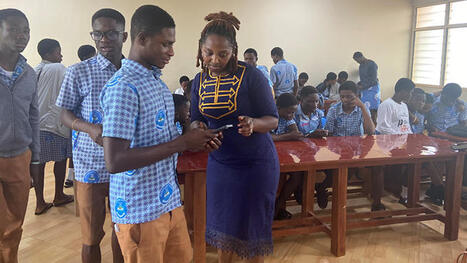
What linguistics expert Dr. Antoinette Barffour's research reveals.
Gen Z's global academic aspirations are driving a seismic shift in English proficiency testing. TOEFL iBT's enhanced adaptive format now mirrors digital-first learning, integrating real-world scenarios for academic and social readiness. This evolution prepares Indian students for cultural integration and success abroad, emphasizing practical skills over traditional methods.
While a young language learner can more easily acquire a native accent, adults retain the ability to learn new languages well into later life.
In this talk, Karolina examines when bilingual children reach key early language milestones, babbling, first words, and first word combinations, between 0 and 3 years of age.
|
OXFORD, Miss. – For bilingual speakers, including many Mississippi-born Latinos who speak Spanish at home and English at school, one language can often influence another. University of Mississippi researcher Stephen Fafulas is studying how those interactions shape language.
José Medina, Elena Izquierdo, and Vanessa Espitia Mendoza talk us through the need for administrators to learn how to lead Dual Language Bilingual Education programs Dual language bilingual education (DLBE) programs succeed or struggle in large part because of leadership. Leaders, including principals, assistant principals, instructional coaches, teacher leaders, and district administrators, are often asked […]
Diana Quintero and co-authors examine how using academic tests to reclassify English learners affects students' high school outcomes.
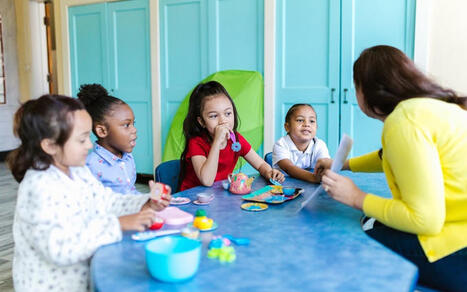
This article examines how co-teachers in Spanish/English dual language bilingual preschool classrooms use transmodal practices—integrating verbal, visual, and actional modalities—to facilitate the Morning Circle (MC) activity, a routine that supports academic and social learning. Through video analysis of three co-teacher pairs, the study finds that teachers strategically coordinate their multimodal and translanguaging resources by mirroring or expanding each other's practices according to the instructional focus, such as melodic learning, numeracy, literacy, or participation norms. These coordinated transmodal practices create a community of practice that engages emergent bilingual children in socially and instructionally relevant routines, highlighting the importance of multimodal communication beyond verbal language alone. The findings challenge traditional hierarchies privileging oral language by legitimizing teachers' collective translingual-transmodal repertoires as essential for supporting bilingual learners' meaning-making and socialization in early childhood education.
Ana Christina da Silva Iddings will never forget the day that she—as a Brazilian teenager who did not speak English—flew by herself to Las Vegas. Her parents sent her there to live with relatives she had never met. Da Silva Iddings’ life-changing experiences in Vegas, where she became fluent in English and worked in daycare, set her on a path to help multilingual children who are simultaneously learning English as they learn other subjects in the classroom.
New study finds a common neural system builds a language across languages
Study shows comprehension intervention, working memory predict math achievement in English learners
Brussels Bilingual Babies: How Easy is it to Raise Multilingual Children
Alexandra Güílamo suggests how dual language program leaders can best integrate science of reading legislation Arias, M. B. (2018). “Preface.” In M. B. Arias and M. Fee (Eds.), Profiles of Dual Language Education in the 21st Century, pp. xiii–xviii. Bristol, UK: Multilingual Matters. Buckingham, J., Beaman, W. R., and Wheldall, K. (2019). “Systematic and Explicit Phonics Instruction: A scientific, evidence-based approach to teaching the alphabetic principle.” In R. Cox, S. Feez, and L. Beveridge (Eds.), The Alphabetic Principle and Beyond (pp. 49–67). Newtown, NSW: Primary English Teaching Association Australia. Butvilofsky, S. A., Escamilla, K., Gumina, D., and Silva Diaz, E.
Researchers discover that the brain proactively builds sentence structures during speech using predictive processing, explaining why second-language listening is difficult.
Bilingual people use largely the same brain system to understand meaning in both their languages, but each language subtly reshapes how that system processes different categories of words, according to new research from UC Berkeley. The study, published Monday in the Proceedings of the National Academy of Sciences, used functional MRI to record the brain
|