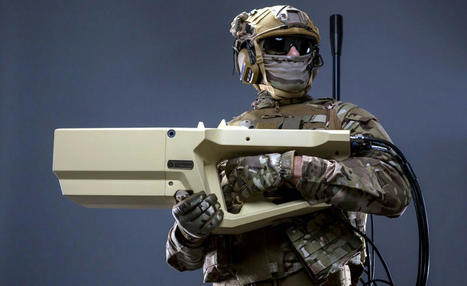
AFRL's THOR (Tactical High-power Operational Responder) is a prototype Directed Energy (DE) weapon used to disable the electronics in drones, and was specifically engineered to counter multiple targets – such as a drone swarm – with rapid results.
In recent tests at Eglin Air Force Base, DARPA’s Mobile Force Protection (MFP) program demonstrated a Counter-Unmanned Air System (C-UAS) multilayer defense architecture to defeat unauthorized drone intrusions over military installations or operations.
Development of this low-cost reusable drone interceptor system approach began four years ago with the aim of creating an integrated system for thwarting attacks from self-guided small unmanned aircraft. The goal is to protect high value convoys moving through potentially populated regions where there is a requirement to avoid using explosive defensive weapons and mitigate collateral damage.
The technology demonstrator successfully neutralized tactically-relevant drones using a newly-developed X band radar that automatically senses and identifies unmanned aerial system threats. The radar then pairs targets to specific interceptors through an automated decision engine tied to a command and control system, launching and guiding rotary and fixed wing interceptors with two types of drone countermeasures while on the move and without operator intervention.
“Because we were focusing on protecting mobile assets, the program emphasized solutions with a small footprint in terms of size, weight, and power,” said MFP program manager Gregory Avicola in DARPA’s Tactical Technology Office. “This also allows for more affordable systems and less operators.”
The requirement that the system field non-kinetic solutions pushed concepts that could be employed in and around civilian areas. The primary drone negation mechanism shoots strong, stringy streamers from reusable interceptors that foul propellers causing loss of propulsion. Additionally, other non-kinetic techniques were developed and demoed. The focus on defeating raids with multiple threats, rather than single unmanned aerial attackers, required the development of an integrated solution of sensors, autonomy, and mitigation solutions more robust than existing systems. Dynetics was the primary systems integrator.
DARPA is currently working with the military services to transition technology developed in the MFP project into various acquisition programs.
The Mobile Force Protection program is designed to defeat drone intrusions over military installations and convoys using small unmanned aircraft. Using an X band radar, MFP automatically detects and identifies potential threats, then selects the appropriate interceptor to respond with. The system has a few different small drones it can send out, including rotary and fixed-wing interceptors. The primary interceptor tool is the one that shoots the streamers to gum up the works of other drones.
The entire process is designed to work without operator intervention.
“Because we were focusing on protecting mobile assets, the program emphasized solutions with a small footprint in terms of size, weight, and power,” said MFP program manager Gregory Avicola of DARPA’s Tactical Technology Office. “This also allows for more affordable systems and less operators.”
Dynetics was the primary systems integrator for MFP.
DARPA received $12 million in fiscal 2020 and $4.3 million in fiscal 2021 for the program. The agency is not seeking more funding in FY22, signaling the end of the development project.
The program, which launched four years ago, successfully demonstrated its ability to intercept a drone during recent tests at Eglin Air Force Base, Florida. Watch MFP in action below:
Three Israeli companies are finalists in the U.S Army’s contest to find the most effective systems to neutralize hostile drones, with only one US company still in the mix.
ELTA, teamed with Iron Drone, and XTEND recently demonstrated their systems at Yuma Proving Grounds. The demos are part of the Army’s effort to select Low Collateral Effects Interceptors (LCEI) to counter the rapidly increasing threat from small drones.
The demos were organized by the U.S Air Force, the Joint Counter small UAS Office (JCO) and the Army Rapid Capabilities and Critical Technologies Office (RCCTO) .
ELTA’s Drone Guard is a multi-sensor system developed for the military and homeland security market. It combines a 3-D radar for detection and tracking with identification by electro-optical sensor slaved to radar. It also uses disruption by a directional jammer.
The ELTA-Iron Drone team’s Drone Kill Drone (DKD) system can perform a hard kill or destroy the hostile drone propellers, says Matan Melamed, CEO of Iron Drone.
“We now offer an additional layer of defense – an autonomous drone that gets a first direction from the Drone Guard radar and then flies to “interception point” so that the operator can see the hostile drone and assess how dangerous it is,” Zvi Yarom, general manager of ELTA’s land directorate told BD.
“The use of EW interception in war zones is very problematic, and our joint solution solves the problem. In the recent demo we proved the capability of the joint system,” Melamed said.
According to ELTA and Iron Drone, their system needs no human intervention other than the command to launch. DKD uses a combination of on-board processing, autonomous flight control and optical target lock to find and strike the target. It contains an entanglement net of cut resistant wires that spring-release during flight and entangle the enemy’s rotors for an extremely high kill rate. DKD is modular and scalable to carry additional effector payloads and can be integrated to accept cues from drone detection sensors or Command and Control (C2) systems.
The third Israeli Company that took part in the demo is XTEND, who offered the Skylord Griffon system.
Ido Baron, VP of business development of XTEND told BD that by using an AR device and single-handed controller, a soldier can easily control the drone and perform complex tasks remotely with precision. Its interface enables the operator to “step into” a remote reality and engage targets effectively yet safely.
The drone weighs 900 grams and has a max speed of 150 km/h “To operate this drone a soldier needs minimal training and no prior expertise is required,” the company’s VP told BD. “The operator feels like he sits in the drone’s cockpit and that allows a new operator to intercept hostile drones after only three days of training.”
Baron explained that the drone carries a very light-weight net. “Our drone flies exactly over the enemy drone, releases the net and it kills the props,” he said. “We have proved its capabilities in Israel and now in the U.S ” he said.
Baron revealed that 150 systems are currently used by US Special Operations Command.
L'entreprise d'ingénierie informatique au service de la défense, du spatial et de l'industrie veut doubler son activité de 200 à 400 millions d'euros en trois ans. Un pari jugé plausible, au vu des spécialités ultra-pointues développées. Par Anne Bauer Publié le 7 juin 2021 à 07:48Mis à jour le 7 juin 2021 à 07:49
CS Group, la société services en ingénierie informatique pour la défense, l'aéronautique, la cybersécurité et le spatial, a présenté lors de son assemblée générale un plan pour doubler son chiffre d'affaires d'ici 2024.
La société cotée en bourse et fondée par Yazig Sabeg se sent pousser des ailes, alors que l'ensemble de ses spécialités : cyber, défense, spatial sont en croissance . L'an dernier, CS Group a réalisé 209 millions de chiffre d'affaires et l'entreprise prévoit de parvenir à 400 millions en 2020,
#MatosTerre #CapaciTerre #Innovation La sureté aérienne des bases projetées est notamment assurée par la Lutte anti-drones (LAD). Pour assurer la sécurité des aéronefs lors des décollages et atterrissages ou des militaires sur base, les opérateurs de la défense Sol Air sont là pour veiller.
Le développement d’ICARE (ICARE pour intégration d’une capacité Anti-drones avec radar embarqué) a été porté par la section technique de l'armée de Terre (STAT) de 2019 à fin 2020. Ce programme s’est effectué dans le cadre de la démarche capacitaire de la lutte anti-drones.
Le système s’inscrit dans le segment de la LAD mobile (appui dynamique des GTIA et des SGTIA, manœuvre aéroterrestre). Cette solution contribue ainsi à garantir notre liberté d’action, en préservant notre potentiel de combat et en garantissant notre supériorité opérationnelle face à une menace pouvant échapper aux moyens traditionnels de défense sol-air.
ICARE sera prochainement projeté en OPEX, accompagné par la STAT.
Quels sont les autres moyens utiliser dans le cadre de la défense sol-air ?
Aéroscope Se présentant sous forme d’une petite valise noire carrée, l’aéroscope se compose d’un écran et d’antennes. Une fois allumé, il affiche une carte qui permet de se repérer et de détecter les drones qui survoleraient la zone définie. Si un drone est détecté, une alarme se déclenche.
Jumelles Jirtang JMLR2 Les jumelles Jirtang sont très précises et permettent de voir de jour comme de nuit. Dotées d’un télémètre pour apprécier les distances, elles ont également une option de vision thermique. Matériel très sophistiqué, elles peuvent être fixées sur un trépied et l’image peut aussi être retransmise sur un écran annexe.
Fusil brouilleur Nightmare Une fois le drone détecté, que ce soit à l’aide des jumelles ou de l’aéroscope, ou même à l’œil nu, l’opérateur revêt son fusil brouilleur. Une partie se portant comme un sac à dos et l’autre se présentant comme un fusil. Une fois le drone mis en joue, l’opérateur appui sur la détente et cela envoie des ondes qui permettent de stabiliser le drone.
Fusil à pompe Benelli Nova calibre 12 Le fusil à pompe dispose de deux types de cartouches aux portées différentes, 0 à 80 mètres et 80 à 100 mètres. Une fois la distance appréciée et le drone stabilisé, l’opérateur n’a plus qu’à neutraliser le drone.
Le département américain de la Défense (Pentagon) a demandé la conception d’une nouvelle arme de poing capable d’abattre les drones ennemis directement depuis le sol. L’arme doit avoir la même forme qu’un bazooka antichar, plus petite et assez légère pour être portée sur l’épaule.
C’est un signe que la plus grande puissance militaire du monde est de plus en plus soucieuse d’augmenter sa capacité à contenir de petits véhicules aériens sans pilote envoyés par des adversaires. Et nous ne pouvons manquer de mentionner le fait que l’une des explications données pour les différents ovnis aperçus par les forces militaires américaines est que ces objets, en fait, sont des drones de pays ennemis des États-Unis essayant de les espionner.
Chaque branche des forces armées a intérêt à une solution anti-drone mobile différente. C’est pourquoi l’armée, la marine, l’armée de l’air et les marines se sont joints à la création du Joint Systems Office Against Small Unmanned Aircraft, qui a publié une demande publique indiquant qu’il recherchait des solutions potentielles à faible coût, terrestres et portables. détachable. ce que veut le Pentagone
Dans l’ordonnance, le bureau indique clairement que le bazooka devrait coûter moins de 15 000 dollars américains (76 170 BRL) par unité, cependant, il n’est pas clair si ce coût couvre le lanceur et les munitions ou uniquement les munitions. De plus, l’arme doit avoir un poids inférieur à 10 kg.
Les cibles potentielles à abattre par la future arme comprennent des quadricoptères, tels que le Phantom 3, produit par le fabricant chinois de drones DJI. Plus de plus gros drones commerciaux et même des avions à voilure fixe de la taille d’une voiture. Une autre exigence du Pentagone est que les armes soient capables d’abattre des navires à une distance de 500 mètres.
Enfin, bien qu’il ne s’agisse pas d’une exigence expresse, l’armée n’exclut pas non plus que l’abattage d’avions soit effectué à l’aide de lasers.
Australian company DroneShield is integrating its DroneSentry-C2 command-and-control system and a miniaturised radar into tethered unmanned aircraft systems (UASs), the latest step in the counter-UAS (C-UAS) specialist’s efforts to expand its work into new technological domains.
L'identité des potentiels prestataires en finale pour le grand contrat du ministère de la justice visant à doter les prisons de systèmes de protection anti-drones reflète les enjeux de ce marché, à la frontière entre renseignement, défense et sécurité privée. [...] (301 mots)
DroneShield Ltd announced its expansion into counterdrone capabilities through tethered aerial vehicles via a partnership with Zenith AeroTech.
Zenith AeroTech is a US-based developer of highly customisable, heavy-lift tethered aerial vehicles (“TAVs”). As part of the integration partnership, Zenith AeroTech deploys DroneShield’s DroneSentry-C2 command-and-control ecosystem into its own family of TAVs, along with a miniaturised radar, to counter drone or drone swarm attacks.
Partnership between the two companies enables better, longer range drone detection, combined with countermeasures.
“By putting a detection capability on a TAV, which typically flies at 400 feet, you get better range than if you were to have these systems on a pole or ground vehicle,” said Kutlay Kaya, CEO of Zenith Aerotech. “Also, your alerts will be more accurate because, at elevation, you’ve eliminated clutter.”
Zenith AeroTech offers three different TAV platforms: Hexa, Quad 8, and Quadro. In contrast to standard drones, these three TAVs can stay aloft for hours—and even days—due to Zenith’s Ground Power-Tether Management System, which converts 120- or 240-volt AC power from a generator (or another source) into high-voltage DC, powering both platform and payload. The platforms themselves can carry 5-15kg of payload.
In addition to a capable drone-detection solution, Zenith AeroTech will be offering (where lawful) DroneShield’s soft kill measures, to be used by personnel on the ground.
“Because we detect inbound drones from further away, we give personnel on the ground more time to jam them,” Kaya said.
There are many potential markets for TAVs with counterdrone capabilities. The military could use them to protect forward operating bases; civilian security managers might have them fly over sensitive facilities; and law enforcement could use them to safeguard well-attended public events.
“We are already working with a couple of federal agencies, and we anticipate broader adoption of this solution,” Kaya said.
DroneShield’s CEO Oleg Vornik commented,
“DroneShield’s deployment with Zenith takes our cutting edge command-and-control ecosystem capabilities into the tethered drone domain, opening a new range of applications for our Government end-users.”
Pour beaucoup d’observateurs, la dernière guerre du Haut-Karabakh, qui a opposé l’Azerbaïdjan à l’Arménie, préfigureraient celles à venir. Alors que les forces arméniennes passaient pour être plus efficaces que leurs adversaires, elles ont cependant dû admettre leur défaite, ce qui a par la suite provoqué des tensions politique à Érevan.
Dès les premiers jours du conflit, la supériorité azerbaïdjanaise aura été évidente, grâce notamment à un emploi massif de drones de combat [notamment les Bayraktar TB2 turc], de munitions rôdeuses fournies par la Turquie et Israël, et de moyens de guerre électronique qui, associés à des frappes, ont permis de neutraliser les défenses aériennes arméniennes. Viennent s’ajouter les actions menées par les forces spéciales ainsi que le recours à de mercenaires [recrutés par Ankara parmi les groupes rebelles syriens], ce qui a sans doute eu un impact psychologique sur la population du Haut-Karabakh.
Le « German Institute for Defence and Strategic Studies » [GDIS] qui, comme son nom ne l’indique pas, relève de la Bundeswehr, s’est posé la question de savoir si l’armée allemande aurait été capable de faire mieux que son homologue arménienne.
Et, malgré l’écart des moyens, tant en ressources qu’en capacités, la réponse faite par le lieutenant-colonel Michael Karl, un expert du GIDS, est brutale.
« Pour le dire de manière très radicale, si la Bundeswehr avait dû lutter contre l’Azerbaïdjan dans ce conflit spécifique, elle n’aurait guère eu de chance », a en effet affirmé l’officier, selon des propos rapportés par la presse d’outre-Rhin. « Avec les systèmes d’armes qui ont été utilisés, tels que les drones de combat et les munitions rôdeuses, nous n’aurions pas été en mesure de nous défendre de manière adéquate. Le déficit capacitaire en matière de défense aérienne aurait causé notre perte à lui seul », a-t-il développé.
D’autant plus que les munitions rôdeuses peuvent s’avérer redoutables, surtout si elles évoluent en essaim. « Contrairement à un missile, auquel on communique les coordonnées de la cible, ces types de drones ‘kamikazes’ poursuivent leur cible » et un « essaim de tels drones peut être programmé pour attaquer une formation de chars de combat », a-t-il rappelé.
Pour le lieutenant-colonel Karl, il est important d’accroître la complémentarité entre les forces aériennes et terrestres – notamment dans le domaine de la lutte anti-drones [LAD] – et de doter la Bundeswehr de technologies de pointe pour contrer les nouvelles menaces. En outre, il plaide aussi en faveur des drones armés, objet de controverses et de polémiques entre les responsables politiques allemands.
Cependant, il est à noter que les Verts allemands, jusqu’alors opposés à l’armement des drones, ont évolué sur cette question. En effet, ces derniers se sont engagés, à une courte majorité, à acquérir des drones armés pour la Bundeswehr lors des débats portant sur le programme électoral qu’ils défendront lors des élections fédérales de septembre prochain…
Reste que la dernière guerre du Haut-Karabakh a accéléré les réflexions des armées occidentales en matière de lutte anti-drones. C’est par exemplae le cas de l’US Army, avec le programme Mobile Force Protection [MFP] qui, conduit par la DARPA [l’agence de recherche et développement du Pentagone, ndlr] utilise un radar en bande X pour détecter les drones menaçants… et guider automatiquement des drones-intercepteurs.
La semaine pasée, l’armée de Terre a communiqué sur des expérimentations menées par sa section technique [STAT] concernant le système ARLAD [Adaptation réactive pour la lutte anti-drone]. Ce dernier, installé sur un VAB [Véhicule de l’avant blindé] repose sur un radar et un lance-grenades monté sur un tourelleau. Le principe est simple : dès qu’un drone hostile est détecté, il est alors la cible de munitions « Aibust », dont l’effet de blast ne devrait théoriquement lui laisser aucune chance.
The Air Force Research Laboratory has created a new video animation that realistically depicts THOR (Tactical High-power Operational Responder) destroying swarms of enemy drones in a base defense scenario.
In an effort to counter the increasing threat posed by enemy drones and other airborne threats, the Air Force developed THOR.
THOR is a prototype Directed Energy (DE) weapon used to disable the electronics in drones, and was specifically engineered to counter multiple targets - such as a drone swarm - with rapid results.
High energy lasers kill one target at a time, and high powered microwaves can kill groups or swarms, which is one reason that THOR offers a unique capability.
"The system output is powerful radio wave bursts, which offer a greater engagement range than bullets or nets, and its effects are silent and instantaneous," said THOR program manager Amber Anderson.
Anderson went on to explain that THOR is housed in a 20-foot shipping unit, can be transported in a military cargo plane, and assembled by just two people.
"Drones represent an emerging threat to U.S. military bases, personnel and infrastructure, and it is THOR's mission to keep them safe, at close range and from a distance," Anderson said.
As the leaders of the seven most powerful nations arrive in Cornwall this week for the G7 Summit, anyone planning to get a glimpse of US President Joe Biden or France President Emmanuel Macron from the air will be sorely disappointed as airspace over the UK’s southern most county has been closed to all but the birds and security services.
Anyone wishing to fly a drone or light aircraft between 7pm on Wednesday, 9 June and 10pm Sunday, 13 June will find themselves grounded as the security services have deemed the sky ‘off limits’ to all civilian aircraft.
As shown on Altitude Angel’s dronesafetymap.com, a free drone flight planning tool, Cornwall has been covered by a Temporary Restricted Area, shown on the map in blue, displaying the area in which drone and manned aircraft flights have been prohibited.
“The sky above Cornwall will look very different over the next few days,” said Phil Binks, Altitude Angel, Head of Air Traffic Management. “Whilst drone and light aircraft activity will be banned, the skies won’t be quiet. There will be an increase in military activity so anyone living or on holiday in the area will be treated to the sights and sounds of helicopters flying overhead.”
“I would strongly recommend any pilot in or around the South West of England, of either a manned or unmanned aircraft, check the status of the airspace over which they intend to fly this weekend using dronesaftetymap.com or by downloading the Drone Assist app. Either flying or straying in to the restricted airspace might not end well…”
Ces dernières années, la lutte anti-drone a été érigée au rang de priorité par les armées du monde entier : ces petits aéronefs, peu coûteux, accessibles et très mobiles représentent un véritable défi stratégique. Équipés d'une charge explosive, ils peuvent venir menacer des bases où des convois en déjouant les équipements de surveillance adverses. Les environnements urbains complexes, où vivent de nombreux civils, rendent la tâche encore plus ardue aux défenses anti-aériennes.
Afin de conjuguer efficacement lutte anti-drone et protection des populations — en évitant donc les armes à feu ou explosifs — l'armée américaine a imaginé le Mobile Force Protection Program (Protection mobile des forces — MFP). L'objectif principal du MFP est de protéger des convois de "haute valeur". Développé depuis quatre ans par l'Agence pour les projets de recherche avancée de la défense (Darpa), le MFP emploie des drones de défense qui parviennent à neutraliser la cible en tirant des serpentins dans ses hélices pour provoquer sa chute.
La Darpa a annoncé le 7 juin que le développement du programme touchait à son terme ; le MFP devrait donc être prochainement déployé à plus large échelle. Ce système de défense mobile repose avant tout sur un radar en bande X — supra-haute fréquence — qui détecte automatiquement les drones menaçants. "Le radar associe ensuite les cibles à des intercepteurs spécifiques par le biais d'un moteur de décision automatisé lié à un système de commande et de contrôle, qui lance et guide les intercepteurs avec deux types de contre-mesures pour drones, tout en se déplaçant et sans intervention de l'opérateur", explique la Darpa.
Le lancement de serpentins filandreux constitue le principal mode d'interception : ces projectiles permettent de bloquer un court instant la propulsion du drone ciblé pour le faire chuter. Surtout, les drones d'interceptions, tirés depuis un véhicule en mouvement, peuvent être réutilisés par la suite. Le MFP a été dévoilé en partenariat avec l'entreprise de défense Dynetics, basée dans l'Alabama.
"Étant donné que nous nous concentrons sur la protection des ressources mobiles, le programme a mis l'accent sur des solutions à faible empreinte en termes de taille, de poids et de puissance", a déclaré Gregory Avicola, responsable du programme MFP au sein du Bureau de la technologie tactique de la Darpa. "Cela permet également d'avoir des systèmes plus abordables et moins d'opérateurs".
L'État fédéral a alloué une enveloppe de 12 et 4,3 millions de dollars pour le développement du programme sur les exercices fiscaux 2020 et 2021, soit environ 10,2 et 3,5 millions d'euros.
Les drones sont configurés par les fabricants pour se poser en cas de brouillage ou pour retourner jusqu'à leur pilote, ce qui permet alors de le localiser. Les militaires disposent aussi d'un fusil à pompe calibre 12 pour tirer sur le drone si la menace est plus forte. Encore faut-il localiser très précisément le drone et le voir : " Les brouilleurs sont efficaces puisqu'ils permettent d'agir à plusieurs centaines de mètres " précise le colonel Nicolas Pen, commandant de l'escadre sol air de défense aérienne d'Avord. " Lorsqu'on décide d'abattre le drone avec le fusil Benelli Nova (un fusil à pompe que l'on trouve dans le commerce, mais que l'armée a modifié en adaptant une rallonge de munitions) lorsqu'il s'avère plus menaçant, il est nécessaire de pouvoir le viser et de le voir. C'est plus compliqué. Plus c'est petit et plus c'est compliqué à détecter. C'est un premier défi à relever."
The Pentagon’s research division, which is called DARPA (Defense Advanced Research Projects Agency) announced on Monday that in recent tests at Eglin Air Force Base, its Mobile Force Protection (MFP) program demonstrated a Counter-Unmanned Air System (C-UAS) multilayer defense architecture to defeat unauthorized drone intrusions over military installations or operations.
The research and development arm said that the development of this low-cost reusable drone interceptor system approach began four years ago with the aim of creating an integrated system for thwarting attacks from self-guided small unmanned aircraft. The goal is to protect high value convoys moving through potentially populated regions where there is a requirement to avoid using explosive defensive weapons and mitigate collateral damage.
The technology demonstrator successfully neutralized tactically-relevant drones using a newly-developed X band radar that automatically senses and identifies unmanned aerial system threats. The radar then pairs targets to specific interceptors through an automated decision engine tied to a command and control system, launching and guiding rotary and fixed wing interceptors with two types of drone countermeasures while on the move and without operator intervention.
“Because we were focusing on protecting mobile assets, the program emphasized solutions with a small footprint in terms of size, weight, and power,” said MFP program manager Gregory Avicola in DARPA’s Tactical Technology Office. “This also allows for more affordable systems and less operators.”
The requirement that the system field non-kinetic solutions pushed concepts that could be employed in and around civilian areas. The primary drone negation mechanism shoots strong, stringy streamers from reusable interceptors that foul propellers causing loss of propulsion. Additionally, other non-kinetic techniques were developed and demoed. The focus on defeating raids with multiple threats, rather than single unmanned aerial attackers, required the development of an integrated solution of sensors, autonomy, and mitigation solutions more robust than existing systems. Dynetics was the primary systems integrator.
Also added that DARPA is currently working with the military services to transition technology developed in the MFP project into various acquisition programs.
Australian company Electro Optic Systems (EOS) has unveiled a scaleable, fully integrated counter-unmanned aerial system (C-UAS) capability that employs soft-kill, hard-kill, and directed-energy effectors.
Launched at the Land Forces 21 exposition in Brisbane and based on the EOS R-series remote weapon station (RWS), Titanis combines detection, command-and-control (C2), and layered capabilities to acquire, track, and defeat all types of unmanned aerial vehicles (UAVs), including fixed-wing platforms and ‘Class 3' quadcopters weighing up to 600 kg.
Dynetics, a wholly owned subsidiary of Leidos, has unveiled Enduring Shield, a mobile ground-based weapon system designed to acquire, track, engage and defeat unmanned aircraft systems, cruise missiles, and rockets, artillery and mortars.
Derived from Dynetics technology and modified around previous Army science and technology programs, the Enduring Shield solution has been bid to meet the Army’s Indirect Fire Protection Capability Increment 2 program needs. In creating Enduring Shield, Dynetics redesigned the launcher, created cost efficiencies, reduced complexity and refined capabilities.
Enduring Shield is capable of firing a range of missiles while, providing current and future growth capabilities. The system offers a 360-degree envelope with the ability to engage multiple targets simultaneously. It can be fully integrated with the Army’s Integrated Air and Missile Defense Battle Command System, and offers both cyber resiliency and electronic warfare protections.
“The Enduring Shield solution leverages Dynetics’ experience with ground-based launcher systems for the Army, including hypersonic missiles and other programs. We are eager to offer this all American solution to the Army’s cruise missile and other air defense needs,”
said Ronnie Chronister, senior vice president for Weapons Technology and Manufacturing at Dynetics.
The manufacturing of components, performance of initial assembly and system integration will be conducted in Huntsville, Alabama. Final assembly and system integration will be performed in Lawton, Oklahoma.
Par Le Figaro avec AFP Publié hier à 09:06, Mis à jour hier à 09:30
Deux drones ont été abattus dimanche 6 juin au-dessus d'une base en Irak abritant des soldats américains, déjà visée il y a un mois par un drone piégé, une technique utilisée par les groupes armés pro-iraniens, a indiqué l'armée irakienne.
Les batteries de défense C-RAM, installées par l'armée américaine après la multiplication des attaques, sont entrées en action à l'aube pour intercepter ces drones au-dessus de la base aérienne d'Aïn al-Assad, dans l'Ouest désertique. Quelques heures plus tôt, une roquette est tombée sur l'aéroport de Bagdad, «sans faire de victime ni de dégât», selon le porte-parole de la coalition antijihadistes emmenée par les États-Unis, le colonel Wayne Marotto.
The Special Purpose Marine Air-Ground Task Force Crisis Response – Central Command has announced that U.S. Marines have received newest hand-held devices that are designed to detect and deter enemy drones.
The Marines also participated in Counter-Unmanned Aircraft System (UAS) training to use hand-held Counter-Unmanned Aircraft System (UAS) devices in the United States Central Command area of operations, May 21, 2021.
Drones have not only been utilized by enemy forces to gain intelligence on U.S. and allied bases, but they have also been weaponized.
On posts throughout the United States Central Command’s Area of Operations, Marines have been supplied with various handheld devices which are effective at jamming or taking control of enemy drones. Marines assigned to the Special Purpose Marine Air-Ground Task Force – Crisis Response – Central Command have been receiving training on the new assets.
The Drone Buster is one of the Marine Corps’ newest Counter-UAS assets. It is a hand-held jammer which has the ability to force a UAS to descend or to return to its operator. If a drone is positively identified, a Marine standing on post can easily point the device at the drone and eliminate it as a threat.
“As we face an ever-evolving enemy, it is important to be able to mitigate the threat at the lowest possible level,” said Captain Christopher Syrowik, a Forward Air Controller assigned to 2nd Battalion, 1st Marines, “putting the drone buster into the hands of a Lance Corporal allows him to have a large impact while remaining mobile and lethal.”
The handheld systems allow the Marines to remain expeditionary and ready to move at a moment’s notice. Regular training with the devices also reinforces the confidence that the Marine’s have in their ability to effectively engage their intended target. This added capability enables the rifleman to protect personnel and assets from a modernized enemy.
Korea’s Hanwha Group has won a 24.3 billion-won ($21.8 million) deal from the Agency for Defense Development to develop a key device that helps laser beam weapons target drones flying several kilometers away, the company announced. Over the next four years, Hanwha will develop a prototype of an amplification device that magnifies the output and travel distance of laser beams.
“Laser weapons can shoot down fast-flying objects at the speed of light. Based on 20 years of research into laser technologies, Hanwha also won Korea’s first-ever laser anti-air defense system project from the Defense Acquisition Program Administration in 2019,” a Hanwha official said.
While Hanwha is developing the hardware for combating drone threats, the government-funded Korea Atomic Energy Research Institute is developing an anti-drone software system.
According to the KAERI, it will form a consortium with 22 partners to co-develop an integrated anti-drone system. The 42 billion-won project will see the development of a total anti-drone system that can detect, identify, analyze, neutralize and investigate illegal drones by 2025.
The program includes five public institutions including KAERI and the Korea Aerospace Research Institute and 18 private anti-drone companies including LIG Nex1.
“Despite calls for establishing anti-drone technologies at key facilities, Korea currently lacks enough technology. Deploying imported equipment is both expensive and has security issues, so KAERI formed the consortium to develop independent technologies,” a KAERI official said.
The program will first apply the anti-drone system at nuclear facilities and airports.
WhiteFox, a global supplier of airspace security, has launched STRATUS, the world’s first cloud-based system to detect and track drones. WhiteFox has adapted its core technology that stops drones from operating unsafely or illegally, such as smuggling drugs into prisons and surveilling nuclear power plants.
STRATUS is available in a cloud-based application, enabling every industry to benefit from drone detection technology.
While drones offer many benefits for the commercial industry, in the wrong hands, they are equally dangerous. The U.S. federal government has repeatedly warned that the risk of a drone attack is steadily increasing in the U.S. due to drones’ widespread availability and ease of use. Small drones have been used to smuggle drugs into prisons, attempt the assassination of Venezuelan President Nicolas Maduro, drop explosives on U.S. soldiers, commit corporate espionage, and shut down airports— costing airlines $64M in a single shutdown.
Tim Bennett, who oversees counter-drone technologies at the Department of Homeland Security told NBC News,
“One of the biggest problems is that we don’t have a true understanding of the complete air picture.”
Traditionally to detect drones, expensive equipment would have to be installed at each facility that required protection. However, STRATUS instantly creates a virtual bubble of protection to track drones and perform risk assessments in real-time. The system enables users to define geofences and notification criteria. Users can track, report, and log drone activity as it occurs with instant text or email notification. Users can also access historical drone traffic over their facilities and produce reports showing exactly what has happened. WhiteFox sensors provide coverage in major metropolitan cities across North America. Customers simply need a computer or phone connected to the Internet to use STRATUS and instantly track drones intruding in their airspace.
As the future of drones is developing, WhiteFox provides this solution as an accessible way to make drone flight information available to increase the safety and security of our airspace.
“STRATUS is a giant leap towards trusted autonomy. But in the wrong hands, drones can fly with near impunity—doing whatever they want with those on the ground often helpless to stop a reckless or malicious drone. WhiteFox envisions a future where drones benefit our lives much like cars. Many drones are authorized and provide substantial benefits to society. But just as when a car breaks the law, people can see that, and the proper authorities can respond. STRATUS is the first-ever technology to create that kind of transparency and accountability of drone activity. After thousands of hours of customer feedback and testing, we are proud to publicly launch the technology that will save lives and help unlock the immense potential of the commercial industry.”
says WhiteFox Founder and CEO Luke Fox.
For customers who have the legal authority to mitigate drones, STRATUS can be paired with other WhiteFox products to provide to enable the safe, surgical mitigation of dangerous drones by safely landing them. As more and more drones fill the skies, knowing where drones are operating and what they are doing will lead to more responsible and beneficial drone use.
To get content containing either thought or leadership enter:
To get content containing both thought and leadership enter:
To get content containing the expression thought leadership enter:
You can enter several keywords and you can refine them whenever you want. Our suggestion engine uses more signals but entering a few keywords here will rapidly give you great content to curate.


 Your new post is loading...
 Scoop.it!