Your new post is loading...

|
Scooped by
Romain
October 1, 2021 1:44 AM
|
Après avoir subi plusieurs incidents sur sa frontière avec le Pakistan impliquant des drones, l'Inde cherche à mettre à jour ses capacités de lutte contre ces engins. Des contrats sur lesquels
|
|
Scooped by
Romain
September 28, 2021 1:18 AM
|
The U.S. Army has finalized a $247 million contract with Leidos-owned Dynetics to build prototypes for its enduring system to counter both drone and cruise missile threats, confirming the decision Defense News broke last month.
Dynetics will deliver 16 launchers, 60 interceptors and associated all-up-round magazines to the Army over a performance period ending March 31, 2024, according to Army leaders in charge of the effort.
By the fourth quarter of fiscal 2023, Dynetics will make 12 launchers available to the Army, Maj. Gen. Robert Rasch, the service’s program executive officer for missiles and space, told a group of reporters in a Sept. 24 briefing.
The service intends for the Indirect Fires Protection Capability, or IFPC, system to protect critical fixed- or semi-fixed assets and to be a more mobile solution than one that would suffice at a forward operating base.
The deal comes after the service held a shoot-off that pitted Dynetics against a Rafael and Raytheon Technologies team.
Raytheon and Israel-based Rafael offered up the Iron Dome launcher and Tamir interceptor (known as SkyHunter in the U.S.), while Huntsville-based Dynetics brought Enduring Shield, featuring a launcher based off the Army’s internally developed, but later canceled Multi-Mission Launcher along with the Raytheon-produced AIM-9X Sidewinder interceptor.
The Army originally planned to develop and field its own multi-mission launcher as part of the enduring solution, but canceled that program in favor of finding a more technologically mature launcher.
Both teams had a chance to bring launcher and interceptor combinations to shoot against threat representative targets at White Sands Missile Range, New Mexico, earlier this year.
The Army is using Iron Dome as an interim cruise missile defense capability as it works to adopt an enduring Indirect Fires Protection Capability, or IFPC, system that will initially be able to counter unmanned aircraft and cruise missile threats and later be able to take out rockets, artillery and mortars.
Rasch said the shoot-off was only meant to provide data to the vendors as they put together proposals for the Army.
Additionally, the shoot-off “wasn’t about hits or misses,” Rasch said. “It was about demonstrating that kill chain from sensor — in this case, the Sentinel radar — providing data, fire-control quality data, to the Integrated Air and Missile Defense Battle Command System — IBCS — which then creates a fire control engagement for the launcher and the interceptor to engage on. That’s the primary piece of data that we collected, that’s what we provided back to the industry partners so that they could then write their final proposals.”
According to the IFPC solicitation, the Army wanted solutions that could tie into current and future versions of the Sentinel radar and be integrated with the service’s IBCS.
Following the prototyping phase, the Army may initiate a follow-on production contract for 400 launchers and associated interceptors, according to the solicitation. That decision will come in FY23, according to Rasch ,with an entry point into a production phase.
According to the service’s solicitation, it planned to select the proposal “that is most advantageous and represents the best value to the [U.S. government] based on an integrated assessment of the evaluation results.”
The Army said that whether proposals met capability requirements to counter UAS and cruise missiles was more important than countering RAM threats. Schedule and price were also factors, but ranked lower in priority, the solicitation noted.
“Capability is more important than schedule. Schedule is more important than price,” the solicitation stated. “However, price may be used as the determining factor when ratings of acceptable proposals are closely grouped.”
According to FY22 Pentagon budget documents, the AIM-9X missile’s price tag has gone from roughly $350,000 per missile in FY20, when the department bought 846 interceptors, to roughly $500,000 per shot in FY22, when DoD plans to spend $250.8 million on 421 interceptors. The Tamir missile’s unit cost is $189,000, according to Army FY22 budget justification books.
The service planned to also evaluate proposals based on how well they’d support future RAM capabilities.
Dynetics has relevant experience designing launchers, from its history on the Army’s multi-mission launcher program to current efforts to build the launcher for the Army’s ground-launched hypersonic missile. Dynetics is also building the first glide bodies for those hypersonic missiles.
|
|
Scooped by
Romain
September 17, 2021 2:00 AM
|
Quatre entreprises ont été sélectionnées par le ministère de la justice dans le cadre de son appel d'offres pour des systèmes antidrones. Il s'agit de Nuances Technologies, KEAS, MC2 Technologies et
|
|
Scooped by
Romain
September 14, 2021 2:52 AM
|
September 13th, 2021 – MSI-Defence Systems Limited (MSI-DSL), the developer of leading-edge weapon and underwater systems and the European leading
|
|
Scooped by
Romain
September 9, 2021 12:14 AM
|
With the use of drones becoming more prevalent, the US Navy has found a way to ensure all of its surface ships can repel unmanned aerial vehicles. The Drone Restricted Access Using Known Electromagnetic Warfare system, or DRAKE, built by Northrop Grumman and originally used on Humvees during the wars in Iraq and Afghanistan, is now used across the Navy’s surface fleet.
“Anybody these days can kind of just buy a $1500 drone and they can use it to fly over the gates and anything else that they want and come see the ship if they really needed to. So, the Navy saw a very big need for having something to defend ourselves against something so simple that is so common these days,”
Gunner’s Mate Kyle Mendenhall told reporters aboard USS Kansas City (LCS-22) last month.
“What this essentially does is it works like a normal jammer. So whenever we have a drone that gets a little bit too close, or flies somewhere that it shouldn’t be, or is in any way, shape or form a risk to us, we can just turn on our DRAKE and the DRAKE will basically keep it from coming close to the ship,” he added. “So it projects basically like an umbrella. So when the drone flies in, this will just cut off the signal.”
The system can be used both off battery power and plugged into the ship. DRAKE was originally mounted on HUMVEES and used to prevent improvised explosive devices (IED) from detonating in Iraq and Afghanistan.
“What this does is it repels drones based on the frequency that they use. So it has pre-programmed frequencies that are common-used frequencies amongst drones and it has the ability to just stop the signal from going,” Mendenhall said. “It won’t necessarily knock them out of the sky, but what it will do – like I said – is as soon as they hit that wall, they can’t go any further.”
With the ability to emanate both high-band and low-band signals, the DRAKE system effectively places a shield around the ship by disconnecting the signal between the operator and the UAV, therefore preventing the drone from coming too close. Operators of the DRAKE can wear the system as a backpack and move around the ship. Kansas City, which has not yet had to use the blocking capability, has multiple DRAKE systems aboard.
“If we encounter a [drone] that happens to come up on the forward-end of the ship, up near the foc’sle, and then it just decides to bolt and go to the aft end on the flight deck, I can just pick this backpack up, I can run to the flight deck and I still keep blocking that signal to make sure the drone stays away from us,” Mendenhall told reporters.
The DRAKE system can also be configured based on the geographical location in which a ship is operating.
“Depending on the AORs, so the area of responsibility that we’re in, we can reconfigure the frequencies that this blocks based on the area that we’re in,” Mendenhall said. “So it doesn’t have to just be specific [to] the one I bought at Target that was $50 . . . we can reconfigure it based on where we’re going.”
While the Navy has for several years been grappling with large Iranian drones operating in the Persian Gulf, the threat to surface ships operating in U.S. Central Command was recently highlighted by an exploding drone that killed two crew members on a merchant tanker off the coast of Oman in July. CENTCOM at the time said samples from the drone used in the attack were “nearly identical to previously collected examples from Iranian one-way attack UAVs.”
The DRAKE system is constantly in use aboard the ship to detect drones, though it’s not always emanating the signals required to block a UAV.
“Every duty section has these available to them. So these are always able to be implemented at any time,” Mendenhall said.
“It’s hard to detect which direction a drone comes from and they can come from the water side and we would never see it, so we always will have one that’s operating to be able to detect and deter.”
In the continental United States, Mendenhall needs authority from the ship’s commanding officer to use the system, but can employ DRAKE if a threat arises.
“If it’s something that we deem a threat, I can turn it on no big deal, and I will backfill basically the chain of command,” he said.
The ship’s anti-terrorism watch officers have the necessary authority to use the blocking system.
“So when we’re in port, we still have use of it,” Mendenhall said. “And we try to refrain from using it, if you will, unless it absolutely is necessary because just because it picks up a signal, doesn’t necessarily mean it’s a threat to us. So it does have a wide range to be able to just detect. But it doesn’t always mean that it’s a threat. Basically, we’d have to see it over our ship to know that it’s a threat to us.”
This isn’t the first system a U.S. Navy ship has used to block a drone threat. During a transit through the Strait of Hormuz in 2019, amphibious assault ship USS Boxer (LHD-4) downed an Iranian drone that came too close. Boxer was likely using an anti-Unmanned Aerial System Marine Air Defense Integrated System (MADIS) that was mounted on a Marine Corps MRZR to take down the drone, USNI News reported at the time.
Photo: USNI News
Source: USNI News
|
|
Scooped by
Romain
September 7, 2021 2:03 AM
|
MCTECH, an Israeli company specializing in the development and production of electronic warfare solutions for security forces, armies, and governments, unveiled recently the MC-HORIZON D360BP, a multi-layered manpack system designed to protect against UAVs.
The reactive system can identify drones, acquire the targets, and neutralize them automatically from far distances. A number of such systems were delivered last week to the army of an African country, according to the company.
The system is designed to protect soldiers, including forces on the move, by preventing enemy UAVs from gathering intelligence or bombarding them. The system is reactive, fully automatic, and capable of detecting, acquiring, and neutralizing single targets or drone swarms within a 2km radius, according to MCTECH.
Ido Bar-Oz, the company’s VP, said
“In recent years, we have witnessed attempts by terror organizations to attack and harm maneuvering forces using drones, either by exposing the location of the forces or by bombarding them from the air. The great advantage of the system is that it is reactive and carried by a soldier, and thus protects the force while it is on the move for long distances, enabling freedom of movement and air defense during operations.”
Source: Israel Defense
|
|
Scooped by
Romain
September 3, 2021 1:10 AM
|
by Robin Hughes
Raytheon Missiles & Defense has demonstrated a swarming drone defeat capability using a ‘non-kinetic' Coyote Block 3 variant reusable air vehicle.
In a demonstration conducted in association with the US Army's Integrated Fires/Rapid Capabilities Office (IF/RCO) at the Yuma Proving Ground, Arizona, the Coyote Block 3 non-kinetic (Block 3NK) air vehicle capability engaged and defeated a swarm of 10 drones that differed in size, complexity, and manoeuvrability at various ranges.
During the tests, the Block 3NK was launched from an army Fixed Site-Low, Slow, Small Unmanned Aircraft System Integrated Defeat System (FS-LIDS) using a Coyote Block 2 launch system supported by the Raytheon Ku-band Radio Frequency System (KuRFS) 360° detect and intercept radar.
Approved by the Joint Counter-Small Unmanned Aerial Systems Office (JCO) in December 2020 as an interim counter-small unmanned aircraft system (C-sUAS) solution for the US Army, the FS-LIDS core architecture includes the SRC Technologies-supplied AN/TPQ-50 Counterfire radar, C-sUAS electronic warfare (EW) system, and electro-optic/infrared (EO/IR) camera, using the army's Forward Area Air Defense Command and Control (FAAD C2) network, along with the KuRFS radar and Coyote Block 2 for kinetic defeat.
Raytheon declined to detail the specific technologies associated with the Block 3's non-kinetic effects capability, but noted that the air vehicle “utilises a non-kinetic warhead to neutralise enemy drones, reducing potential collateral damage. Unlike its expendable counterpart, the non-kinetic variant can be recovered, refurbished, and reused without leaving the battlefield”.
According to Raytheon, the Yuma tests, which were conducted in December 2020 but disclosed in late July this year, “achieved several significant firsts, including air-to-air non-kinetic defeat; survivability, recovery, refurbishment, and reuse during the same test event; a successful launch of the Block 3 from the Coyote Block 2 system [which is already fielded by the army]; and extended-range engagements, communication and KuRFS radar track”.
|
|
Scooped by
Romain
September 2, 2021 1:02 AM
|
Booz Allen Hamilton is objecting to an award that went to Leidos to support Air Force efforts to counter unmanned aircraft. Under the $82.7 million task order contract, the Air Force is looking for systems engineering and integration services. The contract was competed under pool 3 of the GSA OASIS vehicle.
The order supports what the Air Force calls “counter-small unmanned aircraft systems engineering and integration” efforts.
Booz Allen is arguing that if the evaluation had been done properly, it would have been picked over Leidos. The Government Accountability Office says it will have a decision by Dec. 2.
As a task order, there isn’t a lot of publicly-available information on the award. But this Defense Department document describes the challenge the Air Force and the other services face because of the exponential growth in unmanned aircraft.
That threat is two-fold. One side sees direct threats posted by nations, terrorists and criminals. The other side covers unintentional actions by negligent and reckless operators.
DOD is looking at a three-part strategy it calls, Ready the Force, Defend the Force and Build the Team. Each has their own set of supporting goals.
Ready the Force includes maximizing current counter unmanned drone systems and adopting a risk-based approach.
Defend the Force looks for more joint capabilities and operations concepts and doctrines.
Building the Team focuses leveraging existing relationships and creating new partnerships to meet emerging challenges.
Source: Washington Technology
|
|
Scooped by
Romain
August 22, 2021 6:25 AM
|
MZA Associates selected to develop C-UAS HELWS by the Navy and Marine Corps Science & Technology.
MZA Associates has been awarded a contract for the development of a Counter Uncrewed Aerial System (C-UAS) High Energy Laser Weapon System (HELWS).
The contract is part of the Navy and Marine Corps Science & Technology’s Long Range Broad Agency Announcement and is valued at around $18.7 million.
Work is expected to be completed by August 2023, with a potential completion date of 2025 if all options are exercised.
MZA Associates will develop the C-UAS HELWS from the design stage to the demonstration of a compact, portable, low-cost and reliable product.
The C-UAS HELWS is being developed to destroy hostile UAS using an alternative method to the traditional use of kinetic force.
The system uses pure energy to detect, identify and instantly take down UAS, and can target a single drone with precision.
It offers many advantages over other forms of C-UAS, however, there are significant challenges such as power and cooling issues.
David Stoudt, executive advisor at Booz Allen Hamilton, compared a HELWS to a blowtorch ‘You wave a blow torch by a pipe you will have little or no effect and similarly you have to get a laser on a point and hold it there for a dwell time to deposit sufficient energy’.
|
|
Scooped by
Romain
August 9, 2021 1:25 AM
|
Counter unmanned aerial systems have witnessed tremendous advances in terms of the number of deployed systems, individual system capabilities.
|
|
Scooped by
Romain
August 6, 2021 1:44 AM
|
The commercialisation of drones is a key driver in the C-UAS market, with technological advances lowering the costs of acquiring drones.
|
|
Scooped by
Romain
August 5, 2021 1:38 AM
|
As new technologies such as AI and drone swarms mature, UAVs have the potential to revolutionise C-UAS in modern warfare.
|
|
Scooped by
Romain
August 3, 2021 2:25 AM
|
The US Air Force Research Laboratory is looking for contractors to develop a fieldable high-powered microwave system that can protect air bases by disabling or destroying hostile drones, according to a solicitation published July 28.
The program will launch this fall, and AFRL wants a prototype system in 2023.
The program is called “Mjolnir,” the name of the hammer wielded by the Norse god Thor. It will build on the success of an existing experimental version, the Tactical High-power Operational Responder (THOR), and AFRL wanted a related name for the next version, according to an AFRL press release.
The THOR demonstrator “uses bursts of intense radio waves to disable small unmanned aircraft systems [sUAS] instantly,” AFRL said. An AFRL video posted on YouTube shows the THOR sweeping microwaves against a UAS swarmS, causing them to explode or fall out of the sky instantly, but at relatively close ranges to their intended targets.
After a two-year experiment campaign, the AFRL team “has learned a lot about the benefits of the technology and how it can be improved,” said Amber Anderson, THOR program manager. The Mjolnir will be the follow-on system using the same technology, with improved capability, reliability, and “manufacturing readiness,” AFRL said.
The goal is a deployable system that can be “economically produced in large numbers,” THOR deputy program manager Adrian Lucero said, and to “grow a fledgling industry that will become critically important as the U.S. strives to maintain our electromagnetic spectrum superiority,” he said.
The announcement comes a week after AFRL published a paper on potential future directed energy systems called “Directed Energy Futures 2060.” The paper said the Air Force is looking for systems that can destroy swaths of UASs at once, rather than individually pointing directed-energy systems at them and destroying them one at a time.
AFRL is partnered with the Joint Counter-UAS Office and the Army’s Rapid Capability and Critical Technologies Office on the project, which is being managed out of Kirtland Air Force Base, New Mexico, by AFRL’s Directed Energy Directorate, High Power Electromagnetics Division.
The solicitation specifies that AFRL wants “a single, near-production representative, cost-effective counter-unmanned aerial system (cUAS) that is suited to operational environments and performs at levels equal to or greater than” the THOR prototype. The program will capitalize on the earlier work and “enable future transition to a program of record.” A cost-plus, fixed-fee award is anticipated. AFRL estimates it will spend $14 million on the program in fiscal 2022 and $6 million in 2023, for a total of $20 million. Although one award is anticipated, more may be made.
|
|
|
Scooped by
Romain
October 1, 2021 1:38 AM
|
War fighters need a suite of options is needed to thwart the growing threat from unmanned systems. “There’s no one silver bullet that is going to address this," a leader says.
|
|
Scooped by
Romain
September 27, 2021 1:08 AM
|
The British Ministry of Defense (MoD) deployed Rafael Advanced Defense Systems’ DRONE DOME counter-Unmanned Aerial Vehicle (c-UAV) system to protect world leaders from unmanned aerial threats during the G7 Summit in Cornwall, England.
Rafael’s DRONE DOME c-UAV system provides all-weather, 360-degree rapid defense against hostile drones. Fully operational and globally deployed, DRONE DOME offers a modular, robust infrastructure comprised of electronic jammers and sensors and unique artificial intelligence algorithms to effectively secure threatened air space.
DRONE DOME’s advanced technology allows it to effectively address drone and UAV threats through detection, identification, and neutralization by identifying a threat, allocating the target to the laser, locking onto the target, tracking it, and carrying out a soft- or hard- kill with its unique laser technology.
DRONE DOME’s artificial intelligence capabilities and advanced laser and sensor systems provide a precise picture of incoming threats, allowing the system to detect and identify specific threat elements more accurately to engage and neutralize targets faster and more efficiently.
The system’s flexibility across military and civil applications offers advanced protection for manoeuvring forces, sensitive facilities, border protection, and civilian targets such as airports and other public facilities.
“Rafael today recognizes two new and key trends in the field of counter-UAVs, both of which DRONE DOME can successfully defend against,” said Meir Ben Shaya, Rafael EVP for Marketing and Business Development of Air Defence Systems.
“The first trend is the number of drones employed during an attack, and the operational need to have the ability counter multiple, simultaneous attacks; this is a significant, practical challenge that any successful system must be able to overcome.
“The second trend is the type of tool being employed. Previously, air defense systems were developed to seek out conventional aircraft, large UAVs, and missile, but today these defense systems must also tackle smaller, slower, low-flying threats which are becoming more and more autonomous.
“Today’s threats pose a significant challenge for SIGNT and radar systems which are predominantly built to seek larger, more conventional targets. These new threats require hard-kill solutions, which is precisely why Rafael developed its laser interception system now integrated into DRONE DOME.”
|
|
Scooped by
Romain
September 15, 2021 1:35 AM
|
The Defense Digital Service (DDS) is planning to transfer its technologies to sense and detect small unmanned aerial systems to the Air Force Research Lab at the end of the month.
AFRL’s NINJA counter-sUAS program will absorb DDS’s drone-sensing capabilities, including its high-fidelity long-range sensor and user interface for integrating sensors, by Sept. 30, a DDS spokesperson told this publication.
The transition comes after the two organizations signed a memorandum of understanding in April to collaborate on counter-sUAS work.
DDS was developed as a testbed for innovative technologies at the Department of Defense. New systems are tested there before being transferred to a more permanent home — as will happen in this case with AFRL. DDS hopes that moving its counter-sUAS sensor capabilities to the Air Force will allow the program to “thrive and evolve” with continued development, procurement strategy and temporary sustainment of the products until a program of record is identified, according to the spokesperson.
“One of DDS’s superpowers is the ability to rapidly build, buy and deploy the best in technology that can be scaled to meet the needs of the DOD and the broader defense community,”
said Katie Olson, acting director of DDS, in a statement.
“Since adding CUAS as a portfolio in early 2020, our technical experts have been able to rapidly test and deliver best-in-class capabilities that support the warfighter’s need for real-time detection and tracking of CUAS threats for mitigation. Transitioning these capabilities to AFRL enables their evolution and growth and allows them to continue to support and modernize the DOD defensive posture.”
During the early days of the pandemic, DDS was noted for using its sUAS detection capabilities in helping secure the Navy’s COVID-19 floating hospitals off the coasts of New York and Los Angeles.
DDS, led by its Rogue Squadron team, will continue to work in the counter-sUAS space with a focus on rapid response while maintaining the partnership with AFRL for any sensing and detection needs.
The Air Force’s NINJA program — short for Negation of Improvised Non-State Joint Aerial system — is “a fielded, affordable, and software-adaptable system capable of taking control of or disabling” inexpensive, commercially available drones. The Air Force is looking to move NINJA into a program of record in the near future.
Air Force Research Lab earlier this year issued a Request For Proposals for a $490 million contract looking for businesses that can help prototype counter-sUAS technology.
Source: FEDSCOOP
|
|
Scooped by
Romain
September 13, 2021 1:33 AM
|
Les drones militaires représentent une réelle menace sur le champ de bataille. Il y a quelques semaines, la France dévoilait son nouvel armement laser contre les drones. Plus récemment, l’armée américaine a également annoncé le développement d’un système laser du même type. Cette dernière a annoncé dans un communiqué qu’elle avait effectué une série de tests en juillet dernier.
Une nouvelle technologie
L’armée américaine teste actuellement sa première arme laser à haute énergie ! Baptisé Directed Energy-Maneuver Short-Range Air Defense (DE M-SHORAD), le canon laser de l’armée américaine a été monté sur un véhicule militaire Stryker lors de la série de tests effectuée à Fort Sill, une région isolée de l’Oklahoma. « Il s’agit de la première application de combat des lasers pour un élément de manœuvre dans l’armée. La technologie dont nous disposons aujourd’hui est prête. C’est une passerelle vers l’avenir », a déclaré le lieutenant-général L. Neil Thurgood, dans un communiqué.
L’arme a été soumise à plusieurs scénarios de combat possibles. Plusieurs départements de développement du Pentagone ont assisté et supervisé les tests. En outre, plusieurs militaires ont également été formés à l’utilisation de cette nouvelle technologie. L’armée américaine n’a pas donné de détails sur les résultats des tests. Cependant, la communication de ces informations peut signifier que les essais ont été couronnés de succès.
Il s’agit d’une arme laser de 50 kilowatts
Rappelons que deux entreprises étaient en concurrence lorsque l’armée américaine a dévoilé le projet durant l’été 2021. Northrop Grumman et Raytheon ont notamment présenté leur arme laser de 50 kilowatts. Cependant, Northrop Grumman se serait retiré du programme en raison de problèmes techniques. Leur prototype aurait notamment échoué à plusieurs tests.
Le communiqué de l’armée américaine précise que son nouvel armement laser est prêt à être utilisé dans un environnement opérationnel. Cela ne signifie pas pour autant qu’il sera prochainement produit à grande échelle. Pour l’instant, nous savons que quatre véhicules blindés de type Stryker seront équipés du canon laser DE M-SHORAD dans le courant de l’année 2022, selon Task & Purpose.
Les premiers lasers ont vu le jour en 1960. Cependant, ce n’est que récemment que les chercheurs ont pu concevoir un système laser assez puissant pour être utilisé sur le terrain, sans qu’il n’occupe tout l’espace d’un camion ou d’un avion. Comme les drones militaires représentent une menace considérable à ce jour, plusieurs pays se sont mis à développer leur propre système laser pour faire face à d’éventuelles attaques.
|
|
Scooped by
Romain
September 8, 2021 1:46 AM
|
by Rahul Bedi & Mark Cazalet
The Indian Air Force (IAF) has placed a INR1.55 billion (USD21.2 million) order with local private company Zen Technologies for the supply of an undisclosed number of systems to counter unmanned aerial vehicles (UAVs).
The Hyderabad-based firm provided no details about exact type or number of counter-UAV systems contracted by the IAF, but noted in a 3 September statement that deliveries are to be completed within 12 months, adding that the order is also “a significant step towards making India a drone and counter-drone technology export hub”.
|
|
Scooped by
Romain
September 6, 2021 12:55 AM
|
Ruselectronics Holding of Rostec State Corporation has demonstrated its Guard mobile anti-drone system for the first time at the Army-2021 Forum. The system is invisible to other radars and resists electronic countermeasures due to the use of passive coherent location technology.
Rostec Anti-Drone Handheld Case
The Guard radar system can identify an Unmanned Aerial System (UAS) within its 360 degree range at a distance of up to 12km. Accommodated in three handheld cases, it can be operational in 30 minutes.
The system is capable of detecting the location of the UAS control panel and breaking the communication channel with the aircraft. To this end, complete frequency coverage in the range from 400 to 6,200 MHz used to control the UAS is provided using the Serp subsystem. The suppression system of global satellite systems’ navigation signals is operating concurrently with suppression of UAS control channels.
Owing to the passive coherent locator, the Guard radar uses signals emitted by external third-party transmitters, such as digital TV broadcasting signals, reflected from the target. Absence of an active locator enables the system to remain invisible to enemy interceptors, significantly lowering the probability of electronic countermeasures. Furthermore, the passive radar does not require authorization for use of radio frequency channels, which makes it convenient for use in the civil sector.
The Vector Research and Design Institute is developing the Guard system as part of the Vega Group.
“The new system identifies and eliminates intruding drones under the sectoral principle, making it possible to use it for precision suppression of specific intruding drones, as it is distinct from dome systems,” noted CEO of Vega Group, Vyacheslav Mikheev. “This is one of key advantages of the Guard, allowing its use at facilities where drones are used to monitor territories, for instance.”
|
|
Scooped by
Romain
September 2, 2021 1:42 AM
|
by Gabriel Dominguez & Rahul Bedi & Mark Cazalet
The Indian Navy (IN) has awarded public-sector company Bharat Electronics Limited (BEL) a contract for the supply of a locally developed system designed to detect, track, and neutralise micro unmanned aerial vehicles (UAVs).
The contract, which was signed on 31 August, is for an undisclosed number of ‘Naval Anti Drone Systems (NADSs)' featuring both soft- and hard-kill effector options. The former consists of a jammer used to suppress the control and navigation signals to the UAV, with an effective range of 3 km. The latter consists of a high-energy laser that works by directly damaging or destroying the UAV's flight-critical systems, thereby downing it.
Developed jointly by the IN, BEL, and the Defence Research and Development Organisation (DRDO), the counter-UAV (C-UAV) system “will be an effective all-encompassing counter to the increased drone threat to strategic naval installations”, said the Indian government's Press Information Bureau (PIB) in a statement.
The C-UAV system is offered in static and mobile variants, both of which will be supplied to the IN “within a short time”, stated the PIB, adding that BEL “is to sign similar contracts” with the Indian Army (IA) and Indian Air Force (IAF). Neither the value of the IN contract nor the delivery timeline was disclosed.
Janes
|
|
Scooped by
Romain
September 1, 2021 12:38 AM
|
Meteksan Defence has developed KAPAN, a counter-drone system that utilises radar to detect asymmetric UAV (unmanned aerial vehicle) threats for critical facility and border security applications.
KAPAN incorporates Meteksan’s upgraded Retinar FAR-AD drone detection radar, which features a new antenna that has been customized for precise detection of mini and micro UAVs, as well as high-performance hardware and advanced algorithms supported by artificial intelligence technologies. This new version of Retinar FAR-AD can detect aerial targets from a longer range and scan a wider area.
KAPAN also includes a camera system for the classification and tracking of drone targets, and a jammer system for neutralization. The system’s command and control software gathers information from all sensors and produces a common aerial picture, utilising artificial intelligence-supported algorithms and an open, scalable and modular architecture.
İzzet Adil Baktır, Vice President of Meteksan Defence, commented: “The emergence of drones as a threat has been an issue for several years. The whole world is debating what would be the most effective solution to this threat. The issue has many dimensions and they all need to be dealt with separately. We have developed the KAPAN Counter Drone System as an open architecture system that can handle different aspects of the issue, and can include scalable, different types of sensors and drone destruction strategies to meet different operational needs.”
“At IDEF 2021, we want to highlight the new face of this system, KAPAN Command Control Software. This software, supported by artificial intelligence, performs the process of detecting and neutralizing of drone threats in a few seconds completely automatically, regardless of the operator. We see that this puts Meteksan Defence in the forefront of the competition emerging in the field of anti-drone systems.”
|
|
Scooped by
Romain
August 16, 2021 6:02 PM
|
RfOne MKII is a Radio Frequency (RF) detection product that can be used in several applications. Each unit delivers 90° coverage, so deploying multiple RfOne MKII sensors across various installations will enable triangulation to accurately position a drone threat.
The sale was structured as a one-off sale to the Australian Army, and, similar to the standard purchases from DroneShield’s other defence and law enforcement customers, comprises a small purchase of equipment.
While the size of the sale is financially immaterial, it is considered to be material from a growth perspective as it is expected to lead to larger procurements, once the equipment from the earlier purchase has been fielded for a period of time.
“As an Australian company, DroneShield is immensely proud to support the Australian Army with its long-range counter-drone strategy,” said Oleg Vornik, DroneShield CEO.
|
|
Scooped by
Romain
August 6, 2021 2:26 AM
|
Depuis 2016 DroneSec s’est imposée comme la référence en matière de renseignement sur les menaces générées par les drones. Grâce au travail d’analystes tels que d’anciens pirates informatiques, pilotes de drones militaires et pilotes d’avions de chasse, l’équipe de DroneSec audite, forme et informe ses clients sur les risques que représentent les drones sur les […]
|
|
Scooped by
Romain
August 5, 2021 2:06 AM
|
Since 2016 DroneSec has established itself as the benchmark for intelligence on threats generated by drones.
Thanks to the work of analysts including former hackers, military drone pilots and fighter jet pilots, the DroneSec team audits, trains and informs its clients on the risks posed by drones on sensitive infrastructure. Organizer of the Global Drone Security Network, an annual conference gathering the best experts, some 400 customers now trust this SME regionally located in Australia and Singapore to perfect their knowledge of UAV security.
With customers on most continents, CERBAIR claimed a more extensive cooperation with DroneSec for a few months.
As part of a partnership signed on August 1 between the two companies, CERBAIR will provide its customers weekly information in French, English, and Arabic on the state of the art of the threat made in DroneSec. It will also benefit from ad hoc data sources from “Notify”, the UAV Threat Intelligence database of more than 3,000 incidents classified by severity and recently awarded the Airwards Award as “incredibly innovative”.
DroneSec will be able to gain access to new market shares, particularly in terms of training in sensitive infrastructures in the Middle East, in French-speaking Africa and in Europe, and complete its market penetration, with CERBAIR customers.
“Our two successive speeches during the last two Global Drone Security Network with partners from Interpol or NATO who are the most advanced on the issue of anti-drone have convinced us that the company headed by Mike Monnik was a considerable added value for our customers,” explains Lucas Le Bell, CEO, and co-founder of CERBAIR. “Because this threat is constantly evolving and particularly in the Middle-East and African area, cooperating with DroneSec is absolutely vital for us” underlines Lucas Le Bell.
For his side, Mike Monnik explains that “CERBAIR is a stand-out model for C-UAS in the fight against the drone threat. Open to Test & Evaluation, a Threat Intelligence driven approach to product development and the education of their customers through real-life scenarios demonstrates their commitment to the cause.” Mike went on to say that “A partnership with CERBAIR means incident data reaching more customers, more languages and more awareness of the threats that exist today and will be here tomorrow.”
|
|
Scooped by
Romain
August 4, 2021 2:56 AM
|
The U.S. Air Force seeks prototypes for a microwave-based anti-drone system to be called Mjolnir, referring to the mythical hammer of Thor, it said on Monday.
The Air Force Research Laboratory's Directed Energy Directorate at Kirkland Air Force Base, N.M., will build an advanced version of its THOR, or Tactical High-Powered Operational Responder, which uses "bursts of intense radio waves to disable small unmanned aircraft systems instantly," an Air Force press release said.
The Mjolnir prototype will use the same technology but is expected to offer increased capability, reliability and manufacturing readiness.
"The new prototype will be called Mjolnir, after the mythical Norse god Thor's hammer," said Amber Anderson, THOR program manager. "Because THOR was so successful, we wanted to keep the new system's name in the Thor family."
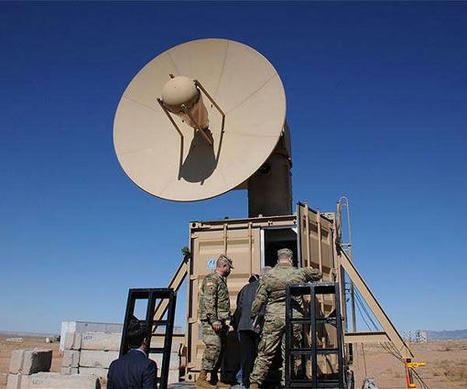
THOR is a prototype directed energy weapon used to disable the electronics in drones, and is designed to counter multiple targets, such as a swarm of drones.
The technology is housed in a 20-foot-long shipping container that can be stowed in a military cargo plane and quickly assembled by two people.
"As the danger from drone swarms evolves, all services are working closely to ensure emerging technologies like Mjolnir will be ready to support the needs of warfighters already engaged against these threats," Adrian Lucero, THOR deputy program manager, said in the press release.
"The program will begin this fall with a delivery of the prototype weapon in 2023," Lucero said.
A request for proposals will be posted on SAM.gov, the official website for companies seeking federal contract opportunities, at a later date, the Air Force said.
|


 Scoop.it!