Your new post is loading...

|
Rescooped by
Romain
from DEFENSE NEWS
March 30, 2022 12:56 AM
|
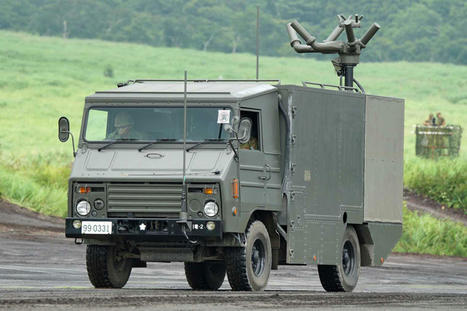
Japan is expanding its number of EW units, plus it is developing high-powered microwave weapons able to counter enemy UAVs.
Most Viewed
Most Shared
FN Herstal demonstrates new C-UAS solutions FN Herstal demonstrates new C-UAS solutions
Trophy gains extra European flavour with technology transfer Trophy gains extra European flavour with technology transfer
DSA 2022: Dillon Aero seeks to stoke Asia-Pacific appetite for miniguns DSA 2022: Dillon Aero seeks to stoke Asia-Pacific appetite for miniguns
Future of Czech IFV acquisition programme to be defined in April Future of Czech IFV acquisition programme to be defined in April
The Japan Ground Self-Defense Force (JGSDF) established an Electronic Operations Unit on 17 March, with its headquarters located at Camp Asaka in Tokyo, to supervise EW units nationwide.
The JGSDF established its first EW unit in Camp Kengun, Kumamoto Prefecture, in March 2021. Six EW units were stood up in FY2021, and four more will be formed by the end of FY2022.
Most are stationed in Okinawa, Kyushu and Hokkaido to counter China and Russia. Each unit consists of 50-100 personnel, and they field the Network Electronic Warfare System.
Their primary mission is to collect electromagnetic information and neutralise
|
|
Scooped by
Romain
March 28, 2022 1:12 AM
|
The Government Accountability Office science and just issued its report on Counter Drone Technologies. Uncrewed aircraft systems, also known as “drones,” are used to take photos, deliver packages, monitor crops, and more. However, drones can pose significant safety and security risks—for example, if they enter airspace near airports or if they’re used for illegal activities […]
|
|
Scooped by
Romain
March 25, 2022 3:34 AM
|
Elettronica Group, an electronic warfare products expert based in Italy, created ADRIAN (Anti-Drone Interception Acquisition Neutralization), a counter-unmanned aerial system (C-UAS). It is designed to intercept and neutralize low-small-slow (LSS) unmanned aerial systems (UASs) in a variety of combat scenarios as well as urban and dense metropolitan environments.
|
|
Scooped by
Romain
March 23, 2022 3:21 AM
|
Ces dernières années, le ministère des Armées, que ce soit via la Direction générale de l’armement [DGA] ou l’Agence de l’innovation de Défense [AID], a lancé plusieurs projets visant contrer la menace des ABIEDs [pour air-borne improvised explosive devices], c’est à dire des drones rudimentaires piégés, voire des munitions rôdeuses.
Ainsi, confié en 2017 à CS Group, le programme MILAD [Moyens mobiles de Lutte Anti-Drones] s’est concrétisé avec la livraison de 18 systèmes de détection et de neutralisation ainsi que environ 80 fusils brouilleurs Nerod. Pour protéger ses convois, l’armée de Terre entend adapter ce système dans le cadre du projet ARLAD [adaptation réactive de lutte anti-drone]. L’armée de l’Air & de l’Espace mise sur BASSALT, destiné à protéger les sites sensibles contre les drones potentiellement hostile. De son côté, la Marine nationale va expérimenter, à bord de ses navires, HELMA-P, une arme laser développée par CILAS et dont les premiers essais [à terre] ont été très encourageants.
D’autres projets, portés par l’AID, sont en cours. Comme celui visant à mettre au point un « drone intercepteur de drones » encore comme celui qui, appelé Deeplomatics, consiste à déployer un réseau de surveillance dont le fonctionnement repose sur des algorithmes d’intelligence artificielle.
Mais l’un des programmes les plus importants en matière de lutte est anti-drones [LAD] est PARADE [Protection déployable modulaire anti-drones], pour lequel, en mai 2021, la DGA a lancé un appel d’offres d’une valeur estimée à 350 millions d’euros [hors TVA], pour la livraison de six systèmes.
« Le marché vise à fournir des systèmes de lutte anti-drones aériens [micro-drones et mini-drones] et à en assurer le maintien en condition opérationnelle et de sécurité. Ces systèmes pourront être déplacés par voie routière, maritime et aérienne d’un site à un autre et assureront une protection permanente et à 360° des sites sur lesquels ils seront déployés, en France et sur des théâtres d’opérations extérieures », indiquait l’avis de marché.
« Détection, caractérisation, identification automatiques et neutralisation seront assurées par ces systèmes, par tous les temps, jour et nuit, contre des drones émetteurs ou non d’ondes électromagnétiques. Chaque système comprendra au moins un système C2 [commandement et contrpole, ndlr] évolutif, un radar, un goniomètre, un système optronique et un système de brouillage.
Les premiers systèmes seront livrés au plus tard fin 2022 », y était-il encore précisé.
Et, selon une information d’Intelligence Online, confirmée par le quotidien Les Échos, ce marché a été attribué au tandem formé par Thales et CS Group, aux dépens, notamment, d’Airbus et d’Indra. L’annonce n’a pas encore été faite officiellement. D’après le journal économique, le système proposé par les deux industriels se serait imposé « haut la main » lors d’une démonstration effectuée dans la rade de Toulon, en novembre 2021.
Le contrat « PARADE » est le second qu’ont obtenu Thales et CS Group auprès du ministère des Armées depuis le début de cette année. Pour rappel, les deux industriels ont été choisi en janvier pour assurer le maintien en condition opérationnelle [MCO] des principaux composants du Système de commandement et de conduite des opérations aérospatiales [SCOOA], dans le cadre du projet VASSCO [VerticAlisation du Soutien du SCCOA], doté de 1,5 milliard d’euros.
|
|
Scooped by
Romain
March 22, 2022 2:20 AM
|
Malgré leurs difficultés sur de précédents programmes antidrones, CS Group et Thales s'imposent face à leurs concurrents sur ce marché structurant pour le secteur, au bénéfice des acteurs déjà
|
|
Scooped by
Romain
March 17, 2022 2:36 AM
|
The Defence Resources Agency signed an agreement on 14 March with Lithuanian-based NT Service for the acquisition of military equipment to combat unmanned aerial vehicles (UAVs), the Lithuanian Ministry of Defence (MoD) announced.
The announcement stated that specific military equipment capable of detecting, identifying, and neutralising military and commercial UAVs by way of suppressing its navigation, video transmission, and control signals would be purchased for the Lithuanian Armed Forces.
The contract has a total value of EUR4 million (USD4.4 million), with a significant proportion of the equipment being delivered to the armed forces this year.
|
|
Scooped by
Romain
March 14, 2022 2:29 AM
|
In a new whitepaper, Teledyne FLIR Defense, part of Teledyne Technologies Incorporated, finds that a multi-layered approach, incorporating common architectures and information sharing, among other imperatives, is needed to address the threat to life and property posed by weaponized use of small Unmanned Aerial Systems (sUAS). In January, non-state actors from Yemen utilized small unmanned […]
|
|
Scooped by
Romain
March 8, 2022 4:59 PM
|
By Paolo Valpolini How to kill an incoming UAV reducing to a minimum the risk of collateral damages, a key
|
|
Scooped by
Romain
March 7, 2022 10:01 AM
|
Technology company MARSS has unveiled a new high-speed interceptor for use during counter-unmanned air system (UAS) duties, touting the design's machine learning capability and increased safety versus employing air defence missiles. Launched at the World Defense Show in Riyadh on 7 March, the new design is a response to th
|
|
Scooped by
Romain
March 3, 2022 1:24 AM
|
US 4th Infantry Division soldiers trained with the Mobile Low, Vehicle Integrated Defense System (M-LIDS) vehicle-mounted counter-drone system in Kuwait
|
|
Scooped by
Romain
March 2, 2022 1:55 AM
|
Leidos is working on a new prototype C-UAS solution called Mjölnir, which harnesses a high-power microwave weapon to defeat drones.
The US Air Force Research Laboratory (AFRL) has selected Leidos to develop a $26 million prototype C-UAS system called Mjölnir, to feature an advanced high-power microwave (HPM) weapon.
Delivery of the prototype is planned for Q1 2023.
The prototype system will be derived from the Tactical High-Power Operational Responder (THOR) C-UAS technology demonstrator, the AFRL noted in a 25 February announcement. The technology will be the same but Mjölnir (named after the hammer of Thor in Norse mythology) ‘will add important advances in capability, reliability, and manufacturing readiness’.
THOR has been tested operationally at an undisclosed African location where it used bursts of intense radio waves to disable sUAS ‘instantly’, the AFRL stated.
Lessons learned from these operational tests will define the new requirements for Mjölnir ‘and will be the baseline configuration for future systems to be deployed around the world’, said Adrian Lucero, THOR programme manager at the AFRL Directed Energy Directorate in Kirtland AFB.
|
|
Scooped by
Romain
March 1, 2022 1:49 AM
|
DroneShield and Teledyne FLIR have announced their C-UAS collaboration has resulted in a marquee customer.
DroneShield and Teledyne FLIR have announced a collaboration to offer a joint sensing and mitigation solution for uncrewed aerial threats.
Teledyne FLIR is providing its C-UAS thermal imaging sensing technology to the DroneShield platform, which has developed and applied its powerful AI and machine learning algorithms via RF sensing and computer vision technologies.
The addition of Teledyne FLIR thermal camera hardware will enable users to improve detection, including identifying and tracking multiple uncrewed threats in the thermal and RF spectrums at a considerable range.
The collaboration has resulted in an initial marquee customer, an undisclosed Western military agency, which will be deploying the combined system at one of the ‘best known’ military testing ranges in the world.
Oleg Vornik, DroneShield CEO, commented the system is positioned ‘for a meaningful-scale rollout with Five Eyes partners and approved allies’.
|
|
Scooped by
Romain
February 28, 2022 1:59 AM
|
Leidos has been selected by the US Air Force Research Laboratory (AFRL) to develop and build a new high-power microwave (HPM) weapon system prototype, building upon the existing Tactical High-Power Operational Responder (THOR) technology demonstrator.
Given the name Mjolnir – after the mythical Norse god Thor's hammer – the new system is intended to demonstrate advances in HPM technology for counter-unmanned aerial systems (C-UAS) missions. Leidos was selected in competition ahead of four rival bids.
HPM weapons provide non-kinetic defeat of targets using bursts of high-power microwaves. According to the AFRL, Mjolnir prototype development is intended to capitalise on earlier HPM systems and enable future transition to a programme of record.
Under a contract valued at USD26.9 million awarded on 24 February, Leidos will develop what AFRL calls a “mature prototype” based on the THOR first-generation C-UAS HPM demonstrator. Work is expected to be completed by the end of February 2024.
|
|
|
Scooped by
Romain
March 30, 2022 12:31 AM
|
DroneShield Limited has advised that it has reached compliance with UK Ministry of Defence (UK MOD) SAPIENT format. SAPIENT is a common operating format for defence devices (with similar principles to the US Department of Defense ATAK system), originally developed by the UK’s Defence Science and Technology Laboratory (DSTL).
It was since adopted as the standard counter drone communication system in the UK.
SAPIENT offers a standard approach for AI and autonomy in networked multi-sensor systems in security and defence, and is being evaluated as a potential NATO standard for counter-drone systems.
Additional information on SAPIENT is available here .
Going forward, DroneShield’s AI-enabled counterdrone/C-UAS RfPatrol, RfOne, and DroneSentry-X products now have the capability to provide a SAPIENT compliant output.
Oleg Vornik, DroneShield CEO, commented,
“In the current challenging geopolitical environment, DroneShield continues to substantially progress our engagement across the NATO militaries, and specifically UK, alongside Australia and the US. We have on-the-ground team members in all 3 countries, supported by a network of highly capable local partners – in the case of UK, our partner is BT with its substantial defence credentials, as well as being a household name in the UK market.”
“Compliance with the SAPIENT format was driven by end-user requests from our UK and European militaries. It ensures our networked devices are plug-and-play compatible to the common operating format of other devices and systems of those end-users. We are currently involved in meaningful acquisition tender processes with UK and European end-users, which require this compliance as part of the deployment.”
|
|
Scooped by
Romain
March 28, 2022 1:11 AM
|
DroneShield Limited has strengthened its relationship with Thales, a global player in the aerospace, defence, and security markets, as drone threats continue to rise globally. Thales and DroneShield commenced their working relationship approximately 3 years ago through the Global Supply Chain (GSC) Program, with Thales having integrated DroneShield sensors into its military and aerospace broader […]
|
|
Scooped by
Romain
March 24, 2022 2:12 AM
|
A few weeks ago, a demonstration of the operation of the anti-drone system (C-UAS or Counter Unmanned Aerial System), from Thales, Horus Shield (part of Eagle Shield Thales’ solution), took place at the airfield of the Segovia town of Marugán.
This demonstration is part of the tests approved by the Spanish Army as part of the Fuerza 2035/BRIEX 2035 initiative, which aims to adapt the Spanish Army to the operational environment foreseen for that year.
The event, coordinated and supervised by the Spanish Army’s Head of Information Systems, Telecommunications and Technical Assistance (JCISAT), was also attended by personnel from other Army units and from the Spanish General Directorate of Armament and Material (DGAM), which reports to the Secretary of State of the Ministry of Defense.
Capable of protecting vulnerable infrastructures from the unauthorized presence of any type of drone, Horus Shield stands out for being a very versatile anti-drone system; offering numerous information to the user on a single screen; and having a surprising capacity to integrate sensors from different manufacturers, which makes it a very interesting C-UAS for different organizations. For example, for the Army, with whose Command and Control systems BMS-ET and PROMETEO it is prepared to be interoperable, although this functionality was not the subject of the demonstration.
C-UAS systems must detect drones at long distances, in order to have sufficient reaction time; identify and track them, in order to determine whether or not they pose a threat and, finally, have the ability to neutralize them in case they pose a real risk. Horus meets all these requirements, as could be seen in the demonstration in Marugán (Segovia), where a drone traveled distances of more than 2 km, despite which the Thales anti-drone system detected and classified it by radar and direction finder, optronic tracking and neutralization by frequency jamming.
The Horus-Shield demonstration included the Thales GECKO optronic system, which has extensive experience in use in border surveillance tasks both in our country and internationally. The Thales Horus-Shield anti-drone system has been deployed for more than three years in different customers monitoring critical infrastructures both in urbanized areas with disadvantaged populations and hostile groups with high technological level, as well as being used in the protection of major sporting events.
Source: Press Release
|
|
Scooped by
Romain
March 22, 2022 11:37 AM
|
Le groupement entre le spécialiste de la lutte anti-aérienne et le géant français de l'électronique de défense a remporté la compétition Parade pour équiper la France de solutions de lutte anti-drones performantes à l'horizon des Jeux Olympiques.
|
|
Scooped by
Romain
March 21, 2022 2:58 AM
|
SOMAG’s Nimble Stabilization Mount (NSM) 400 was presented as part of Elettronica Group’s Snow Leopard counter-drone system during NATO’s White Fox exercis
|
|
Scooped by
Romain
March 14, 2022 2:48 AM
|
The Snow Leopard C-UAS system was demonstrated during a recent NATO exercise in Italy.
Most Viewed
Most Shared
Elettronica adapts ADRIAN for mobile C-UAS operations Elettronica adapts ADRIAN for mobile C-UAS operations
New RWR to enhance F-16 New RWR to enhance F-16
L3Harris connects UK MoD with US and NATO allies L3Harris connects UK MoD with US and NATO allies
MilDef continues tactical IT integration for Swedish Armed Forces MilDef continues tactical IT integration for Swedish Armed Forces
Elettronica presented the Snow Leopard mobile variant of its ADRIAN C-UAS system during a the recent NATO Exercise White Fox that took place in Italy.
Snow Leopard can be deployed in extreme conditions and used while mobile.
‘These capabilities have been realised through AI techniques applied to signal process and imagery analysis,’ Elettronica noted in a statement.
For the demonstration in White Fox, Snow Leopard was installed aboard an Italian Army Bv206S7 tracked all-terrain vehicle.
‘However; the system can be easily installed on other vehicle types, and also be used for the protection of fixed targets,’ Elettronica noted.
The C-UAS system uses EO devices and an electronic support measure with AI algorithms to detect and locate a UAV and its ground control station via radio signals.
|
|
Scooped by
Romain
March 14, 2022 2:28 AM
|
UK technology firm MARSS launched a new counter unmanned aerial vehicle (C-UAV) technology featuring a reusable, electrically powered interceptor
|
|
Scooped by
Romain
March 7, 2022 11:29 AM
|
En matière de lutte anti-drones [LAD], plusieurs initiatives ont été lancées par le ministère des Armées au cours de ces dernières années. comme le programme MILAD [Moyens mobiles de Lutte Anti-Drones, mené par CS Group], le projet ARLAD [adaptation réactive de lutte anti-drone] qui vise à protéger les convois de l’armée de Terre contre cette menace, le système BASSALT, développé par l’armée de l’Air afin de sécuriser les sites sensibles, ou encore le marché PARADE [Protection déployable modulaire anti-drones], lancé par la Direction générale de l’armement [DGA] en 2021.
Cette liste ne s’arrête pas là, l’Agence de l’innovation de Défense [AID] ayant mis plusieurs fers au feu. L’an passé, elle a lancé un appel à projets pour mettre au point un « drone intercepteur de drones », afin de neutraliser les appareils « commerciaux condidérés comme non collaboratifs » [c’est à dire pouvant représenter une menace]. Et elle soutient également le projet HELMA-P, qui repose sur une arme laser développé par le français CILAS. Des expérimentations à bord de navires de la Marine nationale est prévue, après des essais très encourageants.
Et puis il y a aussi le projet Deeplomatics, soutenu par l’AID, via une subvention de près de 300’000 euros accordées, via le dispositif ASTRID [Accompagnement Spécifique des travaux de Recherches et d’Innovation Défense], à un consortium réunissant le laboratoire de Mécanique des Structures et des Systèmes Couplés et le laboratoire CEDRIC du Conservatoire national des arts et métiers, en lien avec l’Institut Franco-Allemand de recherches de Saint Louis [ISL] et la société ROBOOST.
Concrètement, Deeplomatics vise à développer un réseau de surveillance composé de capteurs passifs acoustiques et optroniques et reposant sur des technologies liées à l’intelligence artificielle, et en particulier celle appelée « Deep Learning » [ensemble de méthodes d’apprentissage automatique, ndlr].
Cela suppose de déployer des antennes microphoniques compactes, omnidirectionnelles, dotées chacune « d’une intelligence artificielle indépendante entrainée pour détecter, localiser et identifier en temps réel le type de drone en vol » dans un rayon de 300 mètres.
Ce réseau de surveillance s’appuie également sur un système d’imagerie monté sur une tourelle orientable sur 360°, disposant d’une portée de 1,5 km. « Son orientation et ses paramètres d’imagerie active sont pilotés en temps réel par les données fusionnées des différents capteurs acoustiques », explique l’AID. Et, grâce à une intelligence artificielle « entrainée à détecter les drones dans le flux vidéo », il est ainsi possible de « réaliser la poursuite vidéo d’une cible non coopérative ».
Les essais de Deeplomatics sont prometteurs. « En utilisant une base de données d’une quinzaine d’heures d’enregistrements de drones civils de tailles variées, le système a montré une capacité de détection de drones supérieure à 95% et de reconnaissance du modèle de drone supérieure à 85 % », avance l’AID, pour qui l’approche de ce projet a permis « réaliser un saut scientifique et technique sans précédent pour la sécurisation d’une vaste zone à protéger ».
Près trois ans après avoir été lancé, Deeplomatics est maintenant en phase d’achèvement, le transfert vers l’industrie des technologies qu’il a permis de mettre au point étant en cours de préparation. Sans doute sera-t-il prêt pour les grands évènements que la France doit organiser en 2023 [coupe du monde de Rugby] et en 2024 [Jeux Olympiques]. Voire en 2022 pour le mondial de football au Qatar, Paris et Doha ayant un accord pour en assurer la sécurité.
Dans le même domaine, un autre projet vient d’obtenir un label auprès de l’AID. Le pôle d’innovation technique Bingo, créé en février 2021 sous l’égide de la DGA pour tout ce qui a trait à la cyberdéfense, les systèmes électroniques et la photonique, a ainsi notifié son premier contrat à la société EPSI afin de mener une expérimentation en matière de détection de drones de loisir.
« Fondé sur une technologie civile intégrée dans un radar de détection d’intrusion de piétons, le projet vise à lutter contre l’intrusion des drones de loisirs. EPSI propose d’utiliser cette technologie à des fins opérationnelles dont l’armée de Terre pourrait bénéficier », précise la DGA.
La technologie en question repose sur le système de surveillance de zone PSR, qui, développé par EPSI, est basé sur un radar à onde continue [ou à ondes entretenues], qui émet sans interruption un signal hyperfréquence.
|
|
Scooped by
Romain
March 4, 2022 11:31 PM
|
Pour le ministère des Armées, l’effort mené dans le segment de la lutte anti-drones ne se limite pas aux programmes d’acquisition comme PARADE. D’autres initiatives moins médiatiques sont en cours, à l’image du projet Deeplomatics soutenu par l’Agence de l’innovation de défense (AID) et du contrat d’expérimentation notifié à la PME EPSI par le cluster d’innovation technique BINGO.
Deeplomatics, la détection en environnement complexe
Deeplomatics pour, accrochez-vous bien, « DEEP-learning pour la LOcalisation MultimodAle en Temps réel et l’Identification de Cibles aériennes à faible Signature ». Lancé en février 2019, ce projet a bénéficié d’un financement ASTRID octroyé par la Direction générale de l’armement (DGA). Il s’est achevé récemment.
Le projet était porté par un consortium rassemblant deux laboratoires du Conservatoire national des arts et métiers (CNAM Paris), le LMSSC et le CEDRIC*, ainsi que les équipes « acoustique et protection du combattant » et « visionique avancée et processing » de l’ISL et la société lyonnaise ROBOOST. Loin d’être novice sur la question, cette dernière est impliquée dans une dizaine d’autres programmes (SPID, DAMNED, etc.), dont certains au profit de la DGA et du GIGN. Soit, une vingtaine de chercheurs et de techniciens mobilisés durant 36 mois.
Leur objectif ? Plancher sur une solution capable de « détecter les drones, les suivre, établir leur trajectoire dans des environnements complexes, dans des environnements urbains, dans des environnements montagneux », expliquait hier le porte-parole du ministère des Armées, Hervé Grandjean. Bref, dans des lieux où les multiples « masques » limitent les performances des outils de détection classiques comme le radar.
Un réseau de capteurs intelligents
Deeplomatics repose sur des techniques de deep learning appliquées à un réseau de surveillance constitué d’antennes microphoniques compactes, omnidirectionnelles et indépendantes couplées à un système d’imagerie active monté sur tourelle orientable sur 360°.
Installée sur des supports anti-vibratiles, anti-vent et anti-pluie, chaque antenne est dotée de sa propre intelligence artificielle entrainée pour détecter, localiser et identifier en temps réel le type de drone dans un rayon de 300 mètres. Bien que doté d’un angle d’observation plus restreint, le système d’imagerie active présente une portée de 1,5 km et est orienté en temps réel grâce à la fusion des données en provenance des capteurs acoustiques.
Les données récoltées viennent alimenter en continu des algorithmes d’apprentissage développés spécifiquement pour chaque module. Cette exploitation simultanée des signatures acoustiques et visuelles rend dès lors possible « la poursuite vidéo d’une cible non coopérative », explique le ministère des Armées.
À chaque acteur sa mission. L’ISL, par exemple, coordonnait les questions d’optimisation de motorisation du système d’imagerie active et de fusion de données multimodales et multicapteurs. Pour le laboratoire CEDRIC, il s’agissait de piloter le volet du suivi et de la reconnaissance de drones par deep learning video.
Au terme de 36 mois d’élaboration et d’expérimentation, la formule « a permis de réaliser un saut scientifique et technique sans précédent pour la sécurisation d’une vaste zone à protéger ». « On constate que l’on a une capacité de détection de drones supérieure à 95% et que l’on peut reconnaître le modèle de drone à plus de 85% », complète le ministère des Armées.
Premier contrat pour le cluster BINGO
Si Deeplomatics s’achève, une autre initiative à l’enjeu similaire vient de démarrer, cette fois au travers du cluster d’innovation BINGO (Bretagne Innovation Grand Ouest) piloté par DGA Maîtrise de l’information. Celui-ci a en effet notifié le 2 février la société EPSI pour la conduite d’une étude relative à « la détection des drones de loisir ».
Ce contrat, le premier conclu depuis l’établissement de BINGO en février 2021, verra EPSI adapter sa technologie de radar de détection PSR pour une utilisation à des fins opérationnelles militaires. L’armée de Terre pourrait en bénéficier, souligne le ministère des Armées. Labellisée par l’AID en janvier dernier, cette étude durera neuf mois sous le contrôle de la DGA.
Division produits du garonnais ITNI, EPSI a conçu sa famille de radars PSR pour la surveillance et la protection d’activités et de sites sensibles. Selon les modèles, ces radars à onde continue présentent une portée de détection de 120 à 500 mètres pour les piétons et de 150 à 900 mètres pour les véhicules. Leur zone de couverture varie de 0,1 hectares à 20 hectares pour la version la plus « puissante ».
|
|
Scooped by
Romain
March 3, 2022 1:24 AM
|
US soldiers with the 4th Infantry Division trained with the M-LIDS vehicle-mounted counter-drone system in Kuwait last month.
|
|
Scooped by
Romain
March 2, 2022 1:54 AM
|
Kirtland AFB NM (SPX) Mar 01, 2022 -
The Air Force Research Laboratory has awarded a contract for Mjolnir, a next-generation counter electronics weapon system, to defend against adversarial drone activity, to Leidos Inc.
Building
|
|
Scooped by
Romain
February 28, 2022 1:59 AM
|
he Dutch military has ordered the Smart Shooter Smash AD (anti-drone) fire-control system for small arms after testing it over the past year, the Israeli company announced in a press release on 21 February. The system is being procured mainly for counter-unmanned aerial system (C-UAS) applications.
Smash is designed to ensure that each round finds its target by providing a standard assault rifle with precision-targeting algorithms and advanced electro-optical processing, according to Smart Shooter.
The company said the system works automatically, not autonomously, and enables an operator to quickly neutralise a target, adding that it is a cost-effective solution that can be integrated into any type of assault rifle and combined with other C-UAS systems to provide multilayer defence. Incorporating a laser rangefinder, Smash AD enables the destruction of low-altitude unmanned aerial vehicles (UAVs) at a range of 250 m in day mode and 100 m in night mode. It can also receive target information from an external sensor.
|