Your new post is loading...

|
Rescooped by
Romain
from DEFENSE NEWS
May 24, 2022 4:22 AM
|
Johnstown, Penn. – May 23, 2021 – Production of the Marine Air Defense Integrated System (MADIS) Remote Weapon Station (RWS)
|
|
Scooped by
Romain
May 24, 2022 1:42 AM
|
Rheinmetall Air Defence AG has shipped the latest version of its rapidly deployable Counter-small Unmanned Aerial System (C-sUAS) solution t
|
|
Scooped by
Romain
May 24, 2022 1:42 AM
|
Rheinmetall Air Defence AG has shipped the latest version of its rapidly deployable Counter-small Unmanned Aerial System (C-sUAS) solution t
|
|
Scooped by
Romain
May 24, 2022 1:41 AM
|
Rheinmetall Air Defence AG has shipped the latest version of its rapidly deployable Counter-small Unmanned Aerial System (C-sUAS) solution t
|
|
Scooped by
Romain
May 23, 2022 12:22 AM
|
Indian firm Gurutvaa Systems has delivered the first set of the indigenously developed ‘Dronaam' counter-unmanned aircraft systems (C-UASs) to the Indian Air Force (IAF).
Harshad Dave, director of Gurutvaa Systems, told Janes that an undisclosed number of Dronaam C-UASs were delivered to the IAF earlier in May under a contract signed in August 2021. The system was delivered within nine months.
Dave said the system underwent design review in October 2021 and the first prototype trials were conducted in December 2021. A second trial of a production standard system, which incorporated suggestions from the first trial, was conducted by IAF in February 2022.
Dave further added that the Dronaam system is developed completely indigenously and has proved effective at disrupting the GNSS (global navigation satellite system) navigation and jamming radio frequencies of unmanned aerial vehicles (UAVs).
|
|
Scooped by
Romain
May 21, 2022 8:28 AM
|
Des «armes magiques», rigole Volodymyr Zelensky. L'une des grandes leçons du conflit en cours en Ukraine est l'importance primordiale qu'ont pris les drones dans les guerres modernes, qu'ils soient de conception militaire comme le Bayraktar TB-2 turc aux multiples prouesses
|
|
Scooped by
Romain
May 20, 2022 1:31 AM
|
Fortem Technologies has announced a new, smaller portable counter-UAS system in direct response to the crisis in Ukraine. Working closely with the Ukrainian Ministry of Defense, Fortem provided Ukraine with a number of the Fortem SkyDome man-portable counter-UAS solutions, as well as on site training and support.
The solution includes the Fortem DroneHunter, which removes drones from the sky autonomously day and night.
Ukraine has a dire need for portable counter-drone technology to detect and disarm Group 1 and II enemy surveillance drones. Recognizing this, Fortem took its pre-existing portable counter-UAS system and further miniaturized and simplified it for use as an expeditionary rapid deployment system.
“Fortem creates the world’s best drone interceptor. We work everyday to keep venues, campuses, and entire cities protected from rogue drone incursions,” said Fortem Technologies CEO Timothy Bean. “When our predictions came true – that drones would be relied upon heavily in the next major conflict – we knew we had to act quickly to arm our allies with the technology necessary to keep themselves safe from drone surveillance and attacks.”
The Fortem SkyDome man-portable counter-UAS solution sets up very quickly with an off-power grid without connection to power networks or generators. This allows expeditionary forces to operate at the border of a conflict with no dependency on an operating infrastructure or heavy and noisy support equipment. The solution is very safe for the operators, as the operator can be stationed far away and can stop transmissions across ground radios to avoid electronic detection. The detection sensors operate at a very high beamwidth and low power so that it’s extremely hard to detect the solution with electronic counter measures.
“It’s evident that the new weapon of war is drones, and countries must be prepared to protect their people and infrastructure from such attacks,” said a Senior UKR MOD official. “Fortem’s SkyDome system allows for detection and mitigation of attacking drones, which helps Ukraine in its fight against Putin’s forces.”
Currently, Fortem Technologies is deployed in the U.S., the Middle East, Asia and, most recently, Ukraine. Additionally, Toshiba recently chose Fortem as their counter-drone partner worldwide.
Source: Press Release
|
|
Scooped by
Romain
May 19, 2022 1:43 AM
|
Indian firm Gurutvaa Systems has delivered the first set of the indigenously developed ‘Dronaam' counter-unmanned aircraft systems (C-UASs) to the Indian Air Force (IAF).
Harshad Dave, director of Gurutvaa Systems, told Janes that an undisclosed number of Dronaam C-UASs were delivered to the IAF earlier in May under a contract signed in August 2021. The system was delivered within nine months.
Dave said the system underwent design review in October 2021 and the first prototype trials were conducted in December 2021. A second trial of a production standard system, which incorporated suggestions from the first trial, was conducted by IAF in February 2022.
Dave further added that the Dronaam system is developed completely indigenously and has proved effective at disrupting the GNSS (global navigation satellite system) navigation and jamming radio frequencies of unmanned aerial vehicles (UAVs).
|
|
Scooped by
Romain
May 16, 2022 1:20 AM
|
Pentagon Tests High-Power Microwave Systems Against Drones
The Joint C-sUAS Office (JCO) hosted two C-sUAS demonstrations at Yuma Proving Ground (YPG) last year with the Army’s Rapid Capabilities and Critical Technologies Office (RCCTO) to give industry the opportunity to show their latest technology.
“The counter UAS threat has evolved significantly over the past few years,” said Maj. Gen. Sean Gainey, Director of the JCO. “The way to evolve C-sUAS technology to meet this threat is to constantly re-look our current capabilities. In order to support the warfighter, the demonstrations give us the opportunity to work with industry and bring out all of the latest and greatest capability to get ahead of the threat.”
The first two demonstrations were so successful that YPG was tapped again to host a third multi-week event in April.
“Every JCO event so far has shown higher levels of difficulty because every event has been different” said Hi-Sing Silen, YPG test officer. “This event has two focus areas, as opposed to one last time. It was a crawl-walk-run approach to find out what we needed to support testing.”
“We’ve expanded the time horizon from the first demonstration being a week, the second being two weeks, and this one is three weeks,” said Col. Greg Soule, Acquisition and Resources Division Chief for the JCO. “There are some pretty significant capabilities that we are looking at this time.”
During the first week of the demonstration, testers evaluated systems that utilized high powered microwaves to defeat threat systems.
“Because it is new to us, we had to make sure that the test plan was flexible enough to be able to collect frequencies, power levels, and distances,” said Silen.
In weeks two and three, the demonstration was open to any C-sUAS system that demonstrated how Contractor Owned Government Operated (COGO) capabilities could detect, track, identify, and defeat sUAS threats. This COGO concept is referred to as Counter-sUAS as a Service (CaaS). A Company’s successful demonstration of the CaaS concept could potentially result in them signing a service contract with the government.
“The DOD normally buys things and owns it for the life cycle: you have to put it to rest at the end, and in between you have to maintain it and upgrade it as necessary,” said Soule. “We could potentially pay an industry partner to perform this as a service to the DOD with the responsibility to maintain and upgrade it, and to a certain extent operate it.”
It is also possible that each of these systems has sub-components manufactured by different companies.
“That brings additional challenges to ensure we can accommodate every component that a customer brings,” said Silen.
In the demo scenarios, the testers gave the competitors geographic boundaries for a notional forward operating base (FOB) that the systems had to defend against incoming flying threats.
“The profiles are straightforward, but challenging,” said Silen. “They are designed to make sure customers are tested in a similar way so we are comparing apples to apples.”
The two primary data points that testers sought were the range of effectiveness—how close could a threat get before the counter-UAS system stopped it—and how long it took to defeat the threat system. In some cases, a threat system wasn’t completely destroyed, but was impacted to an extent that it couldn’t get close enough to pose a threat to the mock FOB.
“We could spend a whole year trying to assess every little component of the systems,” said Silen. “This is a very compressed data matrix that collects essential, key aspects of how the systems are performing.”
Truth data—the real location of a threat—was a key aspect to verifying each systems test performance. In the second and third weeks of the CaaS demonstration, the performance data was tailored to the system depending on what types of components were present—a camera or jammer, for instance.
“YPG provides a great opportunity [to test systems] because of the range structure and standardization it provides,” said Gainey. “We’re able to bring out all of the different capabilities from the Services and industry, put them on a common range, and measure the effects equally across the systems.”
“What we primarily focused on in that first week for high-power microwave was how well the effector emitted,”Michael DiGennaro, the test team lead for JCO’s acquisition and resourcing division, said during a May 11 media roundtable.
“We were looking at range to engage the targets that were inbound and the amount of time it took to either deter or defeat the target,” he added. The targets ranged among UAS groups 1, 2 and 3 and were used either one at a time or two simultaneously. (Group 1 drones weigh up to 20 pounds; Group 2 from 21 to 55 pounds; and Group 3 more than 55 pounds but less than 1,320 pounds.)
How’d the counter-drone systems perform?
The Leonardo DRS system — called a “vector inversion generator” — “was hindered in that it did not have an antenna to radiate,” DiGennaro said.
But the JCO was able to assess the technology through its ability to hand off a detected threat from the government-owned command-and-control system, and then generate the power necessary to defeat the threat. “With that, we were able to capture power output and the amount of time that the electromagnetic pulse was on the target just with instrumentation,” DiGennaro explained.
The Epirus system “was able to defeat targets in the range that is normally associated with what is currently in the field,” DiGennaro said, “and has the promise to be a little bit more effective in the future.”
Raytheon’s capability “was very much in development, shows some promise for future development,” he said, but “the ranges were somewhat shorter in their ability to defeat the incoming targets.”
The office also assessed countering small UAS as a service, or CaaS, through contractor-owned, government-operated capability at fixed locations.
The office received a total of 25 whitepapers for CaaS and selected five to demonstrate their capabilities because they met specific requirements. Those five were Anduril Industries, Black Sage, CACI, Rafael Systems Global Sustainment and SAIC.
“We had five very complex architectures out there,” DiGennaro said. “Each of them brought a host of different components for detection, identification, tracking and defeat, and we tested against each of those components both individually and then as a system, culminating in a ‘defend the forward-operating base’ scenario.”
The data collected is still being analyzed, he added, and a report will be published for limited distribution within the Defense Department next week.
“This was as much a learning exercise for us as it was for the companies,” DiGennaro said of CaaS. “We had architectures out there that had not previously been working together, components in particular, architectures that were coming out there for the first time.”
The JCO was able to form new industry partnerships as well as get companies with different elements of the engagement chain together that had not worked together before, he said. “They’re trying new combinations. They’re developing things as we go.”
YPG is among the most capable of a limited number of test ranges able to accommodate this type of work. The proving ground’s clear, stable air and extremely dry climate along with vast institutional UAS testing knowledge makes it an attractive location to testers, as does the ability to control a large swath of the radio frequency spectrum. YPG has more than 500 permanent radio frequencies, and several thousand temporary ones in a given month.
“We’ll continue to enhance what we’ve built,” said Gainey. “We’re investing in the YPG ranges to be able to provide the data collection we need from the different capabilities we’re testing, whether it is high powered microwave, directed energy, or electronic warfare effects. This range is able to accommodate all of that, and we want to continue to improve upon it so we can get after the future threat.”
Photos: Mark Schauer
|
|
Scooped by
Romain
May 5, 2022 2:27 AM
|
The French Navy has considerably reinforced port protection, in particular at Toulon where 70% of fleet assets are concentrated.
As well as the vessels themselves, protection is required for two nuclear reactors on the aircraft carrier Charles de Gaulle and six aboard active nuclear-powered attack submarines (five in the Rubis class and one Barracuda class).
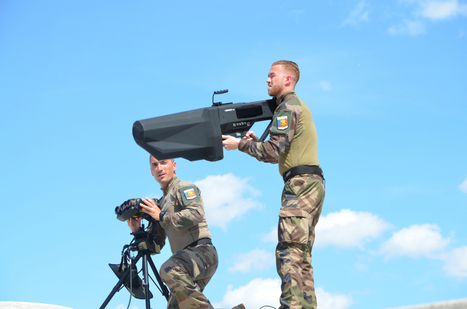
French authorities have focused particularly on C-UAS via a multi-layered defense provided by radar and EO systems from Teledyne FLIR and Nerod F5 microwave jamming rifles from MC2 Technologies.
UAVs such as Anafi-SE and Anafi USA micro-drones are employed on security patrols. Acoustic sensors are
|
|
Scooped by
Romain
May 3, 2022 1:41 AM
|
Le missilier européen MBDA a été sélectionné, au sein d’un consortium de 42 sociétés européennes, par l’Union européenne pour développer une nouvelle architecture de lutte anti-drones.
Anti-drones : l'Europe à la traîne
Le missilier eucharropéen a été sélectionné au sein d’un consortium de 42 sociétés européennes par l’Union européenne pour développer une nouvelle architecture de lutte anti-drones. Pas moins de 14 pays européens, dont la France, sont regroupés sur ce programme de développement qui pourrait déboucher sur un programme financé par le fonds européen de défense. L’Europe est à la traîne dans ce domaine, comparé aux avancées américaines ou israéliennes.
MBDA en charge d'un nouvel effecteur
MBDA est notamment en charge du développement d’un nouvel effecteur, et de la démonstration qui aura lieu sous deux ans, durée maximale de ce programme qui peut sembler modeste (13,5 M€) mais dont le caractère interdisciplinaire doit amener des ruptures. Difficile à ce stade de savoir à ce stade quel type d’effecteur sera retenu (propulsé ou pas, à l’instar d’un dard sans explosif à bord) indique-t-on chez MBDA. D’autant que CILAS, spécialiste français du laser, est aussi partie prenante. Plusieurs autres français ont été retenus, dont l’ONERA, Thales et CS (ces deux derniers ont remporté l’appel d’offres français PARADE il y a quelques semaines, pour une valeur de 350 M€). MBDA France n’est pas le seul retenu, sa sœur italienne est aussi de la partie.
Des programmes français pas toujours probants
La France a multiplié les programmes ces dernières années dans le domaine, mais pas toujours avec succès. Le programme MILAD (moyen interarmées de lutte anti-drone) développé par CS n’a pas avancé à la vitesse et avec les résultats voulus par les Armées. La protection des unités en mouvement n’est pas non plus assurée, malgré un prototype de véhicule de l’avant blindé disposant d’une mitrailleuse de 12,7 mm montée sur un tourelleau Kongsberg M151 Protector et de briques du MILAD. L’Armée de l’Air et de l'Espace a eu plus de succès avec Hologarde, en développant une approche plus opérationnelle, qui assure un meilleur taux de détection.
|
|
Scooped by
Romain
May 2, 2022 1:44 AM
|
Le consortium mené par Thales et CS GROUP a été notifié par la Direction générale de l’armement (DGA) pour la réalisation et le déploiement de la capacité de lutte anti-drones PARADE d’un montant global de 350 millions d’euros sur une durée de 11 ans, dont 33 millions fermes à date.
Le système modulaire et multi-missions PARADE vise à détecter, classifier et neutraliser de manière sécurisée des micro et mini-drones. Il pourra être utilisé dans le cadre d’un déploiement temporaire, pour la protection d’un site fixe ou projeté en opérations extérieures.
Le système PARADE viendra notamment renforcer la sécurité du public et des infrastructures de deux évènements sportifs qui se tiennent en France : la Coupe du Monde de Rugby 2023 et les Jeux Olympiques et Paralympiques de 2024.
Afin d’assurer une protection permanente des infrastructures critiques, Thales et CS GROUP associent des entreprises de la Base Industrielle et Technologique de Défense (BITD) française et européenne, pour réaliser une capacité de Protection déployAble modulaiRe Anti-DronEs (PARADE). Le marché, qui a fait l’objet d’un appel à concurrence européen lancé par la DGA en 2021, vise à renforcer les capacités de lutte anti-drones mises à disposition des armées.
Au cours des 20 prochaines années, des millions de nouveaux drones circuleront dans l’espace aérien, créant un écosystème aéronautique extrêmement complexe et des défis importants en matière de sécurité. Pour faire face à cette menace en constante évolution, le consortium mené par Thales et CS GROUP déploie un système évolutif, modulaire et multi-missions de lutte anti-drones pour la protection des sites militaires, fixes ou projetés en opérations extérieures. Il pourra également être utilisé par les armées pour contribuer à la protection des évènements, du public et des infrastructures civiles, notamment lors de grands rassemblements.
Ainsi, le partenariat entre Thales, acteur reconnu des opérations aériennes civiles et militaires depuis plus de 40 ans et CS GROUP, intégrateur de systèmes critiques de la lutte anti-drones en France, s’inscrit pleinement dans la logique des missions de dispositif particulier de sûreté aérienne (DPSA) qui visent à renforcer la protection d’événements sensibles. Le système PARADE apportera à ce dispositif des capacités supplémentaires de détection et d’intervention. A ce titre, PARADE contribuera à la sécurité de deux évènements sportifs mondiaux qui se dérouleront sur le territoire français et pour lesquels la lutte anti-drones est une priorité gouvernementale : la Coupe du Monde de Rugby 2023 et les Jeux Olympiques et Paralympiques 2024.
La première commande porte sur l’acquisition de six systèmes de lutte anti-drones PARADE. En intégrant des PME tricolores telles que CerbAir, Exavision et MC2 Technologies ainsi que l’entreprise néerlandaise Robin, le système PARADE apporte une aide à la décision et à la compréhension des situations complexes et pourra ainsi neutraliser des micro-drones et des mini-drones. Sont également intégrées au marché la formation des opérateurs, la maintenance et les évolutions sur le système et les équipements.
En plus d’assurer une protection permanente et à 360° des sites où ils seront déployés, les systèmes PARADE sont également mobiles par la route, la mer ou les airs d’un site à l’autre, augmentant ainsi considérablement leur périmètre et leur rapidité d’action.
Les premiers systèmes PARADE seront livrés à la DGA moins d’un an après le lancement du programme.
En tant qu'expert de la suprématie aérienne, Thales offre des solutions intégrées pour la protection de l’espace aérien, des citoyens et des infrastructures. Fort de son expérience de systémier, de son savoir-faire en défense aérienne, en cybersécurité et dans le domaine des architectures digitales, Thales apporte une plus-value de haut niveau à ce projet. Pionnier dans le domaine de la lutte anti-drones avec des projets opérationnels depuis 2016 pour les besoins civils aussi bien que militaires, CS GROUP propose des systèmes modulaires, évolutifs, interopérables et cyber-sécurisés autour d’un centre de commandement et de contrôle intégrant de l’intelligence artificielle et la fusion de données pour une meilleure prise en compte d’une menace en constante évolution.
« En matière de lutte anti-drones, les solutions de Thales assurent la sûreté et la sécurité à tous les niveaux de l'espace aérien tant militaire que civil. La richesse de notre écosystème industriel et nos partenariats avec les PME et ETI françaises sont autant d’opportunités d’innovation qui concourent à améliorer l’offre du Groupe. Le groupement entre Thales et CS GROUP a permis de proposer une solution de lutte anti-drones qui répond aux exigences de la DGA et des forces armées afin d’assurer le plus haut niveau de sécurité aux citoyens participant à des grands rassemblements. » Thomas Got, Directeur Général de l’activité Systèmes Intégrés pour la Protection de l’Espace Aérien, Thales.
« CS GROUP est engagé dans la lutte anti-drone depuis plus de huit ans et assure une veille technologique active et permanente afin de répondre au mieux à l’évolution de la menace drone et aux besoins opérationnels qui y sont liés, de la sécurité des grands événements à la protection de nos soldats en opérations extérieures, en passant par la lutte anti-terroriste. Le partenariat entre CS GROUP et Thales permet d’avoir une vision d’ensemble de la sécurité aérienne, du haut en bas du spectre, pour garantir à tout moment la vision de la menace et la meilleure façon d’y répondre. Nous sommes particulièrement fiers que notre Groupement ait été retenu pour le programme PARADE, et de contribuer ainsi à la protection de la population lors des grands événements. » Marie de Saint Salvy, Directrice générale adjointe de CS GROUP
|
|
Scooped by
Romain
April 29, 2022 1:59 AM
|
France wants to have the systems ready in time for hosting the 2023 Rugby World Cup and the 2024 Summer Olympics.
|
|
|
Scooped by
Romain
May 24, 2022 1:42 AM
|
Rheinmetall Air Defence AG has shipped the latest version of its rapidly deployable Counter-small Unmanned Aerial System (C-sUAS) solution t
|
|
Scooped by
Romain
May 24, 2022 1:42 AM
|
Rheinmetall Air Defence AG has shipped the latest version of its rapidly deployable Counter-small Unmanned Aerial System (C-sUAS) solution t
|
|
Scooped by
Romain
May 24, 2022 1:42 AM
|
Rheinmetall Air Defence AG has shipped the latest version of its rapidly deployable Counter-small Unmanned Aerial System (C-sUAS) solution t
|
|
Scooped by
Romain
May 24, 2022 1:40 AM
|
Rheinmetall Air Defence AG has shipped the latest version of its rapidly deployable Counter-small Unmanned Aerial System (C-sUAS) solution t
|
|
Scooped by
Romain
May 23, 2022 12:13 AM
|
Rheinmetall has successfully tested the technology demonstrator version of a laser weapon built on behalf of the German Bundeswehr.
The first trials with the laser testbed were conducted at Rheinmetall’s proving ground in Unterlüß as part of a Counter-Unmanned Aircraft System (C-UAS) campaign.
The laser testbed serves not only as a technology demonstrator laser weapon, but also as the basis for future R&D work at Unterlüß in Lower Saxony. It is designed so that all components of a future laser weapon system can be examined modularly. Every interface to the sensors – the radar, for example – or to the energy supply and laser source are ‘open’ designs. This makes it possible to test every conceivable combination iteratively and then to compare the results.
The objective of current studies in the laser testbed is to produce a suitable configuration for a mobile technology demonstrator with a laser output of over 10 kW for integration into a Boxer fighting vehicle by the end of 2022. At present, the laser testbed consists entirely of sub-assemblies made by Rheinmetall. But open interface architecture makes it possible to integrate and test components from other manufacturers also.
The laser testbed consists of a 20-foot container divided into three compartments: laser, operator and infrastructure. Encompassing five 2 kW-fibre laser modules, the laser source is installed in the laser compartment. Bundled via spectral coupling, the individual laser modules achieve a total output of 10 kW, producing excellent beam quality. Rough orientation of the laser weapon station is based on data from the suite of electro-optical sensors in the weapon station. This is ready to operate around the clock. For fine tracking, the reflection of the target irradiated by the illumination laser is evaluated in the beam guidance system and transformed into corresponding guidance signals for tracking the target. Furthermore, under conditions of functional safety, all sub-assemblies necessary for target engagement, e.g., beam status monitoring and target point control, were achieved for the first time within the optical beam path.
During the C-UAS campaign conducted in Unterlüß, a variety of drone types were optically tracked and neutralised at ranges of engagement of up to one kilometre. The results obtained were more than satisfactory. A demonstration was subsequently carried out in compliance with corona safety measures at Unterlüß for representatives of the Federal Ministry of Defence and the Federal Office for Bundeswehr Equipment, Information Technology and In-service Support. The outcome met the expectations of all participants.
Source: Press Release
|
|
Scooped by
Romain
May 20, 2022 1:56 AM
|
19 May 2022 – Rheinmetall has successfully tested the technology demonstrator version of a laser weapon built on behalf of
|
|
Scooped by
Romain
May 20, 2022 1:28 AM
|
Liteye Systems will provide its entire portfolio of integrated multi-domain, multi-mission Air Base Surface and Ground Defense systems, includin
|
|
Scooped by
Romain
May 19, 2022 1:40 AM
|
Separatists in Ukraine are touting a janky-looking improvised jamming gun for defending against drones.
|
|
Scooped by
Romain
May 11, 2022 1:24 AM
|
LETTRE DES ARMÉES. Un marché de 33 millions d’euros a été attribué pour la livraison en 2023 de six unités antidrones et leur suivi durant dix ans.
|
|
Scooped by
Romain
May 5, 2022 2:26 AM
|
|
|
Scooped by
Romain
May 2, 2022 2:02 AM
|
29 April 2022 – Thales and, CS GROUP are working with their partners in France and Europe’s defence industrial and
|
|
Scooped by
Romain
May 2, 2022 1:19 AM
|
Pour protéger les sites sensibles militaires et ceux des opérateurs d’importance vitale, la Direction générale de l'armement va acquérir...-aero-spatial
|


 Scoop.it!