

Beautiful Brains: Moody. Impulsive. Maddening. Why do teenagers act the way they do? Viewed through the eyes of evolution, their most exasperating traits may be the key to success as adults.

 Your new post is loading...
 Scoop.it! Beautiful Brains: Moody. Impulsive. Maddening. Why do teenagers act the way they do? Viewed through the eyes of evolution, their most exasperating traits may be the key to success as adults. No comment yet.
Sign up to comment
Scoop.it!

Uncertain about the viability of a career in public education, Peter Goldberg resigned as a Memorial School math teacher shortly after being awarded the school's "Teacher of the Year"...
Scoop.it!

Dedicated e-reader sales aren't growing as fast as those of tablets, but are still expected to nearly triple in the next five years, reaching 67 million sales by 2016, according to Juniper Research.
Scoop.it!

Article in The Journal of Online Learning and Teaching, consisting of a detailed case study of the introduction of a blended learning environment to a college freshman course in Management.
Scoop.it!

Very thorough article and tutorial on how to use the social bookmarking website Diigo as a learning tool in higher education. Very practical and helpful piece. -JL
Scoop.it!

Glogster EDU is one the best, free, education technology websites for teachers to use with their students. It allows you to create interactive posters that include text, video, hyperlinks, and images.
Scoop.it!

Interesting discussion on training in the business world and how Yammer might be used to improve it. What makes it interesting, to me, is the insight into the similarities and differences between business and education. Certainly too, Yammer is an interesting tool for either setting to create a private social network. -JL
Scoop.it!

More than 12 million Americans from 44 to 70 years old would like to start nonprofits or businesses that solve social problems, according to a new study by Civic Ventures, a think tank in San Francisco. The report, which was supported by the MetLife Foundation and compiled by Penn Schoen Berland, a marketing-research firm, also found that more than half of those 12 million Americans say it is very likely they will start such an organization within the next five to 10 years.
Scoop.it!

A practical and comprehensive guide to getting started with Twitter and how to use it for purposes of learning. Nicely organized. -JL Via Tania Sheko |
Scoop.it!

Applications, tutorials, ideas, educational games, mobile apps, and web tools to help you integrate technology into education and enhance mobile learning... Via Kathleen Cercone
Scoop.it!

In a departure from recent efforts to publicly name teachers tied to the performance -- and projected performance -- of their students, a new report says the practice actually undermines efforts to improve public schools.
Scoop.it!
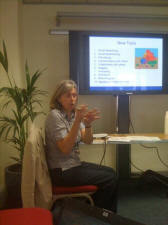
I've just been reading yet another article that expresses the view that Twitter is a trivial, inconsequential tool and has no place in learning, so I thought I'd write this posting on my experiences of using Twitter in a face-to-face Workshop. Via Tania Sheko, Jim Lerman
Scoop.it!

In this self-study, five university instructors who taught the same online literacy course during a summer session formed an online learning community. Through engaging in e-mail exchanges, participating in online discussions, posting weekly teaching reflections, and visiting one another’s online courses, they sought to answer the research question: How can an online literacy learning community support university instructors who teach various sections of a common online course? In answering the research question, the researchers identified the themes that were most prominent in their discussions and reflections, and also the themes that played minor roles in the forming of the literacy learning community.
Scoop.it!

Jefferson County Public Schools in Colorado is the latest among a string of districts that have adopted marketing initiatives as ways to funnel more money into their systems.
When elementary schoolers take their report cards home to mom and dad this year, the bottom will sport a 2-inch ad for CollegeInvest, Colorado's nonprofit education savings plan.
The ads will bring Jeffco, Colorado's largest school district, $90,000 over three years as the district works to close a $70 million budget gap, Jeffco Schools Chief Financial Officer Lorie Gillis told CBS 4.
Scoop.it!

Social bookmarking in education is a new and exciting opportunity for teachers and students to connect and collaborate online. Using Diigo Educator accounts is one of the best ways to achieve this. 
Nicole Valiente's curator insight,
May 14, 2016 11:51 AM
This source provides a great explanation of Social Bookmarking and discusses the use of Diigo Education in the classroom.
Scoop.it!

An educational game centered on scientific understanding and processes that leads students to a better understanding of hand washing. The game takes students through science processes as recommended through national science standards. Designed for middle school students.
Scoop.it!

A free iOS app to teach mental math to 1-3 graders. -JL
Scoop.it!

One of the most comprehensive approaches to developing information fluency among students and teachers. Digital Information Fluency (DIF) is the ability to find, evaluate and use digital information effectively, efficiently and ethically. DIF involves Internet search skills that start with understanding how digital information is different from print information, knowing how to use specialized tools for finding digital information and strengthening the dispositions needed in the digital information environment. As teachers and librarians develop these skills and teach them to students, students will become better equipped to achieve their information needs. Originally started as a project of the Illinois Science and Math Academy.
Scoop.it!

This cute and simple app condenses all of the links shared by the people you’re interested in on Twitter, and only shows you the most popular ones. So instead of sifting through the 500 links in your timeline in the past hour and a half, you’re served only the juiciest, most-shared, and most-retweeted morsels. Via Tania Sheko
Scoop.it!

A calendar of weekly chats on Twitter dealing with topics of interest to educators. Very handy guide for those who may desire to develop network connections on a particular subject area or grade level. -JL Via Tania Sheko |