




The easiest way for writers to gather information for a book, article or paper.
Via Ana Cristina Pratas

 Your new post is loading...
 Scoop.it! The easiest way for writers to gather information for a book, article or paper. Via Ana Cristina Pratas 
Mariusz Leś's comment December 5, 2011 4:47 PM
Seems like interesting tool, but it's at early stage of beta now. After all it's a web clipper mixed with notepad with rich formatting. When it comes out of beta, it will be paid I guess. No tagging, no android app (the page claims there is one).
Sign up to comment
Scoop.it!

Quick Screen Share is the simplest and easiest solution to share your screen with someone else without spending a dime.
Just head to http://quickscreenshare.com/ type your name and click start. A Java plug-in will need to be authorized and after it loads you will be given a URL which you can give out to your contact.
Key features in summary: - No registration required and completely free. - Nothing to install for sharer or sharee.
(Reviewed by Robin Good) Via Robin Good
Scoop.it!

Scoop.it!

By Lisa Nielsen
In the 21st century, the connected classroom is no longer a privilege. It is a right. Fortunately, more and more school systems are bringing their students out of the past and into the present with a basic internet connection, laptop, and projector. With the right building blocks in place, teachers will be positioned to transform their classrooms from disconnected spaces where learning happens in isolation to global communication centers. Here are the building blocks for success that you should put in place for effective change.
Scoop.it!

Talk about project-based learning, there's nothing better than what's happening with the Maker Movement...more and more people are learning how to make things. Who will be the first teacher in your school to get a 3D printer in her classroom? -JL
Scoop.it!
The new app from Educreations is available in the Apple App Store today (iTunes link). The app is designed to make it easy to create, narrate, and record whiteboard video tutorials on the iPad and to share them with others.
Scoop.it!

Blogger Andrew Marcinek shares the real payoff for his digital literacy students.
At the beginning of most units, I present a concept or idea through a video, image or article that leads to a discussion, provokes their thinking and drives further inquiry into the subject at hand. They present understanding through a video, a presentation, and by creating a website or posting to their blog. They're employing critical analysis and critical thinking by seeking out the answers to the questions they generate. They are discerning between credible and bogus information and understanding how to properly cite, organize and share their findings. They are creating surveys to elicit quantitative data and creating support for their assertions. They are building relationships and making connections. In every scenario, their questions and curiosity motivate their learning, while the technology tools available give them the opportunity to connect, share and promote their work a wider audience.
Scoop.it!

Classroom Applications I see content curation as a way for students to develop various 21st century skills: locating, filtering, evaluating, and ranking content; organizing, sorting, and creating content. Via catspyjamasnz
Scoop.it!

"A distinguishing feature of online education verses the face-to-face environment are class discussions. Face-to-face discussions are typically spontaneous interplay with the minority of students being actively involved, haphazard in their preparation, with the appearance of mostly the verbal-oriented and self-confident members of a class. Discussions are often a presentation technique to avoid lecture lethargy or sleepiness, and are not considered a prime facilitator of the education process
In an asynchronous online environment, discussion questions are planned and students and faculty respond with considered answers. Faculty carefully craft questions to fit content and student needs. Respondents, both students and faculty, can take the time to carefully research and develop their responses. Therefore, the achieved learning from online discussions is potentially much greater than in a face-to-face environment."
This is a three part series that will help any online practicioner to better understand the complexities of writing discussion prompts and facilitating threaded discussion. This is a university level research effort with a solid bibliography. Well worth reading! ~ Dennis T. O'Connor
Scoop.it!

Find information about academic papers, authors, conferences, journals, and organizations from multiple sources.
~ Here's another example of serendiptous discover. I picked this specialized search tool up from my Literacy with ICT Diigo group weekly email. Thanks to Phil Taylor for sharing the link.
Microsoft's Academic Search Engine offers a number of ways to search for research about any topic. It's an intriguing, more visuual, alternative to Google's Acadmenic search.
The academic map gives you a world view of universities. You can then drill down into their databases, viewing research by topic, discipline, author. The visual tools enhance the experience and provide entry points for searchers of different levels of expertise.
Comparing organizations by citation count is another innovative way to investigate data. All of the tools give you a variety of ways to compare and consider information from academic sources.
This is a find! Click in and explore! ~ Dennis
Scoop.it!
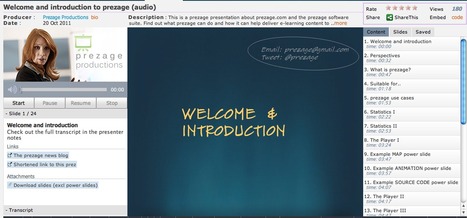
Prezage [prez-AHzh] is a suite of advanced web-based software tools for the creation and delivery of online lectures and presentations.
Prezage presentations can be delivered via a web browser with no additional software, and they provide several advanced features such as text and visual indexing of the presentation sections, audio and video/slide sync alongside many management and delivery options.
See several examples of presentations created with Prezage here: http://prezage.com/web/
Anyone can apply to become a free Prezage presentation Producer by simply applying with the info provided on tis page: http://prezage.com/producer/
Learn more about Prezage through this in-depth Prezage-based interactive presentation: http://prezage.com/player/?p=1
More info: http://prezage.com/ Via Robin Good
Scoop.it!

Without a doubt, Twitter is one of the best innovations of the century. It’s a simple idea coupled with a simple interface that took them to the stratosphere. Via Jeff Pulvino |
Scoop.it!

What are you thinking today? Express yourself creatively with beautiful backgrounds and fonts. Post anywhere. Check out other great applications by Muzy. Via Baiba Svenca
Scoop.it!

This is a great collection of ways for representing information visually. There is an example with each suggestion, just put the cursor over the box. Via Nik Peachey
Scoop.it!

A look at the largest online school company’s operations raises serious questions about whether its schools — and full-time online schools in general — are a good deal for children or taxpayers.
Scoop.it!

The HASTAC/MacArthur Foundation Badges for Lifelong Learning Competition has announced the 60 winners of Stage One of the Competition.
Stage One applicants were asked to submit ideas for compelling learning content, activities, or programs for which a badge or set of badges would be useful for recognizing learning that takes place in a particular area or topic. Winning applications represent a wide array of public and private institutions and organizations from around the world, including museums, non-profits, after-school programs, research institutions and for-profit companies. Proposed content for badge systems address a breadth of topics—from the promotion of civic engagement and commu nity volunteerism, to STEAM (science, technology, engineering, arts, and mathematics) learning in and out of the classroom, to digital literacy, to workforce preparedness and beyond. Winning applications are available for public perusal and commenting at www.dmlcompetition.net.
Scoop.it!

Everyone says the e-book will take over the world—but they're wrong. Even in a world of screens, paper offers unique ways to organize and share your thoughts.
This is a decidedly alternative view of the future of books, but when you think about it, it makes a lot of sense.
Scoop.it!

Michael Horn, co-author of Disrupting Class, reviews Tom Vander Ark's new book 'Getting Smart.'
"In a whirlwind tour of 200 very readable pages, Vander Ark paints an audacious and bold vision for what education could—and he predicts will—be like in the next 10 years. For those familiar with Vander Ark’s daily blog, little in the book will be new, save for how he organizes the sheer volume of his thoughts and on what he chooses to focus and highlight. But for those who don’t follow his writings, Vander Ark’s predictions, which are sprinkled throughout the book every few pages in an entertaining fashion, will likely come as quite a shock—from his prediction that in five years “low-cost blended-learning private schools will serve close to 200 million students in India, China, and Africa” to his declaration that in 10 years, “second-generation recommendation engines will drive tutoring applications that are more effective than one-on-one sessions with a live tutor.”
Lots more in the rest of the review. -JL
Scoop.it!

YouTube can be used as a valuable teaching tool in the classroom, but while it is chockfull of educational content and useful knowledge – it is also filled to the brim with distracting videos.
Scoop.it!

Combine sharing pictures and narration and what do you get? Slidestory! Slidestory is a new, exciting and FREE way to make presentations and share them on the Internet. Via Baiba Svenca
Scoop.it!

"Diigo is a social bookmarking tool that allows teachers and students to save websites into a public or private library, share them with others in your network, highlight any part of a webpage and attach sticky notes to specific highlights or to a whole page. The annotations can be kept private, shared with a group within Diigo or a special link forwarded to others."
Helpful slide deck included here for getting started. -JL
Scoop.it!
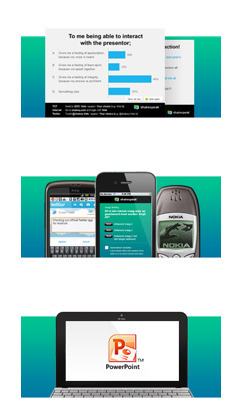
Shakespeak is a new tool that allows you to get live feedback, votes and responses to your questions via SMS, Twitter and the web to appear right into the presentation you are delivering.
The software is presently available for Windows PC, but a Mac-Keynote version is in the works.
This is an interesting approach to create true, live engagement during a live presentation session.
You can check out a video about Shakespeak right here: http://vimeo.com/17365353
Find out more: http://shakespeak.com/ Via Robin Good
Scoop.it!

This has been making the rounds a lot this summer and fall. I've seen it a lot online and in stores. Yesterday I saw it in a store and stopped, really stopped, to study it with care. It impresses me greatly as a wonderful statement for now -- just as the Desiderata did back in the 60's and 70's and Marianne Williamson's "Our deepest fear is not that we are inadequate" statement, used by Nelson Mandela in his 1994 presidential inauguration, did in the late 90's and early 00's. Words can inspire us deeply. -JL
Scoop.it!
At the School Library Journal Leadership Summit 2011, Pew Internet Director Lee Rainie looked at the “state of reading” in the digital age by going through (Check out this SlideShare presentation : Reading, Writing, & Research in the Digital ...)...
Reading as a social contact sport? Provocative ideas and interesting statistics and graphics make this slide show worth clicking through! Via Pippa Davies @PippaDavies , Nancy Jones |






