


Goalbook could revolutionize how we approach differentiated instruction and outcome-based education.

 Your new post is loading...
 Scoop.it! Goalbook could revolutionize how we approach differentiated instruction and outcome-based education. No comment yet.
Sign up to comment
Scoop.it!

In the current constrained financial climate, this type of low cost, self-directed teacher development is interesting. Might the spread of such informal, peer-based, online CPD help to support the drive to raise teaching standards at minimal cost? This report explores this question, focusing on: • how teachers and other educators are currently using social media to aid their professional development, and what they and their students gain from it; • what evidence there is for the benefits of peer-to-peer teacher CPD, and for using social media in this way; and • what teaching can learn from industry in this respect. Drawing on emerging academic research in this area, and on the experience of trailblazing teachers, it recommends ways in which school leaders and policymakers can exploit the benefits of social media for effective and affordable teacher professional development.
Scoop.it!

New Milford High School proudly joined 37 states, 15,000 teachers, and over 2 million students on February 1 for the inaugural Digital Learning Day. This day, however, was not really much different than any other day at NMHS as we have made a commitment to integrate digital learning into school culture for some time now. As Principal I am proud to state that many of the pedagogical techniques, learning activities, and tools described in the rest of this post are consistently in use on a daily basis across all content areas. The reason for this is that we have put a premium on creating a teaching and learning culture that better meets the needs of our learners while enhancing essential skills such as collaboration, communication, creativity, media literacy, and global awareness. Below I have summarized some of the pre-planned activities that my teachers planned and had their students engaged in on Digital Learning Day.
Scoop.it!

If you have a Google Account, Google Dashboard helps you answer the question, “What does Google know about me?”. It shows you the information stored in your Google Account and enables you to change your privacy settings for many products from one central location.
When you go to your Dashboard you’ll find a single page where you can see the various products you use with your account and what’s stored in them, along with easy access to the product-specific controls. Dashboard can remind you of your last Blogger blog, your favorite YouTube playlist, your uploaded photos and more.
Scoop.it!

Because attention is so easy to gather on Twitter, and because your follower count can climb with the speed of a soaring stock, you might find yourself falling into the too typical trap of thinking Twitter’s purpose is to gather as much attention as possible. It’s not.
Attention is great, but it’s only the end result of getting what you’re really after – quality relationships.
The more you establish quality relationships, the more easily you’ll be able to leverage them for your own benefit, whether you’re trying to build your brand or broaden your influence. People in your day-to-day life are happy to help you because you have an existing relationship. The same holds true online.
Scoop.it!

Freshman math teacher Carrie Hochgrebe uses clickers to monitor individual and group achievement. With this information, she can assist individual students, make instructional decisions and ensure that all students are learning.
Scoop.it!

Diane Ravitch video
Public education is under attack, says Ravitch. We are living through a movement in which schooling is being radically re-envisioned as a private rather than a public enterprise, with little debate over whether the ideology of the free market belongs in American schools in the first place. Proponents of the movement see standardized tests as a way to evaluate student and teacher performance.
In practice, test scores are not being used for diagnostic purposes but as a clumsy and myopic way to evaluate (and penalize) American schools, teachers, and students. Since the bipartisan passage of the No Child Left Behind Act (NCLB) in 2001, students have been required to demonstrate "Adequate Yearly Progress" in reading and math, based solely on test performance. Failure means being held back a grade.
Scoop.it!

This is a feature-rich site devoted to enhancing one's skills in Excel. Many free resources are provided. If you want to get better at using Excel, this is a good, free place to start.-JL
From the website: Learn Microsoft Excel Online. Every day we post fresh Excel Tips, Tricks, Charts, Formula Examples, Tutorials, Downloads, Dashboards, Templates and Visualizations for your Inspiration, Success and Productivity.
Scoop.it!

Recently, I was working with some educators who didn't know a pie chart from a hole in the ground. It was actually worse than that, but as we see more and more information communicated via charts, graphs, and other data visualizations, there is also a corresponding literacy needed to read and write these. And while my internal monologue may run along the lines of "OMG...you can't interpret a bar graph?!", my overall goal is to make data viz accessible to educators. Sometimes, that means I will have to start at the beginning.
Scoop.it!

Education blogger Terrell Heick in this blog post offers suggestions for using Google+ with students in the classroom. The social media tool, which often is compared with Facebook, can be used as an avenue for two-way communication with students and as a tool for groups of students and teachers to manage and collaborate on projects, he writes.
Scoop.it!

Another example of challenge based learning. Can we call it question based learning? "Just when you think you know all you need to know, you ask another question and discover how much more there is to learn." Via Jeremy Angoff
Scoop.it!
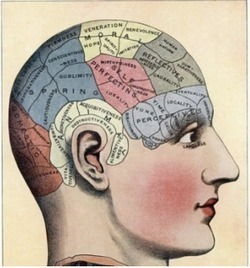
This article is about how teachers in many schools in the D.C. area are foregoing empty praise of the “Good job!” variety, in favor of giving students solid information that will do them some real good. That information concerns how their brains work and how their intelligence and skills develop, and it’s knowledge that should be made available to every child in the country. Stanford psychologist Carol Dweck conducted the groundbreaking research showing that praise intended to raise young people’s self-esteem can seriously backfire. Via Andrea Zeitz, Jim Lerman |
Scoop.it!

Students have an array of introductions to computer programming, which develops critical thinking skills "completely transferable" to other areas of learning, says Lauren Bricker, a computer-science teacher at Seattle's Lakeside School. 
Jared Frost's curator insight,
January 20, 2013 4:39 PM
This article is great motivation for anyone trying to get into computer programming. Just in the first paragraph it talks about a kid who started learning how to program at 8 years old and now makes cell phone applications at 15. If he can do it at such a young age, I can surely do it now. There is a couple kids games that teach kids basic text in the article. I really wish I knew about these when I was younger, things would be a lot easier for me now. With no time for regret, I continued reading and it gave advice for highschool students. Some good books and programs were listed so I will reference them in the future. All in all, a very informative article.
Scoop.it!

Rover provides cloud-based streaming through iSwifter’s technology, enabling iPads to stream Flash content alongside other useful education tools. Free to download, it’s targeted towards the K-12 education sector having partnered with education brands such as Discovery Education, Mathletics and Funbrain. Partnering with such brands immediately makes Roveran immensely useful resource of offering both fun and knowledge without the child even realising how much they are learning. free to download
Scoop.it!
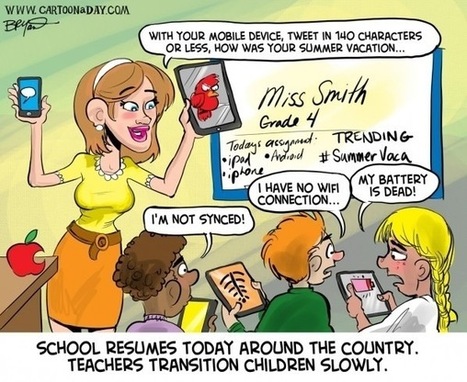
However, no matter how versatile and potentially powerful a product the iPad is, it is merely an extremely expensive placemat without creative, well planned teaching behind its use. Before committing to an iPad implementation of any size, schools need to thoroughly think through how these technological marvels are going to enhance the teaching and learning process.
Scoop.it!

From
edte

Over the last year and a half I have really enjoyed exploring the types of iPad apps that can be used in the classroom and so I thought I would begin to draw together some of my favourites and share them with you here. This is the first of 4 posts in which I feature my first 5 recommendations.
Tom Barrett is a primary grade teacher in the UK who writes a great blog at EDTE.CH.
Scoop.it!

They are in late prototype stages of wearable glasses that look similar to thick-rimmed glasses that “normal people” wear. However, these provide a display with a heads up computer interface. There are a few buttons on the arms of the glasses, but otherwise, they could be mistaken for normal glasses. Additionally, we are not sure of the technology being employed here, but it is likely a transparent LCD or AMOLED display such as the one demonstrated below: In addition, we have heard that this device is not an “Android peripheral” as the NYT stated. According to our source, it communicates directly with the Cloud over IP. Although, the “Google Goggles” could use a phone’s Internet connection, through Wi-Fi or a low power Bluetooth 4.0. The use-case is augmented reality that would tie into Google’s location services. A user can walk around with information popping up and into display -Terminator-style- based on preferences, location and Google’s information. Therefore, these things likely connect to the Internet and have GPS. They also likely run a version of Android.
Scoop.it!

The use of case studies is a powerful pedagogical approach to incorporate student-centered learning activities into lessons. Claire Davis and Elizabeth Wilcock conducted an excellent literature review and created a phenomenal resource called Teaching Materials Using Case Studies. Via Barbara Bray
Scoop.it!

Teacher Erik Odom from The East Bronx Academy incorporates real-world learning through the use of technology. Students consider ideas to promote their school using social networking and web design.
Scoop.it!

I have assembled a catalogue of 85 tools to help you run a more effective social media program for your campaign, organization, or business. Most of these are free. A lot are for Twitter. Many help you leverage Facebook and other social media too. Some help you find the best content to share via social media.
Some of these tools are more useful than others. But I expect you will disagree over which are the most and least useful. That is why I have included such a wide range of tools.
You will find tools for measuring, monitoring, and engaging your social media audience.
Scoop.it!

Pie charts work best when comparing the proportions of two categories. But the problem with pie slices is that it is difficult for users to compare the area of the slices. If you just need to communicate something very basic ("A is bigger than B"), it's probably okay. However, if you need users to understand details (or change over time), then a bar chart is a better graphic. People are much more accurate at reading length, rather than wedges. Labels are simpler to apply. (Although this is kind of an ugly example of pie vs. bar, it does make a good point about why bar graphs are better.) Take a look at this redesign of a pie chart to bar graph on Junk Charts for a good illustration of some of the issues.
Scoop.it!
Project-Based Learning (PBL) naturally lends itself to differentiated instruction. By design, it is student-centered, student-driven and gives space for teachers to meet the needs of students in a variety of ways. PBL can allow for effective differentiation in assessment as well as daily management and instruction. PBL experts will tell you this, but I often hear teachers ask for real examples, specifics to help them contextualize what it "looks like" in the classroom. In fact, the inspiration for this blog came specifically from requests on Twitter! We all need to try out specific ideas and strategies to get our brains working in a different context. Here are some specific differentiation strategies to use during a PBL project. 
Veronica Adedapo's curator insight,
October 7, 2019 8:05 PM
I really liked this article, a good read
Scoop.it!

450 Greenville students will now be connected to class 24 hours a day.The school district is giving students at the elementary, middle and high school levels Droid X2's and Samsung Galaxy Tabs as part of a new pilot program. Greenville School District Technology Director LeeAnn Eyer says the goal is to provide educational access for students no matter where they are.
Scoop.it!

Project Based Learning (PBL) is a great way to teach students content, 21st century skills, and engage them in something fun and educational. I spoke more about PBL in an earlier blog (http://www.techlearning.com/blogs_ektid17052.aspx) and we had some great reader comments (Tech&Learning, May 2009, page 14). Today I'd like to give some tips and ideas on how to get started with PBL in your classroom. |






