Your new post is loading...

|
Scooped by
Jim Lerman
April 4, 2012 3:10 PM
|
Via Learning in Hand "Lisa Johnson and Yolanda Barker have published an eBook titled Hot Apps 4 HOTS: A Guide to Using Free Apps to Support Higher Order Thinking Skills. The book includes nine step-by-step activities that focus on each level of Bloom's taxonomy and includes loads of links to further resources. Like the title says, Lisa and Yolanda write about free apps and most of them work on both iPads and iPod touches. Here are the apps used in the activities:"
|
|
Rescooped by
Jim Lerman
from :: The 4th Era ::
April 3, 2012 4:28 PM
|
This event will take place July 31st and August 1st 2012 at the 92nd Street Y (1395 Lexington Avenue) in New York City. {I attended last year's event...it was great. For $1.40 for a 2-day conference, how can you go wrong? ;-) -JL} Ever since the first #140conf event in New York City back in June 2009, we have been looking at the effects of the real-time web on Education. To date, the #140conf events have provided a platform for: students, elementary and secondary school teachers, college professors and high school principals. In an attempt to provide more attention and more voices to the educators of the world, we have partnered with Chris Lehmann (@chrislehmann) – Principal of the Science Leadership Academy in Philadelphia and we are bringing #140edu back to the 92nd Street Y for our second year. Ticket Prices for this 2 day event will remain the same as last year. Tickets are $140 for vendors / suppliers in the Education ecosystem; $14 for Students and $1.40 for Educators. Registration for #140edu is now open. The changes in the way we live our lives must create change in the way we teach and learn. The real-time web should create profound changes in the way we think about what, how and why students and teachers can do, create and communicate. The very nature of what we consider "school" should be radically different given the powerful reach of the communicate tools our students have at their disposal. #140edu is dedicated to exploring
and expanding that change. Join us. ---- A Call For Speakers With today's "Call for Speakers" we are looking for creative, out-of-the-box thinkers to come forward and pitch me something relevant they would like to discuss from inside the respective worlds of the education segment they are operating in. Educators from around the world are encouraged to come forward and share their ideas. Students and parents are also encouraged to come forward and share their perspectives. And anyone and/or everyone who has a vested interested in the State of Education NOW are invited to come forward and share their perspective. Our hope is to have a variety of industries represented at our first event.
|
|
Scooped by
Jim Lerman
April 3, 2012 3:37 PM
|
By Joshua Bolkan Description by SmartBrief on EdTech "Schools worldwide now can access free subscriptions to Pen Pal Kids Club, a social network for students in kindergarten through eighth grade. On the site, students can communicate securely with other students -- or pen pals -- worldwide whom their teachers approve. Messages are translated in English, Spanish, Chinese, French, German, Italian and Japanese, with more languages to be added."
|
|
Scooped by
Jim Lerman
April 3, 2012 8:23 AM
|
Via The Committed Sardine With much of human knowledge now our fingertips, the Internet is rewiring our brains in various ways, Online College finds: The Internet is our external hard drive Children are learning differently We hardly ever give tasks our full attention We don’t bother to remember We’re getting better at finding information Difficult questions make us think about computers IQ is increasing over time Our concentration is suffering We’re getting better at determining relevance We’re becoming physically addicted to technology The more you use the Internet, the more it lights up your brain Our brains constantly seek out incoming information We’ve become power browsers Online thinking persists even offline Creative thinking may suffer
|
|
Scooped by
Jim Lerman
April 2, 2012 11:22 PM
|
By Paul Horowitz "I love the iPad but I really hate typing on it. Though touch screens are magnificent for some tasks, frankly typing just isn’t one of them. Maybe it’s my hands and fingers fault or maybe I’m just a grouchy old school tactile typer, but I struggle to get in any kind of real workflow that involves typing more than a sentence or two on touch screens. I’m probably not the only one to feel this way, so here are six helpful tips to improve the typing and writing experience on the iPad:"
|
|
Scooped by
Jim Lerman
April 2, 2012 11:16 PM
|
"How is computing (ie computer science) taught in other countries? A look around the world shows that most other countries are experiencing the same epiphany as the UK. The current ferment of excitement around computer science as a school subject here (Google chairman Eric Schmidt's speech criticising British educatioin, Gove's announcements at BETT, the Royal Society report, new GCSEs announced, Raspberry Pi and .NET Gadgeteer, the Turing centenary, etc) makes the UK unique. Other countries are now looking to Britain for lessons about how to do it right. Comparisons are not straightforward, because of the diversity of educational systems. Nevertheless, there are some lessons we can learn from the international experience:"
|
|
Scooped by
Jim Lerman
April 2, 2012 10:16 PM
|
By Med Kharbach "The Entire Guide to Google Search Features for Teachers and Students is the third ebook I am publishing here exclusively for Educational Technology and Mobile Learning readers. After the success of 80 Alternatives to YouTube and The Comprehensive Guide to Google Free Tools in Education, I am expecting my readers to find this guide of the same importance if not more."
|
|
Scooped by
Jim Lerman
April 2, 2012 9:49 PM
|
By Andrew Miller "You knew it was coming, didn't you? Edutopia has officially launched its new Games for Learning Community, and I am honored to be its facilitator. I'm excited to have a space where teachers can share best practices, ask questions around implementation and nerd out on gaming in the classroom. "If you are new to the conversation around games for learning, it is a large umbrella that contains many aspects of using games and game mechanics in the classroom. Whether you're a seasoned gamer or a total noob, here's an intro video and a glossary so that we can all have a common understanding."
|
|
Rescooped by
Jim Lerman
from :: The 4th Era ::
April 2, 2012 8:25 PM
|
It looks more and more like the "Flipped Classroom" is an idea that's here to stay for more than a little while. In two short years, it has spread quite widely and practitioners grow in number daily. Salman Khan, of Khan Academy fame has become a media darling. Formal research is just starting to catch up. Despite all the hype, it seems to me there is something quite subtantial to the concept. In any event, for those who are interested, I came across this Ning social network - "The Flipped Class Network". With 3600 members as of today, it will surely grow to be a very rich source of support and information. -JL
|
|
Rescooped by
Jim Lerman
from Scriveners' Trappings
March 31, 2012 12:20 AM
|
Judy Greller's award-winning blog with resources galore in numerous areas. This page contains a wonderful collection of links to sites related to Digital Storytelling. -JL
Via Ms. Hall, lharvey, Louise Robinson-Lay, Jim Lerman
|
|
Scooped by
Jim Lerman
March 30, 2012 10:47 PM
|
By Heather Wolpert-Gawron Via Nik Peachy "The good news is that succeeding in an online environment isn’t so different than succeeding in a traditional classroom. OK, sure, there’s the time and distance and technological wall that can separate online learners. But the computer, in many cases, doesn’t slam the communication door closed; it, in fact, opens it wider. "But it’s good to know what you’re getting into. So to help teachers communicate their expectations to students who are just starting to blog or use dropbox or set up discussion threads, I’ve provided a list of characteristics that many agree successful distance learners possess. Notice the similarities in many of the attributes that our students need to succeed in a traditional classroom. The difference, of course, is that one’s success relies far more on individual choices and energy management."
|
|
Scooped by
Jim Lerman
March 30, 2012 8:05 AM
|
Posted by Jeff Dunn "The brainchild of our own Terry Heick, the Twitter Spectrum offers 25 different ways teachers can incorporate Twitter into the classroom. "It is organized by the categories WATCH (easiest degree of difficulty, TALK (moderate), and PRODUCE (highest degree of difficulty). We did our best to put each box in the appropriate place. Therefore, some of them are in between different degrees of difficulty."
|
|
Scooped by
Jim Lerman
March 29, 2012 8:16 PM
|
By S. Snyder Via The Committed Sardine "The title of this essay is "How to Ask a Smart Question" and I have tried to lay out some general guidelines and pitfalls to avoid when you pose questions to gain a greater understanding. I wish I could tell you that asking such questions comes easily; it doesn't. Rather, it's an intellectual habit or a disciplined way of thinking that you can only learn by doing. After all, an expert can give you pointers on shooting a free throw or hitting a golf ball, but you only get good at it with practice."
|
|
|
Rescooped by
Jim Lerman
from :: The 4th Era ::
April 3, 2012 6:00 PM
|
I had the pleasure of spending about half of yesterday in the company of Alan November at the Scaling Up Student Success conference run by Educztion Week in Jersey City, NJ at the Hyatt Regency Jersey City. (If you ever get the chance to attend an event at this venue, don't miss it!. The views of lower Manhattan and NY harbor from the 9th floor ballroom and patio are spectacular - and this is coming from a jaded New Yorker.) I enjoy listening to and watching Alan present. I love his iconoclasm, clarity, approach to scholarship, informality, and even his sense of humor. Most of all, I enjoy and believe in a lot of what he has to say. Of course, as with most strong personalities, there are those who do not find him their cup of tea, but that's another story. In any event, at one point Alan made reference to the work of John Hattie, an educational scholar who, until yesterday, was unknown to me. Alan took us to a webpage that seems to do a good job of summarizing a couple of decades of Hattie's work, focused on what works best in education.The link for this Scoop.it post will take you to that page. (I can't wait to compare his conclusions to those of Marzano). I won't attempt to summarize the summary, but in addition to saying that I think Hattie's work warrants some significant attention, I'd like to comment a bit the work of the website's author, James Atherton - for his work seems worthy of more than a passing glance as well. Atherton is a "semi-retired" professor, teacher, web-writer, and professional gadfly. His websites get about a million hits per year, which is no small change. Basically he likes to ask "why" and to tell it like it is. Most of his writing revolves around teaching and learning. What I've read so far is great material. Don't miss the profile of him by the (London) Times Education Supplement, a link to which can be found on the hompage of Atherton's website named doceo (www.doceo.co.uk/me.htm). Lots to think about here. Enjoy! -JL
|
|
Scooped by
Jim Lerman
April 3, 2012 3:45 PM
|
By Caroline Knorr "If the long winter months have sent your kid into the arms of Facebook, Angry Birds, or Sesame Streetreruns, it's time for a little spring cleaning. Thankfully, cleaning up your media act is a lot more fun than figuring out how all those insect wings landed in that weird space in the attic. "The first step is taking stock of the stuff your kid is watching, playing, and downloading. We'll help you figure out what to keep (the good stuff), what to toss (the not-so-good stuff), and what you, as a parent, can "give away" (support strategies for every age). "Stay tuned for the next installment, where we'll tackle the issues that come up and provide handy resources for problem solving.
|
|
Scooped by
Jim Lerman
April 3, 2012 8:28 AM
|
By Andrew Keen "As always, Mobile World Congress, the world's largest mobile telephone extravaganza, is being held in Barcelona this year. But it really should be held in Geneva, close to where Mary Shelley created Frankenstein. "That's because, with our increasing addiction to our mobile phones, we are in danger of creating a monster that we are less and less able to control. "Exaggeration? When was the last time you went out without your smartphone? How naked, how lost, do you feel without your mobile device? How much essential data, I mean really personal stuff that you wouldn't want anyone else to see, does your mobile phone contain?" Via the Committed Sardine
|
|
Scooped by
Jim Lerman
April 3, 2012 8:12 AM
|
By Tanya Roscorla "Across the country, schools announce iPad pilots, bring the mobile devices into the classroom and rave about their new tools. "To figure out how this device impacts schools, we'll take a look at pilot programs in two California schools and one Oregon school district. Keep reading to find out the technical and instructional implications of the iPad in the classroom."
|
|
Scooped by
Jim Lerman
April 2, 2012 11:19 PM
|
By John Naughton "There is a growing consensus that the way children in schools are being taught information technology is in need of a radical overhaul. Here John Naughton explains the problem and offers a manifesto for revolutionary action."
|
|
Scooped by
Jim Lerman
April 2, 2012 10:19 PM
|
By Jill Scott "Teachers today are fortunate to have access to technological tools that make our jobs easier and minimize the paperwork involved in educating our students. I didn’t grow up with computers like today’s students did, but I’m very much on board with becoming more tech savvy and, yes, even accepting help from my students when I have technical difficulties. "About a year ago I bought myself an iPad after saving for it for months. It was going to help me organize my life, both at home and at school, and guess what? It did. I love my iPad and I can’t see myself living without it. Today I want to share with you some of my favorite apps and websites that I use in the classroom."
|
|
Scooped by
Jim Lerman
April 2, 2012 10:13 PM
|
By Med Kharbach "Given the huge importance of Google services in education and the pressing need for us as teachers and for our students as learners to get to know and use these tools, I have compiled a thorough guide containing all the Google tools that we can use in education. I have been working on this guide for sometime now and it took me several days to check what some edu-bloggers have written about this topic because I do not want to repeat what others have already said. I am thinking I came up with a unique guide in that it is video based more than text based. For every single service I included I provide a video tutorial showing how to use it. The purpose is to get as many students to use it as possible. I know students attention when it comes to a lengthy guide full of paragraphs would very easily be distracted and chances are they would not read it all. This is why I included videos to spur them to discover all the tools."
|
|
Rescooped by
Jim Lerman
from :: The 4th Era ::
April 2, 2012 9:40 PM
|
By Tom Jacobs "Students from the lower end of the socioeconomic ladder tend to do less well in school than those from more upscale families. But newly published research identifies one sub-group of these youngsters who tend to exceed expectations: those who participate heavily in the arts. “At-risk teenagers or young adults with a history of intensive arts experiences show achievement levels closer to, and in some cases exceeding, the levels shown by the general population studied,” a team of scholars writes in a new National Endowment for the Arts Research Report. “These findings suggest that in-school or extracurricular programs offering deep arts involvement may help to narrow the gap in achievement levels among youth.”
|
|
Scooped by
Jim Lerman
April 1, 2012 9:17 PM
|
By Ben Reid "I’m a pretty partisan Evernote user, mainly because of how easily everything syncs without me having to really pute in any effort. I’m a firm believer that my smartphone should perform tasks with as little input from myself as possible – leaving me to get on with being extremely lazy. "WriteUp doesn’t fall short on any of the basic tasks, and is a worthy addition to anybody’s inventory of productivity-related apps. Like most note-takers of today, it provides extensive Dropbox support, and the numerous color styles give the app a touch of class. I did find that a few of the colors clashed a little, but if enough tinkering is done, I reckon there’s a combination in there to suit all."
|
|
Scooped by
Jim Lerman
March 30, 2012 11:35 PM
|
Greg Satell has written a thoughtful, succinct, and well-researched blog post on his 5 principles. I like his no-nonsence approach. -JL
|
|
Rescooped by
Jim Lerman
from Tools for Teachers & Learners
March 30, 2012 10:39 PM
|
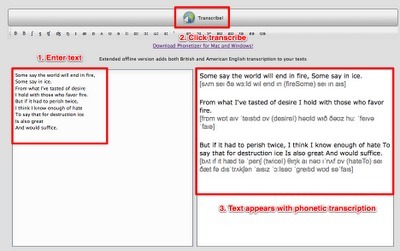
I always believe that the best sites and web tools are the simplest, and this is certainly the case with Phonetizer. It's a really easy to use tool that takes text and adds the phonetic spelling below it.
Via Nik Peachey
|
|
Scooped by
Jim Lerman
March 29, 2012 10:42 PM
|
From OnlineCollege.org via Edudemic "Google+ may still be finding its own footing among the Twitters and Facebooks of cyberspace, but nevertheless hosts a cornucopia of networking opportunities spanning numerous subjects. Education subject matter in particular seems to flourish on the service, with parents, teachers, pros, students, and interested outsiders meeting up and talking about anything and everything."
|