"With the growing demand for video-based online education, Curious.com is joining the crowd today with a marketplace that aims help students and teachers connect around a range of subjects, from pipe soldering and salsa dancing to jewelry making and knife sharpening.
"With 10K learners logging 150K sessions during its five-month private beta, Curious launches today with hundreds of short, video-based lessons for people who want to learn a new skill or rekindle a favorite hobby. Founded by former Homestead founder and CEO Justin Kitch, who sold his company to Intuit for $170 million, Curious is taking a page out of Udemy’s book by not only offering learning content to students but by allowing teachers to market, share and monetize their lessons and engage with new students.
"To support its launch, the company has raised $7.5 million in Series A financing from Redpoint Ventures, former Apple Chairman Bill Campbell and Jesse Rogers, including a personal investment of $500K from Kitch."
"MOVING CUP TO LIP: That's the metaphor that Dr. Kenneth Green, founding director of The Campus Computing Project, uses to address the age-old déjà vuquestion: what does it take for technology to really have an effect in education? Hiskeynote presentation at Saylor Foundation's 2013 Digital Education Conference dishes out nuggets of wisdom as he explores how the absence of infrastructure has so far affected acceptance and adoption of MOOCs, digital textbooks, tablets--you name the tech. (Here are the accompanying PDF slides.) Along the way, he's got a few thoughts on why we--and the media--need to seriously refine our consumer-guided expectations for how technology ought to work in schools. Perhaps best of all, he closes with some suggestions we definitely encourage!"
"Part LEGO, part dominoes, part video game; these cubes try to fuse the games my generation enjoyed as kids (e.g., building blocks, puzzles, LEGO, etc.) with today’s video games, creating a video-board game of sorts that’s happening inside several cubes at once. If this is a little hard to grasp, don’t worry, I’ll show you exactly how it works. But are the Sifteo Cubes really all they’re cracked to be, or is this no more than a gimmick?"
A thorough review and description of Sifteo Cubes, and a lukewarm endorsement. If you've been wanting to know more about the Cubes, this is a good place to get an introduction.
This post could be almost infinite: there is most certainly an extraordinary array of options for videos which expand educators’ understandings and inspire advances in 21st century learning. ...
"In order to have the students become highly engaged in their own learning and take the time to be better students, it is necessary to shift into a different paradigm of learning. It is important to create an educational setting that allows students to explore and engage in multiple levels of learning. To create this type of student engagement in the online world, students should have five very highly interactive experiences; student-to-student, student-to-teacher, student-to-community, student-to- material, and student-to-technology. If an online program/class is able to build this type of learning environment, the students will have one of the most exciting and memorable encounters of their educational experience.
"The best type of learning to develop each of these ideas is to have the student do some type of inquiry-based, project-based, or problem-based learning. These types of learning are not isolated classroom experiences but cross-curricular ones. For example, the work might be developed using a thematic structure that is organized and developed by the teaching staff and allows students to also work toward developing their own projects and activities."
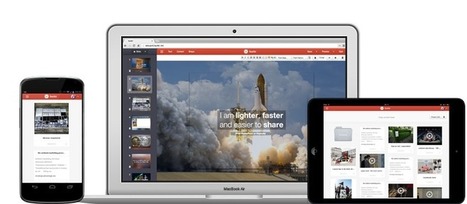
Bunkr is cloud-based presentation software that allows professionals to centralize all the content that inspires them, and to use this content in their presentations.
Prezi isn't the only challenger of Keynote / Powerpoint any longer. Bunkr looks interesting, but I worry if this is not further transforming us into a cut'n'paste culture.
"You’ve got Goodreads and Readmillfor eBooks, Pocket and Instapaper for long-form articles, and Flipboard for news.
"And pretty soon all those apps will feel like clutter on your bookshelf thanks to Dotdotdot, a brand-new site that brings together all your texts in one place.
"The browser plug-in lets you save articles from across the web; you can hook up Google Reader to pump in your news feeds and drag-and-drop to add e-books. Congratulations, you now have your own personal library.
"Dotdotdot will reformat the content and load it into the tool’s beautiful page-flipping format. You can highlight and make notes (which are all wonderfully searchable), send lovely postcards of your favorite lines to friends, and follow people to see what they’re currently reading.
"The site (with apps for iPhone and iPad) is in its early stages and lacks some bells and whistles, but let’s just say we’re pretty darn excited its future."
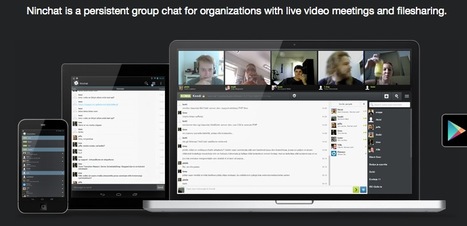
I greatly appreciate these posts, Robin. I'm trying to find the best platform to have a series of online presentation/conversations and feel rather overwhelmed. I need the ability to present material, have live interaction in various forms (video, phone and text/chat), and record the sessions. Free or low cost, as well. I've assumed Google Hangouts would be the best choice but I greatly appreciate the other options you're presenting.
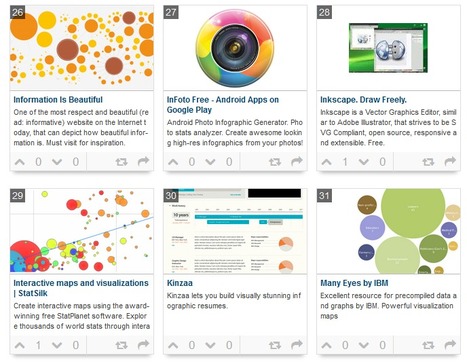
Infographics are interesting–a mash of (hopefully) easily-consumed visuals (so, symbols, shapes, and images) and added relevant character-based data (so, numbers, words, and brief sentences).
The learning application for them is clear, with many academic standards–including the Common Core standards–requiring teachers to use a variety of media forms, charts, and other data for both information reading as well as general fluency...
Las infografías son una herramienta muy útil por su factor visual: en poco espacio y de forma visulamente agradable y atrayente, engloba datos y relaciona conceptos.
"Manners today are often seen as a quaint subject that belongs in Lord Chesterfield’s outlandish advice on the art of pleasing or Esquire‘s dated guide to dating. But in a culture where we regularly do online what we’d never do in person and behave offline in ways our grandparents wouldn’t have dared dream of even in their most defiant fantasies, there’s something to be said for the lost art of, if not “manners,” politeness and simple respect in communication. Though originally published in 1866, Martine’s Hand-book of Etiquette, and Guide to True Politeness(public library; public domain; free Kindle download) by Arthur Martine contains a treasure trove of timeless — and increasingly timely — pointers on the necessary art of living up to our social-animal destiny."
Most educational games for the iPad aim squarely at the kiddish crowd. But those punk whippersnappers who need to get off the lawn shouldn’t have all the fun. Adults can enjoy their own as well, including these!
"Narrative Arc and the prototypical “Plot Diagram” are key learning tools for building literature comprehension and appreciation. Plot diagrams allowsstudents to pick out major themes in the text, track changes to major characters over the course of the narrative, and hone their understanding of literary structure, meeting many Common Core Standards for English Language Arts (CCSS.ELA-Literacy). In addition, these concepts give students a fuller understanding of classroom texts as well as stories present in their favorite books and movies. Below is the basic structure of a plot diagram."
"Today we are extremely pleased to announce the launch of a teacher professional development category on Coursera. We believe that helping teachers improve their skills is an important contribution that we can make to the education of students everywhere. We are truly excited about the possibilities that having these courses available for free online, to be used independently or in a blended learning capacity, will open up for teachers, schools, and districts.
"Seven leading schools of education have joined this initiative, including the College of Education, University of Washington; Curry School of Education, University of Virginia; Johns Hopkins University School of Education; Match Education’s Sposato Graduate School of Education; Peabody College of Education and Human Development, Vanderbilt University; Relay Graduate School of Education; and University of California, Irvine Extension.
"Additionally, we welcome a new network of educational institutions and museums, including the American Museum of Natural History; The Commonwealth Education Trust; Exploratorium; The Museum of Modern Art; and New Teacher Center.
"There are too many courses that I am genuinely excited about to list in this post. Here’s just a taste of them: "
"As mobile devices dictate the terms of search and how results are being conveyed to end users, there's another phenomenon that will greatly influence the future of search - very soon, we're going to be swimming in more data than we will know what to do with.
"The rise of the Internet of Things means billions of physical objects will soon generate massive amounts of data 24 hours a day. Not only will this make traditional search methods nearly impossible to use, it will also create an environment where instead of looking for things in the world, those things will be seeking us out to give us all sorts of information that will help us fix, use or buy them."
"For this feature we have rounded up some of the best and most useful Filmmaking Apps that our Deal Leader Steve Jobs has approved for the App Store. As more filmmakers explore the possibilities with these powerful mobile devices, we are sure this list will continue to grow.È
"Hybrid classrooms, an increasingly common approach to learning in higher education and other school systems, combine traditional class activities with online learning features. Hybrid classes are popular because of their inherent adaptability, allowing for a wide variety in teaching methods and program concentration. When looking for benchmarks and best practices, several strategies emerge as the most effective for using hybrid options."
"Shawn Young of Sherbrooke, Canada has taken it one step further and actually built his own education version of World of Warcraft. He put his own spin on the extremely popularMassively Multiplayer Online Role-Playing Game (MMORPG) and dubbed it ‘World of Classcraft.’
Shawn emailed Edudemic to alert us to this idea and we’re glad he did. It’s a fantastic idea and lets students benefit from the lessons of World of Warcraft but in a safer, education-friendly environment. The World of Classcraft has gotten quite a bit of buzz over the past few months (mentioned by the BBC!) and Shawn’s site dedicated to the game has seen about 200,000 visitors since launch. There’s definitely some desire out there for this kind of game.
"So what is World of Warcraft? It’s basically an immersive video game where you can build up a character, explore towns and other locations, then battle and collaborate with other characters. Except these characters are actual people also playing the same game as you at the same time. So that character you just befriended could be a teenager in Tokyo or a student in Spokane. Either way, you’re interacting with people from around the world in real-time. The game is incredibly well detailed and designed, too. That’s a big reason it’s so popular."
An excellent tool for teachers to share ideas with students in an interactive way. Good for starting discussion and promoting thoughts and ideas around a particular topic.
The Movenote app lets you record video alongside documents or pictures to create an integrated video presentation with slides.
Creating presentations is easy and fast. Simply record video with your device and swipe to synchronize the slides to the video. Presentations are shared by sending a link to the recipient and can be viewed without the app.
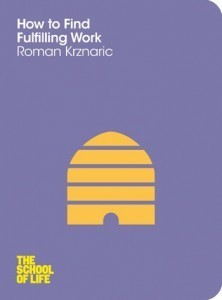
“If one wanted to crush and destroy a man entirely, to mete out to him the most terrible punishment,” wrote Dostoevsky, “all one would have to do would be to make him do work that was completely and utterly devoid of usefulness and meaning.” Indeed, the quest to avoid work andmake a living of doing what you love is a constant conundrum of modern life. In How to Find Fulfilling Work (public library) — the latest installment in The School of Life’s wonderful series reclaiming the traditional self-help genre as intelligent, non-self-helpy, yet immensely helpful guides to modern living, which previously gave us Philippa Perry’s How to Stay Sane and Alain de Botton’s How to Think More About Sex — philosopher Roman Krznaric (remember him?)explores the roots of this contemporary quandary and guides us to its fruitful resolution:
"The desire for fulfilling work — a job that provides a deep sense of purpose, and reflects our values, passions and personality — is a modern invention. … For centuries, most inhabitants of the Western world were too busy struggling to meet their subsistence needs to worry about whether they had an exciting career that used their talents and nurtured their wellbeing. But today, the spread of material prosperity has freed our minds to expect much more from the adventure of life.
We have entered a new age of fulfillment, in which the great dream is to trade up from money to meaning."
“If one wanted to crush and destroy a man entirely, wrote Dostoevsky, “all one would have to do would be to make him do work that was completely and utterly devoid of usefulness and meaning.”
To get content containing either thought or leadership enter:
To get content containing both thought and leadership enter:
To get content containing the expression thought leadership enter:
You can enter several keywords and you can refine them whenever you want. Our suggestion engine uses more signals but entering a few keywords here will rapidly give you great content to curate.


 Your new post is loading...