Your new post is loading...

|
Scooped by
Howard Rheingold
June 24, 2012 5:03 PM
|
Information fluency and evaluation resources as a Diigo list -- Howard Dennis OConnor's List: 21cif.com Guided Tour: Evaluating Web 2.0 Resources - A guided tour of 21cif.com: A Diigo webslide show of web 2.0 evaluation guides, lessons, and online games created the the 21st Century Information Project.
|
|
Scooped by
Howard Rheingold
June 22, 2012 6:42 PM
|
I've used The Brain myself and have played a number of these webinars. It takes some commitment, but it's really an infotention tool far more than just a mind-mapping tool. --Howard "Your Brain lets you make unlimited connections and instantly find any idea or file. This seminar will cover how to start, grow and manage a single Brain on every aspect of your life."
|
|
Scooped by
Howard Rheingold
June 22, 2012 4:14 PM
|
RSS feed readers are great infotention tools, if you formulate a strategy for using them and stick to it. -- Howard "Go and look at your feed reader. How many unread items do you have? If you keep on top of your feeds, great job. If not, well, you’re not alone.
I’ve heard about people who shy away from their feed reader when it hits 1000+ items. Ouch! Mine is currently up to 426 unread items. How on earth can you come back from that?
Well, there’s a fast way to get back to zero, but you need more than that to keep your unread item count relatively low. So let’s begin."
|
|
Scooped by
Howard Rheingold
June 19, 2012 8:52 PM
|
The US Military has been into attention training for some time. -- Howard "Looking for that extra edge? Looking to take your training to the next level? Discover the powerful mind training techniques of the Samurai and learn the essence to living a life of excellence, as you exercise your most powerful weapon...your mind. Designed specifically for the US military, Warrior Mind Training (WMT) is a must for warriors before and after combat experience."
|
|
Scooped by
Howard Rheingold
June 15, 2012 1:32 PM
|
Tom Standage's previous book "Six Glasses" explained how 17th and 18th century coffeehouses in Europe were places where science and revolution and capitalism were born. -- Howard "Here’s an extract from “Cicero’s Web”, my forthcoming book (due 2013) on the prehistory of social media. (A previous extract, about Martin Luther and social media, is here.) You know how you can easily lose track of time while checking Twitter and Facebook? And how people worry that social media is distracting people from doing real work (aka “social notworking”)? The same thing happened in the 17th century with coffeehouses, a new social-media platform where people went to read and discuss the news:"
Learning how to use search and filtering tools is an essential part of infotention -- the other essential part is about learning to manage your attention online -- Howard "Squirro will revolutionize the way you gather and harvest content in a way that matches your exact interests. Share with friends or colleagues. For work or play. Launching this spring."
Via Joyce Valenza
|
|
Scooped by
Howard Rheingold
June 2, 2012 12:30 PM
|
Joe Kraus goes after the "culture of distraction" that necessitates infotention and begins to talk about what to do about it. -- Howard "I think the solution is to balance the DISTRACTING brain training you’re doing every single day with training that strengthens long-form ATTENTION. We want to OVERCOME OUR FEAR OF BOREDOM, OUR ANXIETY OF BEING UNSTIMULATED recognize the value of gap time and not have anxiety about it."
|
|
Scooped by
Howard Rheingold
June 1, 2012 1:44 PM
|
In this article posted on Mindshift, Tasha Bergson-Michelson suggests an interesting search strategy for students to consider. Applied correctly, these steps could potentially provide far more meaningful results when students are on any online knowledge and data quest. posted by Ian Jukes
|
|
Scooped by
Howard Rheingold
May 26, 2012 1:00 PM
|
Metacognition -- awareness of one's attention and thinking process -- is increasingly a 21st century necessity. -- Howard "At New York University, Sir Henry Wellcome Postdoctoral Fellow Dr Steve Fleming is exploring the neural basis of metacognition: how we think about thinking, and how we assess the accuracy of our decisions, judgements and other aspects of our mental..."
|
|
Scooped by
Howard Rheingold
May 23, 2012 6:30 PM
|
The intersection of visualization and networks science is important to infotention, too. -- Howard "Data visualization is a running theme of visual literacy here, and Manuel Lima has been one of its biggest advocates since 2005 when, shortly after graduating from the Parson School of Design, he launched VisualComplexity — an ambitious portal for the visualization of complex networks across a multitude of disciplines, from biology to history to the social web. This month marks the highly anticipated release of Visual Complexity: Mapping Patterns of Information — a rigorously researched, beautifully designed, thoughtfully curated anthology of the world’s most compelling work at the intersection of these two relatively nascent yet increasingly powerful techno-cultural phenomena, network science and information visualization."
|
|
Scooped by
Howard Rheingold
May 22, 2012 3:41 PM
|
This is what "Metaweb" was working on before they were acquired by Google -- Howard "When you search, you’re not just looking for a webpage. You’re looking to get answers, understand concepts and explore. The next frontier in search is to understand real-world things and the relationships among them. So we're building a Knowledge Graph: a huge collection of the people, places and things in the world and how they're connected to one another. This is how we’ll be able to tell if your search for “mercury” refers to the planet or the chemical element--and also how we can get you smarter answers to jump start your discovery."
|
|
Scooped by
Howard Rheingold
May 17, 2012 2:19 PM
|
The overload of the print revolution led to indexes, reference books, editors, authors, classification systems. 17 minute 48 second audio interview with author of "Too Much to Know" Managing Scholarly Information Before the Modern Age" -- Howard "It is a constant complaint: We're choking on information. The flood of data on the Web has reached mind boggling proportions, and it shows no signs of stopping. But wait, says Harvard professor Ann Blair -- this is not a new condition."
|
|
Scooped by
Howard Rheingold
May 7, 2012 12:20 PM
|
Linda Stone was one of the primary sources for my book, http://www.rheingold.com/netsmart -- Howard "Eighty percent of us seem to have it. I broke the story about it in early 2008 on the Huffington Post, and called the phenomenon, "email apnea." Later in 2008, in talks and interviews, I referred to it interchangeably as "email apnea" and also, as "screen apnea." Definition: Shallow breathing or breath holding while doing email, or while working or playing in front of a screen. While we have a greater tendency toward email apnea or screen apnea, while doing email and texting on laptops and smartphones, we are at risk for breath holding or shallow breathing in front of any screen, any time. Not only does this increase stress levels, it impacts our attitude, our sense of emotional well-being, and our ability to work effectively."
|
|
|
Rescooped by
Howard Rheingold
from Content Curation World
June 24, 2012 4:59 PM
|
I learned a great deal about infotention from Robin Good, who foresaw what he called "newsmastering" as a key skill years before it was called "curation." -- Howard Robin Good: Among the five digital trends presently shaping the consumer experience economy, according to Macala Wright who first wrote about this on Mashable, there is one that has as its key objective the reduction of "information noise", distractions and approaches to digital communication that make it harder to grasp and understand a message or to complete a key task one is after. It reads like there is more to information curation than people scanning feeds and selecting relevant items to write about. From the original article I have extracted a few passages: "Calm technology refers to applications that cut down on the digital noise of high-volume data to show the user only enough information that he or she needs to complete a task. ...It refers to technologies that do not disrupt our workflow. The whole idea is to reduce distractions to our work flow without losing functionality. Calm technology fights against many of the principles of digital marketing: instead of screaming for attention with flashing banner ads, technologies and applications politely take a backseat to the user’s primary focus... ... Examples of calm technology can be found in the growing popularity of social curation and discovery. Social product discovery sites such as Lyst, Mulu.Me, Buyosphere, Svpply and Discoveredd are essentially social filters that enable their communities to curate the products that are most relevant to them. Moreover, the rise of interest networks and the idea of following someone who has similar likes and shared interest topics are examples of the principles of calm technology driving user behavior. Google Circles, Pinterest and Chime.In, even location apps such as Sonar, Glancee and Highlight, can all be classified under the “term interest network.” Excellent reading. 8/10 Full article: http://fashionablymarketing.me/2012/06/digital-trends-consumer-experience-economy/ ;
Via Robin Good
|
|
Scooped by
Howard Rheingold
June 22, 2012 5:21 PM
|
Maybe I'm stretching the definition of infotention, but I think knowing how to control blog comment spam ought to be part of the infotention toolkit. -- Howard "If you own a blog, chances are you have encountered a little – or a lot – of spam. The more popular your blog becomes, the more spam it is likely to get. And there is nothing more frustrating than having to spend a lot of time moderating your comments to determine which ones are spam and which ones are legit. In today’s post, we’re going to look at: How to identify spam.
If third-party comment systems control spam.
Settings and plugins you can use in the base WordPress comment system to help moderate spam."
|
|
Scooped by
Howard Rheingold
June 19, 2012 8:53 PM
|
More on military attention training _ Howard "Sarah Ernst, renamed the class Warrior Mind Training and described the practice as mental hygiene—a workout for the brain. With a small group of volunteers, they now teach weekly classes at several military and veteran facilities, where they draw clear connections to other military cultures that have used meditation, particularly the Samurai. “They represent the stereotypical image of an elite warrior, a real badass with a sword and strategy,” Ernst says. “But they cultivated the elite warrior mind, spending hours and hours focusing their minds so that when it was time to go into battle, they knew how to turn off their thoughts and have razor-sharp attention in which there weren’t any thoughts or doubts that would cause them to hesitate—especially in the most critical moments, when it could be a life-or-death situation.” "Gregorian cued up an electronica song on her iPod and told the group to notice each thought and let it slip by, like watching a leaf float down a stream. For beginners, this is difficult and exhausting work. Chatter builds in the mind, as thoughts swirl and linger—leaves caught in an eddy. But this becomes easier and more effective with practice. “Your mind is like a muscle,” Gregorian says. “The more you’re able to train it, the more you’re able to hold your attention and keep it from wandering.”"
|
|
Scooped by
Howard Rheingold
June 17, 2012 12:31 PM
|
Becoming aware of how your deploy your attention is key to both mindfulness meditation and infotention. -- Howard " "We describe an experiment to determine the effects of meditation training on the multitasking behavior of knowledge workers. Three groups each of 12-15 human resources personnel were tested: (1) those who underwent an 8-week training course on mindfulness-based meditation, (2) those who endured a wait period, were tested, and then underwent the same 8-week training, and (3) those who had 8-weeks of training in body relaxation. We found that only those trained in meditation stayed on tasks longer and made fewer task switches, as well as reporting less negative emotion after task performance, as compared with the other two groups. In addition, both the meditation and the relaxation groups showed improved memory for the tasks they performed." (PDF)
|
|
Scooped by
Howard Rheingold
June 14, 2012 3:54 PM
|
Automating filtering via machine learning is an up-and-coming research category for infotention -- Howard " "Predicting items a user would like on the basis of other users’ ratings for these items has become a well-established strategy adopted by many recommendation services on the Internet. Although this can be seen as a classification problem, algorithms proposed thus far do not draw on results from the machine learning literature. We propose a representation for collaborative filtering tasks that allows the application of virtually any machine learning algorithm. We identify the shortcomings of current collaborative filtering techniques and propose the use of learning algorithms paired with feature extraction techniques that specifically address the limitations of previous approaches."
|
|
Scooped by
Howard Rheingold
June 5, 2012 3:32 PM
|
From 1998, but a valuable overview -- Howard "Better ways at finding the most valuable information on the Internet, and to avoid trash, would very much enhance the value of the network. This paper makes an overview of methods and problems in this area, including social filtering, where people help each other with filtering objects on the net."
|
|
Scooped by
Howard Rheingold
June 1, 2012 2:09 PM
|
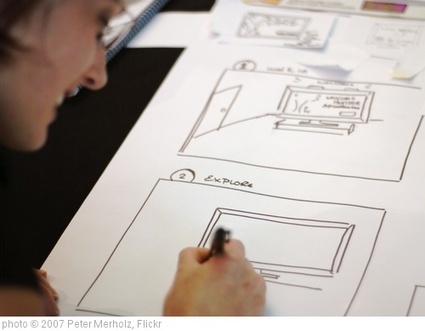
This quote is from Jonah Lenrer's book, "Imagine: How Creativity Works," which I highly recommend -- Howard: "When you draw an object, the mind becomes deeply, intensely attentive,” Glaser says. “And it’s that act of attention that allows you to really grasp something, to become fully conscious of it. That’s what I learned from my mother’s face, that drawing is really a kind of thinking.”"
|
|
Scooped by
Howard Rheingold
May 27, 2012 3:41 PM
|
Yahoo Pipes an be used to combine RSS feeds and display the result as widget on a website. This form makes it easy to fill in, copy, and paste. Think of combining the bookmarks for an agreed delcious tag from a number of people in a group -- Howard "Build a Feed!
The tool below will help you format a feed's display with the information you want to use on your web site. All you need to enter is the URL for the RSS source, and select the desired options below."
|
|
Rescooped by
Howard Rheingold
from Content Curation World
May 26, 2012 12:11 AM
|
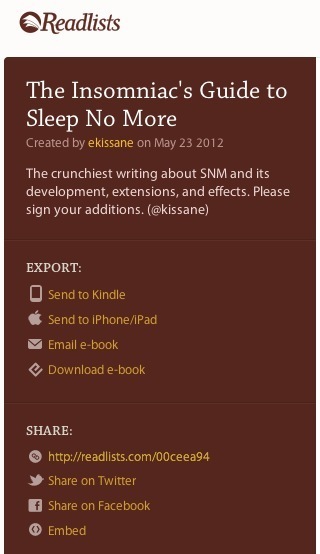
Robin Good: Readlists is a simple web app which allows you to easily create curated lists of web resources, articles and links and bundle them to a downloadable eBook.
"A Readlist is a group of web pages—articles, recipes, course materials, anything—bundled into an e-book you can send to your Kindle, iPad, or iPhone." To create a "Readlist" you simply click on the Create a Readlist button and add one url at a time. The system gently grabs metadata info like title and author and elegatly lays it out in an ebook formatted reading index ready to be published. The service is free to use. Try it out now: http://readlists.com/ ;
Via Robin Good

|
Suggested by
Ken Morrison
May 23, 2012 3:55 PM
|
"Google has launched a new site called Search Education aimed at educators who want to teach online search strategies."
|
|
Scooped by
Howard Rheingold
May 21, 2012 3:35 PM
|
"The School of Data is led by the Open Knowledge Foundation (OKFN) and Peer 2 Peer University (P2PU). The School will provide online training for data ‘wrangling’ skills – the ability to find, retrieve, clean, manipulate, analyze, and represent different types of data."
|
|
Scooped by
Howard Rheingold
May 8, 2012 7:51 PM
|
From a special section of the International Journal of Communication -- Howard "Aristotle could write that we ascribe “universal education to one who in his own individual person is thus critical in all or nearly all branches of knowledge, and not to one who has a like ability merely in some special subject.” Today nobody can know about everything. The flow of information so far exceeds what anyone can observe, learn, or appreciate that we must look at methods of compression, summarization, and filtering. These methods must achieve reductions of a million to one to cope with what is now routine. Fortunately, technology is making this possible."
|