Your new post is loading...

|
Rescooped by
michel verstrepen
from Economie de l'innovation
December 3, 2012 7:41 AM
|
La lecture de la semaine, elle provient du magazine américain Wired (@wired) et de son chroniqueur Clive Thomson (@pomeranian99). Son titre “les règles de la panique”.
“Quiconque s’intéresse à l’actualité le sait, commence Thompson, il y a souvent un effet collatéral aux nouvelles technologies : la panique morale. Facebook engendre le narcissisme ! Ecrire des textos nous rend analphabètes. Ce qui est drôle, c’est que d’autres technologies ne provoquent rien de cet ordre. Prenez Square, par exemple, qui permet à chacun de payer par carte de crédit… Il est en train de devenir un outil mainstream, bouleverse le fonctionnement du petit commerce et la manière dont des amis partagent une addition dans un bar, mais ne provoque pas grand discours. Quelle différence ? Pourquoi certaines technologies nous font-elles peur et pourquoi d’autres provoquent-elles l’indifférence ?
Via Lockall
|
|
Rescooped by
michel verstrepen
from Marketing & advertising 2.0
December 2, 2012 7:21 PM
|
L’avènement des médias sociaux n’en finit pas de chambouler les paradigmes qui ont longtemps structuré les schémas communicants des entreprises et des institutions.
Via Kevin Dangu, Masanet
|
|
Rescooped by
michel verstrepen
from Education 3.0
December 2, 2012 7:06 PM
|
|
|
Scooped by
michel verstrepen
December 2, 2012 6:34 AM
|
Social Media : Today’s Key to Small Business Success...
|
|
Rescooped by
michel verstrepen
from TIC & Marketing
December 2, 2012 6:17 AM
|
Social Media - The differences between search and social media marketing are many, but both are essential in today's marketing. The trick is to know which to use when and how to combine ...
Via sandrinea
Les formations au management apportent aux managers des outils, des techniques qui reposent sur des concepts issus des pratiques et de la recherche, notamm...
Via Louis Levy
|
|
Rescooped by
michel verstrepen
from visual data
December 1, 2012 10:59 PM
|
At the Visualized conference on November 9th, Neil Halloran posed an interesting question: Can DataViz lead to a data savvy society in the same way that the printing press lead to a literate one? One that is prepared to make tough decisions on complex issues? Neil Halloran thinks so. That’s why he created VisualBudget.org to cut through hyperbole surrounding the what may be the most frequently misunderstood and pressing issue facing Americans today, our massive $16 trillion dollar deficit. But how is a modern citizen supposed to make an informed decision on issues of tremendous scope and complexity, such as the fiscal cliff or the growing budget deficit without falling back on sound bites and punditry? Neil Halloran’s solution is to tell a story. Rather than simply presenting a static infographic or a set of tabular data on federal receipts and expenditures, VisualBudget.org takes you on a interactive tour...
Via Lauren Moss
|
|
Rescooped by
michel verstrepen
from Business Socialization
December 1, 2012 10:53 PM
|
Today’s consumer no longer just consumes. In fact we should no longer call themconsumers. Here’s why.First of all lets revisit the word “consume”. Originated some where between 1350-1400 and has the following meanings: to destroy or expend by use; use up. to eat or drink up; devour. to destroy, as by decomposition or burning to spend (money, time, etc.) wastefully. to absorb; engross: consumed with curiosity. to undergo destruction; waste away. to use or use up consumer goods You see my point. Does this describe today’s consumer? Do we really just absorb, use, spend and purchase goods? Not at all. We do so much more before “consuming”.Today’s consumer has totally changed. They are savvy and have a voice. I would like to propose an alternate name. The Comsumer! The name replaces “Con” with “Com” highlighting the importance and characteristics of the 8 com-habits that I would like to propose.
Via Shirley Williams (appearoo.com/ShirleyWilliams)
|
|
Rescooped by
michel verstrepen
from Freewares
December 1, 2012 11:45 AM
|
Une jolie infographie sur l'histoire du blogging qui ravira les blogueurs.
Via Freewares&Tutos
|
|
Rescooped by
michel verstrepen
from Education Library and More
December 1, 2012 11:43 AM
|
|
|
Rescooped by
michel verstrepen
from Digital Delights
November 30, 2012 12:57 PM
|
Adam | Featured Articles, Teaching & Learning, Technology in Education...
Via Ana Cristina Pratas
On Wednesday, Microsoft began running a national ad campaign warning users to avoid being “Scroogled” by Google search results that have been influenced by paid placement. “So for this holiday season, we just want to make sure shoppers know that when searching for that perfect gift for Cousin Harry on Google Shopping, the results they are seeing are partially optimized to benefit Google’s revenue, not a shopper’s pocketbook,” Microsoft's Nichols wrote. “If this practice has you concerned, then please try Bing for an honest search.”
Via Linda Buquet :: Catalyst eMarketing
|
Pouvons-nous devenir plus intelligents, individuellement comme collectivement ?
Via Jose Erigleidson
The pub argument is dead. Google killed it with a little help from your smartphone. A recent study suggests that our modern lifestyles are making us “less intelligent” than our ancestors, at least at a genetic level. This research echoes concerns Einstein had when he supposedly said, ===> “I fear the day that technology will surpass our human interaction. The world will have a generation of idiots.” <=== Read more, very interesting...: http://theconversation.edu.au/education-in-the-information-age-is-technology-making-us-stupid-10844
Via Gust MEES
|
|
Scooped by
michel verstrepen
December 2, 2012 6:34 AM
|
Thing 22 allows you to explore different tools for online collaboration and file-sharing – as well as the benefits of using these tools for your individual work.
|
|
Rescooped by
michel verstrepen
from Arobasenet.com
December 2, 2012 6:19 AM
|
La requête « google » génère plusieurs milliards de résultats…
Qu’on le déifie ou qu’on le dénigre, le moins qu’on puisse dire c’est que le robot ne laisse pas indifférent ! Voici une rétrospective : 15 ans de Google...et de SEO Un billet d'humeur funambule vous invite à danser sur le fil de l'histoire du plus célèbre moteur de recherche.
Via Arobasenet
|
|
Rescooped by
michel verstrepen
from Cartes mentales
December 2, 2012 6:16 AM
|
Pourquoi nos habitudes et notre cerveau nous cantonnent souvent à utiliser des techniques chronophages (par exemple en matière de prise de note, construction ou suivi de projet, etc.) ?
Via Louis Levy
|
|
Rescooped by
michel verstrepen
from NetPublic
December 2, 2012 6:03 AM
|
Le blog Une autre paire de manches propose 4 fiches pratiques à télécharger sur la stratégie de présence en ligne sur les réseaux sociaux au sein d’un article consacré...
Via NetPublic
|
|
Rescooped by
michel verstrepen
from visualizing social media
December 1, 2012 10:57 PM
|
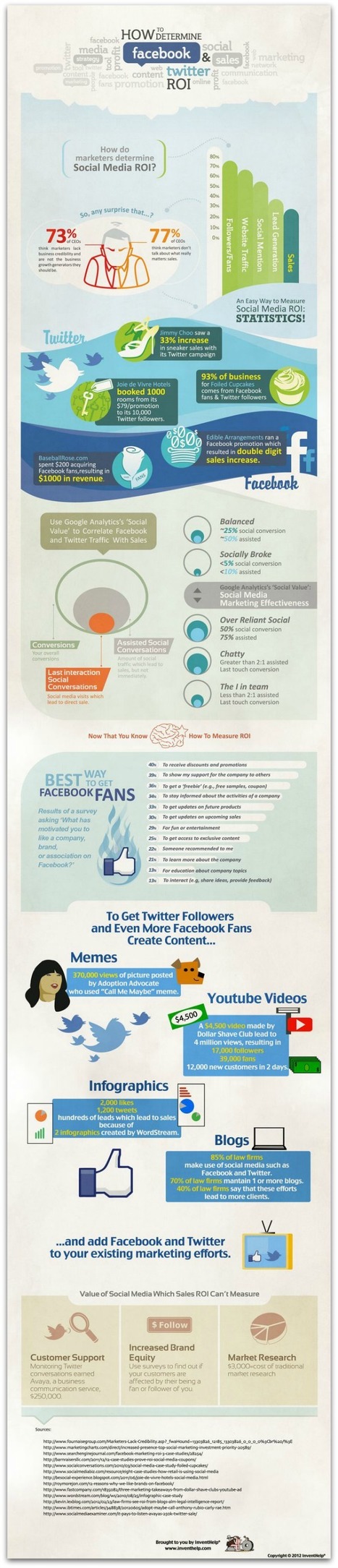
Seventy-three percent of CEOs think marketers lack business credibility and 77 percent believe marketers don't talk about what really matters—sales. If this sounds like your business or company, it's clearly time to find a way to measure the return on investment of all those hours dedicated to social media. This infographic has some tips and examples that can help and explains how to use statistics and analytics to determine and identify conversions, sales leads and potential leads... Check out the graphic for more tips, as well as advice on how to grow your Facebook and Twitter fan base...
Via Lauren Moss
|
|
Rescooped by
michel verstrepen
from sociology of the Web
December 1, 2012 12:00 PM
|
Biella Coleman is a geek anthropologist, in both senses of the epithet: an anthropologist who studies geeks, and a geek who is an anthropologist.
Via nukem777
Doctopus -- a tool allowing to create and share gdocs handouts
Via Ludmila Smirnova
|
|
Scooped by
michel verstrepen
December 1, 2012 11:42 AM
|
The continuous improvements at Wix.com and Imcreator.com have made these two free web-authoring tools more and more practical for use as digital news reporting platforms.
|
|
Scooped by
michel verstrepen
December 1, 2012 1:58 AM
|
ValueWalkThe crazy truth: Google+ can thrive alongside FacebookCNETIt's easy to call Facebook the social network of the past. It's harder to build the social network of the future. To hear Bradley Horowitz tell it, though, Google is well on its way.
|
|
Scooped by
michel verstrepen
November 30, 2012 12:57 PM
|
Une étude de l’Institut Mc Kinsey avait proposé de classer les clients présents sur les réseaux sociaux en 7 groupes. Accrocs, explorateurs, pragmatiques, communicants, info-glaneurs, marchandeurs, monomaniaques, ces clients peuvent prendre différentes formes. Michael Brito, auteur du livre « Smart Business, Social Business: A Playbook for Social Media in Your Organization » propose lui une liste actualisée, qui regroupe ces clients en 6 catégories.
|