


The power of curation’s feedback loops is why to curate more than you create AND why the best ratio may be as high as 90% curation to 10% creation.
by @Martin (Marty) Smith on @ janlgordon's curatti.com
Via Guillaume Decugis

 Your new post is loading...
 Scoop.it! The power of curation’s feedback loops is why to curate more than you create AND why the best ratio may be as high as 90% curation to 10% creation.
by @Martin (Marty) Smith on @ janlgordon's curatti.com Via Guillaume Decugis
Scoop.it!

Le QG des communications du gouvernement britannique surveille le système de réservation des hôtels pour espionner les diplomates, selon le magazine Spiegel en référ Via Morgan BANCEL, Intelligence Economique, Investigations Numériques et Veille Informationnelle
Scoop.it!

High profile data breaches that expose customer information are in the news. This graphic shows how the thieves sell the info and make their money. Via Gust MEES
Scoop.it!

This infographic aims to help readers search Google with a few simple yet very impressive and helpful advance search operators. Via Lauren Moss 
Ray Beauchamp's curator insight,
December 1, 2013 5:01 PM
I knew about some of these tools -Hope that'll help you 
pulau seribu wisata's curator insight,
December 22, 2013 9:44 PM
i like this,,, graphic google, so simple
Scoop.it!

Holly MacDonald's curator insight,
November 17, 2013 2:57 PM
I really enjoy Harold's systems-thinking. He identifies that much of our desire to boil learning down to simple solutions is misguided. We actually need a much more complex approach. Once you land on his blog, I enourage you to keep reading.
Scoop.it!

Réseaux sociaux : 101 questions juridiques, à l’initiative de l’ADIJ sous la direction de Cédric Manara, Éditions Diateino, 2013 Analyse à paraître dans Documentaliste-Sciences de l’information Qu’une responsabilité juridique soit engagée sur les...
Scoop.it!

Grosso modo, il y a maintenant cinq mois que le scandale du PRISM, révélé par Edward Snowden, a éclaté aux yeux de tous. Si une myriade de révélations d’importance a filtré, personne n’avait encore conscience de l’ampleur du nombre de documents volés à la NSA.
PRISM est le nom de code d’un programme du gouvernement américain, ce n’est pas du tout un projet du Shield… Il donne la NSA un accès sans précédent aux serveurs des grandes entreprises de haute technologie. En conséquence de quoi, l’instance gouvernementale se sert sans compassion dans les données personnelles des utilisateurs, sous couvert de la lutte contre le terrorisme et de lois savamment travaillées.
Scoop.it!

Découvrez ABCdoc, un outil méthodologique, réalisé par l'Université Paul Sabatier Toulouse 3, pour aider les étudiants et enseignants à traiter l'information scientifique. Via Thot - Cursus, FrancoisMagnan
Scoop.it!
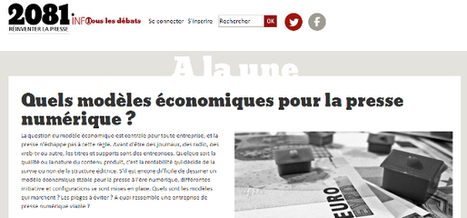
C’est dans le but de lancer une grande réflexion sur l’avenir de la presse et sur ses possibilités de réinvention que le Syndicat de la presse indépendant d’information en ligne (SPIIL) vient de lancer sa plateforme de débat : 2081.info... Via Jacqueline Valladon
Scoop.it!

Even though the world uses the Internet to research nearly everything for work, school and home (job postings, press releases, Wikipedia articles, medical info, etc.), most folks still use old-school ways of annotating, organizing and sharing online info (printing to mark by hand, copying/pasting into Word, etc.). It's archaic, laborious and a waste of time. We're changing that. We're bringing Web-based research into the Internet Era by empowering people to mark up web pages in the browser and manage and collaborate on them online. And that's just the start... We've got much more planned in a variety of areas to help people manage the mounds of info they're pulling off the Web everyday. Via Frédéric DEBAILLEUL
Scoop.it!

Quels sont les enjeux des changements apportés par Google à ses SERPs pour le search marketing ? La réponse en infographie... Via Arobasenet
Scoop.it!

Most tech-savvy email users have a Gmail account - but how many of them know its hidden features? Here's a list of the top nine tips ...
Scoop.it!

The term ‘Big Data’ is as massive in management and technology as Justin Bieber and Miley Cyrus are in music. Like with other mega buzzwords, many say big data is all talk and no action. This couldn’t be further from the truth. With this post, I want to show how big data is used today to add real value. Eventually, every aspect of our lives will be affected by big data. However, there are some areas where big data is already making a real difference today. I have categorized the application of big data into 10 areas where I see the most widespread use as well as the highest benefits [For those of you who would like to take a step back here and understand, in simple terms, what big data is, check out the posts in my Big Data Guru column]. 1. Understanding and Targeting Customers This is one of the biggest and most publicized areas of big data use today. Here, big data is used to better understand customers and their behaviors and preferences. Companies are keen to expand their traditional data sets with social media data, browser logs as well as text analytics and sensor data to get a more complete picture of their customers. The big objective, in many cases, is to create predictive models. You might remember the example of U.S. retailer Target, who is now able to very accurately predict when one of their customers will expect a baby. Using big data, Telecom companies can now better predict customer churn; Wal-Mart can predict what products will sell, and car insurance companies understand how well their customers actually drive. Even government election campaigns can be optimized using big data analytics. Some believe, Obama’s win after the 2012 presidential election campaign was due to his team’s superior ability to use big data analytics. 2. Understanding and Optimizing Business Processes Big data is also increasingly used to optimize business processes. Retailers are able to optimize their stock based on predictions generated from social media data, web search trends and weather forecasts. One particular business process that is seeing a lot of big data analytics is supply chain or delivery route optimization. Here, geographic positioning and radio frequency identification sensors are used to track goods or delivery vehicles and optimize routes by integrating live traffic data, etc. HR business processes are also being improved using big data analytics. This includes the optimization of talent acquisition – Moneyball style, as well as the measurement of company culture and staff engagement using big data tools. 3. Personal Quantification and Performance Optimization Big data is not just for companies and governments but also for all of us individually. We can now benefit from the data generated from wearable devices such as smart watches or smart bracelets. Take the Up band from Jawbone as an example: the armband collects data on our calorie consumption, activity levels, and our sleep patterns. While it gives individuals rich insights, the real value is in analyzing the collective data. In Jawbone’s case, the company now collects 60 years worth of sleep data every night. Analyzing such volumes of data will bring entirely new insights that it can feed back to individual users. The other area where we benefit from big data analytics is finding love - online this is. Most online dating sites apply big data tools and algorithms to find us the most appropriate matches. 4. Improving Healthcare and Public Health The computing power of big data analytics enables us to decode entire DNA strings in minutes and will allow us to find new cures and better understand and predict disease patterns. Just think of what happens when all the individual data from smart watches and wearable devices can be used to apply it to millions of people and their various diseases. The clinical trials of the future won’t be limited by small sample sizes but could potentially include everyone! Big data techniques are already being used to monitor babies in a specialist premature and sick baby unit. By recording and analyzing every heart beat and breathing pattern of every baby, the unit was able to develop algorithms that can now predict infections 24 hours before any physical symptoms appear. That way, the team can intervene early and save fragile babies in an environment where every hour counts. What’s more, big data analytics allow us to monitor and predict the developments of epidemics and disease outbreaks. Integrating data from medical records with social media analytics enables us to monitor flu outbreaks in real-time, simply by listening to what people are saying, i.e. “Feeling rubbish today - in bed with a cold”. 5. Improving Sports Performance Most elite sports have now embraced big data analytics. We have the IBM SlamTracker tool for tennis tournaments; we use video analytics that track the performance of every player in a football or baseball game, and sensor technology in sports equipment such as basket balls or golf clubs allows us to get feedback (via smart phones and cloud servers) on our game and how to improve it. Many elite sports teams also track athletes outside of the sporting environment – using smart technology to track nutrition and sleep, as well as social media conversations to monitor emotional wellbeing. 6. Improving Science and Research Science and research is currently being transformed by the new possibilities big data brings. Take, for example, CERN, the Swiss nuclear physics lab with its Large Hadron Collider, the world’s largest and most powerful particle accelerator. Experiments to unlock the secrets of our universe – how it started and works - generate huge amounts of data. The CERN data center has 65,000 processors to analyze its 30 petabytes of data. However, it uses the computing powers of thousands of computers distributed across 150 data centers worldwide to analyze the data. Such computing powers can be leveraged to transform so many other areas of science and research. 7. Optimizing Machine and Device Performance Big data analytics help machines and devices become smarter and more autonomous. For example, big data tools are used to operate Google’s self-driving car. The Toyota Prius is fitted with cameras, GPS as well as powerful computers and sensors to safely drive on the road without the intervention of human beings. Big data tools are also used to optimize energy grids using data from smart meters. We can even use big data tools to optimize the performance of computers and data warehouses. 8. Improving Security and Law Enforcement. Big data is applied heavily in improving security and enabling law enforcement. I am sure you are aware of the revelations that the National Security Agency (NSA) in the U.S. uses big data analytics to foil terrorist plots (and maybe spy on us). Others use big data techniques to detect and prevent cyber attacks. Police forces use big data tools to catch criminals and even predict criminal activity and credit card companies use big data use it to detect fraudulent transactions. 9. Improving and Optimizing Cities and Countries Big data is used to improve many aspects of our cities and countries. For example, it allows cities to optimize traffic flows based on real time traffic information as well as social media and weather data. A number of cities are currently piloting big data analytics with the aim of turning themselves into Smart Cities, where the transport infrastructure and utility processes are all joined up. Where a bus would wait for a delayed train and where traffic signals predict traffic volumes and operate to minimize jams. 10. Financial Trading My final category of big data application comes from financial trading. High-Frequency Trading (HFT) is an area where big data finds a lot of use today. Here, big data algorithms are used to make trading decisions. Today, the majority of equity trading now takes place via data algorithms that increasingly take into account signals from social media networks and news websites to make, buy and sell decisions in split seconds. For me, the 10 categories I have outlined here represent the areas in which big data is applied the most. Of course there are so many other applications of big data and there will be many new categories as the tools become more widespread. Via Linda Holroyd 
Linda Holroyd's curator insight,
November 13, 2013 5:06 PM
Great insights on how big data will impact us day-to-day, changing the way we live and work |
Scoop.it!

Qu’en est-il du référencement en 2013 ? Quels sont les critères à prendre en compte aujourd’hui pour référencer un site web ? Référencer un site en 2013 Qu’est ce que le référencement naturel ? Via Yann De Tod, Astuces Wordpress 
C-Marketing's curator insight,
November 16, 2013 12:03 PM
Les fondamentaux du référencement naturel en 2013. 
Florence Albouy Hamitri's curator insight,
November 20, 2013 5:03 PM
Mieux comprendre et optimiser le référencement... Tout un art !
Scoop.it!
This short book trailer highlights Stephanie Evergreen's recently released book, Presenting Data Effectively. Find out more at http://stephanieevergreen.com/... Via Beth Kanter
Scoop.it!

Data visualization is an amazing tool. The data we deal with daily would be almost entirely inaccessible when locked up in numerical formats. Luckily, data visualization can help us to extract information, insights, or even knowledge from that data. It relies on the remarkable human visual system that turns visible light into meaningful semantics that inform our decisions.
More details on the human visual system, visual metaphors, visual context, exploration and presentation at the article link. Via Lauren Moss 
Gordon Shupe's curator insight,
November 18, 2013 9:53 AM
Excellent overview - this is a resource to save and use!
Scoop.it!
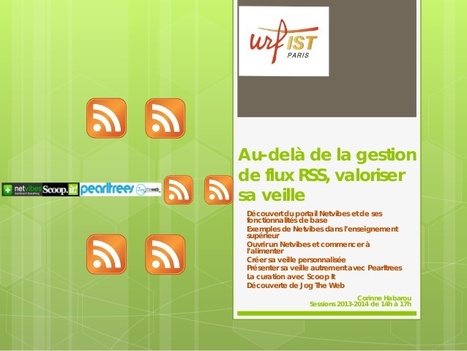
La veille documentaire a pour objectif de se maintenir informé des évolutions d’un domaine de connaissance mais aussi de faciliter cette posture à d’autres qui vont en bénéficier d’où l’importance de sa valorisation par des canaux de diffusion. Via FrancoisMagnan, Freewares&Tutos 
FrancoisMagnan's curator insight,
November 14, 2013 1:48 PM
Autrement dit, " de la veille à la curation"
Scoop.it!

The community that built the largest encyclopedia in history is shrinking, even as more people and Internet services depend on it than ever. Can it be revived, or is this the end of the Web’s idealistic era? Via Jose Erigleidson
Scoop.it!

Are you tired of printing out your document and scanning back in just to put your signature on them ? Well, you don't have to anymore. There are now several ways to cut up on paper and start signing your papers right from your browser. I have compiled for you this list which comprises 3 of the most popular web tools to use for electronic document signing. Via Frédéric DEBAILLEUL, René Z.
Scoop.it!

Olivier Lambert : "Google change tout le temps. Pas moyen de « brancher », Larry Page est décidément pire qu’une adolescente dans un magasin de soulier ! Ce qui fonctionnait hier ne fonctionne peut-être plus aujourd’hui et ce qui fonctionne aujourd’hui ne fonctionnera peut-être plus demain ! Ils testent des milliers de micro-ajustements chaque année et en adoptent environ 10% […]. On comprend que c’est important et c’est pour cette raison qu’on se plie aux caprices du géant de Silicone Valley - et un des ces caprices se nomme Google+… Via Serge Meunier
Scoop.it!

RT @heuristiquement: Similitudes et différences entre carte conceptuelle et carte heuristique http://t.co/efSsU3ACrI (Heuristiquement: Carte conceptuelle et carte heuristique | @scoopit http://t.co/DTD6tGckIl)... Via Louis Levy 
Jocelyne Lacasse's curator insight,
November 19, 2013 8:51 AM
important de bien utiliser les deux au bon moment.
Scoop.it!

Follow this step-by-step guide to Google+ to make Google's social network an effective part of your digital marketing strategy. Via Frédéric DEBAILLEUL
Scoop.it!

Google pushed out Chrome 32 Beta for Windows and Mac a few days back - a release that has some shiny new features in tow. All platforms get new 'Tab Indica Via THE OFFICIAL ANDREASCY
Scoop.it!
Scientists have discovered a new optical illusion that will screw up your brain big time. Focus on the red cross while the dots move. They are wriggling around, right? Wrong. Via THE OFFICIAL ANDREASCY
Scoop.it!

Have you ever wondered how Facebook ranks your friends for you? The company keeps a score for everyone you interact with on the social network.This affects the order of results when you start typing a name into the search box, the people that appear in your Friends pane when someone visits your profile, whose content shows up in your News Feed, and pretty much any list that displays who you interact with on the site. |







..
This is so true. I often get immediate support and responses to content I have curated #curation#socialmedia