Your new post is loading...

|
Scooped by
Trevor Lee @ TravConsult
August 24, 10:33 PM
|
A proud hat-trick for Noor Mahal, Autograph Collection by Marriott International.
Colonel Manbeer Sandhu has been honoured with the Lifetime Excellence in the Hospitality Industry Award, Mahesh Singh Jasrotia has been named Hotel General Manager of the Year, and Noor Mahal, Autograph Collection has received the Historic Hospitality Milestone Award.
Together, these recognitions celebrate a lifetime of vision, leadership that continues to take Noor Mahal forward, and a landmark journey as India’s first Autograph Collection hotel.
A moment of immense pride for the entire Noor Mahal family.
#NoorMahalPalace #NoorMahalPalaceKarnal #AutographCollection #MarriottBonvoy
Roop Partap Choudhary Colonel Saab
|
|
Scooped by
Trevor Lee @ TravConsult
August 24, 1:46 AM
|
India drinks 0.07 kg of coffee per capita. The global average is 1.3 kg.
That gap isn't a weakness. It's a $13 billion runway by 2030.
Here's who's racing to own it:
☕ CAFE WARS
Starbucks India crossed 502 stores, hit ₹1,367 Cr revenue, and slashed losses from ₹136 Cr to ₹49 Cr by pivoting from store count to unit economics.
Blue Tokai Coffee Roasters grew 5x in 4 years (₹41 Cr → ₹325 Cr). 115+ outlets. 35–40% of India's premium at-home segment. Targeting 800 stores and ₹2,000 Cr by 2029. Backed by Verlinvest, A91 Partners, Anicut Capital ($110M+ raised).
Third Wave Coffee: 165 outlets across 12 cities. WestBridge Capital and Creaegis behind it ($69.9M raised). Heavy bet on digital loyalty.
abcoffee doubled revenue YoY. 90+ kiosks. 60% repeat rate. Compact grab-and-go in office parks — the anti-lounge model. Pre-Series B of ₹61 Cr from Kliff Ventures.
Roastery Coffee House: 16 stores, consistently profitable. Raised ₹50 Cr to scale to 50. Opened a pop-up in Helsinki — sold out in 3 days. Now setting up a permanent Nordic flagship.
Cafe Coffee Day India swung to ₹14 Cr profit (from ₹176 Cr loss). Strategy? Shrink stores to 424, scale vending to 55,802 machines.
WISHVISH FOODS PRIVATE LIMITED (The Filter Coffee): 10 outlets, ₹51 Cr revenue. Bikaji's Deepak Agarwal investing ₹100 Cr over 2 years.
Tim Hortons: 44 locations, 11 states. Apparel Group & Gateway Partners JV with ₹2B planned investment.
📦 D2C & RTD
Sleepy Owl Coffee hit ₹350 Cr revenue (58% YoY growth), narrowed losses, moved to 100% Made-in-India manufacturing. Series C2 backed by Gauri Khan Family Trust and Optiscape.
Tata Consumer Products launched RTD cold coffee cans 23% revenue growth in Q4. Nescafé dropped Espresso Concentrate for home iced lattes. Dunkin' rolled out RTD espresso in March 2026.
Rage Coffee and Blue Tokai Coffee Roasters bypassed supermarket shelves entirely building directly on Blinkit, Zepto, Swiggy Instamart dark stores.
🌱 ORIGIN
India produces 374K MT annually. 75% exported. Record $1.8B in coffee exports FY24. Five GI-tagged origins: Coorg, Chikmagalur, Bababudangiris, Wayanad, Araku Valley.
Ratnagiri Estate running 72-hour bio-fermentations hitting SCA 86+ scores attracting global roasters like Onyx Coffee Lab.
📊 The macro setup:
→ Market: $9B today, $13B by 2030
→ GST on instant coffee slashed from 18% to 5%
→ 100% import duty protects domestic growers
→ Quick-commerce is the new shelf space
→ Home coffee machine market growing at 18.4% CAGR
My take: The winners won't be whoever opens the most stores. It'll be whoever cracks unit economics + subscription retention + quick-commerce distribution simultaneously.
Who's your bet cafe-first or D2C-first?
Source: Strategic Analysis of Indian Specialty Coffee Market (FY2026–FY2030)
#Coffee #India #SpecialtyCoffee #D2C #StartupIndia #FoodTech #QuickCommerce #Investing #RetailStrategy #FMCG #Founders #MarketAnalysis
|
|
Scooped by
Trevor Lee @ TravConsult
August 24, 1:41 AM
|
A Japanese VC just invested $1.3M in an Indian coffee chain with just 25 stores 👀 & that tells us more about India’s coffee market than a Starbucks expansion ever could.
The company is First Coffee, founded by Sohrab Sitaram and Shiv Dhawan in 2023.
It opened its 1st store in Delhi in April 2024. Today, it has 25 stores across Delhi, Punjab and Haryana, and has raised $2.5M in total.
The latest round was led by Japan’s DG Daiwa Ventures(DGDV) Ventures, marking its 1st investment in India’s specialty-coffee market.
What makes the bet more interesting is the founder fit.
Sohrab previously helped scale Keventers to 200+ outlets in 3 years, giving him experience with beverage-led retail, rollout discipline and brand replication.
But First Coffee is also betting on a specific format: grab-and-go specialty coffee, with 100% Arabica beans sourced from Indian estates, premium beverages and a model built around speed and convenience.
And the timing is interesting.
India already has 5,339 branded coffee-shop outlets, up 12.7% in a year.
Blue Tokai Coffee Roasters has 240+ outlets and wants to reach 800 by FY30
Nothing Before Coffee has 114 across 45 cities
Third Wave Coffee is targeting 320 cafés this year
So the market is no longer about whether Indians will pay for premium coffee. It is increasingly about the role coffee plays in different parts of their day.
At home, premium coffee competes with the ritual of making it yourself. On the move, it competes on speed and convenience. In a café, the beverage becomes part of a larger experience, where people are also paying for the space, ambience, WiFi, meetings and time spent there.
India’s coffee retail chains market saw dine-in account for 62.4% of the market in 2023, with consumers willing to pay a premium for ambience, seating and social spaces, while takeaway is expected to grow faster with urban lifestyles.
That is why I find this category interesting.
First Coffee is betting that specialty coffee can become a faster, more convenient habit. But premium coffee may still build its strongest moat in dine-in, where the customer is paying for much more than what is inside the cup.
The result is a coffee market that is becoming increasingly fragmented by occasion: the morning ritual at home, the weekday coffee between meetings, the café used as a workspace, the weekend social visit and the quick premium pickup.
And the winner may not simply be the brand with the best beans, the best couch or the fastest counter.
It may be the one that understands which coffee habit India repeats most often over the next 5 years.
|
|
Scooped by
Trevor Lee @ TravConsult
August 23, 1:41 AM
|
The Flybrary initiative allows passengers to browse and read books, plus carry them for the journey
|
|
Scooped by
Trevor Lee @ TravConsult
August 23, 1:39 AM
|
India is often described as a rising travel powerhouse, but the real truth is more textured.Beneath the headlines sits a
|
|
Scooped by
Trevor Lee @ TravConsult
August 16, 8:32 PM
|
Price tags do not matter; provenance takes priority as digital natives look for human effort and lore-building from luxury
|
|
Scooped by
Trevor Lee @ TravConsult
August 16, 8:38 AM
|
IndiGo turned 20 this month controlling 66.3 percent of India's domestic capacity. In December, roughly 4,500 of its flights were cancelled in ten days. Both numbers describe the same airline.
The milestones are real. A 430-aircraft fleet, ranking among the ten largest airlines globally by flight frequency, and the third most punctual airline in the world at 86.64 percent on time performance in June. Twenty years in, IndiGo built genuine scale.
The same year exposed what that scale costs when it fails. New Flight Duty Time Limitation rules meant to reduce pilot fatigue landed on a crew roster that had not been resized for them. Cancellations ran from December 2 to 12, roughly 4,500 flights, more than ten lakh passengers affected, and an estimated 24 crore rupees paid out in compensation. The regulator responded with a 22.2 crore rupee fine and a temporary rule exemption that ran until February 2026 while the airline rebuilt crew buffers.
The structural response followed. The Competition Commission opened a formal abuse of dominance investigation in February, citing artificial scarcity created during the disruption. IndiGo has since proposed voluntary commitments, a crisis management group triggered within 15 minutes of a major disruption, a round the clock grievance desk, and complaint resolution inside 48 to 72 hours, now open for public comment. Separately, the government fast tracked approvals for three new domestic entrants this year, the most direct competitive push in years. IndiGo's own domestic share still climbed to a record 66.3 percent by June.
For corporate group and MICE programs, this is not background news, it is a booking risk data point. When a departure depends on consolidating passengers from a dozen domestic cities onto one carrier's network, a single crew planning failure at that carrier can stall the entire program regardless of how well the trip itself was planned. We build multi carrier contingency into every group movement above a certain size for exactly this reason, not as a cost optimisation, as a delivery guarantee.
Does single carrier dependency sit on your corporate travel risk register the way currency exposure or visa timelines already do?
#MICETravel #CorporateTravel #AviationIndustry
|
|
Scooped by
Trevor Lee @ TravConsult
August 16, 5:54 AM
|
Indian travellers are embracing slower, more meaningful holidays, choosing fewer destinations and longer stays to prioritise rest, local experiences, cultural immersion and quality time over rushed sightseeing schedules., Travel, Times Now
|
|
Scooped by
Trevor Lee @ TravConsult
August 16, 5:53 AM
|
Every hotel booking app in India runs on the same underlying assumption: that a recommendation engine trained on booking patterns from Mumbai, Bengaluru, and Delhi can be extended, with minor tuning, to Indore, Coimbatore, or Siliguri. It can't. And the gap between that assumption and reality is becoming one of the more expensive blind spots in Indian travel tech.
|
|
Scooped by
Trevor Lee @ TravConsult
August 16, 5:44 AM
|
The happiness we associate with travel begins much before you board the plane, says a digital platform's survey of more than 10,000 travellers.
|
|
Scooped by
Trevor Lee @ TravConsult
August 14, 9:38 PM
|
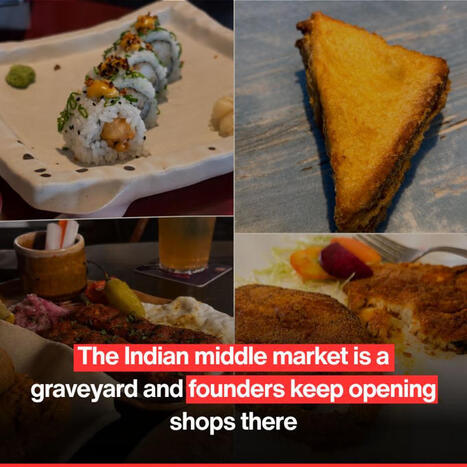
India doesn't have a middle market. Read that again. Fight me in the comments. 👇
India has exactly TWO markets:
1️⃣ Very cheap. Zero frills. Ruthlessly affordable.
2️⃣ Mass premium. Full frills. Deeply aspirational.
Everything in between? A graveyard nobody visits. 🪦
Take food 🍜
You'll eat Chinese at a hygienic tapri for ₹200-250, or at Foo for ₹600+. There is NO ₹400 fried rice that's "better than tapri, cheaper than Foo."
At ₹400, you've paid for rent + interiors + packaging… but not enough for chef talent or experience.
So you're worse than the tapri AND worse than premium. Double downgrade.
Same with clothes 👕
Zudio (value) is a rocket ship. Premium D2C is thriving. Mid-market apparel? A museum of dead brands.
Same with cosmetics 💄
Kirana-shelf mass or Nykaa-luxe. The "in-between" brand is invisible.
And services? Even uglier. 💼
Content, accounting, design, marketing, clients either buy you CHEAP or pay you PREMIUM.
→ Cheap = productise, template, junior talent + tech. A machine. It scales.
→ Premium = senior brains, judgment, accountability. A craft. It doesn't scale, and doesn't need to.
The middle is a treadmill:
❌ Too customised to productise
❌ Too expensive to win on price
❌ Too ordinary to win on reputation
❌ Too commoditised to charge for judgment
And the dirty secret? Middle clients are the hardest clients. Premium clients trust your process.
Cheap clients accept the template. Middle clients want premium outcomes at template prices, with unlimited revisions. 😭
Here's the truth nobody puts on a pitch deck: The Indian middle isn't a market. It's a transit lounge.
Nobody lives there. Consumers pass through it, trading UP the moment aspiration hits, or optimising DOWN because value is a religion here.
So if you're building in India, pick a door:
🚪 Sell CHEAP. Build for scale. Operational brilliance is your moat.
🚪 Sell PREMIUM. Stay boutique. Trust and taste are your moat.
What you cannot do is stand between the doors. The middle is not a position. It's a waiting room for burnout.
Agree? Disagree?
Where have you seen the middle actually WORK? Best counter-example gets pinned.| 17 commentaires sur LinkedIn
|
|
Scooped by
Trevor Lee @ TravConsult
August 1, 10:04 PM
|
India stands as the second-highest source of arrivals for the Maldives, propelling the nation towards the ambitious target of surpassing 2 million tourists by 2024, said Vijai Singh, vice president of Cinnamon Hotels & Resorts Maldives, at a news conference here recently. The Maldives, a bucket-list destination for many Indian tourists, offers a spectrum of unique experiences across islands.
|
|
Scooped by
Trevor Lee @ TravConsult
August 1, 10:01 PM
|
67 per cent of Indians plan holidays around culture, heritage: Report | Travel
|
|
|
Scooped by
Trevor Lee @ TravConsult
August 24, 10:31 PM
|
In 1962, JRD Tata brought in a young hotelier to fix one badly-run hotel in Bombay. 35 years later, he had built the Taj Hotels into 1 of India's most powerful hotel companies.
That hotelier was Ajit Baburao Kerkar.
His path into hospitality started by accident. He moved to Bombay wanting to be a cricketer. Cricket took him to England, where he drifted into the restaurant trade & eventually rose to manage a well-known London catering institution.
That's where the Tatas found him.
When he joined the Taj Mahal Hotel, Bombay, the property was struggling badly. The hotel was so poorly managed that JRD Tata had once joked that he didn't even know where to begin fixing it.
But Kerkar figured it out.
He joined in 1962 & by 1970, he was running IHCL as MD. He gutted parts of the Taj while it remained operational, installed a lift, expanded the property & found ways to fund improvements through the hotel's own savings instead of constantly going back to the Tatas for capital.
Over the next few years, he took that single hotel & built it into India's largest hospitality company. He structured separate companies with outside investors to fund each new property.
He helped build Fort Aguada in Goa, turning it into one of the properties that helped put Goa on the global tourism map.
Then two maharajas approached him separately, one from Udaipur, one from Jaipur, asking if the Taj would run their palaces. Kerkar said yes to both & in doing so invented an entirely new category in Indian tourism: “Palace Tourism.”
Rajasthan as a global destination exists largely because of that decision.
The same approach took Kerkar to Delhi, Kolkata, Kerala and several other destinations.
By the mid-1990s, the company had grown from a single flagship hotel into a portfolio of 40–50+ hotels, with FY1996-97 sales of over ₹618 crore & net profit above ₹146 Cr.
Veteran hospitality journalist Vir Sanghvi summed it up simply: without the Taj, there would be no Palace Tourism, no Goa, no Kerala, and quite possibly no real Indian hotel industry as we know it.
He didn't just build hotels. He built the reasons people started visiting India in the first place🇮🇳 | 39 comments on LinkedIn
|
|
Scooped by
Trevor Lee @ TravConsult
August 24, 1:43 AM
|
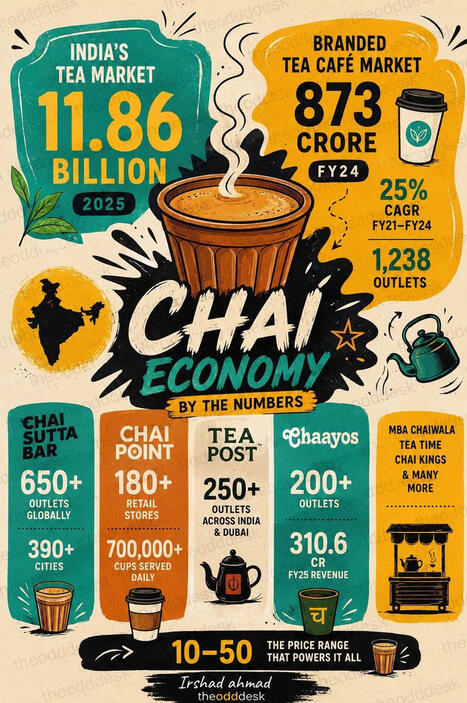
INDIA DOESN’T JUST HAVE A CHAI MARKET.
IT HAS A CHAI ECONOMY.
India’s tea market was worth:
$11.86 BILLION
2025 projects $15.44 billion by 2034
But here’s where it gets interesting.
Chai is becoming a QSR category.
The players are scaling fast:
CHAI SUTTA BAR
650+ OUTLETS
390+ CITIES
Tea Time
4,000+ OUTLETS
20+ STATES
Chaayos
200+ OUTLETS
₹310.6 CR FY25 OPERATING REVENUE
Chai Point
180+ STORES
~9 LAKH CUPS/DAY
Tea Post
250 OUTLETS
INDIA + DUBAI
Tealogy Cafe
500+ OUTLETS
100+ CITIES
And this is only the organised layer.
The older ₹873 CR organised chai-café estimate was for FY24.
The unorganised market?
Millions of tapris.
Local cafés.
Office chai.
Railway chai.
College chai.
Highway chai.
That is the real beast.
Because chai has the perfect QSR economics:
₹10–₹50
LOW TICKET
HIGH FREQUENCY
REPEAT PURCHASE
LOW COMPLEXITY
EASY FORMAT
MASS MARKET
TIER 1 → TIER 3
Coffee built premium cafés.
Chai is building MASS-MARKET QSRs.
And perhaps the biggest opportunity isn't selling Indians more chai.
It is ORGANISING THE CHAI THEY ALREADY DRINK.
The next Starbucks of India might not sell coffee.
It might sell ₹20 chai.
Normal is boring.
We dig the odd.
— TheOddDesk
#QSR #Chai #TeaBusiness #IndianFoodBusiness #FoodBusiness #ConsumerBusiness #IndianStartups #IrshadAhmad #FMCG #BusinessStrategy #TheOddDesk
|
|
Scooped by
Trevor Lee @ TravConsult
August 24, 1:12 AM
|
Reliance has built one of India’s largest portfolios of international and premium brands, particularly across fashion, luxury, beauty, food, toys and home & lifestyle.
Through Reliance Brands Limited (RBL), a subsidiary of Reliance Retail Ventures, the group has partnered with a wide range of global brands and brought them closer to Indian consumers. RBL began operations in 2007 with a focus on building global luxury and premium brands in India. (Reliance Industries Limited)
Some of the major brands in its portfolio include:
• Luxury: Valentino, Tiffany & Co., Giorgio Armani, Bottega Veneta, Zegna, Versace, Burberry, Balenciaga and Ferragamo
• Fashion & Lifestyle: Coach, Tory Burch, Diesel, Michael Kors, Hugo Boss, Superdry, Steve Madden, Brooks Brothers and Tumi
• Home & Lifestyle: Pottery Barn, Pottery Barn Kids, West Elm and Villeroy & Boch
• Beauty: Sephora and Flormar
• Food & Beverages: Pret A Manger
• Toys & Kids: Hamleys and Mothercare
Reliance Retail also operates major fashion and lifestyle formats such as AJIO, Trends, Yousta, Azorte and Tira, giving the group a presence across value, premium and luxury segments. (Reliance Industries Limited)
According to Reliance’s latest available retail information, Reliance Retail operated 20,169 stores as of June 30, 2026, with more than 78.4 million sq. ft. of retail area. Its FY2025–26 gross revenue was ₹3,70,026 crore. (Reliance Retail)
The portfolio shown in the graphic is not exhaustive and represents only a selection of the international brands associated with Reliance’s retail ecosystem.
Venturloop — India’s startup launch and discovery platform.
|
|
Scooped by
Trevor Lee @ TravConsult
August 23, 1:40 AM
|
Explore India’s domestic tourism boom, from experiential and spiritual travel to wildlife, wellness, adventure and offbeat destinations, and discover new opportunities for travel agents.
|
|
Scooped by
Trevor Lee @ TravConsult
August 23, 1:36 AM
|
Explore why more Indian travellers are choosing travel insurance in 2026 for medical emergencies, delays, cancellations and baggage.
|
|
Scooped by
Trevor Lee @ TravConsult
August 16, 8:30 PM
|
Discover how Indian Gen Z luxury consumers are changing luxury through values, culture, and digital engagement.
|
|
Scooped by
Trevor Lee @ TravConsult
August 16, 5:59 AM
|
Indian travellers seek immersive cultural experiences, focusing on heritage, festivals, local food, and community interactions, moving beyond traditional sightseeing.
|
|
Scooped by
Trevor Lee @ TravConsult
August 16, 5:54 AM
|
The study found that 87% prefer trips lasting under a week, while 66% book within days or weeks of travel.
|
|
Scooped by
Trevor Lee @ TravConsult
August 16, 5:47 AM
|
Thomas Cook India has launched its India Forex Report 2026, analysing forex purchasing and spending patterns across leisure, overseas education and corporate travel. The report, based on transactions from April 2025 to March 2026, highlights rising demand from Tier 2 and Tier 3 cities, growing digital adoption, shorter purchase cycles, increased use of destination-specific currencies and strong preference for forex cards among corporate travellers.
|
|
Scooped by
Trevor Lee @ TravConsult
August 16, 5:29 AM
|
Inaugural research shows travel remains a powerful source of joy, reset and connection - even as travellers adapt to uncertainty
|
|
Scooped by
Trevor Lee @ TravConsult
August 4, 10:15 PM
|
🚀 The New Indian Traveller Has Changed. Has the Travel Industry Changed Too?
Something big has changed in the travel industry... and many companies still haven't noticed it.
A few years ago, most Indian travelers were looking for the cheapest package.
Today, they are looking for the right experience.
They no longer ask only:
"How much does it cost?"
They ask:
"What will I experience?"
India is one of the world's fastest-growing outbound travel markets, and traveler expectations are evolving faster than ever.
Today's Indian traveler values:
✅ Authentic Local Culture
✅ Wellness & Meaningful Journeys
✅ Luxury with Comfort
✅ Personalized Itineraries
✅ Safety & Seamless Service
✅ Digital Convenience with Human Touch
This is exactly why destinations like Vietnam, Thailand, Japan, Sri Lanka, Indonesia, Central Asia, and India's Spiritual Circuit are attracting more Indian travelers than ever before.
The biggest opportunity for travel companies is no longer selling destinations...
It's creating unforgettable experiences.
The companies that understand this shift today will lead the travel industry tomorrow.
What travel trend do you believe will shape the next five years?
If you're planning FIT Holidays, Group Tours, Luxury Travel, MICE, Corporate Travel, or Customized Itineraries, I'd be happy to help.
Let's connect and create meaningful travel experiences together.
#TravelIndustry #FutureOfTourism #TravelTrends #LuxuryTravel #CorporateTravel #MICE #Tourism #Leadership #ExperienceEconomy | 10 comments on LinkedIn
|
|
Scooped by
Trevor Lee @ TravConsult
August 1, 10:03 PM
|
Royal Jordanian Airlines is inviting Indian travellers to explore a range of monsoon getaways that combine culture, adventure, relaxation and
|