Your new post is loading...

|
Scooped by
Dr. Tom D'Amico (@TDOttawa)
November 12, 7:00 AM
|
Independent research on how emerging technology can deliver real opportunity to more people, in more places. Browse the series.
|
|
Scooped by
Dr. Tom D'Amico (@TDOttawa)
November 10, 7:00 AM
|
Learn how AI tools empower the disability community—creating practical solutions for work and daily life.
|
|
Scooped by
Dr. Tom D'Amico (@TDOttawa)
November 8, 7:00 AM
|
AI Trivia Time A quick, classroom-ready way to build AI literacy through questions, discussion, and play. AI Trivia Time is a free, educator-led trivia game that helps students explore important AI concepts without requiring student accounts or prior AI knowledge. Choose the age range that bes
|
|
Scooped by
Dr. Tom D'Amico (@TDOttawa)
November 6, 8:12 AM
|
This report presents a taxonomy framework and evaluation tool to help educators and institutions scaffold AI adoption in teaching.
|
|
Scooped by
Dr. Tom D'Amico (@TDOttawa)
November 4, 7:00 AM
|
What if the greatest AI divide in education isn’t about who has access to artificial intelligence, but who is being taught how to use it? As some students learn to think critically with AI, others may be left using it as a shortcut or navigating it without guidance. With Canadian research revealing significant gaps in teacher AI training, are we unintentionally creating two educational futures, one that prepares students for an AI-driven world and another that leaves them behind?
|
|
Scooped by
Dr. Tom D'Amico (@TDOttawa)
November 2, 7:00 AM
|
A free one-day virtual summit on what AI literacy actually is, and how to build it in your community. Join us Nov. 7, 2026.
|
|
Scooped by
Dr. Tom D'Amico (@TDOttawa)
November 1, 11:48 AM
|
A creative resource on generative AI with instructional information to create a learning experience for educators and students aged 13-15 years.
|
|
Scooped by
Dr. Tom D'Amico (@TDOttawa)
October 26, 7:00 AM
|
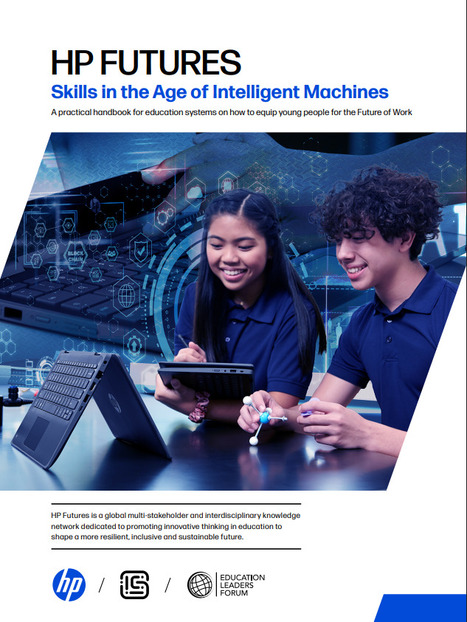
HP Futures 2026 explores skills in the age of AI, offering global insights on lifelong learning, human potential, and the future of education and work.
|
|
Scooped by
Dr. Tom D'Amico (@TDOttawa)
October 24, 5:28 PM
|
|
|
Scooped by
Dr. Tom D'Amico (@TDOttawa)
October 22, 7:00 AM
|
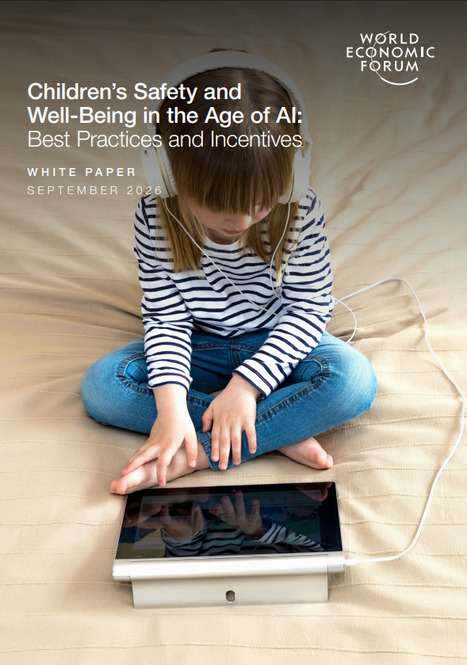
How AI can be used to bully children, and what parents and educators can do to help, from supporting a child to reporting fake images and harmful content.
|
|
Scooped by
Dr. Tom D'Amico (@TDOttawa)
October 20, 7:00 AM
|
Publication from Dr Helen Kelly.
|
|
Scooped by
Dr. Tom D'Amico (@TDOttawa)
October 18, 1:49 PM
|
|
|
Scooped by
Dr. Tom D'Amico (@TDOttawa)
October 13, 7:01 AM
|
|
|
|
Scooped by
Dr. Tom D'Amico (@TDOttawa)
November 11, 7:00 AM
|
We asked 3,001 parents, 3,001 children and 300 teachers across six European countries how AI, technology and changing expectations are reshaping education.
|
|
Scooped by
Dr. Tom D'Amico (@TDOttawa)
November 9, 7:00 AM
|
Learn what AI is and how to use Microsoft Copilot to write messages, plan your day, and stay safe online, while you stay in charge of every choice.
|
|
Scooped by
Dr. Tom D'Amico (@TDOttawa)
November 7, 7:00 AM
|
The PreK-5 Responsible EdTech Use Task Force developed a Pedagogy-First framework for technology integration in early childhood & elementary education. This initiative will establish the national standard for PreK–5 technology: transitioning from mindless "entertainment screen time" to purpose-built, evidence-backed "educational screen time." The Task Force addresses the role and risks of AI for our youngest learners and ensures every tool delivers a measurable, equitable Return on Instruction.
|
|
Scooped by
Dr. Tom D'Amico (@TDOttawa)
November 5, 7:00 AM
|
IDEAL Thinkers is a free, unplugged AI literacy and fluency curriculum for primary schools: 36 lessons from Year 1 to Year 6, each with a plan and slides, plus letters, CPD, printables, a dual coded glossary and assessment.
|
|
Scooped by
Dr. Tom D'Amico (@TDOttawa)
November 3, 7:00 AM
|
|
|
Scooped by
Dr. Tom D'Amico (@TDOttawa)
November 1, 11:52 AM
|
Explore free, award-winning AI literacy resources for teachers and students, including classroom activities, lesson materials, and guidance to teach 8 to 16-year-olds about artificial intelligence, machine learning, and AI safety.
|
|
Scooped by
Dr. Tom D'Amico (@TDOttawa)
October 27, 7:00 AM
|
|
|
Scooped by
Dr. Tom D'Amico (@TDOttawa)
October 25, 7:00 AM
|
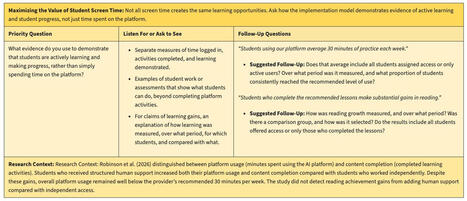
The goal of this guide is to help district leaders ask what it will take for students to consistently engage with and meaningfully benefit from an AI product in their schools. It complements existing district procurement processes by focusing on student engagement and the conditions needed to support it. The questions are informed by Robinson et al. (2026), "Access is Not Enough: Human Support Improves Engagement with AI Tutoring." They are discussion prompts, not a product evaluation rubric.
|
|
Scooped by
Dr. Tom D'Amico (@TDOttawa)
October 23, 7:00 AM
|
|
|
Scooped by
Dr. Tom D'Amico (@TDOttawa)
October 21, 7:00 AM
|
Fifty-nine percent of K-12 educators used AI tools last year, and 64% of them say it freed up time for the parts of the job that matter most to them.
|
|
Scooped by
Dr. Tom D'Amico (@TDOttawa)
October 19, 7:00 AM
|
By OECD Director for Education and Skills Andreas Schleicher The arrival of generative artificial intelligence in classrooms has been swift and its impact immediate. Programme for International Student Assessment (PISA) data show that AI chatbots are now routinely used for schoolwork in many countries. More than 40% of students say they use AI to draft…
|
|
Scooped by
Dr. Tom D'Amico (@TDOttawa)
October 14, 7:00 AM
|
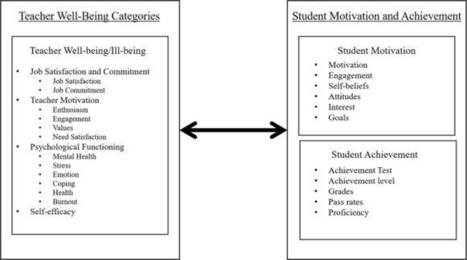
In this meta-analysis, we examine the association between teacher well-being and ill-being with student motivation and achievement. Based on 186 articles, 811 effect sizes, and data from 355,637 teachers, we investigate these relationships through the lens of the Job Demands–Resources Model, Transactional Stress Model, Self-Determination Theory, and the PERMA model. Using three-level meta-analytic models, we found small to moderate associations between student outcomes and teacher well-being (r = .18) and ill-being (r = –.13). These associations were similarly patterned across student motivation and student achievement, with no significant differences by outcome type. Associations were also comparable across domains of teacher functioning with no significant differences by domain. Moderator analyses indicated stronger associations in secondary school settings. Associations were also larger when teacher and student variables were reported by the same informant, although this difference reached conventional significance only for teacher ill-being and approached significance for teacher well-being. These findings suggest that teacher well-being and ill-being show reliable but modest associations with student motivation and achievement across a diverse body of research, though the evidence remains largely correlational. Given this correlational nature and the influence of measurement source, future longitudinal and intervention research is needed to clarify causal mechanisms and the direction of effects.
|


 Scoop.it!