Your new post is loading...
Learn about the United Nations Alliance of Civilizations' (UNAOC) projects and initiatives on media, migration, youth, and education. UNAOC's Pillars While active on a number of cross-cutting issues, UNAOC works mainly in four priority areas to which it brings a multidisciplinary and multi-perspective approach: Youth, Education, Media, and Migration. The four pillars of UNAOC provide an essential organizing structure for the development and implementation of its various programmes and initiatives, which all play a critical role in reducing cross-cultural tensions and building bridges between communities globally. #SpreadNoHate Initiative: Global Symposia UNAOC’s #SpreadNoHate initiative aims at preventing and countering hate speech and the negative portrayal of migrants and refugees in traditional and new media. Since its launch in late 2015, the initiative has promoted constructive dialogue on hate speech among media professionals, academia, and relevant NGOs, and allowed them to share best practices in preventing and countering hate speech in the media. To date, UNAOC has organized five international #SpreadNoHate Symposia at the United Nations Headquarters in New York, as well as in Baku, Azerbaijan, in Brussels, Belgium, in partnership with the European Union, and Cairo, Egypt. The #SpreadNoHate initiative also consists of an ongoing social media campaign that has consistently topped Twitter trends and comprehensive reports with recommendations. Learn More PEACEapp Global Workshops Initially designed with UNDP as a contest for digital games facilitating inter-cultural dialogue and violence prevention, PEACEapp developed into a series of hands-on workshops with young refugees focusing on the creation of video game apps for use on smart devices. PEACEapp creates a platform for mobile technologies to support creative forms of storytelling and digital narratives. The workshops and apps development also aim to connect young refugees to peers while building awareness about their situation and aspirations. Learn More Engagement with Religious Leaders In resolution 69/312, the General Assembly recognized the critical role of UNAOC in promoting inter-religious and intercultural dialogue within the United Nations system. UNAOC works actively with religious leaders and faith-based organizations in three key areas: advocacy, capacity building, and knowledge management. Since 2013, UNAOC has organized or co-organized numerous events involving religious leaders and faith-based organizations, creating a global platform to discuss the best ways to advance the use of interreligious dialogue. UNAOC is also an active member and participant in inter-agency bodies, most notably, the Inter-Agency Task Force on Religion and Development (UNWPF).
High Representative's Statements Archives | Page 5 of 7 | United Nations Alliance of Civilizations (UNAOC) September 6, 2022Filed Under: Featured, High Representative's Statements July 18, 2022Filed Under: Featured, High Representative's Statements July 6, 2022Filed Under: Featured, High Representative's Statements, Videos June 15, 2022Filed Under: Featured, High Representative's Statements June 15, 2022Filed Under: Featured, High Representative's Statements May 10, 2022Filed Under: Featured, High Representative's Statements, High Representative's Updates, Videos May 9, 2022Filed Under: Featured, High Representative's Statements, High Representative's Updates May 5, 2022Filed Under: Featured, High Representative's Statements, High Representative's Updates March 28, 2022Filed Under: Featured, High Representative's Statements March 27, 2022Filed Under: Featured, High Representative's Statements March 23, 2022Filed Under: Featured, High Representative's Statements February 18, 2022Filed Under: Featured, High Representative's Statements February 9, 2022Filed Under: Featured, High Representative's Statements February 4, 2022Filed Under: Featured, High Representative's Statements January 25, 2022Filed Under: Featured, High Representative's Statements January 10, 2022Filed Under: Featured, High Representative's Statements December 7, 2021Filed Under: Featured, High Representative's Statements, High Representative's Updates December 6, 2021Filed Under: Featured, High Representative's Statements November 16, 2021Filed Under: Featured, High Representative's Statements, High Representative's Updates November 16, 2021Filed Under: Featured, High Representative's Statements November 8, 2021Filed Under: Featured, High Representative's Statements November 1, 2021Filed Under: Featured, High Representative's Statements October 6, 2021Filed Under: Featured, High Representative's Statements, Videos September 20, 2021Filed Under: Featured, High Representative's Statements, High Representative's Updates September 7, 2021Filed Under: Featured, High Representative's Statements July 7, 2021Filed Under: Featured, High Representative's Statements June 30, 2021Filed Under: Featured, High Representative's Statements June 30, 2021Filed Under: Featured, High Representative's Statements May 27, 2021Filed Under: Featured, High Representative's Statements May 26, 2021Filed Under: Featured, High Representative's Statements May 21, 2021Filed Under: Featured, High Representative's Statements, High Representative's Updates, Press Statements May 19, 2021Filed Under: Featured, High Representative's Statements April 14, 2021Filed Under: Featured, High Representative's Statements March 17, 2021Filed Under: Featured, High Representative's Statements March 15, 2021Filed Under: Featured, High Representative's Statements March 9, 2021Filed Under: Featured, High Representative's Statements, High Representative's Updates
High Representative's Statements Archives | Page 13 of 13 | United Nations Alliance of Civilizations (UNAOC) March 5, 2020Filed Under: Featured, High Representative's Statements, High Representative's Updates March 5, 2020Filed Under: Featured, High Representative's Statements, High Representative's Updates December 18, 2019Filed Under: Featured, High Representative's Statements, High Representative's Updates Remarks by H.E. Mr. Miguel Moratinos The High Representative for UNAOC at the UAE/UNOCT High-level panel on Promoting Tolerance for December 10, 2019Filed Under: Featured, High Representative's Statements, High Representative's Updates December 3, 2019Filed Under: Featured, High Representative's Statements December 2, 2019Filed Under: Featured, High Representative's Statements, High Representative's Updates November 22, 2019Filed Under: Featured, High Representative's Statements, High Representative's Updates November 17, 2019Filed Under: High Representative's Statements, High Representative's Updates November 13, 2019Filed Under: Featured, High Representative's Statements, High Representative's Updates November 1, 2019Filed Under: Featured, High Representative's Statements, High Representative's Updates September 27, 2019Filed Under: Featured, High Representative's Statements, High Representative's Updates September 25, 2019Filed Under: Featured, High Representative's Statements September 20, 2019Filed Under: Featured, High Representative's Statements, High Representative's Updates September 13, 2019Filed Under: Featured, High Representative's Statements, High Representative's Updates September 12, 2019Filed Under: Featured, High Representative's Statements, High Representative's Updates September 12, 2019Filed Under: Featured, High Representative's Statements, High Representative's Updates August 21, 2019Filed Under: Featured, High Representative's Statements, High Representative's Updates August 9, 2019Filed Under: Featured, High Representative's Statements, High Representative's Updates July 19, 2019Filed Under: Featured, High Representative's Statements, High Representative's Updates July 16, 2019Filed Under: Featured, High Representative's Statements, High Representative's Updates July 15, 2019Filed Under: Featured, High Representative's Statements, High Representative's Updates July 10, 2019Filed Under: Featured, High Representative's Statements, High Representative's Updates June 27, 2019Filed Under: Featured, High Representative's Statements, High Representative's Updates June 19, 2019Filed Under: Featured, High Representative's Statements, High Representative's Updates April 25, 2019Filed Under: Featured, High Representative's Statements High Representative for the United Nations Alliance of Civilizations Belt and Road Forum 2019 (Beijing, China) "People to People March 12, 2019Filed Under: Featured, High Representative's Statements Remarks by The High Representative for UNAOC Mr. Miguel Moratinos at the International Federation BPW of Spain Side Event – Church Center, 2nd February 19, 2019Filed Under: Featured, High Representative's Statements February 6, 2019Filed Under: Featured, High Representative's Statements February 4, 2019Filed Under: Featured, High Representative's Statements February 4, 2019Filed Under: Featured, High Representative's Statements
Protecting the diversity of cultural expressions is more important than ever Held every year on 21 May, UNESCO leads the celebration of World Day for Cultural Diversity for Dialogue and Development highlighting not only the richness of the world’s cultures, but also the essential role of intercultural dialogue for achieving peace and sustainable development. With 89% of all current conflicts in the world occurring in countries with low intercultural dialogue, to forge effective cooperation and sustain peace, strengthening intercultural dialogue must be a priority. According to UNESCO data, the cultural and creative sector is one of the most powerful engines of development worldwide. It accounts for more than 48 million jobs globally –almost half of which are held by women – representing 6.2% of all existing employment and 3.1% of global GDP. It is also the sector that employs and provides opportunities for the largest number of young people under the age of 30. However, the cultural and creative sector still does not have the place it deserves in public policies and international cooperation. Declaration for culture In a bid to change this, in September 2022, delegations from 150 States gathered in Mexico for MONDIACULT 2022, the largest world conference devoted to culture in the last 40 years. They unanimously adopted the historic Declaration for Culture affirming culture as a “global public good” and calling for it to be integrated “as a specific goal in its own right” in the development agenda beyond 2030. The text defines a set of cultural rights that need to be taken into account in public policies. These range from the social and economic rights of artists to artistic freedom, the right of indigenous communities to safeguard their ancestral knowledge, and the protection and promotion of cultural and natural heritage. It also calls for substantial regulation of the digital sector, notably of the major platforms, for the benefit of online cultural diversity, artists’ intellectual property rights and fair access to content for all. Culture and Sustainable Development With the adoption in September 2015 of the 2030 Agenda for Sustainable Development by the United Nations, and the resolution on Culture and Sustainable Development adopted by the UN General Assembly in December 2015 , the message of the World Day for Cultural Diversity for Dialogue and Development is more important than ever. The 17 Sustainable Development Goals (SDGs) can best be achieved by drawing upon the creative potential of the world’s diverse cultures and engaging in continuous dialogue to ensure that all members of society benefit from sustainable development. The UNESCO Culture|2030 Indicators is a framework of thematic indicators whose purpose is to measure and monitor the progress of culture’s enabling contribution to the implementation of the SDGs. Why does cultural diversity matter? Three-quarters of the world’s major conflicts have a cultural dimension. Bridging the gap between cultures is urgent and necessary for peace, stability and development. Cultural diversity is a driving force of development, not only with respect to economic growth, but also as a means of leading a more fulfilling intellectual, emotional, moral and spiritual life. This is captured in the culture conventions, which provide a solid basis for the promotion of cultural diversity. Cultural diversity is thus an asset that is indispensable for poverty reduction and the achievement of sustainable development. At the same time, acceptance and recognition of cultural diversity – in particular through innovative use of media and Information and Communications Technologies (ICTs) – are conducive to dialogue among civilizations and cultures, respect and mutual understanding. Origin and purpose In 2001, UNESCO adopted the Universal Declaration on Cultural Diversity. Next, in December 2002, the UN General Assembly, in its resolution 57/249, declared May 21 to be the World Day for Cultural Diversity for Dialogue and Development, and in 2015, the Second Committee of the UN General Assembly unanimously adopted the resolution on Culture and Sustainable Development A/C.2/70/L.59, affirming culture’s contribution to the three dimensions of sustainable development, acknowledging further the natural and cultural diversity of the world, and recognizing that cultures and civilizations can contribute to, and are crucial enablers of, sustainable development. The day provides us with an opportunity to deepen our understanding of the values of cultural diversity and to advance the four goals of the UNESCO Convention on the Protection and Promotion of the Diversity of Cultural Expressions adopted on 20 October 2005: - Support sustainable systems of governance for culture
- Achieve a balanced flow of cultural goods and services and increase mobility of artists and cultural professionals
- Integrate culture in sustainable development frameworks
- Promote human rights and fundamental freedoms
The ninth session of the Conference of Parties to the Convention on the Protection and Promotion of the Diversity of Cultural Expressions will be held at UNESCO Headquarters in Paris from 6 to 8 June 2023 to examine the state of the implementation of the Convention worldwide and the major challenges facing the cultural and creative sectors in the post COVID-19 pandemic context. Since 2010, the International Fund for Cultural Diversity (IFCD) has funded more than 140 cultural and creative projects in over 69 developing countries. Watch the video to hear directly from project leaders across the globe involved in the protection and promotion of cultural diversity. Development assistance devoted to culture and recreation is on the decline and although the flow of cultural goods and services globally continues to rise, there has been very little progress in addressing the vast disparity between developed and developing countries. Very strong inequalities also persist in the cultural and creative sectors, like those faced by many women. Related International Days International days and weeks are occasions to educate the public on issues of concern, to mobilize political will and resources to address global problems, and to celebrate and reinforce achievements of humanity. The existence of international days predates the establishment of the United Nations, but the UN has embraced them as a powerful advocacy tool. We also mark other UN observances.
Catalysing action for a more equitable and inclusive future The annual Global Forum against Racism and Discrimination serves as a unique space in the international community to convene multiple stakeholders and discuss prominent issues, share best practices and advance the global anti-racism movement through concrete actions. Hosted by a different country each year, the Forum has been recognized globally as a key moment for action with champions such as Kailash Satyarthi, Martin Luther King III, Forest Whitaker, Xueli Abbing, Valentina Sampaio and many more joining. "Discrimination is a double human tragedy because it characterizes our past and defines our future. Discrimination is more than anything a missed opportunity to build an inclusive society." Gabriela RamosAssistant Director-General for Social and Human Sciences of UNESCO Race to the Top Putting racial equity and justice at the forefront of development agendas
The third edition of the Global Forum against Racism and Discrimination was held in São Paulo, Brazil, from 29 November to 1 December 2023 under the theme Race to the Top: putting racial equity and justice at the forefront of development agendas.
This edition focused on the importance of placing race at the center of developing and implementing strategies for socioeconomic development. Government officials, including ministers, policymakers, practitioners, academics and members of civil society and artistic communities, were invited to discuss effective strategies to address systemic racism. The 2023 issue will mark the launch of the UNESCO Network of Anti-Racism and Anti-Discrimination Officials, with the goal of bolstering the development of innovative and inclusive policy solutions towards peace, equity and non-discrimination. There will also be the announcement of new UNESCO initiatives. Outcomes of the 2023 Edition The 2023 issue marked the launch of the UNESCO Network of Anti-Racism and Anti-Discrimination Officials, with the goal of bolstering the development of innovative and inclusive policy solutions towards peace, equity and non-discrimination. The Forum also included the launch of Fighting racism and discrimination: a UNESCO toolkit This guide provides core concepts, good practices from around the world, practical exercises, and more. A tool designed to support policy-makers in developing anti-racist legislation, it is a first step to tackling the historical and structural racism within our societies. Enhancing youth participation in urban governance through city youth councils UNESCO is publishing this report to ensure that the actions and solutions proposed by youth can be applied and scaled up worldwide. It encourages local governments to create spaces for youth to participate actively and genuinely in decision-making processes. Empowering women for the good of society: gender-based resilience Squicciarini, Mariagrazia UNESCO Sarlat , Garance Manca, Anna Rita 2023 This report proposes an encompassing framework to identify key determinants and mechanisms shaping gender-based discrimination. It then takes this framework to existing data and identifies some of the many challenges that women are confronted with, assesses the magnitude of the different facets that this problem takes, and highlights how they relate to societal dynamics, economic performance and resilience to shocks. General history of Africa, X: Africa and its diasporas Silva Santos, Vanicléia UNESCO International Committee for the New Volumes of the General History of Africa 2023 This volume provides critical observation of the dynamics of the relationship between Africa and its diasporas, the movements between Africa and the rest of the world, and the ways in which Africa connects with the rest of the world. It places the innovative concept of global Africa at the centre of its perspective. Programme The agenda covered various topics such as building inclusive policies; advancing gender equality; enhancing the capacities of civil society; approaching artificial intelligence and its role in perpetuating racism; protecting the rights of indigenous peoples; bolstering the roles of cities, civic spaces, artistic and academic communities; and leveraging social philanthropy to address racial inequity. High-level representatives from governments, Mayors from the International Coalition of Inclusive and Sustainable Cities - ICCAR, public policy experts, academia, scientists, civil society actors, NGOs, artists and creatives, the private sector and media exchangeed ideas and recommendations on the way forward. © UNESCO Fostering Inclusion, Rights and Dialogue Discover UNESCO's action in the fight against Racism and Discrimination
Human Rights Related to Freedom of Religion or Belief Freedom of religion or belief, freedom of opinion and expression, the right to peaceful assembly and the right to freedom of association are interdependent, interrelated and mutually reinforcing. They are enshrined in articles 18, 19 and 20 of the Universal Declaration of Human Rights. Upholding these rights plays an important role in the fight against all forms of intolerance and of discrimination based on religion or belief. The open, constructive and respectful debate of ideas, as well as interreligious, interfaith and intercultural dialogue, at the local, national, regional and international levels, can play a positive role in combating religious hatred, incitement and violence. Furthermore, the exercise of the right to freedom of opinion and expression and full respect for the freedom to seek, receive and impart information can play a positive role in strengthening democracy and combating religious intolerance. Acts of Violence Based on Religion or Belief There are continuing acts of intolerance and violence based on religion or belief against individuals, including against persons belonging to religious communities and religious minorities around the world, and the number and intensity of such incidents, which are often of a criminal nature and may have international characteristics, are increasing. That is why the General Assembly adopted the resolution A/RES/73/296, titled “International Day Commemorating the Victims of Acts of Violence Based on Religion or Belief” strongly condemning continuing violence and acts of terrorism targeting individuals, including persons belonging to religious minorities, on the basis of or in the name of religion or belief. The Member States reaffirmed their unequivocal condemnation of all acts, methods and practices of terrorism and violent extremism conducive to terrorism, in all its forms and manifestations, wherever and by whomsoever committed, regardless of their motivation, and reiterated that terrorism and violent extremism as and when conducive to terrorism, in all its forms and manifestations, cannot and should not be associated with any religion, nationality, civilization or ethnic group. The General Assembly decided to designate 22 August as the International Day Commemorating the Victims of Acts of Violence Based on Religion or Belief. The Day comes right after the International Day of Remembrance and Tribute to the Victims of Terrorism, 21 August. Background The General Assembly, in its resolution A/RES/73/296, designated 22 August as the International Day Commemorating the Victims of Acts of Violence Based on Religion or Belief recognizing the importance of providing victims of acts of violence based on religion or belief and members of their families with appropriate support and assistance in accordance with applicable law. It strongly deplored all acts of violence against persons on the basis of their religion or belief, as well as any such acts directed against their homes, businesses, properties, schools, cultural centres or places of worship, as well as all attacks on and in religious places, sites and shrines that are in violation of international law. A previous resolution establishing the International Day of Remembrance of and Tribute to the Victims of Terrorism (A/RES/72/165) also recognized that working together to enhance the implementation of existing legal regimes that protect individuals against discrimination and hate crimes, increasing interreligious, interfaith and intercultural efforts and expanding human rights education are important first steps in combating incidents of intolerance, discrimination and violence against individuals on the basis of religion or belief. By proclaiming an International Day Commemorating the Victims of Acts of Violence Based on Religion or Belief, the General Assembly recalled that States have the primary responsibility to promote and protect human rights, including the human rights of persons belonging to religious minorities, including their right to exercise their religion or belief freely. Resources Documents Websites Office of the High Commissioner for Human Rights (OHCHR): United Nations Educational, Scientific and Cultural Organization (UNESCO):
What is Islamophobia? Islamophobia is a fear, prejudice and hatred of Muslims that leads to provocation, hostility and intolerance by means of threatening, harassment, abuse, incitement and intimidation of Muslims and non-Muslims, both in the online and offline world. Motivated by institutional, ideological, political and religious hostility that transcends into structural and cultural racism, it targets the symbols and markers of being a Muslim. This definition emphasises the link between institutional levels of Islamophobia and manifestations of such attitudes, triggered by the visibility of the victim’s perceived Muslim identity. This approach also interprets Islamophobia as a form of racism, whereby Islamic religion, tradition and culture are seen as a ‘threat’ to the Western values. Some experts prefer the label 'anti-Muslim hatred,' fearing that the term 'Islamophobia' risks condemning all critiques of Islam and, therefore, could stifle freedom of expression. But international human rights law protects individuals, not religions. And Islamophobia may also affect non-Muslims, based on perceptions of nationality, racial or ethnic background. A rising tide of anti-Muslim hate UN Secretary-General António Guterres has repeatedly condemned the continuing acts of anti-Muslim hatred and bigotry around the world, warning on several occasions that this worrying trend targets not only Muslims but also Jews, minority Christian communities and others. In his message for the International Day to Combat Islamophobia, Guterres warns that Muslims face institutional discrimination, barriers and violations of their human rights and dignity. “Divisive rhetoric and misrepresentation are stigmatizing communities. Online hate speech is fueling real-life violence”, he added. Calling for a strong stance against all forms of bigotry, the Secretary-General urges leaders and individuals alike to condemn inflammatory discourse, safeguard religious freedom and promote mutual respect and understanding, while digital platforms must take a stand against hateful content and protect users from harassment. Recent measures to combat Islamophobia include the adoption by the General Assembly of a new resolution requesting the Secretary-General to appoint a United Nations Special Envoy to Combat Islamophobia. Hate speech and violence online and offline In response to the alarming trend of rising hate speech around the world, the Secretary-General launched in 2019 the United Nations Strategy and Plan of Action on Hate Speech. The UN Human Rights Chief also voiced his alarm over the rise in global hatred, including anti-Semitism and Islamophobia, since the beginning of the Israeli military operation in Gaza (7 October) in response to the attack on Israel by Palestinian armed groups. Volker Türk strongly condemned the sharp rise in cases of hate speech, violence, and discrimination, both online and offline. He emphasized that states must ensure a safe and enabling space for participation and debate, consistent with the International Covenant on Civil and Political Rights (ICCPR). Lack of policies to promote diversity States have a responsibility to address any hatred based on religion or belief in a manner that complies with human rights, recalls the UN Special Rapporteur on freedom of religion or belief, Nazila Ghane, in her last report on Hatred on the basis of religion or belief. The expert stresses that advocacy of religious hatred that leads to discrimination, hostility or violence should be prohibited by law. While international norms and standards provide a framework to combat incitement to discrimination and violence, laws are not enough, and States should also adopt policies and programs that promote diversity and freedom of expression, especially in multicultural and interconnected societies, proposed Ghane. Among her recommendations to the States, the Special Rapporteur proposes that countries could collect data on hate speech, take robust action against discriminatory speech, invest in trust-building, review legislation and policies and ensure no impunity for State actors who engage in hate speech. Another report by the former UN Special Rapporteur on freedom of religion or belief, Ahmed Shaheed, found that suspicion, discrimination and outright hatred towards Muslims had risen to 'epidemic proportions’ following the terrorist attacks of 11 September 2001 and other horrific acts of terrorism purportedly carried out in the name of Islam. Combating Islamophobia Many Governments have taken steps to combat Islamophobia by establishing anti-hate-crime legislation and measures to prevent and prosecute hate crimes and by conducting public awareness campaigns about Muslims and Islam designed to dispel negative myths and misconceptions. The United Nations General Assembly adopted a resolution sponsored by 60 Member-States of the Organization of Islamic Cooperation (OIC), which designated 15 March as the International Day to Combat Islamophobia. The document stresses that terrorism and violent extremism cannot and should not be associated with any religion, nationality, civilization, or ethnic group. It calls for a global dialogue on the promotion of a culture of tolerance and peace, based on respect for human rights and for the diversity of religions and belief. Guidelines for Educators on Countering Intolerance and Discrimination against Muslims These Guidelines were developed jointly by the OSCE Office for Democratic Institutions and Human Rights (ODIHR), the Council of Europe and the United Nations Educational, Scientific and Cultural Organization (UNESCO) Resources Documents
|
High Representative's Statements Archives | Page 1 of 4 | United Nations Alliance of Civilizations (UNAOC) July 18, 2024Filed Under: Featured, High Representative's Statements, High Representative's Updates June 9, 2024Filed Under: Featured, High Representative's Statements, High Representative's Updates, Press Statements May 1, 2024Filed Under: Featured, High Representative's Statements May 1, 2024Filed Under: Featured, High Representative's Statements April 22, 2024Filed Under: Featured, High Representative's Statements April 12, 2024Filed Under: Featured, High Representative's Statements March 14, 2024Filed Under: Featured, High Representative's Statements March 10, 2024Filed Under: Featured, High Representative's Statements, Press Statements February 20, 2024Filed Under: Featured, High Representative's Statements February 19, 2024Filed Under: High Representative's Statements, Videos February 5, 2024Filed Under: Featured, High Representative's Statements January 26, 2024Filed Under: Featured, High Representative's Statements December 15, 2023Filed Under: Featured, High Representative's Statements December 5, 2023Filed Under: Featured, High Representative's Statements December 3, 2023Filed Under: Featured, High Representative's Statements, High Representative's Updates November 28, 2023Filed Under: Featured, High Representative's Statements November 16, 2023Filed Under: Featured, High Representative's Statements, Press Statements November 9, 2023Filed Under: Featured, High Representative's Statements November 8, 2023Filed Under: Featured, High Representative's Statements, Press Statements, Videos October 20, 2023Filed Under: Featured, High Representative's Statements October 18, 2023Filed Under: Featured, High Representative's Statements September 22, 2023Filed Under: Featured, High Representative's Statements September 20, 2023Filed Under: Featured, High Representative's Statements September 14, 2023Filed Under: Featured, High Representative's Statements September 7, 2023Filed Under: Featured, High Representative's Statements July 3, 2023Filed Under: Featured, High Representative's Statements June 21, 2023Filed Under: Featured, High Representative's Statements, Press Releases June 19, 2023Filed Under: Featured, High Representative's Statements June 19, 2023Filed Under: Featured, High Representative's Statements June 14, 2023Filed Under: Featured, High Representative's Statements April 14, 2023Filed Under: Featured, High Representative's Statements March 16, 2023Filed Under: Featured, High Representative's Statements March 14, 2023Filed Under: Featured, High Representative's Statements, UNAOC Remarks March 10, 2023Filed Under: Featured, High Representative's Statements March 9, 2023Filed Under: Featured, High Representative's Statements February 28, 2023Filed Under: Featured, High Representative's Statements February 7, 2023Filed Under: Featured, High Representative's Statements January 25, 2023Filed Under: Featured, High Representative's Statements December 19, 2022Filed Under: Featured, High Representative's Statements December 4, 2022Filed Under: Featured, High Representative's Statements November 30, 2022Filed Under: Featured, High Representative's Statements November 28, 2022Filed Under: Featured, High Representative's Statements November 3, 2022Filed Under: Featured, High Representative's Statements October 19, 2022Filed Under: Featured, High Representative's Statements September 26, 2022Filed Under: Featured, High Representative's Statements September 22, 2022Filed Under: Featured, High Representative's Statements September 21, 2022Filed Under: Featured, High Representative's Statements September 14, 2022Filed Under: Featured, High Representative's Statements
High Representative's Statements Archives | Page 8 - 10 | United Nations Alliance of Civilizations (UNAOC) February 4, 2021Filed Under: Featured, High Representative's Statements, High Representative's Updates January 28, 2021Filed Under: Featured, High Representative's Statements January 27, 2021Filed Under: Featured, High Representative's Statements January 25, 2021Filed Under: Featured, High Representative's Statements December 7, 2020Filed Under: Featured, High Representative's Statements December 7, 2020Filed Under: Featured, High Representative's Statements December 2, 2020Filed Under: Featured, High Representative's Statements November 19, 2020Filed Under: Featured, High Representative's Statements November 17, 2020Filed Under: Featured, High Representative's Statements, Videos November 16, 2020Filed Under: Featured, High Representative's Statements, High Representative's Updates November 16, 2020Filed Under: Featured, High Representative's Statements, Videos October 23, 2020Filed Under: Featured, High Representative's Statements, Videos October 23, 2020Filed Under: Featured, High Representative's Statements October 13, 2020Filed Under: Featured, High Representative's Statements, High Representative's Updates, Press Releases October 8, 2020Filed Under: Featured, High Representative's Statements, High Representative's Updates September 29, 2020Filed Under: Featured, High Representative's Statements, High Representative's Updates September 29, 2020Filed Under: Featured, High Representative's Statements, High Representative's Updates September 29, 2020Filed Under: Featured, High Representative's Statements, High Representative's Updates September 25, 2020Filed Under: Featured, High Representative's Statements, UNAOC Remarks September 18, 2020Filed Under: Featured, High Representative's Statements August 28, 2020Filed Under: Featured, High Representative's Statements, High Representative's Updates July 9, 2020Filed Under: Featured, High Representative's Statements, High Representative's Updates July 2, 2020Filed Under: Featured, High Representative's Statements June 30, 2020Filed Under: Featured, High Representative's Statements June 26, 2020Filed Under: Featured, High Representative's Statements, High Representative's Updates, Press Releases June 17, 2020Filed Under: Featured, High Representative's Statements June 12, 2020Filed Under: Featured, High Representative's Statements, High Representative's Updates May 21, 2020Filed Under: Featured, High Representative's Statements, High Representative's Updates May 21, 2020Filed Under: Featured, High Representative's Statements May 19, 2020Filed Under: Featured, High Representative's Statements May 14, 2020Filed Under: Featured, High Representative's Statements, High Representative's Updates May 13, 2020Filed Under: Featured, High Representative's Statements May 12, 2020Filed Under: Featured, High Representative's Statements, High Representative's Updates May 7, 2020Filed Under: Featured, High Representative's Statements March 12, 2020Filed Under: Featured, High Representative's Statements April 6, 2020Filed Under: Featured, High Representative's Statements, High Representative's Updates
UNAOC aims to improve understanding and cooperation among nations and peoples across cultures and to reduce polarization at local and global levels. It helps develop more inclusive societies, in which diversity is experienced as an asset. As our world faces a global human crisis, we are reminded every day of our common fragility and our interconnected fate. There is no alternative to standing together in unity and solidarity in inclusive societies. With its motto, "Many Cultures, One Humanity," UNAOC embraces and promotes cultural diversity, religious pluralism and mutual respect. UNAOC High Representative's Remarks UNAOC Press Statements Read the Latest News Flash We are #OneHumanityLa-Liga Joins #OneHumanity July 18, 2024 July 17, 2024 July 3, 2024 July 1, 2024 June 24, 2024 June 9, 2024 May 9, 2024 May 1, 2024 May 1, 2024 May 1, 2024 April 23, 2024 April 22, 2024 UNAOC High Representative's Blog In his blog, Mr. Miguel Ángel Moratinos, UNAOC High Representative, regularly shares his vision for the work of UNAOC, as well as his thoughts, ideas, and observations about current global events. How to Get Involved UNAOC is the premier global platform for intercultural dialogue, understanding and cooperation. Learn how you can support UNAOC in a variety of ways. Footer UNAOC on Twitter - RT @InterInnovHub: As we wrap up our #YouthDayhighlights, we celebrate the many more organizations supported by IIH that are dedicat… https://t.co/LQjKA1tkx2
6 days ago - RT @InterInnovHub: @StreetProject1 from Nigeria galvanizes #youth from over ethnic groups in in co-creating theatre & ra… https://t.co/tk04qtzCEW
6 days ago - RT @InterInnovHub: Argentina-based @FundEncontrarse uses live music, games, humour & audiovisual technologies to encourage #youth in… https://t.co/BI00cZuo0C
6 days ago
Special Rapporteur on the promotion and protection of the right to freedom of opinion and expression Purpose of the mandate Freedom of expression is the cornerstone of democracy, which allows individuals and groups to enjoy several other human rights and freedoms. The mandate of the Special Rapporteur was created by the Human Rights Council to protect and promote freedom of opinion and expression, offline and online, in light of international human rights law and standards. About the mandate In 1993, the United Nations Commission on Human Rights established the mandate of the Special Rapporteur on the promotion and protection of the right to freedom of opinion and expression.
After replacing the Commission on Human Rights, the Human Rights Council decided to extend the mandate for another three years in March 2008 (resolution 7/36). The mandate was renewed again for an additional three years in March 2011 (HRC resolution 16/4), March 2014 (resolution 25/2), March 2017(resolution 34/18), March 2020 (resolution 43/4) and March 2023 (resolution 52/9). Learn more about the mandate Current mandate holder
Irene Khan was appointed as UN Special Rapporteur for Freedom of Opinion and Expression in June 2020 and is the first woman to hold this mandate. An internationally recognized advocate for human rights, gender equality and social justice, she was Secretary-General of Amnesty International from 2001 to 2009 and Director-General of the International Development Law Organization (IDLO) from 2010 to 2019. Ms. Khan is affiliated with the Graduate Institute of International and Development Studies in Geneva, and has been Consulting Editor of the Daily Star, Bangladesh’s largest English newspaper. Read Ms. Khan’s full biography Calls for Input Call for submissions to the thematic report of the Special Rapporteur on Freedom of Expression in Challenging Times Latest thematic reports A/HRC/56/53: Journalists in exile - Report of the Special Rapporteur on the promotion and protection of the right to freedom of opinion and expression In the present report, the Special Rapporteur on the promotion and protection of the right to freedom of opinion and expression focuses on journalists in exile who face a variety of physical, digital and legal threats. She analyses the responses of States and companies to these threats and challenges. A/78/288: Gendered disinformation and its implications for the right to freedom of expression – Report of the Special Rapporteur on the promotion and protection of the right to freedom of opinion and expression In this report, the Special Rapporteur analyses the concept of gendered disinformation, which she finds is both a strategy to silence the free expression of women and gender nonconforming persons and a threat to their safety and health, as well as a possible form of online gender-based violence. Stressing that there can be no trade-off between women’s right to be safe and their right to speak, the Special Rapporteur promotes a “gendered response” to online threats, including by addressing the underlying factors that drive gendered disinformation and gender-based violence Latest country reports A/HRC/56/53/Add.1: Visit to Honduras - Report of the Special Rapporteur on the promotion and protection of the right to freedom of opinion and expression, Irene Khan 15 May 2024 A/HRC/56/53/Add.2: Visit to Serbia and Kosovo* - Report of the Special Rapporteur on the promotion and protection of the right to freedom of opinion and expression, Irene Khan 02 May 2024
Fight against Racism & Discrimination Fostering Inclusion, Rights and Dialogue While important advancements have been achieved in many areas, societies are still plagued by discrimination, racism and inequalities. None of the multifaceted and complex challenges of our times can be tackled effectively without inclusion. This is the resounding message of Agenda 2030 and its pledge to “Leave no one behind”. The world is more and more interconnected but it does not mean that individuals and societies really live together – as reveal the exclusions suffered by millions of poor, women, youth, migrants and disenfranchised minorities. In our turbulent international globalized landscape, a central message must be heralded: peace is more than the absence of war, it is living together with our differences – of sex, race, language, religion or culture – while furthering universal respect for justice and human rights on which such coexistence depends. Peace is a choice to be made on each situation, an everyday life decision to engage in sincere dialogue with other individuals and communities. Responding to challenges International Coalition of Inclusive and Sustainable Cities − ICCAR assists local authorities in combating discrimination in their capacity as policy maker and service provider Master Class Series against Racism and Discriminations empowers students to spread awareness on how to deconstruct the underlying mechanisms Routes of Enslaved Peoples: Resistance, Liberty and Heritage "Breaking" the silence surrounding the history of slavery UNESCO-Madanjeet Singh Prize for the Promotion of Tolerance and Non-Violence Enabling Intercultural Dialogue to support peacefulness, conflict prevention and human rights Story Circles building resilience through the development of intercultural competencies Human Rights All UNESCO’s global priorities reflect the mainstreaming of human rights principles Migration and inclusive societies emphasizing the human face of migration and supporting inclusive societies UNESCO Global Forum against Racism and Discrimination The annual Global Forum against Racism and Discrimination serves as a unique space in the international community to convene multiple stakeholders and discuss prominent issues, share best practices and advance the global anti-racism movement through concrete actions. Hosted by a different country each year, the Forum has been recognized globally as a key moment for action with champions such as Kailash Satyarthi, Martin Luther King III, Forest Whitaker, Xueli Abbing, Valentina Sampaio and many more joining. What's happening Story Brasília on the Routes of Enslaved Peoples Celebrates 30 Years of UNESCO Programme News Dialogue for Sustainable Peace and National Unity in South Sudan Story Barcelona to host the 2024 UNESCO Global Forum against Racism and Discrimination News UNESCO seeks nominations for the 2024 UNESCO-Madanjeet Singh Prize News Youth Powering Media and Information Literacy Responses to the use of Generative Artificial Intelligence Story Khaby Lame topbills 2024 Global Master Class against Racism and Discriminations News Q&A: Countering racism in and through education
Purpose of mandate The Special Rapporteur on freedom of religion or belief is an independent expert appointed by the UN Human Rights Council. The mandate holder has been invited to identify existing and emerging obstacles to the enjoyment of the right to freedom of religion or belief and present recommendations on ways and means to overcome such obstacles. About the mandate The United Nations Commission on Human Rights appointed further to resolution 1986/20 a “Special Rapporteur on religious intolerance”. In 2000, the Commission on Human Rights decided to change the mandate title to “Special Rapporteur on freedom of religion or belief”, which was subsequently endorsed by ECOSOC decision 2000/261 and welcomed by General Assembly resolution 55/97. On 31 March 2022, the Human Rights Council adopted resolution A/HRC/RES/49/5, which included an extension of the mandate of the Special Rapporteur for a further period of three years. Learn more about the mandate Current mandate holder
On 1 August 2022, Ms. Nazila Ghanea assumed her mandate as Special Rapporteur on freedom of religion or belief. She is Professor of International Human Rights Law and Director of the MSc in International Human Rights Law at the University of Oxford. Her academic work has often connected with multilateral practice in international human rights law. She has contributed actively to networks interested in freedom of religion or belief and its interrelationship with other human rights and has advised states and other stakeholders. She has researched and published widely in international human rights law and served as consultant to numerous agencies. Read Ms. Nazila Ghanea’s full biography and CV Calls for Input Call for Inputs for the country visit to Hungary Deadline: 07 September 2024 Call for inputs: Promotion of the right to freedom of thought, conscience, religion, or belief at the national and local level – GA report of the Special Rapporteur on freedom of religion or belief Call for input: Report on the rights of persons belonging to religious or belief minorities in situations of conflict Deadline: 03 December 2021 Latest thematic reports A/HRC/55/47: Hatred on the basis of religion or belief – Special Rapporteur on freedom of religion or belief In the present report, the Special Rapporteur on freedom of religion or belief, Nazila Ghanea, explores the advocacy of hatred based on religion or belief. The report examines the many forms such hatred takes, its differing legal implications and how it burdens members of society, individually and collectively. The Special Rapporteur also considers State and civil society responses and transformative responses to counter the advocacy of hatred based on religion or belief. A/78/207: Interim report of the Special Rapporteur on freedom of religion or belief, Nazila Ghanea - Freedom of religion or belief, from the grass-roots level Latest country reports A/HRC/55/47/Add.2: Visit to Sweden - Report of the Special Rapporteur on freedom of religion or belief, Nazila Ghanea 01 Mar 2024 A/HRC/55/47/Add.1: Visit to Tajikistan - Report of the Special Rapporteur on freedom of religion or belief, Nazila Ghanea 18 Jan 2024
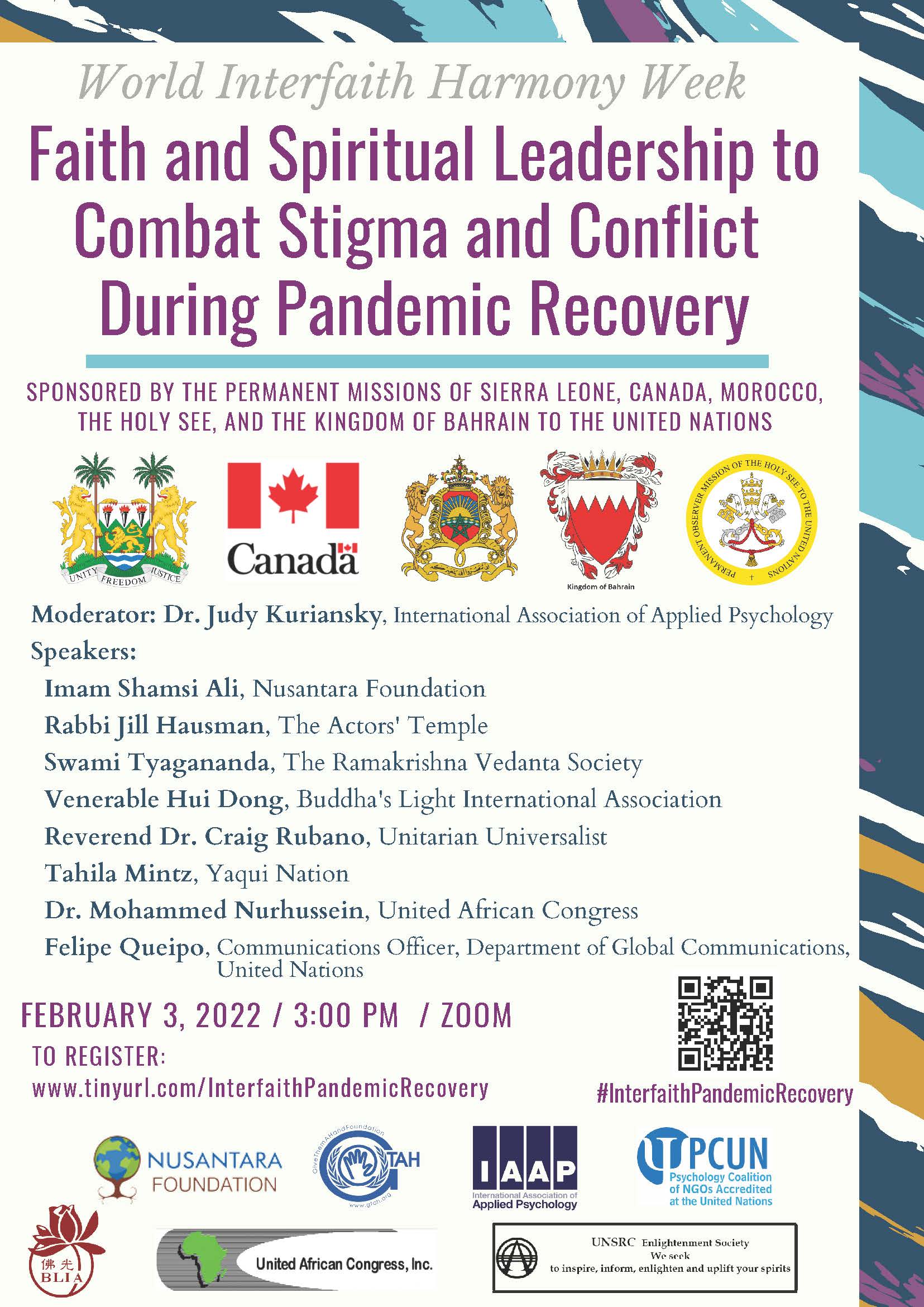
Uniting for peace World Interfaith Harmony Week is an annual event observed during the first week of February, since the General Assembly designation in 2010. The General Assembly pointed out that mutual understanding and interreligious dialogue constitute important dimensions of a culture of peace and established World Interfaith Harmony Week as a way to promote harmony between all people regardless of their faith. Recognizing the imperative need for dialogue among different faiths and religions to enhance mutual understanding, harmony and cooperation among people, the General Assembly encourages all States to spread the message of interfaith harmony and goodwill in the world’s churches, mosques, synagogues, temples and other places of worship during that week, on a voluntary basis and according to their own religious traditions or convictions. Origin and history World Interfaith Harmony Week (WIHW), conceived to promote a culture peace and nonviolence, was first proposed by King Abdullah II of Jordan at the United Nations in 2010. This was quickly adopted by the UN General Assembly (resolution A/RES/65/5), declaring the first week of February each year as World Interfaith Harmony week, calling on governments, institutions and civil society to observe it with various programs and initiatives that would promote the aim of the WIHW objectives. 2023 Future pandemics and natural catastrophic events are likely to continue, adversely impacting the health and wellbeing of peoples. These stressors will continue accentuating already-existing inequities, unless addressed with urgency. Find out more about the topic explored this year, under the theme "Harmony in a world in crisis". 2022 After a two-year hiatus due to the COVID-19 pandemic, which upended all assumptions of life on earth, causing never-before faced challenges worldwide, the observance of the Week took place through a virtual meeting. In 2022 the Permanent Missions of Sierra Leone, Canada, Morocco, The Holy See and the Kingdom of Bahrain to the United Nations, together with the UNSRC Enlightenment Society and partners sponsored a conversation focusing on “Faith and spiritual leadership to combat stigma and conflict during pandemic recovery”. 2019 At the core of all the faith systems and traditions is the recognition that we are all in this together and that we need to love and support one another to live in harmony and peace in an environmentally sustainable world. Our world continues to be beset by conflict and intolerance with rising number of refugees and the internally displaced in a hostile and unwelcoming world around them. We are also unfortunately witnessing messages of hate spreading discord among people. The need for spiritual guidance has never been greater. It is imperative that we double our efforts to spread the message of good neighborliness based on our common humanity, a message shared by all faith traditions. The theme for the observance of the Interfaith Harmony Week for 2019 was, therefore, “Sustainable Development through Interfaith Harmony”. 2016 In 2016 the UN launched the 2030 Sustainable Development Goals. It was also the year when one of the worst global health emergencies, the Ebola pandemic that devastated Guinea, Sierra Leone and Liberia was winding down after claiming more than 11000 lives. The United African Congress was among the first to call attention to the looming health emergency as early as August 2014 by holding an awareness-raising forum at the UN, followed by a concert held at the General Assembly Hall in March 2015. Noting the interconnectedness of the quest for peace and harmony with the global health emergencies, such as the Ebola pandemic spreading across boundaries and with the 2030 UN agenda for Sustainable Development Goals, the theme for the 2016 WIHW was “Building Bridges across Boundaries.” To underscore the significance of the theme they invited Native American Spiritual leader, the ceremonial ritualist from the Mohawk Nation to participate with the other faith leaders. The spirituality that the Native American speaker imparted - through chants and dance- the need to protect ‘Mother Earth that nurtures and sustains us’ was warmly and widely embraced. 2015 In the aftermath of the devastating Hurricane Sandy many homes were destroyed in and around New York City. The United African Congress and its partners organized hundreds of interfaith volunteers to help clean up flooded homes and deliver food to affected communities. Recognizing the power of prayer and interfaith collaboration, the theme for the 2015 WIHW program became “Interfaith Prayer, Healing, and Community Services in the Cause of Peace”. It was a prime example of people of different faiths, colors and ethnicities working together for the common good. The Missions to the UN of Ethiopia, Indonesia and Jamaica were co-sponsors. 2014 For the 2014 WIHW the theme was “Tolerance, Reconciliation and Forgiveness” in honour of the late Nelson Mandela, who led South Africa during its critical transition from Apartheid to a thriving multicultural all-inclusive democracy, thus helping his country avoid what could have been a disastrous racial war. His personal example of forgiveness for the sake of peace among his people resonated throughout the world. The Mission of Indonesia to the UN joined the Mission of Ethiopia in co-sponsoring the event. 2013 They followed this up in 2013 by extending this gathering to include the faith and value systems of indigenous peoples by inviting an African spiritual leader who flew in from Guinea to participate. The core of his message was not only the need for people to live in peace but also the interdependence of humans with nature, hence the need to be good custodians of our environment. His inclusion garnered tremendous amount of interest among the diplomats at the UN and among the wide spectrum of invited guests. 2012 The United African Congress and Give Them a Hand Foundation heeded the call by organizing an interfaith forum at the UN in 2012 and have continued to be involved every year ever since. They chose for their theme “The Diaspora-a Force for Positive Change” citing the ability of immigrant communities of diverse backgrounds, faiths and ethnicities in the United States to live side by side harmoniously bound together by shared values, love of God and love of neighbor. The interfaith forum gathered Christian, Muslim, Jewish, Hindu and Buddhist faith leaders to talk about the teachings of their respective faiths as it relates to peace and harmony. The forum was co-sponsored by the Permanent Mission of the Federal Democratic Republic of Ethiopia to the United Nations. Documents
|