UNITAR CO-HOSTS 3RD ANNUAL DIALOGUE IN COMMEMORATION OF WORLD INTERFAITH HARMONY WEEK
9 February 2018, Geneva, Switzerland - A little-known General Assembly resolution comes back around once a year, in the first week of February, to remind the international community about the unmistakable power of religion to transform the world. In October 2010, UN General Assembly Resolution 65/5 established World Interfaith Harmony Week, in which the UN officially charges “all States to support, on a voluntary basis, the spread of the message of interfaith harmony and goodwill in the world’s churches, mosques, synagogues, temples and other places of worship…, based on love of God and love of one’s neighbour or on love of the good and love of one’s neighbour, each according to their own religious traditions or convictions.”
Three years ago, UNITAR and the Permanent Mission of the Hashemite Kingdom of Jordan to the UN in Geneva joined forces, and co-founded the first annual Interfaith Dialogue at the Palais des Nations. Originally conceived by the United Nations Christian Association (UNCA), the Dialogue serves as the official commemoration of World Interfaith Harmony Week in the UN’s second city, and convenes a diverse group of Ambassadors and other leaders to speak on the vital role of faith and religion in global affairs. Participants of all faiths are warmly invited to engage in the discussion, not to water-down or understate the firmness of their convictions, but to acknowledge and reaffirm the truth that no religion promotes violence, and that no religion ignores the value of peace. We are, indeed, all in this together.
Each year’s Dialogue presents new variations on the Resolution’s theme. In 2016, the statements coalesced around the UN Secretary-General’s Plan of Action to Prevent Violent Extremism (24 December 2015), and the role of faith and interfaith dialogue in halting religiously-motivated terrorism. The second Dialogue explored the myriad ways in which faith-based organizations are helping to drive international development, peacebuilding, and the 2030 Agenda. In 2018, the third annual Dialogue addressed the theme of “Advancing Peace through Interfaith Harmony”. Panelists spoke on the unique ways in which their governments and organizations have used interfaith projects as tools for peacebuilding. The wide array of testimonies came from a panel of ambassadors from Jordan, Algeria, Azerbaijan, Singapore, Sri Lanka, Ecuador, the Holy See, the Sovereign Order of Malta, and the Organization of Islamic Cooperation (OIC). In this rich variety of contexts, the audience heard in concrete terms how faith and faith-based organizations remain not only effective but critical players in the quest for international peace, harmony, and sustainable development.
In 2010, and in every subsequent first week of February, the UN General Assembly has called upon Member States to find and nourish the light at the heart of the world’s varied faiths, and to harness it for the good of all nations. The ideals and aspirations of the Charter of the United Nations rely upon dialogues such as this one, which are not afraid to plumb the depths of our convictions, both diverse and common, and to ask the tough questions. UNITAR is honoured to join forces with the Mission of Jordan to create an official forum in International Geneva for this discussion, and to help foster this exchange of knowledge among states, communities, and people of all faiths.
The Parliamentary Conference on Interfaith Dialogue: Working together for our common future will take place from 13 to 15 June 2023 in Marrakesh, Morocco. The Conference is organized by the Inter-Parliamentary Union and the Parliament of the Kingdom of Morocco in cooperation with Religions for Peace, and with the support of the United Nations Alliance of Civilizations and the Mohammadia League of Religious Scholars.
United Nations Inter-Agency Task Force on Engaging Faith-Based Actors for Sustainable Development
Organization Type: United Nations
The United Nations Interagency Task Force on Religion and Sustainable Development (IATF-Religion) began in 2010 to provide policy guidance around engaging with faith- based actors, deepen UN system staff capacities on/around intersections of religion with the UN pillars of development, human rights and peace and security dynamics, as well as provide strategic policy guidance.
The UN Task Force on Religion and Development consists of the following members:
Chair: UNFPA (United Nations Population Fund)
OGPRtoP (UN Office of the Secretary General’s Special Adviser on the Prevention of Genocide and the Responsibility to Protect)
OHCHR (Office of the United Nations High Commissioner for Human Rights)
UNAIDS (Joint United Nations Programme on HIV/AIDS)
UNAOC (United Nations Alliance of Civilizations)
UN CTC (United Nations Security Council Counter-Terrorism Committee)
UN DESA (United Nations Department of Economic and Social Affairs)
UNDP (United Nations Development Programme)
UNDPI (United Nations Department of Public Information)
UNESCO (United Nations Educational, Scientific and Cultural Organization)
UNEP (United Nations Environmental Programme)
UN Habitat (United Nations Human Settlements Programme)
UNHCR (United Nations High Commissioner for Refugees)
UNICEF (United Nations Children’s Fund)
UNV (United Nations Volunteers)
UN Women (United Nations Entity for Gender Equality and the Empowerment of Women)
World Interfaith Harmony Week is observed every year in the first week of February, from February 1 to 7. This observation has emerged from the United Nations General Assembly (UNGA) Resolution that seeks a worldwide celebration of interfaith harmony. The World Interfaith Harmony Week was started in 2010 by HM King Abdullah II and HRH Prince Ghazi bin Muhammad of Jordan. The goal of the week-long celebration is to promote harmony between citizens of the world, regardless of their faith. It is a celebration of unity in diversity, and the divine connection between people and their faith.
HISTORY OF WORLD INTERFAITH HARMONY WEEK
The World Interfaith Harmony Week was proposed by H.M. King Abdullah II of Jordan at the U.N. General Assembly in September 2010. A month later, the U.N. declared that the first week of February will be celebrated as World Interfaith Harmony Week. The celebration is based on the works of The Common Word initiative. The initiative got Muslim and Christian leaders to discuss the two common fundamental religious teachings — the love of God, and the love of the neighbor. The religious leaders conducted dialogues on how these beliefs were central to both religions.
The World Interfaith Harmony Week modified the two Commandments to “Love of the Good,” and “Love of the Neighbour.” This mantra teaches everyone goodwill and the power of kindness, charity, and healing. During this week, leaders of various faiths gather to discuss how religion can enrich the lives of believers and how that makes the world a better place. World Interfaith Harmony Week also highlights the philanthropic works of religious groups. It encourages others to do similar work or get more involved in their communities.
Amidst rising religious conflicts, noble celebrations like World Interfaith Harmony Week are the call of the hour. The most important goal of this observation is to get people to realize that our common values of love, faith, and kindness easily outweigh our differences. With patience and humility, we could all make the world a wonderful place to live in — one where faith unites and religion is not a means of oppression.
WORLD INTERFAITH HARMONY WEEK TIMELINE
2005
Amman Message
The King of Jordan writes about the tenets of Islam.
2007
A Common Word Between Us and You
The message documents the common teachings of Islam and Christianity.
2010
World Interfaith Harmony Week
The King of Jordan proposes the observation at UNGA.
2014
World Interfaith Harmony Week Prize
The prize is awarded to groups for successfully promoting interfaith harmony.
WORLD INTERFAITH HARMONY WEEK FAQS
What happens during World Interfaith Harmony Week?
World Interfaith Harmony Week spreads harmony and tolerance among followers of different faiths and all the world’s religions.
What is interfaith harmony?
Interfaith harmony means bringing peace and tranquility among people, regardless of their faiths.
Why is interfaith harmony important?
Interfaith harmony encourages peaceful coexistence among practitioners of various religious beliefs in an age of increasing political and social differences.
HOW TO OBSERVE WORLD INTERFAITH HARMONY WEEK
Tune in to the live stream
The events of World Interfaith Harmony Week are live-streamed online. Tune in to the celebrations to learn more about interfaith harmony.
Do your bit
Promote interfaith harmony in your own way during World Interfaith Harmony Week. Tell people about the shared goals of all faiths and how love and kindness are integral to all religious beliefs.
Learn about a different faith
Read the scriptures or learn about a different faith during World Interfaith Harmony Week. This will help you understand the different ways of praying and living.
5 FACTS ABOUT RELIGION THAT WILL BLOW YOUR MIND
Christianity is the largest religion
There are about 2.5 billion practicing Christians.
Atheism is a belief too
There are an estimated 1.2 billion non-believers.
Rastafari is the most minor religion
There are 600,000 Rastafaris.
Christianity, Islam, and Judaism are Abrahamic religions
Meaning that they all worship a form of Abraham.
Islam is the second-largest religion
There are 2 billion followers.
WHY WORLD INTERFAITH HARMONY WEEK IS IMPORTANT
It promotes peace
Celebrations such as World Interfaith Harmony Week promotes peace and unity among people of all faith. It makes them believe in the goodness of people.
It celebrates humanity
The most important objective of World Interfaith Harmony Week is celebrating humanity. Throughout the week, the good deeds of humanity are highlighted. The week also inspires us to be better.
It celebrates unity in diversity
World Interfaith Harmony Week celebrates the unifying function of faith. The week-long celebrations remind us that despite our differences, we are connected by acts of love and devotion.
VIENNA, 1 February (UN Information Service) For billions of people around the world, faith is an essential foundation of life. It provides strength in times of difficulty and an important sense of community. The vast majority of people of faith live in harmony with their neighbours, whatever their creed, but each religion also harbours a strident minority prepared to assert fundamentalist doctrines through bigotry and extreme violence.
These acts are an affront to the heritage and teachings of all major religions. They also contravene the Universal Declaration of Human Rights, which affirms the right of all to freedom of thought, conscience and religion. It is imperative that the moderate majority is empowered to stand firm against the forces of extremism. But, this can only be achieved through strong leadership.
Next month at its forum in Vienna, the Alliance of Civilizations will continue its efforts to unite faiths and cultures. Whether on the world stage or in their communities, religious and cultural leaders have a responsibility to speak the language of tolerance and respect. This is a central message of World Interfaith Harmony Week.
We must also reach out to young people with a message of hope. Too often marginalized, jobless and facing a future of uncertainty, youth can be easy prey for fanatics offering a sense of cause and community. We need to expose the invalidity of this lure and offer a compelling alternative.
This cannot be achieved by words alone. Young people need jobs and a meaningful stake in a future that they can believe in. The United Nations is currently engaged in defining a post-2015 sustainable development agenda. Our goal is to eradicate extreme poverty in our lifetime and promote equitable economic opportunity for all while protecting the environment. To do that, we need the engagement of all actors - including young people and communities of faith.
We live in times of turmoil and transformation - economic, environmental, demographic and political. These transitions bring both hope and uncertainty. Our job is to ensure that hope wins, and our task will be made easier if the followers of all faiths collaborate in common cause. Let us never forget that what divides us is minuscule compared with what unites us. Working together, we can achieve all our goals for peace, prosperity and physical and spiritual well-being.
For more information about the World Interfaith Harmony Week celebration, click here.
REMARKS OF H.E. MR. NASSIR ABDULAZIZ AL-NASSER HIGH REPRESENTATIVE OF THE UNITED NATIONS ALLIANCE OF CIVILIZATIONS AT THE WORLD INTERFAITH HARMONY WEEK- NEW YORK 7 FEBRUARY 2018- UN CHURCH CENTER- 1-3 pm
It is a great pleasure to be with you again. I would like to thank the Committee of Religious NGOs at the UN for their persistent commitment to interfaith dialogue by bringing together spiritual, traditional and religious leaders to advance global unity.
This initiative aims to celebrate our common values instead of our differences, and thus provide a vision of peace and harmony to our communities. I would like to take a moment to recognize all NGOs present here for their extraordinary efforts in promoting and protecting human rights across the globe, and “Inspiring Faith for Humanity”.
I believe that interfaith and cross-cultural dialogues are interlinked, as the moral imperatives of all religions, convictions and beliefs call for peace, tolerance and mutual understanding. Therefore I am encouraging the trend towards dialogue with religious and interfaith organizations at the United Nations with the goal to eliminate conflict and sustain peace.
My faith is Islam. At the heart of Islam is the call for justice. Those who misuse and abuse Islam to support a political agenda do injustice to the basic teachings of our religion. Too often politics divides people, while faith, or belief in something more transcendent than ourselves, should be a tie that binds all of us together. As such, promoting respect among human beings and embracing the diversity of their beliefs and cultures and languages is at the core of the United Nations Alliance of Civilizations and the UN Charter.
The Alliance is one of the United Nations leading entities promoting interfaith and intercultural dialogue, reconciliation and forgiveness.
We have organized more than 30 events involving religious leaders since 2013. We have taken the time to understand the dynamics and social processes that drive interfaith dialogue and encourage peaceful coexistence. We recognize that we must give every group—no matter its faith—an equal chance, an equal voice in decision-making.
Let’s focus on achievements that restore our Faith in the possibility of humanity rising above its political and economic differences. Actions resolutions, and decisions adopted at the United Nations provide examples of our collective human capacity to do good. Building a world from the 2030 Agenda, the Paris Agreement on Climate Change, Beijing+20, Treaties on the Non-Proliferation of Weapons, inspires our own search of purpose in life. It’s a good moment to congratulate, the “International Campaign to Abolish Nuclear Weapons” (ICAN) that received the Noble Price last year.
During my GA mandate, I showed a compelling documentary titled, “Beyond Right and Wrong.” It was directed by Roger Spottiswoode and Lekha Singh. This film explored the true stories of people who were either victims or perpetrators of violent acts in conflict situations. The film focused on unique and touching stories from people affected by the conflict between Israelis and Palestinians, the “troubles” in Northern Ireland and the genocide in Rwanda.
They listened to courageous survivors, who spoke about their personal struggles for justice, healing, and reconciliation. The resulting film demonstrated how the power of forgiveness can start to break the cycle of violence and create meaningful closure for those who have suffered terrible human loss. They also observed in some cases, the successes of such life-changing efforts.
We need more inspirational stories, we must share your journey and struggles to demonstrate how religions teach us to be compassionate.
Whether you follow a certain faith, or are not practicing any at all, there is no set of beliefs that endorses violence, destruction and harm. In fact, every major religion and philosophy is based on the idea of “Love your neighbour as yourself”.
Ladies and Gentlemen,
I would like to draw your attention on the crucial role of youth in this regard. It is essential to provide young people with adequate tools and instruments to understand freedom of religion, of belief and tolerance of the other, and promote it worldwide to overcome every form of discrimination.
In accordance with SDG 16, we must resist the siren song of virulent nationalism that promotes me and mine over our shared human needs and values. Instead, we must promote social and cross-cultural harmony with inclusive societies that unify rather than divide people. There is no single country, no single race or religion that has a unique or exclusive claim to universal truth. Each has something positive to contribute to social harmony and human values. I invoke the mantra of UNAOC: Many Cultures, One Humanity.
The spirit of this special event will be enhanced by uplifting music and culinary, the voices of children and a beautiful ceremony with people of different faiths, where everyone plays his part, with all of us praying for the same goal: Peace On Earth.
On 27 March 1953, the Canadian Government presented seven nickel-silver doors for the General Assembly building. On the exterior of each one of them are four panels in bas-relief symbolizing fraternity (inset), peace, justice, and truth.
Let us reaffirm our commitment to bridging divides, fostering religious understanding and cooperation among people of all cultures and beliefs. Together, let us forge a path towards a more peaceful, just and harmonious world for all. UN Secretary-General António Guterres
Human fraternity for peace and cooperation
We need — perhaps more than ever before — to recognize the valuable contribution of people of all religions, or beliefs, to humanity and the contribution that dialogue among all religious groups can make towards an improved awareness and understanding of the common values shared by all humankind.
We also need to underline the importance of raising awareness about different cultures and religions, or beliefs, and the promotion of tolerance, which involves societal acceptance and respect for religious and cultural diversity, including with regard to religious expression. Education, in particular at school, should contribute in a meaningful way to promoting tolerance and the elimination of discrimination based on religion or belief.
Furthermore, we must acknowledge that tolerance, pluralistic tradition, mutual respect and the diversity of religions and beliefs promote human fraternity. Thus, it is imperative that we encourage activities aimed at promoting interreligious and intercultural dialogue in order to enhance peace and social stability, respect for diversity and mutual respect and to create, at the global level, and also at the regional, national and local levels, an environment conducive to peace and mutual understanding.
Within that frame, the General-Assembly took note of all international, regional, national and local initiatives, as appropriate, as well as efforts by religious leaders, to promote interreligious and intercultural dialogue, and in this regard took note also of the meeting between Pope Francis and the Grand Imam of Al-Azhar, Ahmad al-Tayyib, on 4 February 2019 in Abu Dhabi, which resulted in the signing of the document entitled “Human fraternity for world peace and living together”.
Background
Following the devastation of the Second World War, the United Nations was established to save succeeding generations from the scourge of war. One of its purposes is to achieve international cooperation in solving international problems, including by promoting and encouraging respect for human rights and for fundamental freedoms for all without distinction as to race, sex, language or religion.
In 1999, The General-Assembly adopted, by resolution 53/243, the Declaration and Programme of Action on a Culture of Peace, which serves as the universal mandate for the international community, particularly the United Nations system, to promote a culture of peace and non-violence that benefits all of humanity, including future generations.
The declaration came about as a result of the long-held and cherished concept — contained within the Constitution of UNESCO — that "since wars begin in the minds of men, it is in the minds of men that the defenses of peace must be constructed." The Declaration embraces the principle that peace is not merely the absence of conflict, but also requires a positive, dynamic participatory process, in which dialogue is encouraged and conflicts are resolved in a spirit of mutual understanding and cooperation.
On 20 October 2010, the General Assembly in resolution A/RES/65/5 pointed out that mutual understanding and interreligious dialogue constitute important dimensions of a culture of peace and established World Interfaith Harmony Week as a way to promote harmony between all people regardless of their faith. It further recognized the imperative need for dialogue among different faiths and religions to enhance mutual understanding, harmony and cooperation among people.
At the core of all the faith systems and traditions is the recognition that we are all in this together and that we need to love and support one another to live in harmony and peace in an environmentally sustainable world. Our world continues to be beset by conflict and intolerance with rising number of refugees and the internally displaced in a hostile and unwelcoming world around them. We are also, unfortunately, witnessing messages of hate spreading discord among people. The need for spiritual guidance has never been greater. It is imperative that we double our efforts to spread the message of good neighborliness based on our common humanity, a message shared by all faith traditions.
The United Nations General Assembly proclaimed 4 February as the International Day of Human Fraternity, with resolution 75/200.
What is the Culture of Peace?
A culture of peace is a set of values, attitudes, traditions and modes of behaviour and ways of life based on:
Respect for life, ending of violence and promotion and practice of non-violence through education, dialogue and cooperation;
Full respect for the principles of sovereignty, territorial integrity and political independence of States and non-intervention in matters which are essentially within the domestic jurisdiction of any State, in accordance with the Charter of the United Nations and international law;
Full respect for and promotion of all human rights and fundamental freedoms;
Commitment to peaceful settlement of conflicts;
Efforts to meet the developmental and environmental needs of present and future generations;
Respect for and promotion of the right to development; Respect for and promotion of equal rights and opportunities for women and men;
Respect for and promotion of the right of everyone to freedom of expression, opinion and information;
Adherence to the principles of freedom, justice, democracy, tolerance, solidarity, cooperation, pluralism, cultural diversity, dialogue and understanding at all levels of society and among nations; and fostered by an enabling national and international environment conducive to peace.
While visiting with Pope Francis at the Vatican on 19 December 2019, UN Secretary-General António Guterres said: “In these turbulent and trying times, we must stand together for peace and harmony.” Mr. Guterres conveyed his “deep appreciation” for the Catholic leader’s “extraordinary service in promoting interfaith relations,” including his landmark declaration with the Grand Imam of Al-Azhar on human fraternity for world peace and living together. “This declaration is extremely important when we see such dramatic attacks on religious freedom and the lives of believers,” said the Secretary-General.
International days and weeks are occasions to educate the public on issues of concern, to mobilize political will and resources to address global problems, and to celebrate and reinforce achievements of humanity. The existence of international days predates the establishment of the United Nations, but the UN has embraced them as a powerful advocacy tool. We also mark other UN observances.
Chicago Interfaith Community Celebrates United Nations World Interfaith Harmony Week
The first week of February marks the official United Nations observance of World Interfaith Harmony Week and Chicago’s own interfaith community is coming together to celebrate. On February 8th, the Parliament of the World’s Religions is hosting an Interfaith Breakfast in commemoration of UN World Interfaith Harmony Week—a global event that encourages grassroots efforts designed to link people together in a global wave of understanding, respect, and action. “Chicago can proudly claim to be the birthplace of the global interfaith movement and its central role continues 125 years later as the Chicago-based Parliament of the World’s Religions promotes the United Nations World Interfaith Harmony Week initiative during the month of February. Our interfaith breakfast on February 8, at Chicago Temple, will bring faith communities from across the region together to celebrate mutual understanding and cooperation toward the goals of justice, peace, and environmental flourishing across the globe”, expresses Dr. Larry Greenfield, Executive Director of the Parliament. World Interfaith Harmony Week is the result of UNGA Resolution A/65/PV.34 and was proposed in 2010 by HM King Abdullah II and HRH Prince Ghazi bin Muhammad of Jordan. All around the world, organizations, and individuals host interfaith events during the first week of February. The breakfast celebrates organizations and individuals dedicated to fostering interfaith harmony in the Chicagoland area. Local faith leaders, community organizers, and interfaith partners will lead prayers and representatives from the Council of Religious Leaders of Metropolitan Chicago, Faith In Place, ARISE Chicago, Sacred Space International, and Spiritual Playdate will share remarks on the work being done locally to create bonds of friendship and support amongst faith communities. The event will also mark the launch of the Parliament’s “Chicagoland Interfaith for Good” Donation Drive. The Parliament invites individuals, communities, and organizations of faith and conscience to host a drive to collect non-perishable food items, hygienic products, and gently-used clothing between February 8th and February 28th. Donations will benefit the Chicago Food Depository, Olive Branch Mission, Cornerstone Community Outreach, and Dress for Success.
For More Information Please Contact: Miriam Quezada Constituency Development Manager miriam@parliamentofreligions.org 312-971-3096
Follow the Parliament on Twitter @InterfaithWorld, Instagram @InterfaithWorld and Facebook @Parliament of Religions
About The Parliament of the World’s Religions: The Parliament of the World’s Religions cultivates harmony among the world’s spiritual traditions and fosters their engagement with guiding institutions in order to achieve a more peaceful, just and sustainable world. Its origins are rooted to the 1893 World’s Columbian Exposition in Chicago, where the historic first convening of the World Parliament of Religions created a global platform for engagement of religions of the east and west. Headquartered in Chicago, Il, USA, the Parliament of the World’s Religions is an international 501(c)3 NGO affiliated to the United Nations Department of Public Information.
4422 N. Ravenswood Ave #1030 Chicago, IL 60640 (312) 629-2990
LAND ACKNOWLEDGMENT
The Parliament of the World's Religions acknowledges it is situated on the traditional homelands of the Bodéwadmik (Potawatomi), Hoocąk (Winnebago/Ho’Chunk), Jiwere (Otoe), Nutachi (Missouria), and Baxoje (Iowas); Kiash Matchitiwuk (Menominee); Meshkwahkîha (Meskwaki); Asâkîwaki (Sauk); Myaamiaki (Miami), Waayaahtanwaki (Wea), and Peeyankihšiaki (Piankashaw); Kiikaapoi (Kickapoo); Inoka (Illini Confederacy); Anishinaabeg (Ojibwe), and Odawak (Odawa).
PoWR recognizes the region we now call Chicago remains home to a diversity of Indigenous peoples today and this land upon which we walk, live, and play continues to be Indigenous land.
UNITAR Co-hosts 3rd Annual Dialogue in Commemoration of World Interfaith Harmony Week
UNITAR CO-HOSTS 3RD ANNUAL DIALOGUE IN COMMEMORATION OF WORLD INTERFAITH HARMONY WEEK
UNITAR CO-HOSTS 3RD ANNUAL DIALOGUE IN COMMEMORATION OF WORLD INTERFAITH HARMONY WEEK
9 February 2018, Geneva, Switzerland - A little-known General Assembly resolution comes back around once a year, in the first week of February, to remind the international community about the unmistakable power of religion to transform the world. In October 2010, UN General Assembly Resolution 65/5 established World Interfaith Harmony Week, in which the UN officially charges “all States to support, on a voluntary basis, the spread of the message of interfaith harmony and goodwill in the world’s churches, mosques, synagogues, temples and other places of worship…, based on love of God and love of one’s neighbour or on love of the good and love of one’s neighbour, each according to their own religious traditions or convictions.”
Three years ago, UNITAR and the Permanent Mission of the Hashemite Kingdom of Jordan to the UN in Geneva joined forces, and co-founded the first annual Interfaith Dialogue at the Palais des Nations. Originally conceived by the United Nations Christian Association (UNCA), the Dialogue serves as the official commemoration of World Interfaith Harmony Week in the UN’s second city, and convenes a diverse group of Ambassadors and other leaders to speak on the vital role of faith and religion in global affairs. Participants of all faiths are warmly invited to engage in the discussion, not to water-down or understate the firmness of their convictions, but to acknowledge and reaffirm the truth that no religion promotes violence, and that no religion ignores the value of peace. We are, indeed, all in this together.
Each year’s Dialogue presents new variations on the Resolution’s theme. In 2016, the statements coalesced around the UN Secretary-General’s Plan of Action to Prevent Violent Extremism (24 December 2015), and the role of faith and interfaith dialogue in halting religiously-motivated terrorism. The second Dialogue explored the myriad ways in which faith-based organizations are helping to drive international development, peacebuilding, and the 2030 Agenda. In 2018, the third annual Dialogue addressed the theme of “Advancing Peace through Interfaith Harmony”. Panelists spoke on the unique ways in which their governments and organizations have used interfaith projects as tools for peacebuilding. The wide array of testimonies came from a panel of ambassadors from Jordan, Algeria, Azerbaijan, Singapore, Sri Lanka, Ecuador, the Holy See, the Sovereign Order of Malta, and the Organization of Islamic Cooperation (OIC). In this rich variety of contexts, the audience heard in concrete terms how faith and faith-based organizations remain not only effective but critical players in the quest for international peace, harmony, and sustainable development.
In 2010, and in every subsequent first week of February, the UN General Assembly has called upon Member States to find and nourish the light at the heart of the world’s varied faiths, and to harness it for the good of all nations. The ideals and aspirations of the Charter of the United Nations rely upon dialogues such as this one, which are not afraid to plumb the depths of our convictions, both diverse and common, and to ask the tough questions. UNITAR is honoured to join forces with the Mission of Jordan to create an official forum in International Geneva for this discussion, and to help foster this exchange of knowledge among states, communities, and people of all faiths.
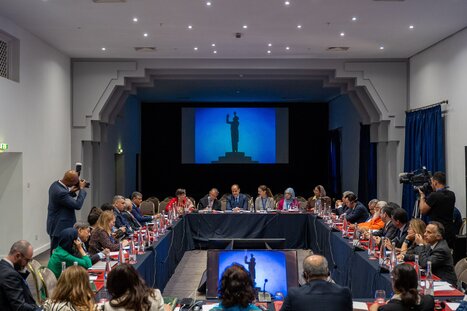
Photo: Panelists and speakers at the 3rd Annual Interfaith Dialogue at the Palais des Nations, 9 February 2018.
From left to right: H.E. Luis Gallegos, former Ambassador and Permanent Representative of Ecuador to the UN in Geneva; H.E. Kok Jwee Foo, Ambassador and Permanent Representative of the Republic of Singapore to the UN in Geneva; H. E. Vaqif Sadiqov, Ambassador and Permanent Representative of the Republic of Azerbaijan to the UN in Geneva; H.E. Aissata Kane, Deputy Permanent Observer of the Organization of Islamic Cooperation to the UN in Geneva; H.E. Saja Majali, Ambassador and Permanent Representative of the Hashemite Kingdom of Jordan to the UN in Geneva; H.E. Marie-Thérèse Pictet-Althann, Ambassador and Permanent Observer of the Sovereign Order of Malta to the UN in Geneva; H.E. Archbishop Ivan Jurkovic, Apostolic Nuncio and Permanent Observer of the Holy See to the UN in Geneva; H.E. Idriss Jazairy, UN Special Rapporteur to UN OHCHR and Executive Director, Geneva Center for the Advancement of Human Rights and Global Dialogue; Mr. Alex Mejia, Programme Director, UNITAR
With religious tensions and interfaith violence posing significant threats to peace and security today, parliaments as state institutions and parliamentarians as representatives of their communities are beginning to engage more with religions and beliefs.
With this in mind, in its 2022-2026 strategy, the IPU decided to pioneer a new approach which encourages parliaments to interact more with the ecosystems in which they operate, including representatives of governments, the United Nations, international organizations, academia, civil society, religions, beliefs and faith-based organizations.
The approach seems to be working with the global parliamentary community which is increasingly using interfaith and intercultural dialogue as tools for promoting peaceful coexistence and the rule of law.
Dialogue has been fundamental to the IPU’s mandate since its inception in 1889 and is streamlined into all of its work.
The 2017 IPU St. Petersburg Declarationon Promoting cultural pluralism and peace through interfaith and inter-ethnic dialogue recognized that dialogue with faiths, cultures and ethnicities was essential to peace and cultural pluralism and that, as representatives of the people, the world’s parliaments were committed to strengthening normative processes and legal frameworks.
More recently, the 2023 IPU Manama Declarationon Promoting peaceful coexistence and inclusive societies: Fighting intolerance acknowledged the importance of dialogue, education and awareness-raising as tools for countering different forms of intolerance and fostering inclusion and peaceful coexistence.
Dedicated events have been emerging for parliamentarians to share good practices on the contribution they or their parliaments are making to integrating interfaith and intercultural dialogue into the exercise of their functions of lawmaking, budgeting, representation and oversight.
The first Parliamentary Conference on Interfaith Dialogue: Working together for our common future took place in Marrakesh in June 2023. It was organized by the IPU together with the Parliament of the Kingdom of Morocco and other partners. Morocco has a long history of interfaith and intercultural engagement. Pope John Paul II visited Morocco in 1985, the first visit of a Pope to a Muslim country.
The Parliamentary Conference in Marrakesh was attended by over 70 parliamentary delegations. It concluded with the Marrakesh Communiqué, in which parliamentarians acknowledged that interfaith dialogue, which was grounded in support of fundamental rights and freedoms, was important for promoting inclusivity and peaceful coexistence, upholding the rule of law and encouraging collective efforts to achieve a better society, and providing concrete action-points for parliamentarians to follow to these ends. It was circulated at the 77th Session of the UN General Assembly and was acknowledged by the UN High Commissioner for Human Rights, Volker Türk in his Report to the 55th Session of the Human Rights Council.
In February 2024, the Parliament of Bosnia and Herzegovina, in strategic cooperation with the Muslim World League, organized a Conference meeting of parliamentarians and religious leaders for coexistence and peace, which was held in the debate chamber of the Parliament in Sarajevo. The Conference focused on the wisdoms and good practices of international experts and regional experts from the West Balkan countries vis-à-vis rebuilding cohesive societies in ethno-religiously diverse post-conflict settings and responding to global challenges. It concluded with the Sarajevo Declaration.
In May 2024, the 6th World Forum on Intercultural Dialogue took place in Baku, Azerbaijan, under the motto Dialogue for Peace and Global Security: Cooperation and Interconnectivity. It was organized by the Republic of Azerbaijan, in partnership with UNESCO, UN Alliance of Civilizations, the Council of Europe, the Islamic Educational, Scientific and Cultural Organization (ICESCO) and UN Tourism.
The 6th World Forum on Intercultural Dialogue included, for the first time, an Inter‑Parliamentary Conference on The role and best practices of the legislature in the protection of cultural heritage. In attendance were current and former members of national parliaments, and representatives from international parliamentary institutions. Participation from Central Asia and other regional powers was particularly strong. The Conference was live-streamed on UN TV.
The energy of the parliamentary community continues; preparations are currently underway for the second edition of the Parliamentary Conference on Interfaith Dialogue, which will be organized by the IPU together with the Italian Parliament and other partners, and take place in Rome in 2025, to coincide with the Year of Jubilee.
There are also other active networks of parliamentarians engaging with religion and belief, including cross-party groups or organizations such as the International Panel of Parliamentarians for Freedom of Religion or Belief (IPPFoRB), which has a human rights focus. In February 2024, IPPFoRB established a Southeast Europe network, in addition to networks already existing in Africa and Southeast Asia.
The IPU continues to develop its own work in this area, in line with the commitments outlined in the Marrakesh Communiqué, including by producing Parliamentary Reports on Religion and Belief, engaging with United Nations bodies, experts, frameworks and commitments intersecting with religion and belief, and responding to the needs of IPU Members.
Zimbabwe’s Ambassador At Large, Uebert Angel, has added another title to his list of responsibilities. News coming to us is that he has been appointed as the African Union’s Pan African Parliament Ambassador for Interfaith Dialogue and Humanitarian Affairs.
The Pan-African Parliament (PAP), alternatively known as the African Parliament, is the legislative body of the African Union and exercises oversight, and has advisory and consultative powers.
PAP was set up to ensure the full participation of African people in the economic development and integration of the continent.
A source who spoke to Nehanda Radio said “Ambassador Angel’s extensive knowledge, influential network, and commitment to fostering unity among diverse religious communities is what saw him emerge as an ideal candidate for this vital role.”
“He will be part of five individuals from diverse regions in the African continent spearheading initiatives aimed at fostering dialogue, understanding, and cooperation among different faiths.
“His experience in leading Spirit Embassy, a Christian organization with a global reach and a registered members who go well over 3.5 million as of their last count , provides him with deep insights into religious diversity and the promotion of mutual respect.
“This appointment is a testament to the belief in his ability to bridge gaps and cultivate harmony within society,” the source told Nehanda Radio.
Ambassador Angel is expected to actively engage with religious leaders, government officials, and civil society organizations to promote interfaith dialogue and cooperation.
“He will emphasize the importance of religious tolerance, respect, and understanding as essential foundations for peaceful coexistence within African communities,” we were told.
Having led the Uebert Angel Foundation (UAF) which donated millions in humanitarian aid across the continent the Zimbabwean preacher is expected to leverage his experience and resources to provide relief and assistance to marginalized communities.
We couldn’t reach Ambassador Angel for comment at the time of going to press as he was said to be in Kenya attending the 14th African Union’s High Level Private Sector Forum where he was a participant.
Greetings of peace and blessing from URI-Africa. This is to inform you that URI-Africa took part at the 1st Interfaith Dialogue Forum Steering Committee workshop, which took place in the premises of the Pan African Parliament (PAP) in Midrand, South Africa from May 22-23, 2017.
Greetings of peace and blessing from URI-Africa.
This is to inform you that URI-Africa took part at the 1st Interfaith Dialogue Forum Steering Committee workshop, which took place in the premises of the Pan African Parliament (PAP) in Midrand, South Africa from May 22-23, 2017.
During the African Union Interfaith Dialogue Forum which was held in Abuja, Nigeria in 2016 the Steering Committee was established to work with African Union to support and strengthen the process of interfaith dialogue within African Community as well as to enhance partnership between religious leaders and policy makers at the African Union. The steering committee was also tasked to develop a 5-year strategic plan, the Terms of Reference and working modalities.
With this in mind the 1st Interfaith Dialogue Forum Steering Committee workshop organized in South Africa in collaboration between AU-CIDO, the Strategic Planning Directorate of the AU Commission and KAICIID.
The two-day workshop succeeded in providing general updates of the Steering Committee since its election, and in developing the first section of the strategic plan, the TORs of the SC and the working modalities. They also came up with Core Values of The Interfaith Dialogue Forum to upholds:
Mutual Respect
Human Dignity
Integrity
Honesty
Transparency
Compassion
Respect for Creation
Equality in Diversity
The Steering Committee divided into two groups to discuss on broad issues to be addressed in the Strategic Plan. Following the deep reflection and discussion, the groups agreed on 5 main strategic pillars, namely:
Building effective structures for the sensitization and awareness raising of the role of religion and faith traditions on Agenda 2063
Developing the capacities of religious leaders, faith-based organizations and AU organs to work together to implement the policies and programmes supporting the peace and development in Africa
Building synergies and coordination for effective policy implementation of AU Interfaith Dialogue Forum programmes within the AU.
Forging partnerships with Faith Based communities to encourage the implementation of relevant policies of selected AU organs through the appropriate tools and resources
Develop strategies for communication, advocacy and capacity building among state and non-state actors, including the media, and religious leaders to ensure accurate representation of religions and faith communities
The President of the Pan-African Parliament (PAP), H.E. Hon.
Religious and political leaders must use influence to promote tolerance, forster peace and transform societies: PAP President tells Conference on Interfaith Dialogue
Jun 14, 2023
The President of the Pan-African Parliament (PAP), H.E. Hon. Chief Fortune Charumbira has urged political and religious leaders to act as vectors for tolerant, inclusive, and peaceful societies.
As part of his resolve to ensure that the voice of African citizenry finds expression in global parliamentary diplomacy, the leader of the Pan-African Parliament today addressed the first Parliamentary Conference on Interfaith Dialogue, convened by the Inter-Parliamentary Union (IPU) and the Parliament of Morocco. Held under the theme: “Working together for our common future”, the interfaith gathering is taking place until 15 June 2023 in Marrakesh.
In his address, H.E. Hon. Chief Charumbira briefed the audience on the objectives of the Pan-African Parliament especially as it relates to the promotion of peace, security, and stability. The President therefore explained that the presence of Africa’s Premier parliamentary forum at the Marrakesh interfaith gathering was in alignment with its mandate of promoting peace, security and stability through tolerance, inclusivity, and respect for diversity.
In this regard, the President of the Pan-African Parliament recognised the incommensurable influence wielded by religious and political leaders and their capacity to build resilient societies, where all members feel included. On the other hand, H.E. Hon. Chief Charumbira cautioned that if not used responsibly, and for the greater good of mankind, the influence can foster intolerance, cultism, and the conflicts and fatalities attendant to them.
Citing examples where political and religious influence has had negative impacts, the President noted the ongoing conflict in Sudan caused by a political and military stand-off, which has claimed over 1000 lives, displaced more than 1.4 million people with a further 476 800 fleeing to neighbouring countries. The President further highlighted a case in Kenya where at least 201 bodies were found at a ranch of a pastor who allegedly told his followers to starve themselves to death to meet Jesus.
“The examples I have given above underscore the timeliness and relevance of this Conference and I must once again applaud the Inter-Parliamentary Union and the Parliament of Morocco for convening this conference. Our people can either become victims or perpetrators of intolerance on the basis of their beliefs but they can also be agents of change in encouraging tolerance, promoting dialogue, inclusivity and respect for diversity if we lead them in the right direction. Parliamentarians, as community and opinion leaders, have an important role to play in meaningfully engaging with the values and worldviews of their constituents, many of which are influenced by religion or belief,” said H.E. Hon. Chief Charumbira.
The Leader of Africa’s Parliament was adamant that religious and political leaders must look within themselves to effect change in the world: “I will draw on the sobering words of the great Indian leader, Mahatma Gandhi who said, “You must be the change you wish to see in the world.” The late former Vice-President of Zimbabwe, Dr. John Landa Nkomo, (God rest his soul!) amplified this by saying, “Change begins with you. Change begins with me. Change begins with all of us.” As politicians and religious leaders we are revered by our people as opinion leaders. Even before we look at what our Parliaments or congregants are doing, we must start by asking ourselves, what are we doing to make this world a better place for our children to live in regardless of race, gender, ethnicity, religion or political affiliation?” asked H.E. Hon. Chief Charumbira.
He added: “Parliaments and Parliamentarians must ensure that human rights are upheld, without distinction of any kind, be it religious or otherwise. Religious leaders also wield an influence comparable to political actors Moreso with the growing prominence of the ‘Man of God’ some of whom have been elevated to the status of deities. We thus have a collective responsibility to leverage on our influence to inform, educate and raise awareness among our people on the importance of tolerance, inclusivity and collaboration and thus transform our societies into peaceful, tolerant and inclusive societies.”
Additionally, H.E. Hon. Chief Charumbira demanded that politicians and religious leaders responsibility for causing intolerance and the consequences thereof in many cases. He called on them to play a role in curbing incidences of xenophobic, ethnic, gender-based, racial and political violence, all of which point to intolerance of differences, intolerance of divergent opinions and discrimination.
“As a continental Parliament, we have debated and spoken out against racism, xenophobia, religious and political intolerance and we shall continue to do so. We cannot afford to remain silent. We have a duty to hold our Member States to account and ensure that we promote peaceful co-existence. Research has found that countries that uphold freedoms have more vibrant and democratic political institutions, rising economic and social well-being, diminished tension and violence, and greater stability.” H.E.Hon. Chief Charumbira indicated.
Lastly, the President of the Pan-African Parliament called for synergies between politicians and faith leaders to provide sustainable and long-lasting solutions to challenges facing the world in general and Africa in particular. “Africa is still riddled with a lot of challenges, chief among them, poverty, unconstitutional changes of government, rising incidences of conflict, the ravages of climate change, terrorism and violent extremism, unemployment, migration, energy insecurity and the looming threat of hunger and malnutrition. The resolution of these challenges requires a concerted approach by all regardless of religion or political affiliation. It is, therefore, critically important now more than ever for political and religious leaders to come together to work towards a common future for posterity instead of focusing on issues that undermine socio-economic development.” He concluded.
By JoAnne Wadsworth, Communications Consultant, G20 Interfaith Forum — — On April 15-16, 2024, the G20 Interfaith Forum, in collaboration with the African Union, the United Religions Initiative (URI), and the Inter-Religion Council of Ethiopia, hosted a conference in Addis Ababa, Ethiopia, to celebrate the 2024 Golden Rule Day and…
By JoAnne Wadsworth, Communications Consultant, G20 Interfaith Forum
— —
On April 15-16, 2024, the G20 Interfaith Forum, in collaboration with the African Union, the United Religions Initiative (URI), and the Inter-Religion Council of Ethiopia, hosted a conference in Addis Ababa, Ethiopia, to celebrate the 2024 Golden Rule Day and commemorate World Interfaith Harmony Week. The event, themed “Africa’s 2024 G20 Agendas,” aimed to honor and promote interfaith collective action in Africa, fostering peace, human dignity, development, and preservation of the environment while countering hate speech, violence, and xenophobia.
As part of this broader conference, a panel discussion entitled “Africa’s Challenges to Peace and Security: Interreligious Approaches and Promise” was held on April 15. This session addressed the urgent need to focus on conflicts across Africa amidst the global security megacrisis of 2024. The panel explored how religious and interreligious dialogue and active peacebuilding could offer creative solutions to mitigate the enormous human suffering, worsening challenges for women and children, and derailed development progress caused by these conflicts. The discussion aimed to highlight approaches that both the African Union and G20 could support and spotlight.
Panelists included Dr. Martha Njiiri, Head of Strategic Communication at IGAD Center of Excellence for Preventing and Countering Violent Extremism; Sister Agatha O. Chikelue, Executive Director of Cardinal Onaiyekan Foundation for Peace; Dr. Gordon Simango, Director of the All Africa Conference of Churches Liaison Office to the African Union; Birtukan Mitiku, Peacebuilding Officer at Catholic Relief Service; andJoshua Kitakule, Secretary General of the Interreligious Council of Uganda. The discussion was moderated by Prof. John Azumah, Executive Director of the Sanneh Institute.
Participants at the Interfaith Harmony Week celebrations in Addis Ababa, Ethiopia
Prof. John Azumah
Azumah opened the discussion by highlighting the paradox of Africa being considered highly religious yet facing significant challenges:
“Africa is one of the continents that we have heard many people talk about with pride. Africa is the most religious continent. And I used to say that with pride also. Pope Benedict once said that Africa is the spiritual lungs of the world. And I have stopped saying that Africa is the most religious continent with pride because of all the issues that Africa is facing, despite being the most religious continent.”
Dr. Martha Njiiri
Njiiri emphasized the importance of countering extremist narratives and working with religious leaders:
“Currently there are meta narratives that they misuse, to be able to radicalize and to recruit, unfortunately, and the most affected are the youth. And in some instances, we are seeing children who are being recruited into these groups.”
She stressed the need for interfaith cooperation in developing counter-narratives and highlighted the credibility of religious leaders as messengers for peace.
Sister Agatha O. Chikelue
Chikelue focused on the interconnection between justice, peace, and security:
“When you talk about justice, then you are talking about peace. You cannot separate the two sides of one coin. And that is the issue we’re here to discuss.”
She emphasized the need for religious leaders to work proactively with governments to address issues of bad governance, poverty, and inequality.
Dr. Gordon Simango
Simango highlighted the importance of investing in youth education on peace and security issues:
“One of the most important things is really to make sure that we try and invest in the children and the young people in peace and security issues. I think most of the discussions that we actually have around tables, we realize that we are missing them.”
He also stressed the need for a common understanding of concepts like hate speech and the importance of non-violent approaches in peace and security architectures.
Simango highlighted the importance of investing in youth education and bringing young voices to the table.
Birtukan Mitiku
Mitiku emphasized the role of interfaith dialogue in promoting peace:
“Interfaith dialogue is important for peace because it can help to break down the walls of division and promote mutual understanding, acceptance and tolerance.”
She called for collective efforts to challenge discrimination and promote peace at the individual level.
Joshua Kitakule
Kitakule emphasized the need for religious leaders to be better equipped to address societal issues:
“Have we [as religious leaders] been given capacity, trained, on how to deal with these other issues that you are confronted with before you go to heaven? Issues of governance, issues of poverty, issues of disease, issues of managing diversity? Do we have the tools? Do we have the knowledge, do we have the awareness of what needs to be done? Because we are here [on Earth] not just as visitors. People live as long as 90 years before they go to heaven. So maybe we need to go back to the basics.”
He also highlighted the lack of safe and inclusive spaces for dialogue between faith communities and political leadership.
Q&A Session
The Q&A session delved into various topics, including:
The need for formal mechanisms of engagement between religious councils and governments
The importance of addressing intra-religious conflicts before tackling inter-religious issues
The role of African values in education and peacebuilding
The potential for faith-based early warning systems for conflict prevention
The challenge of election-related violence and the role of religious leaders
Conclusion
The panel discussion highlighted the complex challenges facing peace and security in Africa and the potential for interfaith approaches to contribute to solutions. Key takeaways included the need for:
Greater youth engagement and education on peace and security issues
Improved interfaith dialogue and cooperation
More proactive involvement of religious leaders in governance and electoral processes
Revival and integration of African values in education and peacebuilding efforts
Enhanced capacity building for religious leaders on socio-economic issues
As Africa continues to navigate its peace and security challenges, the insights and collaborative efforts of religious leaders and faith communities will be crucial in fostering understanding, countering extremism, and building sustainable peace.
— —
JoAnne Wadsworth is a Communications Consultant for the G20 Interfaith Forum Association and Editor of the Viewpoints Blog.
Interfaith dialogue – that is, engagement with religious leaders and religious actors to build trust, strengthen communities, advocate for social justice and mitigate conflict – has been growing over the past 70 years as a tool of peacebuilding and diplomacy. It recognizes the important place of religion in the lives of many people worldwide, as well as the influential role of religious actors as community leaders and religious institutions as important providers of spiritual and material support.
The world of interfaith dialogue has undergone a profound shift since the tragic events on and following 7 October 2023. These began in Israel and Gaza but were quickly felt in the region and across the globe (See IPU Statements). Since then, interfaith dialogue has been difficult, as the conflict has taken on, or been given – depending on how you view it, a religious dimension. Islamophobia, anti-Semitism and other forms of identity-based hatred have experienced a sharp increase, decades old interfaith relationships have been compromised, communities and societies are becoming increasingly divided. These tensions are also being felt in national parliaments.
As the interfaith movement crumbles, practitioners have found themselves asking where this leaves policymakers with interfaith engagement. How can policymakers engage with what some label the “conflict of all conflicts”, where religion and politics are deeply intertwined, but also, unfortunately, instrumentalized by some influential religious and political actors who see division as a tool to secure power or personal gain?
Since 7 October, when business as usual ground to a halt, a loose coalition has been emerging of institutions committed to engaging faith actors to counter polarization and promote peaceful coexistence. What unites them is a belief in the importance of dialogue, shared values and equal human dignity, common to all religions or beliefs, and which underlies the social contract which makes societies cohesive.
The IPU has been firmly engaged in this work from the beginning, having a long history of declarations, documents, activities and publications, which reinforce the vital role of parliaments and MPs in upholding rights, countering intolerance, and promoting human and common security, as tools for advancing peaceful coexistence. The IPU 2022-2026 strategy aims to advance parliamentary ecosystems, encouraging parliaments to engage with the actors and dynamics that impact them, including religious actors. Religious engagement by the IPU is not, however, new: as early as 1998, an audience with Pope John Paul II took place as part of an IPU and Food and Agriculture Organization (FAO) Conference, which was hosted by the Italian Parliament... follow link to continue reading
SOVEREIGN MILITARY HOSPITALLER ORDER OF ST. JOHN OF JERUSALEM OF RHODES AND OF MALTA _____
PERMANENT OBSERVER MISSION TO THE UNITED NATIONS OFFICE AND OTHER INTERNATIONAL ORGANIZATIONS IN GENEVA
United Nations World Interfaith Harmony Week 2024
9th Annual Geneva Interfaith Dialogue “Common human values in multilateral diplomacy”
Intervention by H.E. Ambassador Marie-Thérèse Pictet-Althann, Permanent Observer Palais des Nations, 9th February 2024
Excellencies,
Distinguished panellists,
Ladies and Gentlemen,
At the outset, allow me to seize this opportunity to express my sincere gratitude to Assistant Secretary-General Nikhil Seth and H.E. Ambassador Walid Khalid Obeidat, as well as to Mr. Alex Mejia, for their kind invitation to participate in the 9th Geneva Interfaith Dialogue, co-organised by UNITAR and the Permanent Mission of the Hashemite Kingdom of Jordan.
It is always an honour and great pleasure for the Sovereign Order of Malta to participate and co-sponsor these annual Dialogues, as we have done since the very beginning.
Before sharing my thoughts on this year’s theme “Common human values in multilateral diplomacy”, I would like to show a brief video explaining the history and the work of the Order of Malta today.
VIDEO
Thank you for your attention.
Dear Friends,
While multilateral diplomacy often involves secular principles and considerations, it is widely acknowledged that religious values can play a crucial role in the diplomatic process, especially where faith is a significant part of society and politics. Many religious traditions emphasise the importance of peace, reconciliation, and resolution of conflicts. In this context, faith is a powerful source of inspiration and motivation for countless individuals involved in peacebuilding.
By bringing together diverse religious communities in dialogue and cooperation, interfaith initiatives lay the foundation for effective collaboration and the advancement of common goals. Interfaith dialogue helps build bridges of understanding and trust among nations with diverse religious backgrounds. By fostering mutual respect and appreciation for each other's beliefs, interfaith harmony lays the groundwork for diplomatic cooperation on global issues.
Despite differences in religious beliefs, most religions subscribe to the shared values solidarity, charity and social welfare, cultural understanding and respect for others. of peace, human dignity, compassion, justice and fairness, international relations. By emphasizing common ground, interfaith initiatives environmental protection, and human rights.
Interfaith harmony highlights these values and promotes them as universal principles that can guide facilitate cooperation on issues of mutual concern, such as poverty alleviation, Moreover, by addressing the underlying religious tensions, interfaith harmony can contribute to peaceful resolutions and the prevention of further conflict. Many conflicts around the world have deep-rooted
religious dimensions. Interfaith dialogue can play a crucial role in resolving these conflicts by facilitating reconciliation, forgiveness, and understanding among conflicting parties. It can help prepare governments and international organizations to take proactive roles in building trust during negotiations.
The promotion of tolerance, moderation, inclusivity and interfaith initiatives also undermines the appeal of extremist ideologies. This, in turn, creates an enabling environment for multilateralism by reducing sources of conflict and instability. In such contexts, human and spiritual values can have a tremendous impact on the shaping of diplomatic efforts and agreements.
As a lay/religious institution of the Catholic Church, the Sovereign Order Malta is engaged in humanitarian diplomacy with a strong spiritual component. It undertakes its worldwide humanitarian activities without distinction as to the regions, political consideration or the status of the beneficiaries from a cultural, religious, or social point of view.
To illustrate this point, H.M.E.H. the Prince and Grand Master Fra’ John Dunlap said earlier this year in his traditional New Year’s Address to the Diplomatic Corps accredited to the Sovereign Order of Malta:
“The duty to assist the poor is indeed universal, and the Order strives to mirror this universality in its approach to the problems of global poverty. Assisting the poorest and the most vulnerable at the international level, however, requires several conditions, in particular the widespread respect for some basic universal principles and a framework of effective international cooperation.
The Order of Malta believes in an international order based on principles ofhuman fraternity and solidarity. This is the reason why it upholds the norms of International Humanitarian Law and recognises itself in the provisions of the Charter of the United Nations. Multilateral co-operation and a system based on universal principles of solidarity are also requisites for dealing with fundamental themes of our time. International co-operation and respect for universal principles must be employed to effectively deal with migration, global health, debt, climate change, energy transition and the many challenges – as well as huge opportunities — posed by the development of the artificial intelligence.”
With regard to the protection of human dignity, effective engagement and dialogue among communities, human rights advocates and policymakers are essential within diverse cultural and religious contexts. The basic human right of freedom of religion must be upheld to guarantee human rights, protect religious minorities and promote tolerance. Freedom of faith for all is a moral imperative that strengthens peace and stability worldwide. The Order of Malta is particularly concerned by the rising global crisis of religious persecution. Believers of all faiths continue to be victims of persecution, as illustrated by numerous statistics (Pew Research Centre and the 2024 Open Doors World Watch List). Yet, despite mounting evidence of the disastrous consequences of religious persecution, opinion leaders in the academy, the media and the corporate and policy worlds pay scant attention to this global decline in religious freedom that represents a grave threat to international security and stability.
Conclusion
In conclusion, the Sovereign Order of Malta will continue to play its traditional role on the world stage as an advocate for Peace, Solidarity, Human Rights and as a provider of Humanitarian Assistance. The Order believes that there is an increasing need for stronger and more effective Multilateral Diplomacy, supported by a greater emphasis on interfaith dialogue which is a fundamental component in the quest for Peace and Justice. Entities and organisations, whose mandate and vocation are deeply rooted in the richness and diversity of faith traditions, should work together to ensure a greater impact through advocacy directed at political leaders, the media, educational institutions, and other channels of public communications. We all need to do more to promote a culture of peace based on solid mechanisms of co-operation, mediation and peaceful resolution of conflicts. In this context, religions can inspire humanity, to go to extraordinary lengths to care for the most vulnerable in our societies.
Sovereign Military Order of Malta
orderofmalta.int
The Sovereign Military Order of Malta, officially the Sovereign Military Hospitaller Order of Saint John of Jerusalem, of Rhodes and of Malta, and commonly known as the Order of Malta or the Knights of Malta, is a Catholic lay religious order, traditionally of a military, chivalric, and noble nature.
Interfaith voices want UN General Assembly to hear: “There is so much that needs to be done—and time is running out”
NEWS
Interfaith voices want UN General Assembly to hear: “There is so much that needs to be done—and time is running out”
An interfaith panel discussion on climate, held 21 September, sent a clear message to the world’s governments: a social and spiritual transformation must underpin policies that care for the earth and the most vulnerable people living on it.
2 September 2022, Karlsruhe, Germany: Activists demand attention to the climate crisis during a protest at the World Council of Churches' 11th Assembly in Karlsruhe, Germany. The Assembly's theme is "Christ's Love Moves the World to Reconciliation and Unity."
The discussion was held during three converging times: the Season of Creation, New York Climate Week, and the UN General Assembly’s opening of the 77th Session.
The discussion, entitled “Listen to the Voice of Creation: Caring for Creation in a Season of Climate Emergency,” explored the theme of this year’s Season of Creation as a way of sending messages to the UN and to the world’s policymakers.
Held at the Episcopal Church Center in New York City, the event also drew a global online audience. Speakers from many religious and spiritual backgrounds, while differing in their beliefs and the sources of their moral authority, united in their call to care for creation and our common earthly home.
They asked a complex question: How do we listen to the voice of creation—of nature— individually, as faith bodies, as decision-makers and policymakers in our societies?
The UN General Assembly’s 77th Session will involve related discussions of education, peace, sustainable development, and nuclear disarmament.
Social transformation
Rev. James Bhagwan, general secretary of the Pacific Conference of Churches, spoke via video message, urging that campaigns—such as the one for a fossil fuel nonproliferation treaty—be strengthened.
“These are significant mechanisms that we need to be engaged with,” he said. “We continue to struggle for momentum on climate finance, on loss and damage, and these will be key.”
He also called for a more broad understanding of how we contain any further damage to an already fragile eco-system. “We need to ensure that, whatever we do, is done in the context of protecting the environment,” he said. “There is a need for a social transformation—we know that.”
Such a social transformation would underpin the needed policies, laws, and regulations, Bhagwan added. “That social transformation will provide the political will, the business will,” he said. “We need to ensure the countries that are the most vulnerable and affected at the moment do not go further into debt as they seek to protect the environment.
“There is so much that needs to be done—and time is running out,” he concluded.
Dr Ryan Smith, programme executive for the Ecumenical Office to the United Nations, and representative to the UN Headquarters for the World Council of Churches, spoke about “the need for the faith community to bring our unique voice to the discussion of the climate crisis and work together with faith based partners and the scientific community to ensure that God’s creation is habitable for the next generations.”
The panel discussion was preceded by an ecumenical prayer service in which those gathered lifted up their concerns—and their hopes—for the future.
Hailing Calls for Dialogue, Interfaith Harmony, Secretary-General Tells Alliance of Civilization’s Global Forum ‘Let Us Stand Together as One Human Family’
Following are UN Secretary-General António Guterres’ remarks at the ninth Global Forum of the United Nations Alliance of Civilization, in Fez, Morocco, today:
Let me begin by thanking the Government and people of the Kingdom of Morocco for the warm welcome. Morocco has long been a champion of interfaith dialogue and a leader in our fight against extremism — and as such, you are a natural host for this Forum.
I would particularly like to thank His Majesty Mohammed VI for his personal and permanent commitment to the defence of interreligious and intercultural dialogue, tolerance and diversity as a richness for our societies and our world. I also thank High Representative [Miguel Ángel] Moratinos for his stewardship of the Alliance. And I commend the inspired choice of Fez as the place of our gathering. This rich and ancient history makes Fez the ideal place to gather and reflect on the state of our world.
Scanning the globe today, we see a world in crisis. The forces of division and hate are finding fertile ground in a landscape marred by injustices and conflicts. Divisions are widening — between rich and poor, North and South, and developed and emerging economies. Tensions — geopolitical, social, and economic — are rising.
A growing number of conflicts — including the war in Ukraine — is devastating lives and undermining economies. A cost-of-living crisis is hitting the most vulnerable people the hardest. Trust — in political leadership and in one another — is crumbling. This breakdown in trust is leading to a breakdown in values. Human rights and the rule of law are either neglected — or attacked outright. Hate speech, disinformation, and abuse are proliferating, targeting especially women and vulnerable groups. Intolerance and irrationality are running rampant.
And old evils — antisemitism, anti-Muslim bigotry, persecution of Christians, xenophobia, and racism — are receiving new leases on life. These hateful and harmful afflictions feed off each other. They foment division and block collective action. All this, while our climate hurtles towards irreversible tipping points — a clear and tragic result of our inability to work as one, for the common good of all.
We know what to do. We know that to curb the climate crisis, we need to reach carbon neutrality by mid-century and urgently reduce emissions this decade. That is why at COP27 [twenty-seventh conference of the Parties to the United Nations Framework Convention on Climate Change] I proposed a Climate Solidarity Pact that combines the capacities of developed and emerging economies for the benefit of all.
We know that to tackle global inequalities, we need to provide developing countries with the resources and support they need to invest in their future. That is why at the G20 [Group of 20] Summit in Bali, I urged leaders to support an Sustainable Development Goals stimulus for debt relief and restructuring for the Global South, and investments across all the Sustainable Development Goals — from education and health care to eradicating poverty and realizing full equality for women and girls.
We know that we need urgent action to prevent further instability and hunger — from the Horn of Africa and the Sahel to Afghanistan to Haiti and beyond. That is why the Black Sea Grain Initiative — and efforts to ensure Russian food and fertilizers can flow to global markets — are so critical to stabilize markets and lower food prices. And we know that to halt the proliferation of conflicts, we need to strengthen prevention and build the foundations of lasting peace.
The “what” is not the challenge. The “how” is. How to secure cooperation. How to raise ambition. How to marshal resources. How to mobilize political will. How to catalyse actions at all levels — from the global to the local. And how to act in solidarity.
The Alliance of Civilizations is helping show the way. You embody the core values enshrined in the United Nations Charter — “to practise tolerance and live together in peace with one another as good neighbours”. You are giving life to vital United Nations frameworks — from the Call to Action for Human Rights and the Strategy on Hate Speech to the Plan of Action to Safeguard Religious Sites.
You are promoting more resilient and cohesive societies by putting a spotlight on youth, education, media and migration, and the vital role of women as peacemakers. You are working to build bridges and help people move from conflict to collaboration.
I particularly welcome your efforts to place youth at the centre in communities torn apart by conflict. I am thinking of people like Magdalen Amony from Uganda who lost a family member to the Lord’s Resistance Army. Today, she is helping former child soldiers reintegrate into their communities in the face of severe human trauma and mistrust.
I am thinking of people like Elsa Marie D’Silva from India, who co-founded a platform that crowdsources and maps sexual violence and harassment. Her efforts are mobilizing thousands of young people around the world to break the silence and end gender-based violence.
And I am thinking of the work of people like Imam Muhammad Ashafa and Pastor James Wuye, who used to lead opposing militias in Nigeria. Today, they are united in friendship and partnership to defuse religious conflict. It is examples like these that fill me with hope for the future.
I am also grateful to religious leaders across the world who are joining hands to promote dialogue and interfaith harmony. The declaration “Human Fraternity for World Peace and Living Together” — co-authored by His Holiness Pope Francis and His Eminence the Grand Imam of Al-Azhar Sheikh Ahmed El Tayeb — is a model for compassion and human solidarity.
We need this spirit more than ever. Together, we can build an alliance of peace that spans the global and the local to meet the tests of our time if we recognize diversity as richness; and if we invest in inclusion; and if we make sure that all of us — regardless of race, descent, origin, background, gender, religion, or other status — can live lives of dignity and opportunity.
The Holy Qur’an teaches us that God created nations and tribes “so that we might know one another”. At this time of peril, let us take inspiration and stand together as one human family. Rich in diversity, equal in dignity and rights, united in solidarity. Let’s all do our part. And I thank all of you for your leadership and your commitment.
In October of 2010, the United Nations General Assembly adopted a resolution to mark World Interfaith Harmony Week dannually during February 1-7. In honor of this week, on February 3, 2011, Qamar-ul Huda presented his work on a panel entitled "The Role of faith-based organizations and interfaith initiatives in Development, Reconciliation and Peacebuilding” sponsored by the Organization of Islamic Conference (OIC).
February 10, 2011
In October of 2010, the United Nations General Assembly adopted a resolution to mark World Interfaith Harmony Week dannually during February 1-7. The interfaith harmony week stresses the need to advance mutual understanding and interreligious dialogue as a way to promote harmony between all people. With conferences, workshops, seminars, and lectures on every continent, various U.N. agencies are cooperating to discuss effective strategic dialogues to foster mutual understanding among faiths, cultures and the work of the U.N.
On February 3, 2011 Qamar-ul Huda, senior program officer in the Religion and Peacemaking Center of Innovation and editor of "Crescent and Dove," presented his work on a panel entitled "The Role of faith-based organizations and interfaith initiatives in Development, Reconciliation and Peacebuilding” sponsored by the Organization of Islamic Conference (OIC). Huda spoke about the ways in which Muslim religious leaders are working in the areas of conflict prevention, mediation, and conflict transformation. Huda said religious leaders and religious organizations involved in peacemaking are operating from their respective faith traditions to support personal, communal, and relational transformations. Some of these peacemaking efforts include recognition of pain, counseling to victims, rehabilitation, supporting conflict victims from from trauma, using public confessions to heal, joint interfaith prayers, using narratives to create empathy, creating advocacy programs for victims, using innovative platforms to explain misunderstandings, addressing the distorted image of the other in the faith tradition, and using the arts to express mutual respect.
By: Yu Yu Htay; Sarah Harper-Johnston; Divya Moorjani
There is a growing mental health crisis in Myanmar — one fueled by the junta’s violent atrocities against the population and a humanitarian crisis that has displaced an estimated 3.1 million people.
Vladimir Putin’s campaign to make the world safe for violent authoritarianism visibly exploits conflicts and bolsters military rule in Africa with mercenary armies, internet-borne disinformation and weaponized corruption. A less recognized Russian effort to build influence in Africa is an expansion across the continent of the Russian Orthodox Church. As the Russian church’s overt support for Putin’s war on Ukraine has corroded its influence in the traditionally Orthodox Christian world, the Moscow Patriarchate is opening parishes and hiring priests away from the established African church.
At age five, Muhsin Kaduyu began following his father, a respected imam in southern Uganda, on missions of peace — constant meetings, mediations, consolations and prayers among Muslims and Christians in their town and surrounding farmlands. So years later, Kaduyu felt sickened when Islamist suicide bombers killed 74 soccer fans in a crowd near his university, deforming and defaming his faith. That bombing, and an anti-Muslim backlash, ignited a life’s mission that has made Kaduyu a prominent peacebuilder among millions of Ugandans who struggle for survival, prosperity and peace amid communal conflicts, violent extremism and growing climate disaster.
Kenya captured the world’s attention last month as thousands of youth took to the street to protest the government’s controversial proposed tax hikes. As these demonstrations reached a boiling point in late June, the predominately Gen-Z activists received support from a somewhat unexpected ally: faith leaders.
The United Nations Alliance of Civilizations (UNAOC) was founded in 2005, following the devastating attacks by al Qaeda on the United States on 11 September 2001 (‘9/11’). The article examines the UNAOC’s involvement in interfaith dialogue by focusing on three faith-based entities with which the Alliance regularly cooperates in joint interfaith events: The Committee of Religious NGOs at the United Nations, Religions for Peace, and United Religions Initiative.
The article concludes by suggesting that, while such cooperation is no doubt well-meaning and probably does no harm, it is unclear whether it actually advances the goals of interfaith dialogue and cooperation: reduced tensions and conflicts.
1 In this article, the “West” refers to the following regions and countries: Europe, the Americas, Australia and New Zealand. The term is used to refer to any country and/or geographical region whose culture is “western”, that is, historically and culturally heavily influenced by western European cultures. In this chapter, the “Muslim world” is synonymous with the notion of a transnational community of Islamic believers, the ummah, suggesting shared religious, cultural and civilisational characteristics.
2 António Guterres, appointed in January 2017, has not publicly made known his views about UNAOC and the value of its work.
3 There is of course a problem with comparing like with like here. While the “West” is a geographical area—albeit a dispersed one, that is, if Australia and New Zealand are included along with North America and (Western) Europe—the “Muslim world” is often thought of as a “religious” entity. On the other hand, Huntington (Citation1997) and others have sought to identify Western civilisational characteristics which are said to differ from those which the Muslim world exhibits. Chief among these is the issue of individual versuscollective rights and responsibilities.
5 These terms are often used synonymously in the UN and scholarly literature. See Haynes (forthcoming) for a lengthy and detailed discussion of the problems and challenges of trying to find and use an appropriate term for both scholarly and policy purposes which can encompass both the faith-based and non-faith-based elements of “cultures” and “civilizations”.
7 It should be noted that the UNAOC does not define what it means by use of terms such as: “civilization”, “culture”, “the West”, or the “Muslim world”. Part of the reason may be that, following UN norms, potentially controversial discussions about such issues are avoided in the interests of sometimes bland and uninformative consensus.
8 The relationship between “the West” and the “Muslim world” is not the only “civilisational” relationship which the UNAOC might be interested in. For example, there is that between China and the West or Russia and the West which are also controversial. Yet, the fact is that the UN has been focused on—some might say obsessed with—this issue since 9/11. Interested states fund the UNAOC’s activities voluntarily and those states are overwhelmingly interested in dealing with “Islamic radical terrorism”—to use President Trump’s preferred designation—rather than focus on any other potentially problematic civilisational issue. See Haynes (forthcoming) on this issue.
9 “All members of the Group of Friends have been invited to appoint a Focal Point for the United Nations Alliance of Civilizations in their capitals or headquarters. Focal Points are officials working in Governments and international organizations who coordinate the UNAOC’s related work in their institutions, facilitate and coordinate regular communication between each member of the Group of Friends and the Office of the UNAOC in New York. Through the network of Focal Points, the UNAOC benefits from national and international inputs and contribution to its strategic orientation, programs and initiatives. The High Representative for the United Nations Alliance of Civilizations convenes Focal Points annual meetings and working sessions in the framework of the annual forums of UNAOC” https://www.unaoc.org/who-we-are/group-of-friends/
11 Given that there are c.350 FBOs registered with ECOSOC alone, it is clear that the achievement of bringing together 38—that is, c. 11 percent—in a UN-focused umbrella body is a work in progress.
12 The CRNGO was non-active for some years due to a lack of interest from faith-based NGOs at the UN. Why this was the case is hard to be sure about, other than to mention that until the 1990s the UN more generally had little interest in faith-based actors and that in this context it may have seemed futile to try to organize. (Interview with Revd. Dr Liberato Bautista, head of CRNGO, January Citation2017).
14 Beittinger-Lee (Citation2017: fn 31, 255) reports that “[a]n older membership list from 2005 showed 108 members, however those reflected organizations on CRNGO’s mailing list and not paying members. The membership fee is US$25 and is payable in June of every year.”
15 The designation is in quotation marks as the author, who has recently written a book on the UNAOC, is unclear what “the United Nations Alliance of Civilizations Council” is. There is no mention of such a Council at the UNAOC website, nor has the author come across it in interviews or discussions for this article, or more widely, in the context of two years (2015–2017) of research into the UNAOC.
18 Abu Dhabi-based, Forum for Prompting Peace in Muslim Societies, works “mostly towards resolving civil strife that in the majority of cases is dressed in the cloak of religion. Those who use religion to validate and justify their violent acts rely on their own flawed understanding and interpretation of religion. Hence, we refute them with a scholastic approach by providing not a counter narrative, but rather the primary narrative of peace and prosperity that relies upon sound religious texts in order to provide the antidote and to provide them with the correct interpretation and understanding” (http://peacems.com/?banners=national-dialogue-conference-house-of-state-address-by-shaykh-abdallah-bin-bayyah&lang=en).
Additional information
Funding
The Enhancing Life Project, under auspices of Profs. Bill Schweiker, University of Chicago, and Gunter Thomas, University of the Ruhr at Bochum (http://enhancinglife.uchicago.edu/). The funding came from the John Templeton Foundation.
Notes on contributors
Jeffrey Haynes
Jeffrey Haynes is emeritus professor of politics at London Metropolitan University. He is the author or editor of 45 books, 80 peer-reviewed articles and 120 chapters in edited books. His most recent book is The United Nations Alliance of Civilisations and the Pursuit of Global Justice: Overcoming Western versus Muslim Conflict and the Creation of a Just World Order, New York and Lampeter, Edwin Mellen Press, 2018.
United Nations World Interfaith Harmony Week is held each year in the first week of February. This year, the United Nations World Interfaith Harmony Week commences on Monday, 1st February 2021 and will end on on Sunday 7th February 2021.
World Interfaith Harmony Week was first proposed at the United Nations General Assembly on 23 September 2010 by H.M. King Abdullah II of Jordan. Just under a month later, on 20 October 2010, it was unanimously adopted by the UN and henceforth the first week of February, every year, will be observed as a World Interfaith Harmony Week.
The World Interfaith Harmony Week is based on the pioneering work of The Common Word initiative. This initiative, which started in 2007, called for Muslim and Christian leaders to engage in a dialogue based on two common fundamental religious Commandments; Love of God, and Love of the Neighbour, without nevertheless compromising any of their own religious tenets. The Two commandments are at the heart of the three Monotheistic religions and therefore provide the most solid theological ground possible.
The World Interfaith Harmony Week extends the Two Commandments by adding ‘Love of the Good, and Love of the Neighbour’. This formula includes all people of goodwill. It includes those of other faiths, and those with no faith.
The World Interfaith Harmony Week provides a platform—one week in a year—when all interfaith groups and other groups of goodwill can show the world what a powerful movement they are. The thousands of events organized by these groups often go unnoticed not only by the general public, but also by other groups themselves. This week will allow for these groups to become aware of each other and strengthen the movement by building ties and avoiding duplicating each others’ efforts.
His Excellency, Deputy President of the Republic of South Africa Paul Mashatile;Honourable Cabinet Ministers Present;Premier of Gauteng Province, Honourable Panyaza Lesufi;Honourable Members of Executive Councils of different provinces Present;Respective Your Holinesses and Leaders of all the...
26 Sep 2023
Remarks by the Minister for Social Development, Ms Lindiwe Zulu, MP On the Occasion of the Engagement between Government and Inter-Faith Leader, Birchwood Hotel, Boksburg, Ekurhuleni
His Excellency, Deputy President of the Republic of South Africa Paul Mashatile; Honourable Cabinet Ministers Present; Premier of Gauteng Province, Honourable Panyaza Lesufi; Honourable Members of Executive Councils of different provinces Present; Respective Your Holinesses and Leaders of all the Faiths Represented Here; Distinguished Guests; Ladies and Gentlemen; and Fellow South Africans. May the grace, peace, blessings, and the boundless light, love and life be with you.
Today’s government-interfaith sector engagement is founded on the common motive force that binds South Africa’s heritage and future together: namely, the comprehensive well-being of the people. South Africa is its people, and her people need our attention.
Yes, our mutual interests in the people is the strongest shared factor between us. As much as this is historically true, our common purpose in the people also underlies our positive outlook of, and spirit with which we continue on this path of co-creating and growing, the people’s future prospects.
Please allow me to paraphrase the ancient Roman poet who is known as Virgil in saying: Blessed are those who know the causes of things, and have trampled all fears beneath their feet.
In other words, in the same way that the teachings of the great faiths that are under this roof have been doing for the people and communities over millennia (and among which are traditional African spirituality, Christianity, Islam, Judaism, Hinduism, Buddhism, etc.) this engagement puts at its centre the need to develop the resilience and prosperity of families owing to the fact that the people are members of families.
When we partner to eradicate the causes of the social ills that are plaguing families, these families will truly grow to be resilient. From this intentional development of resilience in families, they certainly will increase their prospects and further strengthen their immediate communities’ common prosperity.
In other words, when we all channel our energies, efforts and programmes towards undoing social ills at the level of society’s primary socialisation institution — namely, families — we are socially reconstructing our common recovery. Together with the interfaith community, our government is recommitting to trample beneath our proverbial feet the causes of fears, anxieties, uneasiness, worries, insecurity and disempowerment that accompany social ills that are undermining the family.
Among the social ills that today’s intentional engagement can tackle decisively at the level of families, and thereby progressively creating the conditions of resilience and prosperity are: 8.1 father-less families; 8.2 children’s vulnerability; 8.3 substance abuse; 8.4 gender-based violence and femicide; 8.5 hunger and malnutrition; 8.6 poor health and educational outcomes; and 8.7 poverty, unemployment and inequality.
Let us agree on, together, doing one thing right — that is, giving rise to resilient and prosperous families — and doing that right. Places of worship are not only members of the communities wherein they operate by virtue of their proximity, their speciality — namely, faith — is the substance that will strengthen the values upon which the currently unfolding moral regeneration and social reconstruction of the people’s lives towards dignity and prosperous recovery will be reaffirmed.
Consequently, when this time-tested partnership targets the implementation of Social Development programmes in families — your worshippers and congregants — we will together be adding tangible value to the people’s lives and thereby help give rise to stronger communities.
This partnership is the incarnation and embodiment of things hoped for and the revitalisation of our mutual reassurances towards the realisation of things that the people hope to encounter in their lives.
As it is mentioned in Matthew 25: 13 [I quote] So stay awake, because you don’t know the day or the hour. [Close quote]. These are the day and hour for the reinforcement of the family- and community-centred partnership between government and the inter-faith sector.
As I conclude, I am assured that today’s robust deliberations with and insights from the inter-faith sector will concretise our common conviction, and foster practical family- beneficial collaborations in communities. Resilience, dignity and prosperity are families’ basic asks.
The International Dialogue Centre (KAICIID) is an intergovernmental organization founded to promote intercultural and interreligious dialogue to foster peace around the world.
Statement of the Steering Committee of the AU Interfaith Dialogue Forum (AU-IFDF) on the occasion of its fourth meeting in Maputo, Mozambique on 28th- 29th August 2019.
The world is currently facing many challenges: political instability and violent extremism, conflict, poverty, disease, corruption, and environmental degradation. Such challenges cannot be overcome with conventional mindsets and approaches alone. More than ever, they require the active engagement and collaboration of different sectors and stakeholders- including religious, interfaith and faith-based actors- to deal with them effectively.
The Steering Committee of the African Union Interfaith Dialogue Forum was created to address precisely this need for a cross-sector approach, to bring the interests and moral imperative of the faiths of Africa to bear on policy making, and to encourage the support the implementation of relevant government decisions.
On the occasion of the fourth meeting of the Steering Committee, and in the context of powerful interfaith activity across the world manifested in the Religions for Peace World Assembly (20-23 August), one of the largest interfaith gatherings worldwide, where many of our members represented their denominations and we welcomed the election of Dr. Azza Karam, as the first woman to become Secretary General of Religions for Peace.
In anticipation of the upcoming visit of His Holiness Pope Francis to Mozambique, Madagascar and Mauritius in September 2019 to encourage peace, hope and reconciliation in the region by appealing to the power of faith among many peoples and particularly youth.
In solidarity with the people of Mozambique who have suffered in the aftermath of cyclones Kenneth and Idai in 2019 and are courageously rebuilding their communities and infrastructure;
Recalling the positive impact which diverse religious leaders with the involvement the Council of Religions in Mozambique (COREM) made in bringing Mozambique out of conflict, resulting most recently in the signing of the Peace Agreement on 6th August which we trust and pray will bring lasting social cohesion and stability.
In gratitude to our partners and hosts: the African Union Citizens and Diaspora Directorate and KAICIID Dialogue Centre, as well as the Mozambique’s Government, Council of Religions and people for their warm welcome and hospitality.
We, the elected representatives of the religious communities of Africa’s five regions
Commend the work done by religious leaders, interfaith organizations and people of faith across the continent to bring peace, understanding and social cohesion to their countries;
Call upon different faith communities to reach out to one another in trust, mutual respect and friendship to achieve goals which serve all humanity and Mother Earth;
Recommend to policy makers to take note of the rich resource faith represents in Africa, and to include and seek the means to engage with faith-based and interfaith organizations and religious leaders as they design policies, respond to regional challenges and implement Agenda 2063 and the Sustainable Development Goals.
We particularly raise our concerns for:
Migration: too many of our brothers and sisters are displaced, by war, famine and the determination to make a better life for themselves. Let us commit together to making better homes of their countries, so that no one is uprooted, ostracized or forced to risk death to support their families. We commend the African Union’s focus upon this issue in the “Year of Refugees, Returnees and Internally-Displaced Peoples: Towards Durable Solutions to Forced Displacement in Africa” and appreciate the work of United Nations High Commissioner for Refugees and International Organization for Migration on these issues.
Peacebuilding: Some countries in Africa still suffer internal conflicts and the misuse of religion to divide and sow hate. Education, sermons and public campaigns can remind people of the loving message of religion and call for respect for human dignity, peaceful coexistence and harmony. Whether in emerging states, in which minorities need to feel protected and included, or during elections when tensions are high, religious leaders and policy makers must work together to call for calm, restraint and reconciliation. We take this opportunity to recognize the crucial interventions of interfaith and religious organizations in peacebuilding and conflict resolution in different African countries and commend the initiative “Silencing the Guns by 2020” and pray for its success.
Environment: the Amazon rainforest, the lungs of the Earth, are burning. In Africa, drastic deforestation is also taking place and the poorest communities are the first to feel the devastating effects of climate change. All faiths teach appreciation for the works of the Creator. With all other institutions, let us advocate for better treatment of the earth’s resources and not conflicts and smaller interests to put at stake the future of our grandchildren and the planet. We commend and support the initiative of the United Nations Environment Programme “Faith for Earth Initiative”, designed to gather and empower religious leaders to work with policy makers to advocate and partner to protect the environment.
In gratitude for all that has been achieved so far, we call upon Member States of the African Union and all other stakeholders to maintain their valuable support of our endeavor; which is to nurture partnerships and platforms for engagement between the AU, policy-making organs and religious communities, mainstream interfaith and intercultural dialogue in the work of AU organs, promote Agenda 2063 among faith communities; so that we can achieve a united, peaceful, prosperous and sustainable Africa.
Collaboration between faith and religious leaders, along with other stakeholders, should be guided by the principles of inclusivity, social cohesion, and evidence-based decision-making to achieve lasting and meaningful progress in addressing Africa's complex problems.
The first ever Parliamentary Conference on Interfaith Dialogue which opened today in Marrakesh, Morocco, highlights the increasing recognition of the potential of faith and religious leaders in addressing Africa’s challenges. The conference also being attended by a delegation of the Pan-African Parliament led by Hon. Senator Chief Fortune Charumbira aims to bring together political and religious leaders, along with various stakeholders, to explore solutions to societal issues by leveraging the intersection of religion, politics, and governance. However, it is crucial to critically analyze the effectiveness of such partnerships in addressing Africa’s complex problems. In this article, we delve into some five key issues that will have to be considered to achieve a level of success for the inaugural initiative.
Chief Fortune Charumbira President of the Pan-African Parliament sitting next to Saqr Ghobash, Emirates Speaker of the Federal National Council (FNC). Image courtesy of PAP Media
1. Limited Scope and Addressing Systemic Issues: While faith and religious leaders can play a role in providing moral guidance and addressing certain community-level challenges, it is essential to question whether their involvement alone can address Africa’s systemic problems. Many of the continent’s issues, such as poverty, corruption, governance failures, and socioeconomic inequalities, require comprehensive strategies that go beyond the purview of religious institutions.
2. Political Exploitation and Manipulation: It has been argued that partnerships between faith and political leaders in Africa have often been marked by political exploitation and manipulation. Some political leaders have sought alliances with religious figures to gain legitimacy or divert attention from their own shortcomings. This raises concerns about the independence and impartiality of faith leaders and their ability to genuinely tackle the continent’s problems.
3. Religious Divisions and Social Cohesion: While interfaith dialogue can be valuable for fostering understanding and promoting peaceful coexistence, Africa is diverse in terms of religious beliefs and practices. Partnering with faith leaders may inadvertently perpetuate divisions along religious lines, potentially exacerbating tensions instead of fostering unity. It is crucial to ensure that interfaith initiatives do not prioritize the interests of specific religious groups, thereby excluding others and deepening existing social fault lines.
4. Secular Governance and Separation of Church and State: Africa’s diverse population includes individuals with varying religious affiliations, as well as those who adhere to non-religious worldviews. In a democratic and pluralistic society, it is important to uphold the principles of secular governance and the separation of church and state. Overreliance on faith and religious leaders in policymaking may undermine the principles of inclusivity and equality for all citizens, regardless of their religious or non-religious beliefs.
5. Comprehensive and Evidence-Based Solutions: While faith and religious leaders can contribute to addressing certain societal issues, it is essential to ensure that their involvement is part of a comprehensive and evidence-based approach. Collaborative efforts should incorporate input from various sectors, including academia, civil society, and grassroots organizations, to develop sustainable solutions that address the underlying causes of Africa’s challenges.
Venue of the Parliamentary Conference on Interfaith Dialogue: Working Together for Our Common Future. Image courtesy of PAP Media
Conclusion:
While partnerships between faith and religious leaders in Africa, as exemplified by the Parliamentary Conference on Interfaith Dialogue, demonstrate an acknowledgment of their potential role, critical analysis is necessary. It is vital to recognize the limitations of such partnerships in addressing systemic issues and avoid political exploitation. Effective solutions require a comprehensive approach that encompasses diverse perspectives and expertise from various sectors. Collaboration between faith and religious leaders, along with other stakeholders, should be guided by the principles of inclusivity, social cohesion, and evidence-based decision-making to achieve lasting and meaningful progress in addressing Africa’s complex problems.
PAP President leads delegation to Parliamentary Conference on Interfaith Dialogue in Marrakesh.
Jun 13, 2023
H.E. Chief Fortune Charumbira and his delegation have arrived in Marrakesh, Kingdom of Morocco to take part in the Parliamentary Conference on Interfaith Dialogue. Organised by the Inter-Parliamentary Union from 13 to 15 June 2023, the conference is held under the theme: “Working together for our common future.”
The Parliamentary Conference on Interfaith Dialogue brings together political and religious leaders, along with representatives of faith-based and civil society organizations, think tanks, research bodies, scholars of religion and belief and subject matter experts, to engage in dialogue and share good practices around some of the key issues threatening societies worldwide which engage both the religious and political spheres.
They will jointly explore action points aimed both at alleviating issues standing in the way of sustainable co-existence and at promoting respectful and inclusive societies and a more peaceful and just world.
The President of the Pan-African Parliament is expected to address the Conference on the important area in which parliaments and religion and belief intersect, which is their common interest in building resilient societies, where all members of society feel included.
The United Religions Initiative-Africa in partnership with Inter-Religious Council of Ethiopia (URI CC), G20 Interfaith Forum, the African Union Interfaith Dialogue Forum, the African Union Citizens and Diaspora Organizations Directorate (CIDO) and AU-ECOSOCC organizing a one-day interfaith event...
The United Religions Initiative-Africa in partnership with Inter-Religious Council of Ethiopia (URI CC), G20 Interfaith Forum, the African Union Interfaith Dialogue Forum, the African Union Citizens and Diaspora Organizations Directorate (CIDO) and AU-ECOSOCC organizing a one-day interfaith event aimed at fostering mutual understanding and cooperation among people of diverse religions, spiritual expressions, and indigenous traditions. Recognizing the importance of interfaith dialogue, the event is being held in commemoration of World Interfaith Harmony Week.
The one-day event, to be held on February 28, 2023, will bring together religious leaders and other key stakeholders from across Africa and beyond and will be held at the African Union Commission Conference Hall complex. The theme for the event is "The Role of Religious Communities in Africa: Advancing Peace, Human Dignity, Preservation of the Environment, Sustainable Development, and Freedom of Religion or Belief". The organizers aim to use this opportunity to promote the importance of religion in shaping a better future for all people in Africa and beyond.
The event which be held under the patronage of H.E. Sahle-Work Zewde, President of the Federal Democratic Republic of Ethiopia, will bring together around 350 participants, including religious, spiritual, and traditional leaders, policy makers, diplomatic communities, government officials, representatives from the African Union and UN agencies, youth and women associations, artists, scholars, students, and various NGOs. Approximately 100 international participants from various countries around the world are expected to attend.
The event aims:
1. To strengthen inter-faith cooperation and collaboration at the national, regional and international levels and to promote the exchange of best practices and experiences between different faith communities.
2. To promote greater understanding and respect between people of different religious backgrounds and to foster a culture of peace and non-violence.
3. To provide an opportunity for cross-religious and faith discussions and provides recommendations on various important topics such as urgent humanitarian and peace building action, freedom of religion and belief, refugee and displaced populations, human dignity and human security, and preservation of the environment.
4. To make recommendations for the AU to be a G20 member
The URI-Africa Leadership team (sub regional coordinators and trustees) will take part in the event.
May Peace, Compassion, Human Dignity, Social Justice and Harmony Prevail on Earth
To get content containing either thought or leadership enter:
To get content containing both thought and leadership enter:
To get content containing the expression thought leadership enter:
You can enter several keywords and you can refine them whenever you want. Our suggestion engine uses more signals but entering a few keywords here will rapidly give you great content to curate.


 Your new post is loading...