Your new post is loading...

|
Scooped by
Beeyond
January 28, 8:13 AM
|
Most financial analysts frame 2026 as flat-to-low-growth revenues with improving margins. ING anchors the European view: sales growth around 2% and median EBITDA growth around 2.5%, with the spread explained by cost rationalisation rather than a demand step change.
After a dip in 2025, analyst models show EBITDA growth rebounding above the four-year median in 2026, reflecting the delayed impact of restructuring, automation, and cost rationalisation programs rather than any improvement in underlying demand or capex intensity. Even that 1.5% to 2% revenue growth is a grind. In many competitive markets, operators fight ongoing high price erosion while discounts and value segment pressure keep ARPU fragile. Penetration is above 100% in most countries, which doesn’t leave room for “new customer growth” but rather forces a sum-zero game. That's an expensive endeavour for the consumer market.
Analysts call out exactly that dynamic, with upside coming from bundles and selective price increases, and downside coming from competitive discounting and weak ARPU markets.
|
|
Scooped by
Beeyond
January 21, 7:33 AM
|
On January 21, the U.S. Supreme Court will hear oral arguments in Trump v. Cook — a case that will, at minimum, decide whether the president has the power to fire Federal Reserve Board of Governors member Lisa Cook. But according to Harvard Law Professor Daniel Tarullo, the Court’s decision could have much broader impacts. “Cook is really the test case of whether there is any limit to untrammeled power for the president,” he says. “Thus, one way or another, I think it will end up being one of the most important decisions of the Roberts Court.”
|
|
Scooped by
Beeyond
January 17, 6:25 AM
|
For most of its history, telecom venture capital was symbolic. That changed after 2018 and accelerated sharply after 2022, as tier-one operators and vendors began treating venture investing as a structural tool rather than innovation theater. Competitive pressure, AI-driven compute shifts, and geopolitical risk forced telcos to engage with emerging technology earlier and more deliberately. Today, the ten most relevant telco and vendor-backed venture platforms collectively deploy or manage an estimated $10B to $15B, with annual deployment of roughly $1.5B to $2B. Capital is highly concentrated, and portfolios are tightly scoped around network software, AI infrastructure, cybersecurity, edge compute, silicon adjacencies, private networks, enterprise platforms, and regulated data services rather than consumer growth plays.
|
|
Scooped by
Beeyond
January 13, 9:08 AM
|
Once standalone reached scale, the industry expected financial performance to diverge between early adopters and laggards. That divergence has not appeared. The United States is the clearest test case. By 2025, nationwide standalone cores were operational, and live traffic was being migrated. If SA were changing monetization dynamics, it should have shown up first in the world’s largest mobile market. Instead, mobile service revenue growth remained modest. AT&T’s mobile service revenues grew 3.4% year over year through the first three quarters of 2025, roughly in line with inflation. Verizon showed a similar profile. Neither operator cited standalone driven services as a material contributor to ARPU or margin expansion. Equity markets reflected the same assessment. Since the launch of 5G in 2019, AT&T’s market capitalization declined by approximately 18%, while Verizon’s fell by about one-third, despite years of network upgrades and SA completion.
|
|
Scooped by
Beeyond
January 7, 2:22 PM
|
L'opération militaire américaine contre le Venezuela, officiellement justifiée par la lutte contre le narcotrafic, la défense de la démocratie ou la sécurité régionale, s'inscrit dans un cadre bien plus large que celui affiché par Washington. Derrière ces arguments récurrents se dessine une lecture alternative, plus structurelle, qui met au centre non pas l'idéologie ou la sécurité, mais la monnaie. L'enjeu fondamental serait la préservation du dollar américain comme pivot du système financier mondial.
|
|
Scooped by
Beeyond
January 6, 2:55 AM
|
Mature assets, strong incumbents, high technical competence, and slow decision cycles. In that environment, advantage no longer comes from owning better infrastructure. It comes from how effectively the organization coordinates what it already owns. Analysts consistently find that, after asset normalization, operating model and decision velocity account for roughly 30-40% of performance variance. Network quality explains survival but does not explain outperformance. Once technical parity is reached, internal friction becomes the dominant tax. Culture here is not about kindness or slogans. It concerns incentives, permissions, ways of working, and coherence.
|
|
Scooped by
Beeyond
January 4, 5:05 AM
|
The idea that telecom networks can be used for weather sensing is not new. GNSS-based atmospheric estimation, rain attenuation on microwave links, and radio refractivity effects have been studied for more than 20 years. The physics is well understood and already embedded in network planning and synchronization systems.
|
|
Scooped by
Beeyond
January 1, 1:23 PM
|
La faillite de Kodak est souvent présentée comme l’illustration parfaite de la théorie de la disruption popularisée par Clayton Christensen. L’étude d'Albéric Tellier montre d’abord que Kodak n’a ni ignoré ni sous-estimé le numérique. Dès le début des années 2000, sous la direction de Daniel Carp, l’entreprise consacre près des deux tiers de sa R&D aux technologies numériques et élabore en 2003 un plan stratégique ambitieux prévoyant trois milliards de dollars d’investissements. C’est précisément ce plan qui se heurte à une opposition frontale des actionnaires.
La chute de Kodak ne s’explique pas uniquement par une incapacité managériale face à la rupture technologique, mais par l’impossibilité de déployer une stratégie de rupture dans un cadre de gouvernance dominé par des investisseurs institutionnels orientés vers le court terme.
|
|
Scooped by
Beeyond
December 31, 2025 9:45 AM
|
The more realistic role of 6G is to enable an AI-driven economy without collapsing network economics. AI traffic is not primarily about terabytes but about transactions, latency variance, trust, and coordination. Supporting that efficiently requires lower control density, tighter timing, integrated compute placement, and autonomous operation. Those capabilities protect margins first and create optionality second.
Standards strategy reflects this shift. The emphasis is moving from feature accumulation to architectural coherence, AI-native operation, and system-level efficiency. Success will be measured less by headline speeds and more by reduced cost per delivered service, lower energy per transaction, and fewer human interventions per network element.
6G therefore carries a narrower but more complex value proposition. It does not promise revenue miracles, but it aims to stop economic deterioration while preparing networks for continuous machine interaction and AI-driven workloads. The ROI case is defensive and makes it less exciting, but far more grounded than the narratives that accompanied 5G.
|
|
Scooped by
Beeyond
December 30, 2025 8:14 AM
|
From pipes to machine governance: how 5G and 6G turn the telco stack into deterministic coordination, trusted identity, and real time control for billions of robots
|
|
Scooped by
Beeyond
December 29, 2025 7:26 AM
|
On Dec 19, 2025, the White House issued a national security presidential memorandum ordering federal users to begin relocating from 7.125 to 7.4 GHz to free the band for full-power, licensed commercial 6G. Agencies have 12 months to submit relocation plans with costs and timelines, while protecting national security missions and critical infrastructure operations. The memorandum also triggers immediate studies on 2.69 to 2.9 GHz and 4.4 to 4.94 GHz for potential additional full-power 6G capacity. It directs the State Department to advance US 6G positions through international engagement ahead of the next set of standards and spectrum cycles.
|
|
Scooped by
Beeyond
December 27, 2025 12:04 PM
|
At the Fangchenggang project, Walker S2 units will help border staff guide passenger queues, direct vehicles, and answer simple questions from travelers. Some robots will patrol corridors and waiting areas, watching for blocked exits or crowd patterns that might require human officers to intervene. Others will move between cargo lanes to support logistics teams, checking container IDs, confirming seals, and relaying status updates to dispatch centers. Away from the border itself, the fleet is expected to inspect steel, copper, and aluminum facilities, walking structured routes through hot industrial yards.
|
|
Scooped by
Beeyond
December 27, 2025 10:38 AM
|
Telecom is rarely associated with startup innovation. Software, fintech, and consumer AI dominate venture narratives, while telecommunications is viewed as slow, regulated, and capital-heavy. Despite structural barriers, a non-trivial startup ecosystem has formed around telecom. Analysts identify roughly 7,000 active telecom startups globally, spanning RAN software, AI-driven operations, security, satellite systems, private networks, and connectivity platforms. This is small relative to SaaS or fintech, but large enough to bring disruption.
The backdrop for this new wave of telecom startups is a mix of necessity and disruption. Operator revenues are flat, while complexity continues to rise across multi-generation networks.
|
|
|
Scooped by
Beeyond
January 24, 8:45 AM
|
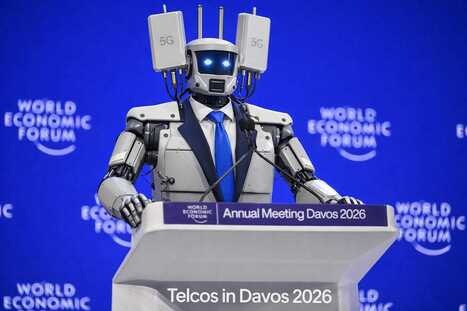
Davos 2026 marked a clean break for the telecom industry. The industry shifted the discussion away from speed, coverage, and generational labels toward control, autonomy, fragmentation, capital, and geography. Telecom CEOs converged on one reality: Networks are no longer passive infrastructure; they are becoming intelligence systems operating under geopolitical pressure, financial stress, and physical limits. What emerged in the Alps were 5 narratives that will set the roadmap for Telcos in the coming years.
|
|
Scooped by
Beeyond
January 20, 6:10 AM
|
Telcos attempted multiple monetization strategies without achieving any change in outcome. Quality tiers, zero rating, sponsored data, and later network slicing promised differentiation but failed to command durable price premiums. Enterprises adopted private networks selectively, yet volumes remained insufficient to move group-level revenue. Latency improvements delivered technical gains but limited willingness to pay, since applications abstracted transport and captured the value layer.
Cost per bit continued to fall faster than achievable price increases, driven by silicon scaling, higher-order MIMO, densification, and fiber economics. Transport approached marginal cost behavior while remaining capital-intensive.
|
|
Scooped by
Beeyond
January 16, 4:51 AM
|
Last week, Bob Sternfels, CEO of McKinsey & Company, stated that the firm has 60,000 employees and that 25,000 of them are AI agents. Not tools or copilots but employees. The wording was deliberate as it places AI agents in the same category as human workers inside an enterprise. That is not a visionary statement; It is a technical bullcrap. Counting AI agents as employees implies equivalence in autonomy, judgment, accountability, and decision ownership. Anyone with a serious background in AI and machine learning knows this equivalence does not exist today, and is not even close to it. What exists are probabilistic systems wrapped in orchestration layers, heavily supervised by humans, brittle under long-horizon execution, and fundamentally incapable of owning outcomes.
|
|
Scooped by
Beeyond
January 9, 7:39 AM
|
Over the past weeks, I have had long private conversations with five senior telecom analysts. The reason is because I was a dissapointed about many of the latest reports I saw regarding 2026. trends They felt just corporate talk or even sponsored reports. So I wanted to have a honest discussion. What came out of those discussions has very little to do with the trend reports filling our inboxes right now. Those documents are written to keep ecosystems stable, relationships smooth, and marketing budgets justified. This was different. This is where the industry is structurally weak and where 2026 will prompt uncomfortable discussions.
This is not a future-looking hype piece and not a technology wish list. It is a confession-style assessment of what actually matters next year, based on what people say when they stop selling and start thinking.
|
|
Scooped by
Beeyond
January 7, 8:05 AM
|
In the near future, you will not be able to tell whether you are talking to a human or an AI. That statement is no longer speculation; it is the direct outcome of how generative systems are evolving and how rapidly the underlying economics are collapsing. Voice, video, and interactive presence are already at the point where human perception is an unreliable security control, and the remaining gaps are closing quickly.
|
|
Scooped by
Beeyond
January 5, 3:50 PM
|
Over the last 24 months, Deutsche Telekom has not been experimenting with AI. It has been reallocating capital. Venture investments through T.Capital, large-scale compute commitments, and targeted acquisitions are converging into a single objective: control where AI becomes operational. In an industry with flat revenues and rising network complexity, this is a defensive move against margin erosion and an offensive attempt to turn distribution, compute, and execution into an AI advantage. This is not a technology story. It is a balance sheet story.
|
|
Scooped by
Beeyond
January 2, 6:42 AM
|
Starlink’s decision also comes after the company disclosed in December that one of its satellites suffered an in-orbit anomaly, producing a “small” amount of debris and cutting off communications with the spacecraft at an altitude of about 260 miles. The company said the satellite, one of nearly 10,000 currently in orbit for its broadband internet network, rapidly lost 2.49 miles in altitude, suggesting an internal explosion, in what was described as a rare kinetic accident.
|
|
Scooped by
Beeyond
January 1, 12:13 PM
|
The killer app is one of the most persistent myths in technology. It promises salvation through brilliance. One product so compelling that customers flood in, competitors fall behind, and monetization somehow takes care of itself. History shows the opposite: killer apps are excellent at creating demand but poor at protecting value.
The iPhone is the cleanest way to expose the myth, precisely because it is so often misused as proof. People talk about it as if the device itself were the business, and it never was. A smartphone is a standardized object the moment it succeeds: glass, battery, radios, silicon, and software. Once adoption explodes, expectations harden, and competitors converge. That is what killer products do: they define the reference design that others copy.
What prevented the iPhone from becoming a commodity phone business was not the phone itself. It was everything built around it. App distribution, payments, identity, accessories, defaults, services. Remove those layers, and Apple would have faced the same fate as every other hardware success story. Indispensable product, shrinking margins.
|
|
Scooped by
Beeyond
December 31, 2025 9:14 AM
|
L’idée, si on résume, c’est un peu de traiter le soleil comme un interrupteur. Il fait nuit, mais seulement sur une partie de la Terre. Le soleil ne s’arrête jamais de briller donc ses rayons sont toujours là. C’est une source d’énergie quasiment inépuisable pour encore cinq milliards d’années en tout cas, ce qui laisse le temps de voir venir. Les deux jeunes fondateurs de Reflect Orbital pensent qu’il ne faut pas forcément améliorer le rendement des panneaux solaires ou concevoir des batteries pour stocker l’énergie. Il suffit "juste", selon eux, d’allonger les journées.
|
|
Scooped by
Beeyond
December 30, 2025 7:36 AM
|
Revolut has not entered mobile communications to outperform network operators on coverage or spectrum efficiency. The company has entered the market because mobile connectivity has become another digital capability that fits naturally within a platform already handling identity, payments, subscriptions, rewards, travel, and daily financial behavior. When connectivity is viewed as software rather than infrastructure by the customer, the economics shift upstream.
|
|
Scooped by
Beeyond
December 29, 2025 7:09 AM
|
According to new data from Eurostat in a press release from the European Environmental Bureau, the amount of electronic equipment sold in Europe in 2023 skyrocketed to almost 16 million tons, an 89% increase over the amount sold in 2012. On top of that, 5.7 million tons of e-waste were collected in 2023, and collection rates of e-waste left much to be desired.
|
|
Scooped by
Beeyond
December 27, 2025 12:01 PM
|
The robot in question ran off an internal AI agent. By exploiting a flaw in the software, the researchers were able to take over the robot while it was connected to a network, at which point the researchers had the robot use local wireless communication to spread the hack to another nearby robot that actually wasn't even connected to the network at the time. Spreading the hack from one robot to another only took a matter of minutes. Even worse, the researchers were able to issue a command for the robot to physically strike a mannequin on stage.
|


 Scoop.it!