Your new post is loading...

|
Scooped by
Beeyond
March 22, 7:05 AM
|
It might sound like déjà vu, but it isn’t. According to recent Reuters reports, Amazon is quietly preparing to reenter the smartphone market under the highly classified “Project Transformer.”
Twelve years after the catastrophic failure of the Fire Phone, the company is attempting a surgical hardware reboot. This time, the strategy is radically different. Rather than engaging in a head-to-head battle with the Apple and Google app store duopoly, Amazon is pivoting to an entirely new category: an AI-assisted “anti-smartphone.” This minimalist, agentic dumbphone is not designed to compete on hardware specs or app ecosystems; it is engineered strictly as a frictionless tether to accelerate Amazon’s proprietary flywheel of e-commerce, advertising, and Prime media.
|
|
Scooped by
Beeyond
March 12, 4:00 AM
|
NVIDIA’s ambition is not to conquer a relatively small, low-growth niche business. As is typical of CEO Jensen Huang’s playbook, the strategy is far more visionary. NVIDIA is putting immense effort into telecom because it is the necessary physical gateway to a much larger prize: a $500 billion top-line opportunity driven by the automation of the physical world. They aren’t trying to build better radios; they are building the global nervous system for Physical AI.
|
|
Scooped by
Beeyond
March 1, 9:53 AM
|
In the early 2000s, Linux altered the balance of power in computing. It dismantled the tight vertical integration model that vendors like Sun and IBM relied on and replaced it with a shared software foundation that ran on almost any hardware. The operating system stopped being a proprietary control point and became a common infrastructure. Value moved up the stack. Ecosystems expanded. The industry shifted from closed systems to programmable platforms.
Two decades later, a similar attempt is unfolding in telecom. A Western coalition led by the Linux Foundation, seeded by US FutureG funding and joined by NVIDIA, DeepSig, Ericsson, and Nokia, is pushing to create a “Linux of RAN” through the OCUDU initiative. The target is the CU and DU layer, the programmable heart of the radio network. If this effort gains real deployment, it could reshape a 35 to 40 billion dollar RAN market, open the baseband layer to new entrants, and accelerate a structural split in 6G between Western and Chinese ecosystems.
|
|
Scooped by
Beeyond
February 24, 9:25 AM
|
Create a living AI version of you, or whoever you want to be.
Your AI Self talks, posts, remembers, and grows, so you can live your best life—without all those silly human limits.
|
|
Scooped by
Beeyond
February 17, 11:01 AM
|
Between 2010 and 2020, IoT was positioned as telecom’s next growth engine. Forecasts projected tens of billions of devices, recurring revenues, and deep enterprise integration. The volume materialized, but the value did not.
By the end of 2025, global IoT connections reached roughly 21 billion, according to IoT Analytics. Cellular IoT alone accounts for approximately 4.5 billion connections and is projected to reach 8 billion by 2031, according to the Ericsson Mobility Report. On paper, scale exists. IoT connections are projected to double by 2031, but most growth comes from short-range technologies rather than cellular.
However, the economics of this business tell a different story. Cellular IoT ARPU in many markets ranges from $1 to $5 per device per month for NB-IoT and LTE-M deployments. Even broadband IoT modules, such as LTE Cat 1, operate at narrow connectivity margins. Compare that to satellite IoT, where legacy plans often range from 40 to 70 dollars per device per month. Volume versus premium.
|
|
Scooped by
Beeyond
February 16, 4:52 AM
|
Chinese car companies make more vehicles than anyone else on Earth and export more as well. But high tariffs and hostile US-China trade relations have kept them out of the American market.
That’s likely to change, according to experts, with Chinese autos hitting US showrooms in the next five to 10 years.
|
|
Scooped by
Beeyond
February 15, 6:46 AM
|
There are enormous geopolitical, economic and climate ramifications to the U.S. abandoning leadership on the energy transition. If you live in America, basically none of them are good.
|
|
Scooped by
Beeyond
February 13, 7:08 AM
|
In the semiconductor industry, Arm is everywhere and nowhere. Designs from the British-based, American-listed, Japanese-controlled firm sit in almost all the world’s smartphones and most other connected devices. Yet Arm does not sell a single chip. Customers license its designs, tweak them if they wish and produce the chips themselves (or have them made). Arm pockets an upfront licence fee and a slim per-chip royalty. The model has made it ubiquitous. More than 300bn chips built on its designs have been shipped—over 30bn of them last year alone.
|
|
Scooped by
Beeyond
February 12, 10:00 AM
|
#dotdot - Frictionless Wireless Connectivity for Incremental Revenue Generation. Extend network reach, enable opportunistic connectivity, and unlock new revenue streams — without deploying new infrastructure.
|
|
Scooped by
Beeyond
February 9, 4:34 AM
|
Super Bowl LX is not just the biggest sporting event in the world. It is the most extreme connectivity experiment ever deployed in a single venue. More than 35 terabytes of in-venue traffic are expected to be generated by roughly 70,000 spectators, each acting as a live content producer. This load is not driven by messaging or browsing, but by uplink-intensive behavior: high-definition video uploads, multi-angle replays, immersive applications, real-time social sharing, and continuous background streaming.
To meet that demand, Levi’s Stadium is running the most ultra-dense stack that combines mmWave, mid-band 5G, Wi-Fi 7, private 5G networks, network slicing, satellite-backed mobile cells, and real-time AI-driven optimization. That is why Super Bowl LX has become the place where Verizon, AT&T, T-Mobile, Ericsson, and Nokia show everything they have. It is a full-stack stress test of the future network. Let us break it down layer by layer.
|
|
Scooped by
Beeyond
February 3, 12:45 PM
|
On January 30, 2026, SpaceX filed with the Federal Communications Commission for authorization to operate up to one million satellites described as orbital AI data centers. The number dominated coverage, but the underlying driver received less attention.
Global data centers consumed about 460 terawatt hours of electricity in 2024. Multiple forecasts from IEA and industry analysts converge between 1,200 and 1,700 terawatt hours by the mid-2030s, driven primarily by AI workloads. In Northern Virginia, the world's largest data center market, grid interconnection queues exceed 40 months. In Ireland and the Netherlands, permission for new campuses has already been frozen or delayed due to power and water constraints. Cooling now represents a larger share of capital expenditure growth than servers.
|
|
Scooped by
Beeyond
February 2, 9:42 AM
|
The AI value chain economics at this stage is focused on infrastructure. AI value creation is concentrated upstream, where capital intensity is highest and scale advantages compound most rapidly. The market rewards balance sheets, not clever prompts. Training and inference workloads demand dense compute, high-bandwidth memory, optical interconnects, and ample power. Those inputs scale poorly for small players and extremely well for incumbents.
Gartner frames 2026 as the Trough of Disillusionment. Enterprises prioritize predictable ROI over experimentation. AI gets sold by incumbent vendors and bundled into existing contracts rather than procured as standalone moonshots. That behavior reinforces concentration. Buyers choose suppliers already embedded in their infrastructure stack.
|
|
Scooped by
Beeyond
January 28, 9:45 AM
|
L’accord noué avec TerraPower, société cofondée par Bill Gates, retient particulièrement l’attention. Il prévoit le financement et le développement de deux réacteurs capables de fournir jusqu’à 690 mégawatts, dès 2032 si tout se déroule comme prévu. Mais ce n’est pas tout : six autres installations pourraient suivre, totalisant potentiellement 2,1 gigawatts supplémentaires d’ici trois ans. Particularité technique : ces sites reposeront sur les réacteurs « Natrium », utilisant le sodium comme fluide caloporteur en lieu et place de l’eau – un choix jugé plus prometteur par certains experts.
|
|
|
Scooped by
Beeyond
March 17, 6:54 AM
|
I’m not exaggerating: “Robotic AI Radio” is the exact phrase Jensen used during GTC 2026. What we are witnessing is a fundamental rewiring of how the world computes, and this groundbreaking development was showcased alongside 120 different robots at GTC 2026 today. This deployment is the first fruit of the partnership between Nokia and NVIDIA for building their Aerial RAN product. It is a massive architectural shift that incorporates GPUs directly into the RAN (Radio Access Network) for two critical purposes: improving RF signal processing and, crucially, enabling physical AI inference right at the edge. Although we are really early in the game, it is abundantly clear that AI has left the central datacenters and training labs. It is now all about the physical world and inference, where telcos can play a big role.
|
|
Scooped by
Beeyond
March 9, 11:47 AM
|
MWC 2026 is over, and the hype hangover begins. Back to reality, there is one metric the telecom industry should look at right now: how much money we are actually making from AI. Not how much AI we deploy internally, not how many partnerships we announce, but real revenue generated by operators. This has been the industry’s problem for decades as Telcos build the infrastructure, enable the ecosystem, carry the traffic, and then watch someone else capture the value.
In 2025, the global AI economy generated roughly $1.5 trillion. At best, telecom operators captured about $300 million in direct AI revenue. Even if the definition is stretched to include connectivity and other indirect services, the most optimistic estimates reach around $4 billion. The sense of déjà vu is hard to ignore.
Telcos have already invested well over $300 million in AI and are deploying it across networks and operations, yet we capture only about 0.02% of the AI economy. The opportunity is massive. But if telecom does not fix how value is captured, AI will repeat the same story we already lived through with cloud, apps, and streaming.
|
|
Scooped by
Beeyond
February 25, 9:23 AM
|
A few days ago, John Saw introduced a term that reframes how we think about AI in the physical world. He called it the kinetic token. His argument is simple but structural: If large language models are built on informational tokens that represent fragments of text, then machines that move, lift, weld, or drive must be built on atomic units of time-indexed physical state and not just symbols. Measurements are tied to position, velocity, force, energy, and identity.
That shift marks the boundary between Language AI and Physical AI. In one world, tokens optimize probability distributions over words. In the other, tokens sit inside control loops where milliseconds translate into motion, and error margins translate into safety risk. When intelligence leaves the cloud and enters factories, roads, ports, and robots, the unit of computation changes. And with it, the infrastructure and monetization logic must change as well.
|
|
Scooped by
Beeyond
February 23, 12:22 PM
|
In the last three months, OpenAI has moved from speculation to reality. Reporting based on sworn court filings confirms a working prototype and indicates that the first hardware product will not ship before late February 2027, alongside a branding pivot away from the “io” name. Executive statements at Davos anchor a reveal window in the second half of 2026.
More importantly, first-party hiring signals describe an end-to-end consumer device stack: custom silicon, embedded systems, operating system kernel and frameworks, camera firmware, secure boot, A/B OTA infrastructure, and hardened software supply chain controls. The pattern matches with OpenAI building a vertically integrated hardware platform designed to sit beside the smartphone and control the ambient AI interface layer around daily digital life.
OpenAI is leaving chat interfaces behind and moving into the physical world.
|
|
Scooped by
Beeyond
February 16, 10:49 AM
|
In early February, more than $285 billion in software market value was lost in a single session following the release of enterprise agents by Anthropic and OpenAI. Within days, cumulative losses across SaaS names crossed $1 trillion. The IGV Software Index fell roughly 30% from its late September peak. Forward earnings multiples compressed from around 39x to near 21x in a matter of months. Short sellers reportedly generated more than $20 billion in profits in 2026 positioning against legacy SaaS.
|
|
Scooped by
Beeyond
February 15, 11:21 AM
|
If you follow the US telecom market closely, there is little need for scripted drama elsewhere. In Q3, the three kings were still marching in different directions. Verizon was focused on yield discipline and cultural reset. AT&T was executing a fiber-led convergence model with almost mechanical consistency. T-Mobile was scaling fixed wireless and pushing growth into every open flank. Three doctrines, three tempos, three interpretations of where value would come from next.
By Q4 and full year 2025, something shifted. The divergence narrowed.
All three are now targeting the same asset: the American home. Not as a side product, but as the strategic control point of the account. Home broadband increases wallet share per household, reduces mobile churn through bundling, and raises switching costs by embedding connectivity deeper into daily life. Fiber passings, fixed wireless scale, and even satellite backstop coverage are now tools for the same objective: own the household relationship, and the rest of the revenue stack follows.
|
|
Scooped by
Beeyond
February 14, 12:07 PM
|
Quantum internet is approaching faster than many expected. At the same time, the world still runs on classical encryption that quantum computers are projected to break within the next decade.
Enterprises, governments, and consumer networks rely on cryptographic foundations that will not withstand a quantum computer with cryptographic relevance. Post-quantum standards were finalized in 2024, and regulators have begun setting migration timelines. The transition is an infrastructure upgrade that must start now.
Telcos sit at the center of this shift.
They move the world’s data and operate the physical networks where quantum security will be deployed. According to STL Partners, 35 operators are already active across 75 quantum-related projects, from pilots to commercial launches.
Telco Momentum is building, and yet the risk is familiar: Telcos can either shape the quantum internet and own the trust layer, or remain passive transport providers while others capture the value. As quantum capabilities move closer to the network, the strategic choice cannot be deferred.
|
|
Scooped by
Beeyond
February 13, 7:07 AM
|
China has long been a counterfeiting hub. Shoppers do not have to look far to find fake Nestlé food seasoning or imitation Nike sneakers. And brands are not the only form of intellectual property (ip) that is readily pilfered. Foreign multinationals that set up shop in the years after China opened its economy to the world often complained of their trade secrets being stolen. General Motors, an American carmaker, discovered in 2003 that a Chinese partner was rolling out a model strikingly similar to one of its own. Kawasaki, a Japanese industrial giant, and Siemens, a German one, believe their technology was nabbed to help build China’s extensive high-speed rail network.
|
|
Scooped by
Beeyond
February 9, 8:13 AM
|
6–7, matcha latte, two-second attention span, Ramen lovers, five hours a day inside mobile apps, visual-first communication, loyal but always ready to change, perfectly fine consuming and creating AI-generated content.
That is the generation telcos are struggling to understand. This is Gen Z. Born roughly between the late 1990s and the late 2000s, they are the first generation to have grown up entirely within algorithmic systems. No memory of life before smartphones. No novelty around connectivity. Always on, always available, always assumed. Their expectations were shaped by feeds that adapt in real time, services that anticipate intent, and tools that integrate creation, consumption, and monetization into a single flow. They experience technology as an environment. And that difference is what makes them so hard for telcos to read, price, and serve using models designed for an earlier era.
|
|
Scooped by
Beeyond
February 4, 8:55 AM
|
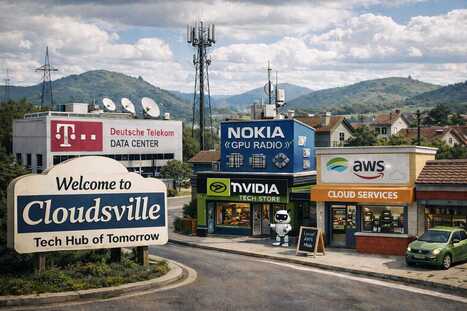
Deutsche Telekom announced that its sovereign public cloud inside Germany will match core hyperscaler features by 2026, backed by a €1 billion NVIDIA-powered AI data center designed to host industrial and regulated workloads. In parallel, Nokia is integrating GPU-based AI inference directly into the radio access network, pushing compute from centralized data centers into live mobile networks. At the same time, hyperscalers are expanding across multiple regions, zones, metro deployments, and sovereign stacks, bringing cloud execution closer to enterprises and machines rather than keeping everything centralized.
Against that backdrop, global AI spending is approaching $2.52 trillion, with roughly 60% directed to infrastructure. Power, data centers, cooling, fiber, and silicon dominate the spend, not models or applications. This resembles previous infrastructure cycles in which capacity was built before demand clarity. Cloud is not reversing direction; it is expanding with the use of AI. As execution becomes more local and physical, local networks and infrastructure operations move back to the center of the AI economy.
|
|
Scooped by
Beeyond
February 3, 7:22 AM
|
New research isolates an old foe — smoking — as the principal culprit behind U.S. midlife mortality gaps defined by place and education.
|
|
Scooped by
Beeyond
February 1, 4:04 PM
|
The United States sets the global benchmark for telecom intensity. With over 300 million connections, deep smartphone saturation, and fiber builds colliding with fixed wireless, it remains the industry’s highest-stakes market. Pricing, retention, spectrum, and infrastructure decisions made here ripple worldwide. To a greater extent, AT&T, Verizon, and T-Mobile set the pace of telecom strategy worldwide.
In 2026, these three players seem to be moving in sharply different directions. AT&T scales fiber to lock in convergence. Verizon executes a stripped-down reboot under Dan Schulman, targeting precision over volume. T-Mobile shifts to cash extraction mode, layering dividends and buybacks on top of its subscriber lead, all while pushing enterprise and network slicing into new territory. One market, three models, and a competitive field that leaves no room for mistakes.
|