
'Putting pandemics in perspective', by Mark Honigsbaum, an article from History & Policy, the independent initiative working for better public policy through an understanding of history
Get Started for FREE
Sign up with Facebook Sign up with X
I don't have a Facebook or a X account


|
Scooped by
Beeyond
onto High level trending in... October 25, 2013 3:03 PM
|
 Scoop.it!
'Putting pandemics in perspective', by Mark Honigsbaum, an article from History & Policy, the independent initiative working for better public policy through an understanding of history


 Your new post is loading...
 Your new post is loading...
Your new post is loading...
Scoop.it!

NVIDIA’s ambition is not to conquer a relatively small, low-growth niche business. As is typical of CEO Jensen Huang’s playbook, the strategy is far more visionary. NVIDIA is putting immense effort into telecom because it is the necessary physical gateway to a much larger prize: a $500 billion top-line opportunity driven by the automation of the physical world. They aren’t trying to build better radios; they are building the global nervous system for Physical AI.
Scoop.it!
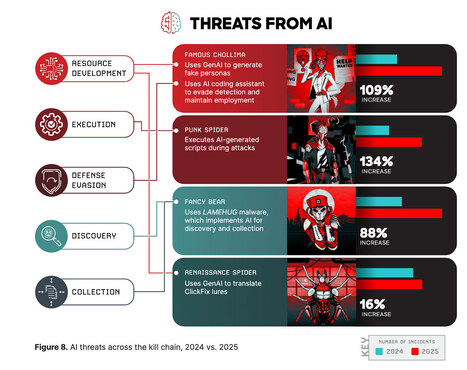
AI expands the attack surface faster than anyone can adapt. Deepfakes undermine identity, autonomous agents execute attacks at machine speed, and AI systems introduce entirely new vulnerabilities across prompts, models, and data pipelines. In this environment, the central problem becomes trust. Who is communicating? Where is the system located? Is the interaction authentic? Telecom needs to decide what role they play in this architecture. An industry cannot stand for twenty different things; It needs a clear identity in the digital economy.
Scoop.it!

Selon les prévisions d’IDC, le marché mondial des smartphones pourrait connaître en 2026 sa plus forte baisse historique, conséquence directe d’une crise majeure de l’approvisionnement en mémoire qui menace l’ensemble du secteur.

Marco Bertolini's curator insight,
March 8, 1:51 AM
L'approvisionnement en mémoires entrainera-t-il une baisse des ventes de smartphones ?
Scoop.it!
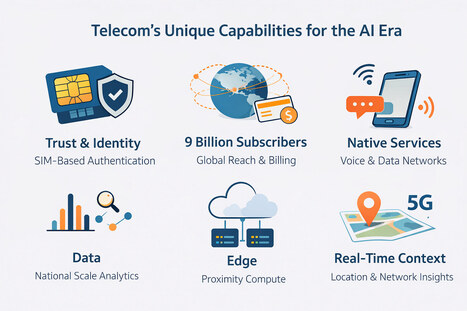
Telecom often adopted the technology early, but money still landed elsewhere. SMS shows what happens when the service is native, end-to-end. The first SMS was sent in 1992. Interoperability accelerated around 1999 to 2000. By 2012, global SMS revenue was above 110 billion dollars per year, and global volumes were in the trillions of messages annually. In several markets, SMS margins exceeded 80 percent because delivery cost per message was near zero and billing was built in.
Scoop.it!

From
dotdot

#dotdot - Frictionless Wireless Connectivity for Incremental Revenue Generation. Extend network reach, enable opportunistic connectivity, and unlock new revenue streams — without deploying new infrastructure.
Scoop.it!

Telco layoffs dominate headlines these days, yet global employment barely flinches.
Scoop.it!
Most financial analysts frame 2026 as flat-to-low-growth revenues with improving margins. ING anchors the European view: sales growth around 2% and median EBITDA growth around 2.5%, with the spread explained by cost rationalisation rather than a demand step change.
Scoop.it!

AI is no longer an incremental network feature. It is changing how telcos invest, where traffic grows, and which layers of the infrastructure stack capture value. Over the last 12 to 18 months, operators have moved from isolated AI pilots to coordinated investment across mobile access, fixed networks, transport, and automation software. This shift explains why Ericsson, Nokia, and Huawei are no longer pursuing similar strategies.
Scoop.it!

For most of its history, telecom venture capital was symbolic. That changed after 2018 and accelerated sharply after 2022, as tier-one operators and vendors began treating venture investing as a structural tool rather than innovation theater. Competitive pressure, AI-driven compute shifts, and geopolitical risk forced telcos to engage with emerging technology earlier and more deliberately. Today, the ten most relevant telco and vendor-backed venture platforms collectively deploy or manage an estimated $10B to $15B, with annual deployment of roughly $1.5B to $2B. Capital is highly concentrated, and portfolios are tightly scoped around network software, AI infrastructure, cybersecurity, edge compute, silicon adjacencies, private networks, enterprise platforms, and regulated data services rather than consumer growth plays.
Scoop.it!

Once standalone reached scale, the industry expected financial performance to diverge between early adopters and laggards. That divergence has not appeared. The United States is the clearest test case. By 2025, nationwide standalone cores were operational, and live traffic was being migrated. If SA were changing monetization dynamics, it should have shown up first in the world’s largest mobile market. Instead, mobile service revenue growth remained modest. AT&T’s mobile service revenues grew 3.4% year over year through the first three quarters of 2025, roughly in line with inflation. Verizon showed a similar profile. Neither operator cited standalone driven services as a material contributor to ARPU or margin expansion. Equity markets reflected the same assessment. Since the launch of 5G in 2019, AT&T’s market capitalization declined by approximately 18%, while Verizon’s fell by about one-third, despite years of network upgrades and SA completion.
Scoop.it!

Since 2000, telecommunications operators have paid approximately $1 trillion for spectrum access. Not equipment. Not fiber. Not radios. Just permission to transmit. Roughly $400–450B upfront in primary license awards, $50–100B in clearing and refarming, and hundreds of billions more in recurring spectrum fees paid every year. This is the largest capital and rent extraction in telecom history.
Scoop.it!

The idea that telecom networks can be used for weather sensing is not new. GNSS-based atmospheric estimation, rain attenuation on microwave links, and radio refractivity effects have been studied for more than 20 years. The physics is well understood and already embedded in network planning and synchronization systems.
Scoop.it!

La proposition a pris corps mercredi avec la publication d’un avis au Federal Register, le Journal officiel américain : l’administration Trump veut désormais exiger des visiteurs bénéficiant du programme d’exemption de visa (ESTA) qu’ils fournissent l’historique de leurs comptes sur les réseaux sociaux sur cinq ans.
|
Scoop.it!

MWC 2026 is over, and the hype hangover begins. Back to reality, there is one metric the telecom industry should look at right now: how much money we are actually making from AI. Not how much AI we deploy internally, not how many partnerships we announce, but real revenue generated by operators. This has been the industry’s problem for decades as Telcos build the infrastructure, enable the ecosystem, carry the traffic, and then watch someone else capture the value.
Scoop.it!

Loin de se limiter au simple affichage numérique, les prototypes développés par Xpanceo promettent une véritable révolution pour le consommateur. Le modèle le plus avancé à ce jour associe ainsi un écran miniature intégré sur la lentille à un dispositif de surveillance en continu du taux de glucose sanguin. Un atout majeur pour les personnes concernées par le diabète ou soucieuses de leur santé avec, en prime, une attention portée au confort oculaire.
Scoop.it!
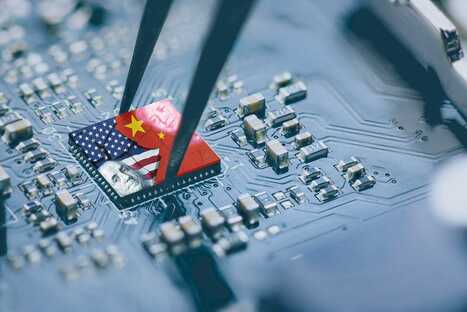
In the early 2000s, Linux altered the balance of power in computing. It dismantled the tight vertical integration model that vendors like Sun and IBM relied on and replaced it with a shared software foundation that ran on almost any hardware. The operating system stopped being a proprietary control point and became a common infrastructure. Value moved up the stack. Ecosystems expanded. The industry shifted from closed systems to programmable platforms.
Scoop.it!

Le lancement commercial des services 5G, amorcé dans certaines régions dès octobre 2022, a rapidement pris de l’ampleur. Les opérateurs majeurs – Bharti Airtel et Reliance Jio – se sont lancés dans une course effrénée, chacun revendiquant déjà 50 millions d’abonnés après seulement douze mois. La concurrence s’est ensuite intensifiée avec l’arrivée progressive de Vodafone Idea, notamment dans plusieurs grandes villes dès 2025.
Scoop.it!
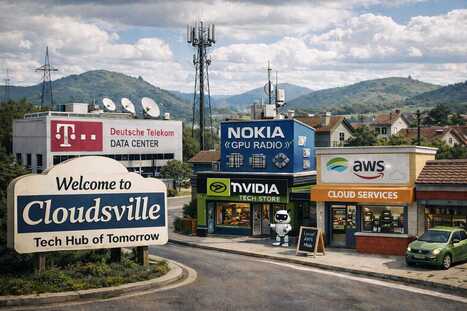
Deutsche Telekom announced that its sovereign public cloud inside Germany will match core hyperscaler features by 2026, backed by a €1 billion NVIDIA-powered AI data center designed to host industrial and regulated workloads. In parallel, Nokia is integrating GPU-based AI inference directly into the radio access network, pushing compute from centralized data centers into live mobile networks. At the same time, hyperscalers are expanding across multiple regions, zones, metro deployments, and sovereign stacks, bringing cloud execution closer to enterprises and machines rather than keeping everything centralized.
Scoop.it!

Depuis des années, les univers des satellites et des réseaux mobiles semblaient évoluer en totale autonomie. Les premiers, jugés coûteux et réservés aux usages spécialisés, bateaux, avions ou zones reculées – paraissaient inaccessibles au quotidien. Quant aux opérateurs mobiles, leur réseau dense n’allait guère au-delà des villes et des villages, laissant de vastes espaces sans aucune connectivité. Deux modèles économiques distincts, deux langages industriels quasi incompatibles… jusqu’à récemment.
Scoop.it!
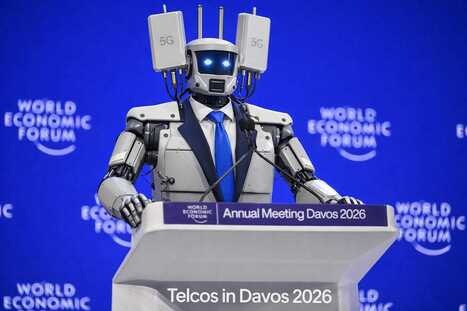
Davos 2026 marked a clean break for the telecom industry. The industry shifted the discussion away from speed, coverage, and generational labels toward control, autonomy, fragmentation, capital, and geography. Telecom CEOs converged on one reality: Networks are no longer passive infrastructure; they are becoming intelligence systems operating under geopolitical pressure, financial stress, and physical limits. What emerged in the Alps were 5 narratives that will set the roadmap for Telcos in the coming years.
Scoop.it!

Telcos attempted multiple monetization strategies without achieving any change in outcome. Quality tiers, zero rating, sponsored data, and later network slicing promised differentiation but failed to command durable price premiums. Enterprises adopted private networks selectively, yet volumes remained insufficient to move group-level revenue. Latency improvements delivered technical gains but limited willingness to pay, since applications abstracted transport and captured the value layer.
Scoop.it!

Last week, Bob Sternfels, CEO of McKinsey & Company, stated that the firm has 60,000 employees and that 25,000 of them are AI agents. Not tools or copilots but employees. The wording was deliberate as it places AI agents in the same category as human workers inside an enterprise. That is not a visionary statement; It is a technical bullcrap. Counting AI agents as employees implies equivalence in autonomy, judgment, accountability, and decision ownership. Anyone with a serious background in AI and machine learning knows this equivalence does not exist today, and is not even close to it. What exists are probabilistic systems wrapped in orchestration layers, heavily supervised by humans, brittle under long-horizon execution, and fundamentally incapable of owning outcomes.
Scoop.it!

Over the past weeks, I have had long private conversations with five senior telecom analysts. The reason is because I was a dissapointed about many of the latest reports I saw regarding 2026. trends They felt just corporate talk or even sponsored reports. So I wanted to have a honest discussion. What came out of those discussions has very little to do with the trend reports filling our inboxes right now. Those documents are written to keep ecosystems stable, relationships smooth, and marketing budgets justified. This was different. This is where the industry is structurally weak and where 2026 will prompt uncomfortable discussions.
Scoop.it!

Mature assets, strong incumbents, high technical competence, and slow decision cycles. In that environment, advantage no longer comes from owning better infrastructure. It comes from how effectively the organization coordinates what it already owns. Analysts consistently find that, after asset normalization, operating model and decision velocity account for roughly 30-40% of performance variance. Network quality explains survival but does not explain outperformance. Once technical parity is reached, internal friction becomes the dominant tax. Culture here is not about kindness or slogans. It concerns incentives, permissions, ways of working, and coherence.
Scoop.it!

Starlink’s decision also comes after the company disclosed in December that one of its satellites suffered an in-orbit anomaly, producing a “small” amount of debris and cutting off communications with the spacecraft at an altitude of about 260 miles. The company said the satellite, one of nearly 10,000 currently in orbit for its broadband internet network, rapidly lost 2.49 miles in altitude, suggesting an internal explosion, in what was described as a rare kinetic accident.
|




