|
Rescooped by
Antonios Bouris
from Creativity Scoops!
April 3, 2015 4:45 AM
|

No comment yet.
Sign up to comment

 Your new post is loading...
 Scoop.it! No comment yet.
Sign up to comment
Scoop.it!

We can be tactical in our schooling. The traditional advice on learning has been to “study hard,” in a quiet place and with the same routine, yet that doesn’t say much about what to specifically do. But pupils today can change the way they study to exploit the brain’s quirky learning processes, using the strategies revealed by memory and learning research. While that science is still maturing, “it’s at a place now where it can give you a specific tactical plan,” Carey said. . Students can tailor their preparation with techniques targeting different kinds of content or skills, and manage their schedule to optimize their time. “That’s a powerful thing, because we go through our whole lives never knowing that,” he said. . Ultimately, the value of these learning strategies isn’t just about earning better grades, Carey said. In the modern jungle of society, learning is still about surviving: For young people, it’s about sussing out what they’re good at, what rings their bell, and what they want to do with their lives. “It’s informing you of: Who am I? Where do I place my bets? Do I major in physics or do I major in architecture or design, or do I major in English? Do I belong here at all?” Carey said. Those are important decisions. “Being self-aware about what’s effective learning and how it happens, I think, gives you a real edge in making those choices.” Learn more: - https://gustmees.wordpress.com/2013/04/25/learn-every-day-a-bit-with-curation/ Via Gust MEES

Steve Bavister's curator insight,
April 3, 2015 5:33 AM
Nice set of tips here for studying more effectively

Jake Goulet's curator insight,
April 15, 2015 11:35 AM
Figure out what strategies will help you expand your language knowledge!
Scoop.it!

NBBJ proposes a set of "shadowless" towers for London's rapidly changing skyline. Architects from the global firm NBBJ have designed what they call a “No Shadow Tower” for a site along the Thames River in London. The hypothetical scheme, developed in response to a call for ideas from the architecture think tank New London Architecture (NLA), offers one way to lessen the impact of tall buildings on the urban fabric surrounding them. NBBJ’s proposed scheme has a similar goal to Jean Nouvel’s recently completed One Central Park complex in Sydney, which depends on a giant heliostat to illuminate a garden that would otherwise often be in shade. But NBBJ uses the geometry of the buildings themselves to mitigate their shadows. The two London towers subtly twist and flair, with floor plates that are slightly larger on the upper floors. Developed with parametric design, the configuration is intended to reflect sunlight from the south face of the taller tower into the plaza below. This arrangement would create what Coop describes as dynamic pools of light... Via Lauren Moss

Lola Ripollés's curator insight,
April 5, 2015 2:25 PM
Despite its name, the NBBJ proposal consists not of a single tower, but a pair of glass-clad skyscrapers—one about 50 stories tall and the other about 30 stories. Kidney-shaped in plan, with their concave elevations facing each other, the two buildings together define a plaza at the ground. This space captured NBBJ’s attention. “Although tall buildings have an impact on the skyline, their success or failure comes down to what occurs at the base,” says Christian Coop, design director of the firm’s London office.
Scoop.it!

"Over the last few years I've seen more schools opening up access to YouTube, at least to teachers, than I had in the past. YouTube for Schools has partially contributed to that trend. Tools like ViewPure and Watchkin have made using YouTube videos in schools a little less scary too. All that said, there are still lots of schools that block access to YouTube. That's why a few years ago I started to maintain a list of alternatives to YouTube." Via Beth Dichter

Tennelle Searle's curator insight,
March 31, 2015 8:42 AM
WOW I will be defiantly be looking into the use of some of these. I am always hiding in a corner watching YouTube videos to ensure no nasty surprises before I show it to the children, 
SMARTERTEACHER's curator insight,
April 6, 2015 11:45 AM
With so many schools and districts handcuffing faculty and students, there are ways to get around the censorship.
Scoop.it!

Temple University researchers recently put together the world's largest tree of life visualized across time. The family tree of living and extinct organisms encompasses 50,000 species—only a fraction of the world's history of life—and would easily take up hundreds of pages if laid out linearly. To fit their work onto a printed page, the researchers, led by evolutionary biologist S. Blair Hedges, instead decided to visualize the data as a spiral. Via Lauren Moss
Scoop.it!

You can make creativity into an everyday thing in seven steps by focusing on the everyday. Via Creativity For Life
Scoop.it!

An all-time list of the best Banksy graffiti art and street art pieces, all showing Banksy locations of his works with street map views where applicable Via Kuniko
Scoop.it!

A new interactive tool estimates the economic, urban, and demographic risks through 2030. According to the World Resources Institute, river floods affect 21 million people in the world every year. In 2030, that number could rise to 54 million, with climate change driving the increase and urbanization putting more people in harm's way... Via Lauren Moss

Judit Urquijo's curator insight,
March 29, 2015 12:33 PM
Información útil Descarga: web Precio: gratuita Idioma: inglés Website del desarrollador: World Resources Institute Descripción El Aqueduct Global Flood Analyzer es una herramienta web interactiva diseñada para mostrar mediante modelos los daños de las inundaciones sobre los entornos urbanos, el PIB y la población, pudiendo consultar esta información tanto desde el punto de vista de la nación, la cuenca hidrográfica o el estado. Una vez seleccionado el ámbito, la aplicación permite seleccionar el nivel de protección contra inundaciones medido en años, que hace referencia a los tipos de sistemas construidos para prevenir las inundaciones y que normalmente suelen estar dimensionados en función de los períodos de retorno. En base a los citados criterios, la herramienta presenta los costes generados por las inundaciones en base a datos de 2010. La aplicación también permite a los usuarios estimar el riesgo futuro, realizando proyecciones en el contexto de tres escenarios climático y socioeconómicos distintos. Más información http://www.wri.org/resources/maps/aqueduct-global-flood-analyzer
Scoop.it!

Design thinking is less abstract than it sounds and more organisations are using it to drive innovation and create winning solutions Via A. Kosuke
Scoop.it!

Damascus-based photojournalist John Wreford gives an account of the street art and graffiti that has flourished throughout Cairo since the beginning of the Egyptian Via Kuniko
Scoop.it!

Reverse brainstorming is a design thinking tool that solves the problem through focusing on the idea of what causes the problem or how to achieve an opposite result of what is expected. Via A. Kosuke
Scoop.it!
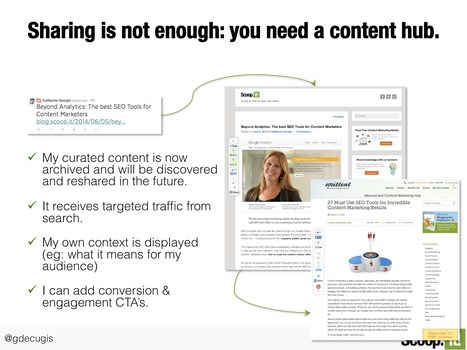
What really separates curation from filtration is context — specifically a curator providing the reader the necessary context within which the filtered content should be consumed in order for it to make sense and have value to the reader. Via Guillaume Decugis

Guillaume Decugis's curator insight,
March 9, 2015 6:18 PM
In the age of information overload, content has little value without context. It became a commodity which we're seeing a huge amount of flowing on our news feeds. This is a problem but also a great opportunity to show expertise: to explain, connect the dots, add value by positioning content in the context of a relationship with au audience. As this post's author Tom Martin highlights in this post, the logical conclusion is that this presents a challenge: How can you add context and value in 140 characters on Twitter? How can your 200-word explanations compete with LOL cats on Facebook? By using a content curation hub. What do we mean by that? Instead of sharing links and limiting your context to whatever fits in your tweet or focusing on grabbing attentions on Facebook, you can publish your curated content as a post on your blog (or if you don't have one, a Scoop.it topic page) which gives you plenty of opportunity to elaborate. There are several benefits with doing that: 1. By sending your social media audience to a page where they can show your curated content with added context and value, you can build that trust with your readers and show your expertise. And therefore what Tom Martin calls the content curation challenge. 2. Readers can easily see related content which will engage them more and reinforces your importance to them. 3. Your curated content can now be rediscovered in the future, in particular through search engines. 4. You can add conversion hooks and call to actions to get in touch with your company, buy your products, etc... |
Scoop.it!

The latest exoskeleton technology doesn't need an outside power source to boost your strength. It harnesses the power of your own muscles to put a spring in your step instead. And soon baby boomers could be using it to keep hiking and jogging just a few years longer. The new devices, described Wednesday in Nature, are still just in the prototype phase. But the researchers who created the inexpensive, easy-to-wear exoskeletons believe they could be ubiquitous in another decade. They're quite unlike the hulking, "Iron Man"-like suits that others have created to help people walk more easily. These little braces don't require any outside power, and they make walking 7 percent more efficient with nothing but a well-placed spring system. They can't support someone who can't stand on her own like a bulkier, motor-aided suit might. But for people who can walk but have difficulty doing so, the boot-like new apparatus could help create a more balanced, comfortable gait. Just under 10 percent less energy per step doesn't sound like much -- it's the equivalent of removing a 10-pound backpack. According to study co-author Gregory Sawicki, a biomedical engineer and locomotion physiologist in the joint NC State/University of North Carolina-Chapel Hill Department of Biomedical Engineering, people using the braces don't really notice the difference -- until it's gone. Via Dr. Stefan Gruenwald
Scoop.it!

The library as a community garden, a public living room, and more innovative ideas from the AIA/ALA Library Building Awards. Via Julie Tardy
Scoop.it!

In the end, it turns out that imagining and day dreaming are not a waste of time -- as some people still tend to think.... Via Creativity For Life
Scoop.it!
March 20, 2015 Find out more here: - http://www.scoop.it/t/21st-century-tools-for-teaching-people-and-learners Via Gust MEES

Gust MEES's curator insight,
March 21, 2015 10:29 AM
March 20, 2015 Find out more here: - http://www.scoop.it/t/21st-century-tools-for-teaching-people-and-learners
Scoop.it!

On March 7, 2015 Google and frog partnered in Milan, Italy and brought together 80 talented creatives with a background in technology and design to ideate and prototype concepts on the future of Media.
Scoop.it!

Artist Emily Garfield maps places that don't exist. "I think that's related to the way cities grow in real life." Emily Garfield like to say that she grows cities. With pen, ink, and watercolor, the Boston-based artist creates maps of imaginary places that tap into the essence of urban form. Garfield has long been interested by the presentation of architecture in visual art. The inviting, surrealist arcades and sidewalks of the Italian painter Giorgio de Chirico inspired Garfield to begin producing her own street-level dreamscapes as an art student at Brown University. But it was when she created her first aerial view of a fantasy city—an abstract web of streets, bridges, and blocks—that she got a particularly positive response from other people. Even without any text, Garfield's drawings were strongly recognizable as maps... Via Lauren Moss
Scoop.it!

The purpose of this article is simply to remove some of the negative connotations around smartphones and to consider new possibilities which we have at our disposal. In order for students to use smartphones in school responsibly, it is important that we set limits and rules beforehand. A MUST READ! Via Gust MEES

Eneritz Madariaga's curator insight,
March 19, 2015 6:37 PM
Oso interesgarria ikasleen motibazioa sustatzeko!!
Scoop.it!

Beth Dichter's curator insight,
March 18, 2015 10:38 PM
Outer space fascinates learners...and this post from VOX provides 40 maps that are divided into sections: * The Solar System * Earth * Space History * The Moon * Mars * The Rest of the Solar System * Beyond the Solar System If you teach Earth Science many of these maps may be of interest. One map that many students may find of interest is takes a look at the universe based on the moon being 1 pixel. It is located at this link.
Scoop.it!
Scoop.it!

From
likes

Remember when a glass elevator was considered cutting edge? These buildings blow every taboo design out the window (...pun intended?) Via Kuniko
Scoop.it!

Ecologico ed elegante: il rubinetto riduce il consumo d'acqua trasformandola in design Via Massimiliano Cammuso

Massimiliano Cammuso's curator insight,
March 10, 2015 8:07 PM
Water no get enemy! (Fela Kuti) The product designer Simin Qui, has developed a water aerator that produce a beautiful complex liquid combination with three different designs. Water is a precious resource, we shouldn't waste it! Water aerators are very useful for preventing it and you can buy for small change. According to you, the SWIRL will be sold in large quantities? |