 Your new post is loading...

|
Rescooped by
Antonios Bouris
from Biomimicry
July 14, 2017 6:34 AM
|
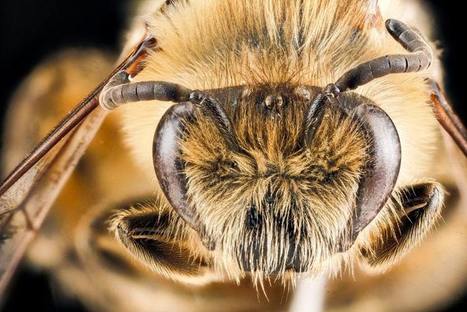
"New research on how bees perceive colour could be put to good use in our digital cameras, meaning photos shot by drones or phones would look more natural than ever. It's all to do with colour constancy, the way that bees (and humans) can tell a flower is red no matter what the colour or quality of the light – a mental trick that the digital cameras of today really struggle with."
Via Miguel Prazeres
|
|
Rescooped by
Antonios Bouris
from Banksy - Street Artist
June 30, 2017 4:17 AM
|
Twitter is exploring adding a feature that would let users flag tweets that contain misleading, false, or harmful information, according to two people familiar with the company's thinking.
Via Jessica Kelly
Au Bahamas, l’artiste Jason deCaires Taylor construit d’incroyables statues au fond de l’eau et laisse les coraux finir le boulot.
Via Anne Bak
|
|
Scooped by
Antonios Bouris
June 23, 2017 5:54 AM
|
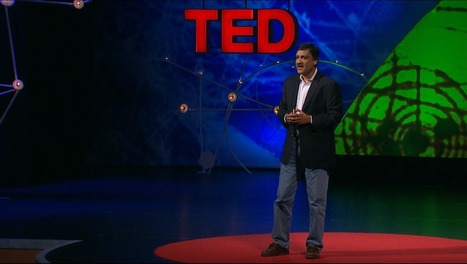
In the last ten years, technology has changed the way we work and communicate with others — and it’s also changed how we interact in the classroom. In fact, some educators argue that technology can improve the classroom by eliminating the need for a physical one, and allow students to learn remotely, from wherever they do their best work. While it’s still too early to know if this is the most effective way to teach, it’s important to stay-to-update on these innovations in education and see what we can learn from them. In these TED talks, students and educators share their …
|
|
Rescooped by
Antonios Bouris
from Amazing Science
June 16, 2017 5:21 AM
|
A new MIT-designed open-source website might well be the Pinterest of microfluidics. The site, Metafluidics.org, is a free repository of designs for lab-on-a-chip devices, submitted by all sorts of inventors, including trained scientists and engineers, hobbyists, students, and amateur makers. Users can browse the site for devices ranging from simple cell sorters and fluid mixers, to more complex chips that analyze ocular fluid and synthesize gene sequences. The site also serves as a social platform for the microfluidics community: Any user can log in to submit a design; they can also like, comment on, and download design files to reproduce a featured device or improve on it. David S. Kong, director of the MIT Media Lab’s new Community Biotechnology Initiative, says the new site is designed to accelerate innovation in microfluidic design, which until now has followed a conventional, academically peer-reviewed route. “There’s a familiar experience for people in microfluidics: You see a really amazing paper that shows you a design, but if you want to try to copy the design, the actual design files that are a critical part of reproducing or remixing a device are not shared in any systematic way,” Kong says. “As a result, researchers around the world are in parallel reinventing the wheel. It’s one of the reasons why open-source in general is a very powerful set of principles. It can really accelerate the diffusion of technology.” Kong and his colleagues outlined the open-source platform in a paper published last week in the journal Nature Biotechnology. His co-authors are Todd Thorsen, Peter Carr, and Scott Wick of MIT’s Lincoln Laboratory; Jonathan Babb and Jeremy Gam in the Department of Biological Engineering; and Ron Weiss, professor of biological engineering and of electrical engineering and computer science.
Via Dr. Stefan Gruenwald
Download FREE 5m very high-resolution satellite imagery
Satellite imagery is essential for GIS users. In almost every project we need to get high-resolution satellite imagery of the area of our interest, not only for interpretation or for vector digitization, but also for analysis.
Among numerou
Via Fernando Gil
Facebook seems to be catching more flak than Twitter on the issue of fake news, but that didn’t stop Colin Crowell, Twitter’s vice president of public policy, government and philanthropy, from being proactive.
Via Jessica Kelly
The architecture and design of the years-in-the-making Apple Park are brilliant. How it fits into the world around it? Not so much.
Via Levin Chin
|
|
Scooped by
Antonios Bouris
June 4, 2017 6:10 AM
|
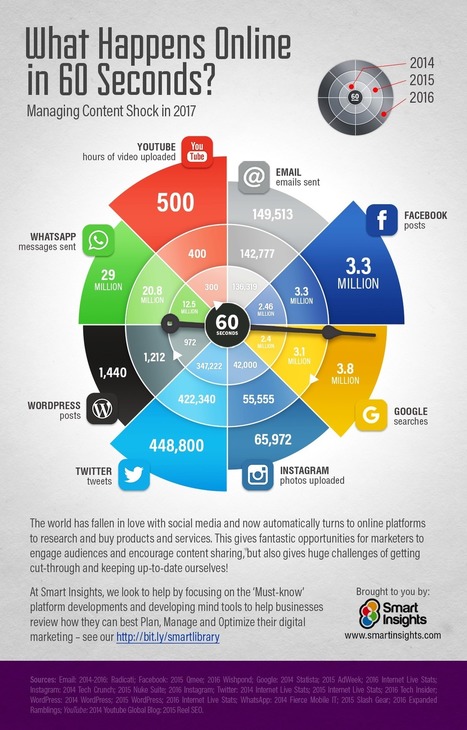
Our latest infographic visualises what happens in just one minute on the web. The number of Google searches, Facebook posts and WhatsApp messages sent in a mere 60 seconds is truly phenomenal.
|
|
Scooped by
Antonios Bouris
June 4, 2017 6:08 AM
|
More companies are turning to smart machines to save money on slow, expensive human employees. Here’s everything you need know about automation – and what it means for your job. Grand Challenges In this special series, Future Now takes a close look at the biggest, most important issues we face in the 21st Century.…
|
|
|
Rescooped by
Antonios Bouris
from Biomimicry
July 14, 2017 6:35 AM
|
One area where biomimicry is yielding fascinating results is in the field of optics and machine vision. While our cameras and ways of thinking about sight have largely been informed by the human visual system, cutting-edge research is looking to insects to find new tricks for everything from depth perception to colour analysis.
Via Miguel Prazeres
To some, content may be king but to marketers, content is simply a way of life. It has the ability to set you apart from other companies, mark you as an industry expert, and create new business oppor…
Via Jessica Kelly
|
|
Scooped by
Antonios Bouris
July 3, 2017 9:26 PM
|
Music is very beneficial. It can affect our expressions, emotions, and behavior and heal illnesses. Find out the best benefit of music for you.
At DigitalGlobe we spend a great deal of time focused on urban areas, where the majority of the world’s people now live, and thus where the majority of commerce, conflict, and change take place. Earlier this year an interesting thought crossed my mind: “What would a perfect city look like from space?” Would it have large open venues or lots of public transportation? Would there be an abundance of parks or the tallest skyscrapers in the world? How would this vision of idyllic urban design change depending on where in the world you were?
Via Fernando Gil
In many neighborhoods, income’s influence on a neighborhood can manifest itself physically in different ways. Well paved roads and better maintained buildings are just two signs of a wealthier neighborhood. The amount of vegetation, even in densely urban areas, can also be a predictor of the relative wealth of a neighborhood. Known as the “gray-green divide”, the amount of trees and green space can be an indicator of the income level of the neighborhood.
What is the Gray-Green Divide?
The gray in the phrase, “gray-green divide”, refers to the dominant color from roads, sidewalks, and rooftops that strikes the viewer when looking at an aerial or satellite image of a lower-income neighborhood. In contrast, higher-income neighborhoods tend to have more vegetation in the form of trees and landscaping that provide a “greener” view to the imagery. The disparity is even more evident when viewing a lower-income neighborhood that back ups to a wealthier one.
Via Fernando Gil
|
|
Scooped by
Antonios Bouris
June 23, 2017 6:19 AM
|
Researchers at The University of California Santa Barbara have developed a method of 3D imaging through walls using drones.
|
|
Rescooped by
Antonios Bouris
from Must Design
June 23, 2017 5:48 AM
|
Best of Japanese Design
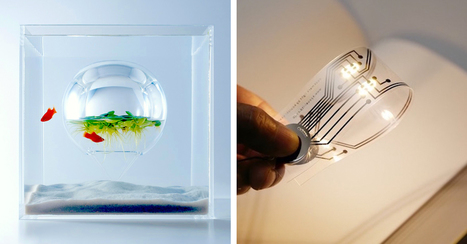
Turns out the best of Japanese design is pretty good. These 15 examples cross the thin line between design, art and commerce and so so with a grace and beauty you'd expect from Japanese design. I'm building a "tiny house" based on Japanese design so I love it.
Via Martin (Marty) Smith
The platform’s latest update to Direct Messages make branded chatbots better for engagement, customer service and direct sales.
Via Jessica Kelly
Every artificial intelligence solution is built on these four foundations; here’s your quick guide
Via Marylene Delbourg-Delphis
|
|
Rescooped by
Antonios Bouris
from Amazing Science
June 9, 2017 4:03 AM
|
A monkey’s brain builds a picture of a human face somewhat like a Mr. Potato Head — piecing it together bit by bit. The code that a monkey’s brain uses to represent faces relies not on groups of nerve cells tuned to specific faces — as has been previously proposed — but on a population of about 200 cells that code for different sets of facial characteristics. Added together, the information contributed by each nerve cell lets the brain efficiently capture any face, researchers report June 1 in Cell.
Via Dr. Stefan Gruenwald
|
|
Rescooped by
Antonios Bouris
from Amazing Science
June 9, 2017 4:02 AM
|
The planet KELT 9b is so hot — hotter than many stars — that it shatters gas giant temperature records, researchers report online June 5 in Nature. This Jupiter-like exoplanet revolves around a star just 650 light-years away, locked in an orbit that keeps one side always facing its star. With blistering temps hovering at about 4,300o Celsius, the atmosphere on KELT 9b’s dayside is over 700 degrees hotter than the previous record-holder — and hot enough that atoms cannot bind together to form molecules. “It’s like a star-planet hybrid,” says Drake Deming, a planetary scientist at the University of Maryland in College Park who was not involved in the research. “A kind of object we’ve never seen before.” KELT 9b also boasts an unusual orbit, traveling around the poles of its star, rather than the equator, once every 36 hours. And radiation from KELT 9b’s host star is so intense that it blows the planet’s atmosphere out like a comet tail — and may eventually strip it away completely. The planet is so bizarre that it took scientists nearly three years to convince themselves it was real, says Scott Gaudi of Ohio State University. Deming suspects KELT 9b is “the tip of the iceberg” for an undiscovered population of scalding-hot gas giants.
Via Dr. Stefan Gruenwald
|
|
Scooped by
Antonios Bouris
June 4, 2017 6:09 AM
|
Become part of a vibrant community of world-class professionals transforming the lives of a motivated and diverse student population. A pioneer in innovative academic programs since 1897 Bay Path University is seeking an experienced adjunct faculty member to teach an online graduate level course for the Master's program in Applied Data Science. This course runs in an 8-week session (October 23, 2017 through December 16, 2017) and meets fully online.
|





















Let’s get started…
Learn from These 10 Social Media Mistakes We’ve Made
Here’s a quick overview of the social media mistakes we’ve been making until recently:
Learn more / En savoir plus / Mehr erfahren:
http://www.scoop.it/t/21st-century-learning-and-teaching/?&tag=Marketing