To unearth new functional regions in the human genome with potential roles in shaping clinically important traits, researchers searched for how elephants, hibernating bats, orcas, dolphins, naked mole rats, and ground squirrels changed critical parts of the human genome that are shared with most other mammals. These regions are highly conserved, but to evolve their highly distinctive traits, these seven species had to change how these conserved DNA elements work.
For example, elephants are the largest land mammals and were discovered to have changed several conserved regions associated with DNA repair. This discovery hints at why elephants rarely get cancer despite their large size and may provide clues to the genetics of human cancer. The study was published March 6 2018 in the journal Cell Reports.
Pinpointing where and how the human genome is evolving can be like hunting for a needle in a haystack. Each person’s genome contains three billion building blocks called nucleotides, and researchers must compile data from thousands of people to discover patterns that signal how genes have been shaped by evolutionary pressures.
To find these patterns, a growing number of geneticists are turning to a form of machine learning called deep learning. Proponents of the approach say that deep-learning algorithms incorporate fewer explicit assumptions about what the genetic signatures of natural selection should look like than do conventional statistical methods.
Chinese news readers may have some new competition – artificially intelligent robot anchors that can mimic human facial expressions and mannerisms while reading out reports. The AI anchor, developed by state news agency Xinhua and tech firm Sogou Inc, was on display at the World Internet Conference in the eastern Chinese town of Wuzhen, drawing in curious passers-by.
The anchor, modelled on real-life Chinese news reader Qiu Hao and sporting a black suit and red tie, is part of a major push by China to advance its prowess in AI technology, from surveillance equipment to self-driving cars.
On Monday, Oct. 1st 2018, NASA turned 60. Over the last six decades, it's had a remarkable run of rocketeering and exploratory achievements, from the moon landings to the space shuttles, from the surface of Mars to destinations far beyond our solar system. And as space becomes just another place to do business, NASA looks to keep its edge as it is facing an identity crisis. Blame people like SpaceX's Elon Musk and Amazon's Jeff Bezos in part for that. They're in the vanguard of a new wave of commercial activity that's launching into what had for so long been the exclusive domain of government agencies, both in the US and abroad.
NASA's 60th anniversary was an occasion to look both back to a settled past and ahead to an uncertain future. The agency long-associated with America's scientific prowess and can-do spirit got its start in one space race. Its next challenges lie in a new race to return humans to the moon and to push onward to Mars. There's a lot to keep track of. Here's a handy cheat sheet to get you started, with more to come.
The electric car, which was launched on the Falcon Heavy rocket in February, is reportedly 179 million miles away from Earth.
Elon Musk's red Tesla Roadster has made its way past Mars' orbit, according to a tweet from SpaceX on November 2, 2018. The Roadster, along with a dummy driver named "Starman" in the driver's seat, was launched into space on the Falcon Heavy rocket in February. The website WhereIsRoadster.com calculated that the electric car is now about 179 million miles away from Earth and is moving at a speed of roughly 35,000 mph. It's set to swing back into its planned 557-day orbit around the sun.
Solar power accounts for less than 2 percent of U.S. electricity but could make up more than that if the cost of electricity generation and energy storage for use on cloudy days and at nighttime were cheaper.
A Purdue University-led team developed a new material and manufacturing process that would make one way to use solar power – as heat energy – more efficient in generating electricity.
The innovation is an important step for putting solar heat-to-electricity generation in direct cost competition with fossil fuels, which generate more than 60 percent of electricity in the U.S.
“Storing solar energy as heat can already be cheaper than storing energy via batteries, so the next step is reducing the cost of generating electricity from the sun's heat with the added benefit of zero greenhouse gas emissions,” said Kenneth Sandhage, Purdue’s Reilly Professor of Materials Engineering.
The research, which was done at Purdue in collaboration with the Georgia Institute of Technology, the University of Wisconsin-Madison and Oak Ridge National Laboratory, published in the journal Nature.
Why Amazon reportedly wants to open 3,000 Automated StoresAmazon will reportedly open 3,000 physical stores within three years. Some stores will carry a small number of groceries and others will carry prepared foods. Amazon has the advantage of drawing on the vast amount of data they collect from cu
Researchers monitored a group of participants from 8 countries across the world with results showing that every single stool sample tested positive for the presence of microplastic and up to 9 different plastic types were identified.
Microplastics have been found in the human food chain as particles made of polypropylene (PP), polyethylene-terephthalate (PET) and others were detected in human stools, research presented today at the 26th UEG Week in Vienna reveals.
This world-first nanophotonic device, unveiled in Nature Communications, encodes more data and processes it much faster than conventional fiber optics by using a special form of 'twisted' light.
What happens when a new technology is so precise that it operates on a scale beyond our characterization capabilities? For example, the lasers used at INRS produce ultrashort pulses in the femtosecond range (10-15s) that are far too short to visualize. Although some measurements are possible, nothing beats a clear image, says INRS professor and ultrafast imaging specialist Jinyang Liang.
In a press release on February 22, 2017, NASA announced the discovery of the most Earth-sized planets found in the habitable zone of a single star, called TRAPPIST-1. This system of seven rocky worlds–all of them with the potential for water on their surface–is an exciting discovery in the search for life on other worlds. There is the possibility that future study of this unique planetary system could reveal conditions suitable for life.
In February 2018, closer study of the seven planets suggested that some could harbor far more water than the oceans of Earth, in the form of atmospheric water vapor for the planets closest to their star, liquid water for others, and ice for those farthest away. The new study pinned down the density of each planet more precisely, making TRAPPIST-1 the most thoroughly known planetary system apart from our own.
Virtual Singapore could be test bed for planners, and plotters
With the click of a button, Singapore's security forces could soon use a digital version of the city-state to simulate a bomb threat at a sports stadium - and learn how to respond if there was a real attack. Jim Drury reports.
By 2050, we could be living on a drastically different planet Earth — one that’s much harder to survive on. We’d see higher ocean levels, warmer temperatures, and more extreme weather events.
To demonstrate what life on the planet might be like in the future, meteorologists from countries around the world created weather reports of a day in 2050. While the reports were, of course, fictional, they were based on various scientific data. The Brazilian report included rains so heavy in South Brazil and the West Amazon that they surpassed the expected amount of rainfall for the month in a few days. Northern Brazil and the East Amazon, meanwhile, were struggling with drought. Similar, but less drastic, conditions have already occurred in Brazil. In 2014, rainfall from a series of storms over three days was three times higher than the historical average. Eleven people died in the storms.
This article is incredibly horrifying to me. Just by 2050, surviving on this planet will be much different. According to this article, by 2050, the temperatures could rise by 2 degrees celsius globally. There will also be a difference in ocean levels, temperatures, and more extreme weather disasters. This is scary. This article proves more that we need to save our planet, not destroy it.
Autodesk announced its new innovative lander design today at the company’s conference in Las Vegas — revealing a spacecraft that looks like a spider woven from metal. The company says the idea to create the vehicle was sparked when Autodesk approached NASA to validate a lander prototype it had been working on. After looking at Autodesk’s work, JPL and the company decided to form a design team — comprised of five engineers from Autodesk and five from JPL — to come up with a new way to design landers.
Reseachers from Wageningen University & Research are inspired by the ovipositor of the parasitic wasp for the development of a steerable surgical needle.
Flexible, ultra-thin and steerable needles would help surgeons perform operations even better. Researchers at Wageningen University & Research are therefore studying the ovipositor with which the parasitic wasp lays its eggs. Based on their findings, colleagues at Delft University of Technology have developed the first prototype of this needle which is the thinnest needle in the world. Solutions found in nature are often the source of human inventions such as self-cleaning paint and underwater robots.
Blue asteroids are rare, and blue comets are almost unheard of. An international team led by Teddy Kareta, a doctoral student at the University of Arizona's Lunar and Planetary Laboratory, investigated Phaethon, a bizarre asteroid that sometimes behaves like a comet, and found it even more enigmatic than previously thought.
Astronomers are building instruments that can characterize the many alien worlds the Kepler spacecraft revealed—and look for signs of life.
One of Earth’s most venerable planet-hunters, NASA’s Kepler spacecraft, has gone quiet. On October 30th 2018, the space agency announced that after nearly a decade of staring at the stars, Kepler is out of fuel. Now, the spacecraft will stay in its Earth-trailing orbit, looping around the sun and never coming closer than a million miles from home.
Scientists have finally confirmed that the massive object at the heart of our galaxy is, in fact, a supermassive black hole.
Researchers used the European Southern Observatory’s sensitive GRAVITY instrument on the Very Large Telescope (VLT) to observe infrared radiation flares coming from the accretion disc around Sagittarius A* — the massive object at the center of our galaxy. Scientists think that most galaxies have a supermassive black hole at their center, but they’d never before had the data and observations to prove it.
Carolyn Kormann on a new report from the I.P.C.C., which states that global climate change will have catastrophic consequences once the planet surpasses 1.5 degrees of warming, which could happen in just a few years.
Historically, computer-assisted detection (CAD) in radiology has failed to achieve improvements in diagnostic accuracy, decreasing clinician sensitivity and leading to unnecessary further diagnostic tests. With the advent of deep learning approaches to CAD, there is great excitement about its application to medicine, yet there is little evidence demonstrating improved diagnostic accuracy in clinically-relevant applications. A group of scientists now trained a deep learning model to detect fractures on radiographs with a diagnostic accuracy similar to that of senior subspecialized orthopedic surgeons. They were able to demonstrate that when emergency medicine clinicians are provided with the assistance of the trained model, their ability to accurately detect fractures significantly improves.
The fabric of civilization is materials science. Humanity’s success in material science is written into our history. Our early progression, from the Stone Age through the Bronze Age to the Iron Age, demonstrates the relentless development of novel materials: stronger, lighter or more versatile than those that came before. But such has been our success that we are long past an age that could be summed up by a single element. The range of materials used by industry has become ever-more complex — not just in terms of their variety, but also in their scale and how they are used together.
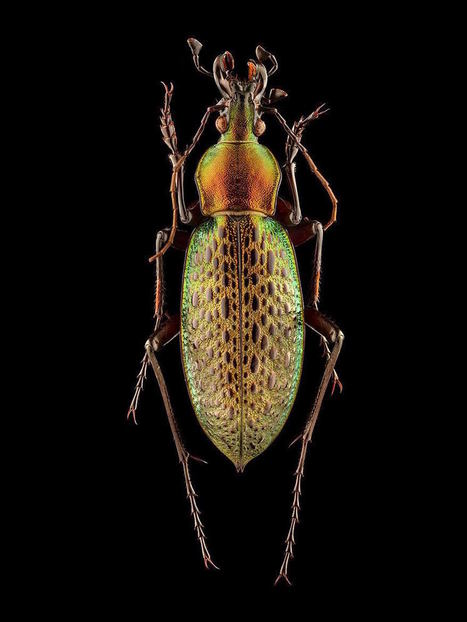
Commercial photographer Levon Biss typically shoots portraits of world-class athletes—sports players caught in motion. His new series however, catches subjects that have already been paused, insect specimens found at the Oxford Museum of Natural History. The series originally started as a side-project capturing the detail of bugs that his son would catch at home, and is now displayed at the museum in an exhibition titled Microsculpture.
During the course of his selection from the museum’s collection Biss rejected more than 99% of the bugs he came across, only choosing those that were of the right size and color. To capture these subjects in such immense detail, each part of the insect required a completely different lighting setup.
When the Huygens probe dropped into Titan’s atmosphere January 14, 2005, no one knew what to expect. Would it splash down into a methane ocean? Sink into a tar pit? Crash into sharp rocks or tumble off a ravine? And, most importantly, what manner of world lurked beneath Titan’s thick shroud of haze and clouds?
For landings on Mars or the Moon, mission scientists plotted out landing sites with meticulous care. Telescopes and orbiters scanned the ground, imaging dangerous terrain and safe zones, and flight engineers pored over their maps and planned accordingly.
To get content containing either thought or leadership enter:
To get content containing both thought and leadership enter:
To get content containing the expression thought leadership enter:
You can enter several keywords and you can refine them whenever you want. Our suggestion engine uses more signals but entering a few keywords here will rapidly give you great content to curate.


 Your new post is loading...