Your new post is loading...

|
Scooped by
Antonios Bouris
August 18, 2019 7:51 PM
|
Taking at least one or two economics or business courses should be mandatory. That way I’d hear fewer business ideas that start with, “It’s like Facebook, only better.” One of the first lessons of economics is the importance of competition. Specifically, that if you try to do what everyone else is doing, you’ll probably fail. …
|
|
Scooped by
Antonios Bouris
August 14, 2019 12:09 AM
|
A new survey reveals that teens tend to trust social media and YouTube personalities more than they do established news outlets.
|
|
Rescooped by
Antonios Bouris
from Amazing Science
August 11, 2019 6:16 AM
|
University of Sydney astronomers, working with international colleagues, have found a star system like none seen before in our galaxy. The scientists believe one of the stars—about 8000 light years from Earth—is the first known candidate in the Milky Way to produce a dangerous gamma-ray burst, among the most energetic events in the universe, when it explodes and dies. The system, comprising a pair of scorchingly luminous stars, was nicknamed Apep by the team after the serpentine Egyptian god of chaos. One star is on the brink of a massive supernova explosion.
Via Dr. Stefan Gruenwald
|
|
Scooped by
Antonios Bouris
August 7, 2019 12:58 AM
|
Private companies will be able to use the habitable artificial satellite for movies, commercials, and more.
|
|
Scooped by
Antonios Bouris
August 6, 2019 10:36 PM
|
The California-based company plans to start recovering and reflying the first stage of its Electron launch vehicle in the near future....
|
|
Scooped by
Antonios Bouris
August 6, 2019 8:41 PM
|
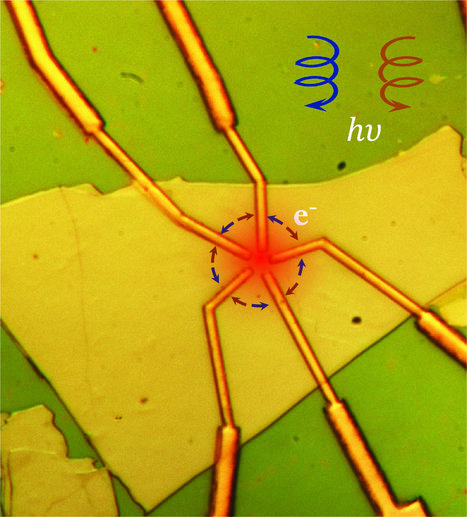
Insights from quantum physics have allowed engineers to incorporate components used in circuit boards, optical fibers, and control systems in new applications ranging from smartphones to advanced microprocessors. But, even with significant progress made in recent years, researchers are still looking for new and better ways to control the uniquely powerful electronic properties of quantum materials.
|
|
Scooped by
Antonios Bouris
July 31, 2019 12:57 AM
|
NASA's Transiting Exoplanet Survey Satellite, or TESS, has discovered three new worlds that are among the smallest, nearest exoplanets known to date. The planets orbit a star just 73 light years away and include a small, rocky super-Earth and two sub-Neptunes -- planets about half the size of our own icy giant.
|
|
Scooped by
Antonios Bouris
July 31, 2019 12:46 AM
|
This new invention forces men to put their legs together.
|
|
Scooped by
Antonios Bouris
July 21, 2019 4:28 AM
|
A new smart glove makes VR more immersive by making the virtual objects people touch feel as though they're really there.
Beneath the spread of all “fake news,” misinformation, disinformation, digital falsehoods and foreign influence lies society’s failure to teach its citizenry information literacy: how to think critically about the deluge of information that confronts them in our modern digital age. Instead, society has prioritized speed over accuracy, sharing over reading, commenting over understanding. Children are taught to regurgitate what others tell them and to rely on digital assistants to curate the world rather than learn to navigate the informational landscape on their own. Schools no longer teach source triangulation, conflict arbitration, separating fact from opinion, citation chaining, conducting research or even the basic concept of verification and validation. In short, we’ve stopped teaching society how to think about information, leaving our citizenry adrift in the digital wilderness increasingly saturated with falsehoods without so much as a compass or map to help them find their way to safety. The solution is to teach the world's citizenry the basics of information literacy.
Via John Evans
|
|
Rescooped by
Antonios Bouris
from Amazing Science
July 16, 2019 5:23 AM
|
The moon’s light influences lion prey behavior, dung beetle navigation, fish growth, mass migrations and birdsong. Crowds of people gather to watch an evening spectacle on beaches in Southern California: Twice a month, typically from March through August, the sand becomes carpeted with hundreds or thousands of California grunion. Writhing, flopping, silvery sardine look-alikes lunge as far onto shore as possible. As the female fish dig their tails into the sand and release eggs, males wrap around females and release sperm to fertilize those eggs. About 10 days later, the eggs hatch and the little grunion get washed out to sea. This mating ritual is set to the tides, with hatching timed to the arrival of the peak high tide every two weeks. But the ultimate force choreographing this dance is the moon. Many people know that the moon’s gravitational tug on the Earth drives the tides, and with them, the life cycles of coastal creatures. Yet the moon also influences life with its light.
Via Dr. Stefan Gruenwald
|
|
Rescooped by
Antonios Bouris
from Amazing Science
July 16, 2019 5:11 AM
|
Using just the language in millions of old scientific papers, a machine learning algorithm was able to make completely new scientific discoveries. In a study published in Nature on July 3, 2019, researchers from the Lawrence Berkeley National Laboratory used an algorithm called Word2Vec sift through scientific papers for connections humans had missed. Their algorithm then spit out predictions for possible thermoelectric materials, which convert heat to energy and are used in many heating and cooling applications.
Via Dr. Stefan Gruenwald
|
|
Rescooped by
Antonios Bouris
from Amazing Science
July 9, 2019 7:08 AM
|
Theories concerning the cause of right- or left-hand preference in humans vary from purely learned behavior, to solely genetics, to a combination of the two mechanisms. The cause of handedness and its relation to the biologically specified scalp hair-whorl rotation has also been determined. The general public, consisting of mostly right-handers (RH), shows counterclockwise whorl rotation infrequently in 8.4% of individuals. Interestingly, non-right-handers (NRH, i.e., left-handers and ambidextrous) display a random mixture of clockwise and counterclockwise swirling patterns. Confirming this finding, in another independent sample of individuals chosen because of their counterclockwise rotation, one-half of them are NRH.
Via Dr. Stefan Gruenwald
|
|
|
Scooped by
Antonios Bouris
August 14, 2019 1:31 AM
|
With technology revolutionizing the construction industry, Structure Tone needed to get company leaders up to speed and on board with digital innovation plans. So, the CIO created a six-step strategy.
|
|
Scooped by
Antonios Bouris
August 11, 2019 6:20 AM
|
An amateur astronomer caught a photograph of what appears to be an asteroid slamming into Jupiter. A photograph captured by amateur astronomer Ethan Chappel appears to show an asteroid slamming into the gas giant Jupiter on Wednesday (Aug. 7). So far, astronomers are still waiting to see whether anyone else spotted the sudden flash, which was located over the planet's South Equatorial Belt.
|
|
Rescooped by
Antonios Bouris
from Amazing Science
August 11, 2019 6:14 AM
|
In an attempt to create a "Noah's ark" or a "back-up" for the Earth, non-profit organization The Arch Mission sent a lunar library -- a stack of DVD-sized disks that acts as an archive of 30 million pages of information about the planet -- to the moon. Along with the library, Arch Mission sent human DNA samples and a payload of tardigrades, which had been dehydrated, into space. "We chose them because they are special. They are the toughest form of life we know of. They can survive practically any planetary cataclysm. They can survive in the vacuum of space, they can survive radiation," Nova Spivack, co-founder of the Arch Mission Foundation, said. Tardigrades have eight legs with claws at the end, a brain and central nervous system, and a sucker-like pharynx behind their mouth, which can pierce food.
Via Dr. Stefan Gruenwald
|
|
Rescooped by
Antonios Bouris
from Amazing Science
August 7, 2019 12:49 AM
|
Until now, the understanding of the galaxy's shape had been based upon indirect measurements of celestial landmarks within it and inferences from structures observed in other galaxies. The Milky Way is not flat, as previously thought, but warped and twisted in shape, according to the most detailed map ever constructed. Astronomers at the University of Warsaw used a telescope in the Chilean Andes to measure the distances between the sun and 2,400 stars to build a three-dimensional picture of the galaxy we live in. In doing so, they showed it is in fact a disk, with four major spiral arms and a pole-like core running through the middle.
Via Dr. Stefan Gruenwald
|
|
Scooped by
Antonios Bouris
August 6, 2019 9:06 PM
|
Whales are killed each year for their blubber and meat to prepare people for the winter.
|
|
Scooped by
Antonios Bouris
August 6, 2019 8:27 PM
|
The huge northern ice sheet is in the middle of its second major melt event this year, a warning sign for the planet.
|
|
Scooped by
Antonios Bouris
July 31, 2019 12:48 AM
|
Colonists could avoid the harsh environment of the lunar surface by living in subterranean lava tubes. But researchers first need to learn more about these curious structures.
|
|
Rescooped by
Antonios Bouris
from Amazing Science
July 31, 2019 12:43 AM
|
Complex neuromorphic systems are set to drive many more benefits in the future, Intel hopes. Intel has revealed a new powerful AI solution codenamed Pohoiki Beach, which the chip giant boasts can crunch data up to 1,000 times faster than a general-purpose CPU.
Via Dr. Stefan Gruenwald
|
|
Rescooped by
Antonios Bouris
from Amazing Science
July 21, 2019 4:20 AM
|
Researchers from China’s Peking University have developed a new gene-editing technology — and they think it shows promise as a CRISPR alternative for fighting human diseases. According to a paper published on Monday in the journal Nature Biotechnology, this new technology, LEAPER, which stands for “leveraging endogenous ADAR for programmable editing of RNA,” works similarly to CRISPR-Cas13, targeting RNA molecules as opposed to DNA like the well-known CRISPR-Cas9. But while CRISPR-Cas13 relies on both a guide RNA and the Cas13 enzyme to make its edits to RNA, the LEAPER system needs just one component known as an arRNA. This makes the system “more easily deliverable and less likely to result in unwanted cellular immune responses,” the researchers told China-based media outlet Caixin. As for the potential uses of their CRISPR alternative, Peking researcher Zhou Zhuo told Caixin that “there are clear prospects for using this technology in disease treatment.” In fact, in tests of cells taken from people with the debilitating genetic disorder Hurler syndrome, LEAPER was able to correct “sufficient amounts” of the cells’ mutated RNA, University of Queensland geneticist Ernst Wolvetang, who wasn’t involved in the research, told Caixin. However, the research is still in the early stages and is only now moving into tests on animals — meaning we won’t know for some time if LEAPER will dethrone CRISPR as the preeminent gene-editing technology.
Via Dr. Stefan Gruenwald
|
|
Rescooped by
Antonios Bouris
from Amazing Science
July 21, 2019 4:16 AM
|
The principle behind the GAN was first proposed in 2014, and at its most basic level, it describes a system that pits two AI systems (neural networks) against each other to improve the quality of their results. To understand how they work, imagine a blind forger trying to create copies of paintings by great masters. To start with, he has no idea what a painting should look like – but he happens to have a friend who has a photographic memory of every masterpiece that's ever been painted.
Via Dr. Stefan Gruenwald
|
|
Rescooped by
Antonios Bouris
from Amazing Science
July 16, 2019 5:18 AM
|
On 1 January 2011, Germany introduced early benefit assessment (Frühe Nutzenbewertung) of new drugs through the reform of the market for medicinal products act (AMNOG). Its aim is to determine whether a new drug has any added benefit over standard care. The Federal Joint Committee (G-BA), the main decision making body within the German statutory health insurance system, is responsible for the assessment procedure and ultimately decides on the added benefit.
The G-BA specifies the standard care based on criteria laid down in the law. According to these criteria, standard care is an approved and reimbursed intervention that is established in clinical practice and for which a benefit has been proved according to the standards of evidence based medicine (predominantly based on studies with patient relevant outcomes). If appropriate, standard care might also be watchful waiting or best supportive care.
Via Dr. Stefan Gruenwald
|
|
Rescooped by
Antonios Bouris
from Amazing Science
July 16, 2019 5:10 AM
|
In July 2019, the village of Gallargues-le-Montueux located in southern France outside of Montpellier topped 114.6 degrees Fahrenheit, the highest temperature ever recorded in continental France.
That sweltering heat broke the previous record of 113.2 degrees, which was set just hours before in the village of Villevieille. And those weren’t the only hot spots. Brian Kahn at Earther reports that at least 12 weather stations in France detected temperatures above 111.4 degrees Fahrenheit, the previous hottest temperature set in 2003.
Via Dr. Stefan Gruenwald
|